
Home Blog Page 69

Stop deadly purge of civilians in Cordillera, Philippines -ICHRP

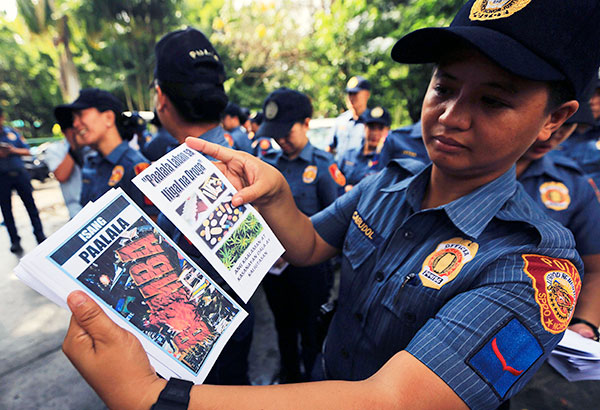
“The February 24, 2021, resolution by 47 senior police and government officials in the Cordillera Region calling for the notorious ‘Oplan Tokhang’ to be deployed against ‘known left-leaning personalities in the government, media, and other entities’ demonstrates that the Duterte government is brazenly defiant of its human rights obligations”, said Mr. Peter Murphy of the International Coalition for Human Rights in the Philippines (ICHRP).

This Resolution was made at the same time that Justice Secretary Guevarra was telling the United Nations Human Rights Council that “the PH strongly emphasizes its legal and judicial system, its domestic accountability mechanisms are functioning as they should.”

“The international community must know that ‘Oplan Tokhang’ is the method used by police to kill tens of thousands of civilians in the mis-named ‘war on drugs’ over the last five years,” said Mr Murphy. “This Resolution demonstrates that the Philippine state is planning to systematically kill its civilian critics. It is not ‘knock (on the door) and plead’, but kick in the door and shoot.

Last December, the International Criminal Court’s (ICC) Office of the Prosecutor said there is a “reasonable basis” to believe that crimes against humanity were committed in the Duterte administration’s drug war policy. 

The ICC identified ‘Oplan Tokhang’ as a way for authorities to kill civilians through a drug watch list wherein “some of those targeted also included persons who had previously ‘surrendered’ to the police. 

In the ‘war on drugs’, local government officials are required to provide lists of residents allegedly using or dealing drugs, or just ‘troublemakers’. These lists are provided to the police, who then eliminate the targets without any regard to due process. Local government officials switch off CCTV on the nights of these police raids. In the one case where two police were prosecuted for murder – that of 17 year-old Kian De Los Santos – in August 2017, the Barangay Captain had failed to switch off the CCTV.

The Cordillera officials decided that “this resolution be elevated to the Regional Peace and Order Council for their concurrence and adoption and convince local government units (LGUs) to support this and be brought to the attention of all governors and Mayors in the Cordillera Region”.

“While the bureaucratic machine tries to bring together all the elements for this program of civilian repression, there is time for the international community to say no, and they can say it now at the 46th Session of the UN Human Rights Council,” said Mr Murphy.

When the media revealed this resolution last week, the Cordillera Regional Director of the Commission on Human Rights, Atty Romel Daguimol, withdrew his signature, declaring that the resolution was in conflict with CHR policy. “We continue to stand that activism is not a crime. People should be free to express legitimate dissent and grievances for the government to act on.”

“The other 46 police and other government officials must likewise withdraw their signatures,” said Mr Murphy.

“ICHRP strongly supports the many statements coming from media organisations, the National Union of Journalists, the Karapatan alliance for Peoples Rights, and members of Philippine Congress who condemned the resolution, and who uphold the basic democratic and human rights of the people despite the massive threats they have to endure under the Duterte government”, Mr. Murphy concluded.#
Empty claims by Philippine gov’t at UN Human Rights Council

0

NEWS RELEASE

February 25, 2021

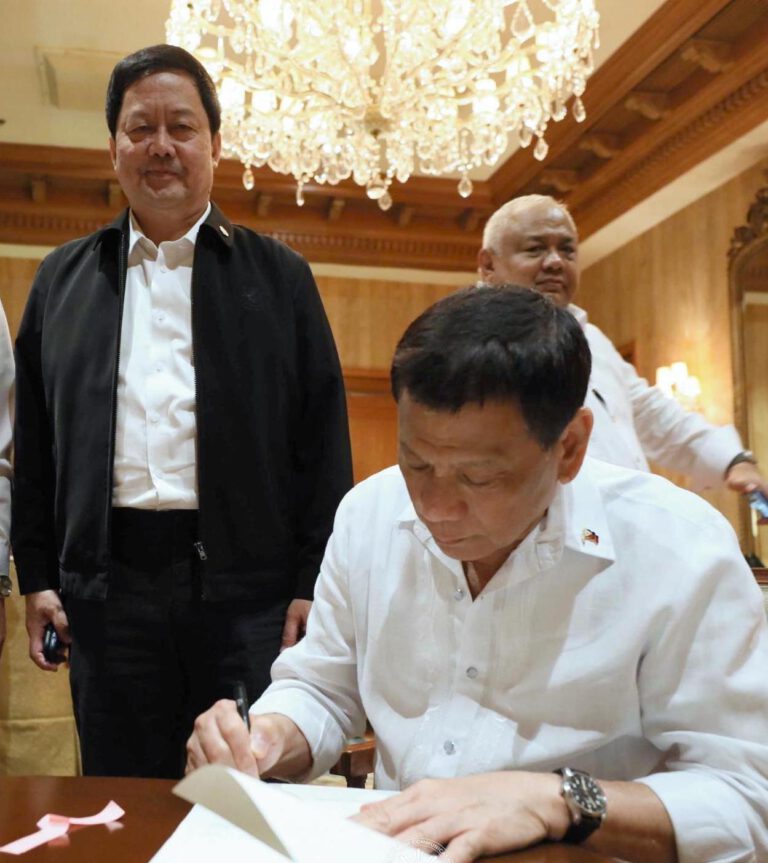
“The reassuring diplomatic tone of Philippine Justice Secretary Guevarra’s message to the UN Human Rights Council yesterday cannot hide the raw truth that so far there has been no accountability for the murder of tens of thousands of civilians by police and the armed forces in the government’s war on drugs and counter-insurgency program,” said global human rights coalition spokesperson Mr Peter Murphy today.

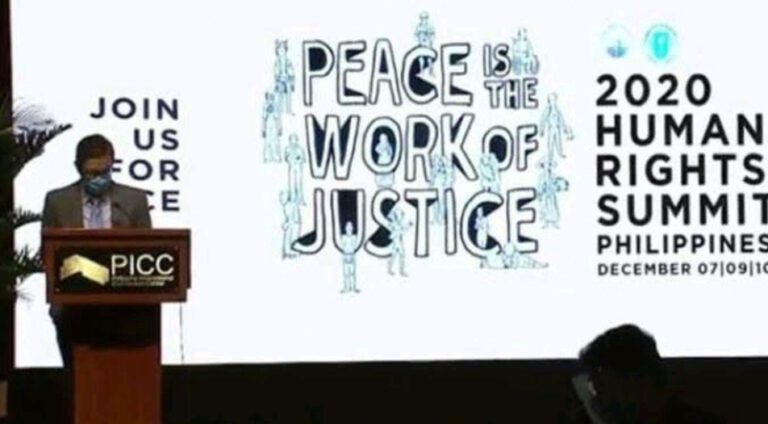
“The statement opened with the apparent good news that the Philippine government had held a Human rights Summit on December 7 last year, but failed to mention that on December 10, Human Rights Day itself, police made early morning raids on the Manila homes of six union leaders and a prominent journalist, and planted weapons and explosives on them to enable non-bailable charges.

“The news was far worse on December 30, 2020, when a combined force of 500 police and soldiers on the island of Panay raided the homes of leaders of the Tumandok indigenous people at 4am, executing nine of them in their homes, and arresting a further 16 on phoney charges.

“As recently as February 15, 2021, Philippine police took custody of 21 indigenous Lumad students and arrested tribal elders and school teachers from their ‘Bakwit School’ in the University of San Carlos Talamban campus, Cebu, absurdly claiming this was a ‘rescue’ from a rebel training school,” Mr Murphy reported.

“All we have from Secretary Guevarra’s statement is news of an unpublished internal review of some of the drug war killings, a claim that administrative and criminal actions are being taken against some police officers, and promises that a technical cooperation program on human rights with the UN agencies will be announced some time soon,” said Mr Murphy, of the International Coalition for Human Rights in the Philippines.

“Secretary Guevarra told the Council that President Duterte’s war on drugs is a ‘campaign widely supported by our people’, but failed to report that the people equally support the right of the accused to be charged and have a fair trial, and not to be shot out of hand,” Mr Murphy said.

According to the ICHRP statement, it is in fact no less than the president himself who emboldens and issues policy statements for state authorities to commit human rights violations. At a speech last December 2020, President Duterte explicitly urged police to shoot first, and worry about human rights later.  

“President has made clear countless times that he does not care about human rights and has encouraged authorities to kill people. And, this is what Guevarra has tried to gloss over in his grandstanding in the UN body,” says Murphy. 

ICHRP stressed that “the reality is impunity and escalating human rights abuses, a determined affront to the efforts of the UN Human Rights Council and the whole international community.”

The response of ICHRP to the October 7 resolution was to initiate the Independent International Commission of Investigation into Human Rights Violations in the Philippines, which was announced in December 2020, and launched in January this year, with the name INVESTIGATE PH. It will present its first report to High Commissioner Ms Michelle Bachelet on March 15, 2021.#

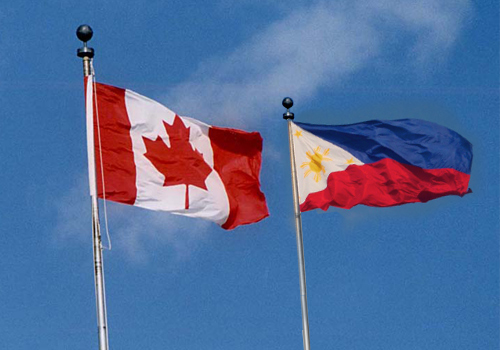
Statement of Canadian Civil Society on the Tumandok Massacre Targeting Indigenous People of the Philippines

On December 30, 2020, during a joint police and military operation at Capiz, Panay Island and in Iloilo Province, nine leaders of the Indigenous Tumandok peoples were killed, and 17 residents were arrested. Prior to the massacre, the Philippine police and military authorities had been issued 28 judicial search warrants against supporters and party members of the Communist Party of the Philippines and the New People’s Army (NPA) rebels alleged to be in possession of firearms and explosives.

Based on these warrants, in the early hours of December 30, the police and military stormed residences in the Tumandok community and killed nine Tumandok leaders while they were sleeping.  According to local activists, the wife of one of those killed refuted that her husband was a member of the communist party or NPA, nor did he carry a weapon.  This is not the first-time civilians were made victims of extrajudicial killings by authorities. The Duterte government has become widely known for committing extrajudicial killings of people who oppose the government throughout the Philippines.

Canadian civil society organizations and churches deeply mourn the murdered Tumandok leaders and extend sincere condolences to the residents who had to start the New Year in fear.

The international community has called repeatedly on the Duterte government to put an end to extrajudicial killings as a serious violation of human rights.  Nevertheless, the extrajudicial killings have been ongoing, leading to this massacre of Indigenous peoples.   Canadian civil society continues to denounce the Philippine government’s extrajudicial murders and the anti-terrorism legislation (Executive Order 70 and Executive Order 32)  that support and encourage such actions by the police and military.

The massacre of Tumandok Indigenous leaders is a response to collective, community opposition to the “Jalaur Mega Dam project (Phase 2)”. Local residents who suffered both direct and indirect damage from the dam project have been opposing the construction, citing the risk of earthquakes, forced evictions, damage to ancestral graves, and violations of Philippine domestic and international laws.

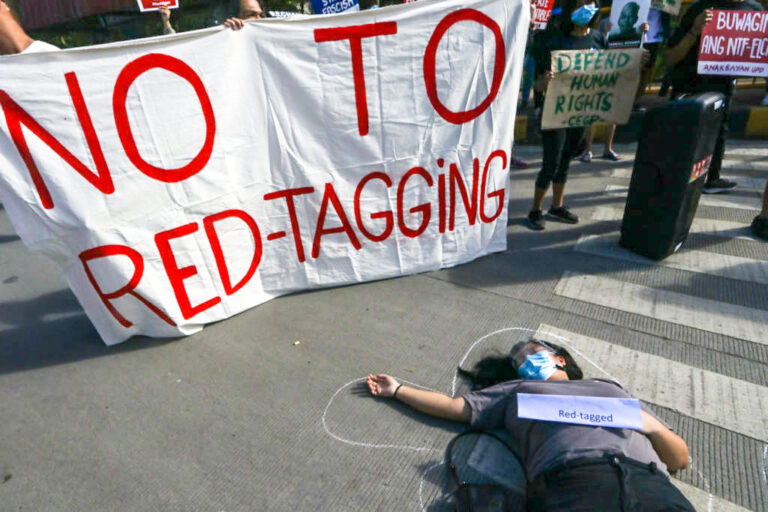
Activists and local residents of the “People’s Action for the Jalaur River”, formed by Tumandok Indigenous people and others who have long opposed and resisted the Jalaur Dam project, visited Korea in April and December 2018 to provide information on the problems of the Jalaur dam and the damage done to the Indigenous people. In particular, they explained that the activists and Indigenous people opposed to the dam project are suffering from human rights violations due to the Duterte government’s “red-tagging”, and that there were even incidents of extrajudicial killings.

Foreign Governments and companies involved in the project should be aware of and take seriously, the present situation in which severe human rights violations by the Philippine police and military, including extrajudicial killings, are taking place. Under the pretext of protecting the dam project, armed state troops have been stationed in the Indigenous people’s residential areas. Indigenous leaders who oppose the project are being killed, causing the residents to leave their villages out of fear.

In 2017, the UN Committee on Economic, Social and Cultural Rights expressed its concern regarding the documented cases of human rights violations in the Philippines resulting directly from operations of multinational companies, and recommended that public financial institutions link the provision of loans and grants to companies and projects to human rights requirements.

Canadian civil society has written repeatedly to the Canadian government to raise concerns about human rights violations, “red-tagging” and extrajudicial killings with the Philippines government and authorities.  In particular, we have raised concerns about attacks and violations against the rights of Indigenous peoples in the Philippines, including their right to Free, Prior and Informed Consent (FPIC).

At this time, we write with serious concern about the current situation of Indigenous peoples who oppose the massive dam development projects in Panay, including the Jalaur Dam project, and are being threatened and killed by Philippines State authorities. It is an established international human rights principle to seek prior consent from Indigenous peoples for a development project on their territory, and to respect their tradition and culture. We strongly condemn the Duterte government’s continued enforcement of anti-human rights policies, and urge the Canadian government to

  •  implement fundamental measures such as conducting human rights impact assessments on Official Development Assistance (ODA) projects.
  •  issue a public statement condemning the December massacre of Tumandok leaders, Panay Island. 
  • ensure the robust implementation of Voices at Risk: Canada’s Guidelines in Supporting Human Rights Defenders (2019) by the Embassy of Canada in the Philippines. In particular, that the Embassy “build and maintains contact with human rights organizations and marginalized grassroots movements” especially those who are the subjects of the Government’s red-tagging campaign by meeting them and facilitating response in emergencies. (Voices at Risk, #3.3)

Furthermore, we urge the Government of Canada to call on the Government of the Philippines to:

  • immediately cease extrajudicial killings and all other violations of human rights.
  • immediately stop military operations on Panay Island and release the arrested residents.
  • revoke executive orders 32 and 70 and the Anti-Terror Law to eliminate measures legal which support and generate Human Rights abuses.
  • Respect the rights of Indigenous peoples to free, prior and informed consent. Governments, companies and institutions involved should immediately take steps to assess the human rights impacts of the project and address them. 

Jan 23 2020

International Coalition for Human Rights in the Philippines – Canada

Ontario Committee for Human Rights in the Philippines

KAIROS

Anglican Church of Canada

Mining Watch Canada

Partera Peacebuilders  International 

Public Service Alliance of Canada

National Union of General and Public Employees

Vancouver & District Labour Council (VDLC)

Mining Justice Alliance (MJA)

Canadian Union of Public Employees (CUPE-BC) International Solidarity Committee

Canada-Philippines Solidarity for Human Rights (CPSHR)

Alliance for People’s Health (APH)

BAYAN Canada

Gabriela BC

Migrante BC

SULONG UBC

Global Pinoy Diaspora of Canada (GPDC)

Just Peace Committee (Vancouver, BC)

Eco-Justice Unit,-Anglican Diocese of New Westminster

KAIROS BC-Yukon

Beaconsfield Initiative – United Church of Canada

Dr. Leonora Angeles, Professor, University of British Columbia

Billie Pierre,  Nlaka’Pamux  woman-leader

HUMAN RIGHTS 2021: Red-tagging, systematic state murder are the order of the day in the Philippines -ICHRP

0

On the night of January 2, in Sta. Rita town, Pampanga, Federico Pineda, a construction worker who was celebrating his daughter’s seventh birthday was shot dead by a police officer after being mistaken for a robber. 

According to the International Coalition for Human Rights in the Philippines (ICHRP) the new year 2021 in the Philippines heralds more targeted state political killings, massacres, continuous police killings of the poor, and a threat of mass arrests of leaders and members of red-tagged organisations.

“Donald Trump, with his blatant assault on the US Congress on January 6, 2021, has demonstrated what happens when impunity is the rule of the day. The international community must act against impunity of state actors in the Philippines to stop a greater tragedy unfolding in this nation which once fired the global imagination with the “people power” removal of the Dictator Marcos in 1986,” said Mr Peter Murphy, Chair of the International Coalition for Human Rights in the Philippines today.

On October 7, 2020, the United Nations Human Rights Council took at face value the Duterte government’s claim that it was defending the human rights of the Filipino people and offered technical cooperation. By this decision, the Human rights Council chose to ignore the recent enactment of a new Anti-Terrorism Act, and the targeted assassinations of Randell Echanis and Zara Alvarez in August 2020 and the continuing murders of poor people for allegedly using or dealing in drugs.

What followed?

On December 9, the Duterte government’s new Anti-Terrorism Council – an appointed executive body – designated the Communist Party of the Philippines and the New Peoples Army as “terrorist organizations, associations, and/or groups of persons”.

Early in the morning of December 10, International Human Rights Day, police raided the homes trade union leaders in Metro Manila to arrest six trade union activists, Dennise Velasco, Romina Astudillo, Mark Ryan Cruz, Jaymie Gregorio Jr., Joel Demate, and Rodrigo Esparago, and one journalist, Lady Ann Salem.

On December 15, at around 5.30pm, Dr Mary Rose Sancelan, and her husband Edwin were shot dead at Brgy. Poblacion in Guihulngan City. Dr Sancelan was the head of the Inter-Agency Task Force on Emerging Infectious Diseases (IATF) in the city, which handles the government response on the coronavirus disease (COVID-19) pandemic. She had been included in the “hit list” of the anti-communist group Kagubak, which made the absurd allegation that she was the spokesperson of the Leonardo Panaligan Command of the New People’s Army in Central Negros.

On December 17, five farm workers in Barangay San Juan, Baras, Rizal, were gunned down and mutilated by combined police and military forces. They were caretakers and workers at a private mango farm but Local Government and Interior Secretary Eduardo Ano red-tagged them suspected members of the Communist Party of the Philippines and members of the New People’s Army, killed in an encounter.

On the evening of December 20, Sonya Gregorio, 52, and her son Frank, 25, were shot point blank by Police Senior Master Sergeant Jonel Nuezca in Tarlac. They were neighbours. The shooting was captured on video and went viral on social media. The perpetrator was arrested, since his crime was captured on video, however, two previous administrative charges against him for murder had been dismissed for lack of evidence, and he had been allowed to carry his firearm off-duty.

On December 30, at 4am, nine leaders of the Tumanduk indigenous people on Panay Island were brutally massacred by Region 6 police and elements of the 12th Infantry Battalion, and 17 others were arrested in separate police raids. Their organisation was opposing two dam projects. The leaders had previously refused to declare that they would “surrender” as NPA members and been warned that they would be arrested under the Anti-Terrorism Act.

“Impunity and, red-tagging and systematic state murder are the order of the day in the Philippines, and it will only get worse with the terrorism designation of the CPP and NPA,” said Mr Murphy. “This designation will now extend to any organisation or individual calling for urgent economic and social reforms in the poverty-stricken Philippines.

“The shocking December 10 raids on Metro Manila trade union leaders will be a model for systematic raids on hundreds more organisations unless the international reaction can constrain the government,” Mr Murphy concluded.#

PH gov’t human rights summit, a deodorizer

0


An international rights group called out the government’s “human rights” summit as another platform to save face after gaining global notoriety for human rights abuses. As the world commemorates the 72nd human rights day, International Coalition for Human Rights in the Philippines (ICHRP) supports the Filipinos’ call for credible independent investigation on what’s happening in the country.

“We find it ironic that arrests and rights violations continue in the same week that Philippine government launches a human rights summit. It is clear that this platform is nothing but an extravagant deodorizer aimed at exonerating the state-sanctioned perpetrators from their crimes,” says ICHRP chairperson Peter Murphy.

Last December 2, a land rights defender Amanda Echanis was illegally arrested and planted with guns and explosives by Philippine authorities in Cagayan, north of the country’s capital. Amanda is also the daughter of peace activist Randall Echanis who was assassinated in his home last August. In his most recent tirade, Philippine president Rodrigo Duterte accused progressive lawmakers as communists while failing to offer any proof to back up his allegations. 

According to ICHRP, it is alarming that the government is on one hand publicly terror-tagging activists and civilians and on the other speaking of strengthening local and international partnerships on human rights issues. 
The global coalition was referring to Justice Secretary Menardo Guevarra’s keynote address in the taxpayer funded human rights summit. Guevarra claimed that the event is a platform for an “earnest, intelligent discourse so that we may strengthen sectoral engagement and international partnerships in addressing human rights challenges.”

“Honestly, this duality of the State smacks of hypocrisy and worse, it comes off as an insult to the thousands victimized by the Duterte government,” says Murphy. 

The summit comes 2 months after the United Nations Human Rights Council (UNHRC) passed a resolution providing technical cooperation and capacity-building for promotion and protection of human rights in the Philippines, which took wide criticism from the international community for falling short of mandating an independent international investigation into the human rights situation in the country.

Despite this, ICHRP manifests their support for Filipinos activists and human rights defenders who have been tirelessly advancing people’s rights under the deadly administration.

“We share your disappointment that the momentum for change built up over many years of effort at the level of the UNHRC was stalled and deflected by the Duterte government this year,” says Murphy.

ICHRP together with the international community seeking accountability is stepping it up for a credible investigation to happen. Murphy asserts: “Our response is to initiate the task that the UNHRC should have done, to launch a further independent international investigation of the human rights violations in the Philippines.”

As of this writing, global independent investigations have already been ongoing and will be officially launched this December.#