
Home Blog Page 51

UN Member States Fall Short on Accountability for Philippine Mass Killings

0

Press Release
November 14, 2022

ICHRP supports the recommendations of the UN Human Rights Committee through the Universal Periodic Review (UPR), but is concerned by a general lack of support for action among UN member states.  

The United Nations Human Rights Committee is a treaty body composed of 18 experts, established through the International Covenant on Civil and Political Rights (ICCPR). The Committee meets for three four-week sessions per year to consider the periodic reports submitted by the 173 state parties to the ICCPR on their compliance with the treaty.

The 2022 report of the Human Rights Committee highlights the ongoing failure of the Philippine government in ensuring that human rights are upheld. The recommendations take note of the issues and instruments that have contributed to a system of impunity and state-orchestrated terror, such as: the red-tagging of human rights defenders and attacks on journalists and lawyers; continued extra-judicial killings under the guise of the war on drugs; and the repressive provisions of the Anti-Terror Law which target the fundamental foundations of democracy, freedom of assembly, freedom of expression and the right to dissent.  

The Committee’s recommendations are timely, given the continuing human rights violations under the new Marcos administration. The current administration must not ignore nor downplay these recommendations and instead find concrete ways of upholding its treaty obligations under the ICCPR. 

There was a great deal of interest expressed among member states in the Philippines UPR here in Geneva. A total of 107 states intervened and about 40% took a critical stand and supported  the Committee’s recommendations. There is a general reticence among the majority of member states to be critical towards the Philippines’ abysmal human rights record. Despite the UN’s ongoing documentation of the Philippine’s poor civil and political rights record which dramatically worsened under the Duterte administration, only a minority of states are willing to openly express concerns and even fewer were willing to make strong recommendations for action (specifically some European and Latin American States). We specifically laud the intervention of Sierra Leone who called for the abolition of the NTF-ELCAC (National Task Force to End Local Communist Armed Conflict) which has functioned as one of the main instruments of state terror against dissidents.

Several member states including Lichtenstein, Sierra Leone, Sweden, Romania, and the USA, called for an end to the practice of red-tagging, a process by which individuals and organizations are labelled as fronts for the Communist Party of the Philippines. The Philippine representative Jesus Crispin Remulla, Secretary of the Department of Justice, for his part angrily responded to the US criticism claiming, “there is no government policy of red-tagging, it is a term invented by the left”.  This was a complete turnabout from Remulla’s contention two weeks earlier that red tagging was a government right and a vibrant part of the democratic process.  This is an example of the Philippine government’s state of denial to the international community regarding its continuing war on dissent. 

ICHRP Chairperson Peter Murphy expressed “profound appreciation to those member states who spoke out pressing for greater accountability from the Philippine government,” but he urged the international community to “press member states for concrete action on human rights from the Marcos administration”.  He further called for an immediate need for an end to the supply weapons to the Marcos government, noting that “the United States has recently extended $100 million in credit for weapons purchases, and supplied $1.14 billion [2015-21] in weapons to the Philippine government during the worst period of rights violations”. 

The recommendations stem from a recognition of the dire human rights situation in the Philippines. The experts do not appear swayed by the claim that the justice system in the country is working for the victims of human rights violations. ICHRP Global Council Member, Rev. Patricia Lisson, indicated that “all evidence to date points to a failure of domestic measures with less than 15 prosecutions among the thousands of cases of rights violations. Given such weak evidence to the contrary, the experts and a number of member states are clearly not convinced that the human rights situation has greatly improved”.

ICHRP calls on UN member states to hold the Philippines accountable to act on the findings of the UPR, to take concrete action to support an end to impunity, and to support the struggle of the victims and their family for justice and to finally conduct an independent international investigation as a follow-up to the 2020 Bachelet report. In the interim, the most visible and effective measure will be a cessation of all arms trade with the Philippines.

#InvestigatePH
#StopMilitaryAidPH
#UPRWatchPH

###

International Human Rights Coalition Calls for Action by UNHRC Member States During Universal Periodic Review of the Philippines

0

Press Release
November 14, 2022

“Members of the International Coalition for Human Rights in the Philippines (ICHRP) are physically present in Geneva, Switzerland to witness the fourth Universal Periodic Review (UPR) of the Philippines,” said ICHRP Chairperson Peter Murphy this Monday morning. “We remain vigilant in advance of the proceedings, and reiterate our calls to all Human Rights Council (UNHRC) member states to respond seriously to human rights violations that have occurred under former president Duterte, and continue under current president Marcos.”

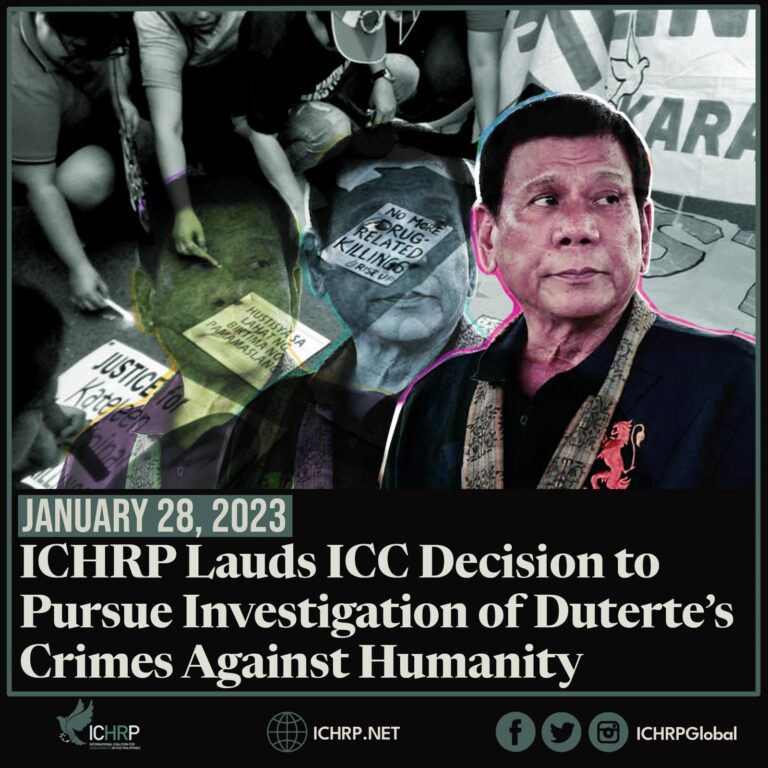
In support of the UPR session, ICHRP released on November 10 the Final Compendium Report of Investigate PH, an international independent investigation spearheaded by ICHRP, which was carried out in response to the dismal resolution of the UN Human Rights Council on “capacity building and technical cooperation” and to create space for the clamor of the victims seeking justice. “Looking back to the report of Investigate PH, we know there is definitive evidence of countless human rights violations under the Duterte administration, and a state of impunity for many of the perpetrators,” said Murphy. “Even the International Criminal Court has recognized some of these rights violations as crimes against humanity. In our opinion, member states of the UNHRC have a long way to go if justice is to be served for these crimes against the Filipino people.”

“Much of the evidence documented by Investigate PH showed systematic violation of the basic economic, social, and cultural rights of the people,” continued Murphy. “Workers and peasants face poverty, landlessness, and job insecurity. Hundreds of workers are driven out of the country every day in search of work. Yet the government of Duterte did little to create a support system for these people.

“In fact, the situation of the people was made worse by constant attacks on their civil and political rights, often perpetrated by state forces; and in creating the National Task Force to End Local Communist Armed Conflict (NTF-ELCAC) which red-tags individual human rights defenders and organizations. Tens of thousands of supposed drug dealers or users, many of whom lived in poverty, were killed in Duterte’s war on drugs. People who advocated for their rights faced red-tagging, arrests, and even extra-judicial killings. Some attacks on the people by the military violated international humanitarian law, as in the case of the use of white phosphorus bombs in Abra, and the shelling of civilian areas in Marawi and Moro areas in Mindanao.

“Given the evidence, it is clear that all UNHRC member states contributing to today’s UPR session have a responsibility to make recommendations to the Philippines which would begin to address the human rights crisis,” said Murphy. “This includes investigation and prosecution of all those responsible for the many rights violations in the past five years.

“Even outside of the UPR recommendations, ICHRP calls on member states to respond seriously to this situation. Under the new Marcos administration, the rights violations and state of impunity established under Duterte continue. In particular, the NTF-ELCAC continues to receive enormous funding under the new administration, which it uses to surveille, intimidate, and attack progressives all across the country. Member states must take serious action and be critical of the brazen human rights violation record of the Duterte government, stop funding the counter-insurgency program of the current Marcos-Duterte administration, and push for a UNHRC-led investigation.”

#InvestigatePH
#StopMilitaryAidPH
#UPRWatchPH

Further comment: Peter Murphy
WhatsApp +61 418 312 301

###


ICHRP Condemns the Arrest of Filipino Labor Leader Banjo Cordero

0

The International Coalition of Human Rights in the Philippines (ICHRP) condemns the arrest of Benjamin “Banjo” Cordero, a trade unionist, labor leader, and Chairman of Sandigan ng Manggagawa sa Quezon City (SMQC). At around midnight of October 26, he was illegally arrested by four non-uniformed police at his home under allegations of frustrated homicide. Cordero was profiled without an attorney for an hour, under the guise of confirming his ‘identity’.

“This is yet another attack against labor leaders. Just recently, Kara Taggaoa and Larry Valbuena of the Kilusang Mayo Uno (KMU) were arrested under patently false charges. This pattern of arresting progressive leaders using trumped-up charges just shows that the Marcos Jr. administration is as desperate to repress any form of opposition from the Filipino labor movement as was Duterte before him”, said ICHRP Chairperson Peter Murphy.

Banjo Cordero is now released on bail, but faces years of court processes before he might clear his name.

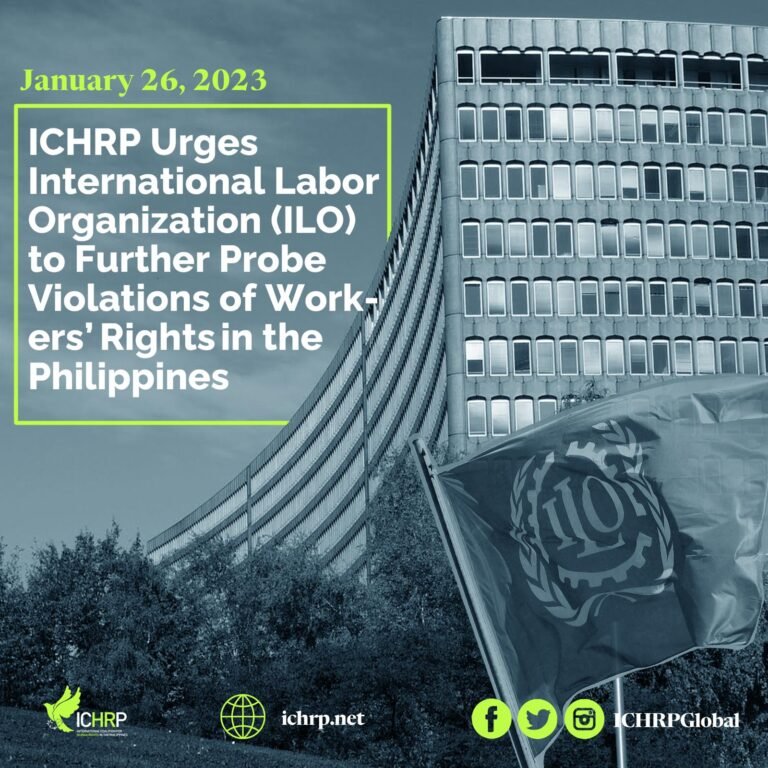
“With the continuing severe human rights situation in the Philippines, we reiterate our call for the High-Level Tripartite Mission of the International Labor Organization to investigate the killings of labor leaders and union members. We also urge the International Criminal Court (ICC) to conclude its investigation into the grave human rights violations of the Duterte administration, and take appropriate action”, added Murphy.

ICHRP continues to call for the international community to remain vigilant and to stand in solidarity with the Filipino people by amplifying their calls for justice from the crimes committed by all administrations past and present.

Further comment: Peter Murphy
WhatsApp +61 418 312 301

ICHRP Calls for the Release of Labor Leaders Kara Taggaoa and Larry Valbuena

0

Urgent Alert
October 10, 2022

“The International Coalition for Human Rights in the Philippines (ICHRP) calls for the immediate release of Kilusang Mayo Uno (KMU – May First Movement Labor Center) International Officer Kara Taggaoa, and PASODA-PISTON President Larry Valbuena, who were arrested on fabricated charges this Monday, October 10,” said ICHRP Chairperson Peter Murphy. “The two KMU officers were apprehended without warrant on the basis of trumped-up charges of assault, and were not afforded their full rights in the process of arrest. The fabricated charge of assault, as well as a second charge of robbery for which they served their arraignment immediately before the arrest, actually date back to a rally against the Anti-Terrorism Act in 2020. They were denied their right to due process as they were not given a chance to be heard in a preliminary investigation on the complaint against them.

“ICHRP vehemently condemns the use of these fabricated charges by the current Marcos administration to attack and threaten the militant labor center KMU and its officers,” continued Murphy. “The arrest of the two labor leaders demonstrates that the present administration won’t recognize due process and legitimate dissent, and is continuing the repression of workers and all legitimate dissent under the notorious National Task Force to End Local Communist Armed Conflict created by outgoing President Duterte at the end of 2018.

“The international community must stay vigilant in the coming months with the possibility of further attacks on the labor movement. Our call for independent investigation into the human rights situation in the Philippines is more urgent than ever. It must include but is not limited to a high-level tripartite mission by the International Labor Organization to investigate the killings of labor leaders and union members as well as on the violation of the workers’ right to organize unions and to collectively bargain, under the previous Duterte administration and the current Marcos administration.”


The two arrestees face a total bail charge of PHP 136,000 (USD2,300) for the cases of alleged robbery and assault. If you are able to contribute funds to the collective bail fund effort of KMU, you can do so by sending donations the following account:

BDO
Acct. Name: Kilusang Mayo Uno (KMU)
Acct. Number: 001490187039

Human Rights Crisis Ongoing in First 100 Days of Marcos Jr Presidency

0

100 days after the inauguration of President Ferdinand “Bongbong” Marcos Jr, the Filipino people continue to suffer crisis and unrest. Following the tradition of his father, Marcos has repeatedly violated and ignored the rights of the Filipino people. The new administration continues to sell out the country to foreign powers while violently suppressing progressive groups who call for change. The International Coalition for Human Rights in the Philippines (ICHRP) calls on the Marcos administration to uphold the civil, political, economic, social, and cultural rights of the Filipino people, and to heed the calls of the international community for investigation and accountability.

Despite Marcos’ complete omission of reports on human rights violations during his State of the Nation Address on July 25, attacks on progressive activists and organizations have continued under his watch. Among the many targeted since June 30 were Gary S. Campos, a Lumad school teacher arrested on July 17; Kyllene Casao, a nine-year-old peasant girl who was shot dead on July 19; and Percy Lapid, a broadcast journalist critical of the current administration, who was shot dead by unknown assailants on October 3. Progressives have also faced red-tagging, as in the case of 16 members of the Rural Missionaries of the Philippines who were charged with providing funds to “terrorist” organizations on August 15. Ominously, Marcos Jr. has boosted the budget of the notorious red-tagging National Task Force to End Local Communist Armed Conflict.

Marcos’ first 100 days in office have also demonstrated a lack of genuine solutions for the economic crisis in the country. The issues of low wages, contractualization, lack of jobs, landlessness, and debt continue to plague the people, and inflation hit a four-year high in September. His economic team are technocrats who will operate interest rate and government spending levers to please markets rather than address the dire needs of the people. Marcos’ recent visits to the US, Indonesia and Singapore in September and October are notable for vacuous statements and little information. The subservience of his administration to the interests of the US is displayed in the current Kamandag naval amphibious exercises between the Philippine and US militaries.

The new administration has also failed to engage in ongoing diplomatic and judicial processes which could provide a solution to the human rights crisis. The call of the international community for independent investigation into the human rights situation, as expressed in the recommendations of Investigate PH (2021) and the International Election Observer Mission (2022), has been ignored so far, and the new government has yet to cooperate with the ongoing investigation of the International Criminal Court into massive civilian killings that took place during Duterte’s ‘war on drugs’. Marcos has also failed to continue peace talks with the National Democratic Front of the Philippines, a process which has potential to end the ongoing armed conflict by addressing its root causes.

ICHRP calls on the new administration to seek genuine solutions to the problems of the Filipino people, and to address the ongoing human rights crisis through both domestic and international mechanisms. We ask the international community to remain vigilant over the next 100 days of the administration, and to continue to campaign for a just and lasting peace in the country.