Home Blog Page 65

ICHRP marks 1st anniversary of the state murder of Filipina human rights worker Zara Alvarez

August 17, 2021 – A year ago, human rights worker Zara Alvarez, a brave and staunch defender of farmers and Filipino rights, was murdered.  Zara was assassinated by a state death squad in Bacolod City, Philippines, a victim of the Duterte regime’s War on Dissent.

Zara Alvarez, 39, was a local community health worker, a paralegal for Karapatan-Negros Island and a single mother. At the time of her death, Alvarez was the 13th member of Karapatan-Negros Island murdered under the Duterte government.  Her death was part of a week of state-orchestrated violence last August.

Zara was one of the paralegals who helped bring the cases of human rights violations in Negros to the UN Human Rights Council. In December 2019, a high-level delegation of lawmakers, church people, and trade unionists visited Bacolod City with the help of Zara.

Her death was a classic instance of red-tagging.  For her human rights advocacy work, she was harassed, vilified, imprisoned, and ultimately murdered “tokhang-style”.  Alvarez’s name and photo had earlier appeared on public posters across Negros, tagging her as a terrorist. Alvarez was the fifth person on that poster to have been murdered. The other cases were activist Haide Flores, lawyer Benjamin Ramos Jr., City Councillor Bernardino Patigas and lawyer Anthony Trinidad.  All cases remain unsolved.

Through the Duterte administration’s Memorandum Order No. 32 in 2018, Oplan Sauron, and Executive Order No. 70 of 2019, state forces have wreaked terror across Negros Island.  These measures, along with the Anti-Terrorism Law of 2020, sought to legitimize the regime’s state terror and ongoing fascist attacks on ardent human rights defenders like Zara.

“Under these instruments of state terror, human rights defenders, farmers, farmworkers and civilians continue to be slayed one after the other with brazen impunity. The Duterte government’s policy of political killing merits international condemnation and prosecution at the International Criminal Court.  The Duterte regime has killed our colleagues and fellow human rights advocates like cattle and it must be held to account,” says ICHRP Chairperson Peter Murphy.

“The recent Investigate PH Reports documented in detail many of these rights violations, the war on dissent, red-tagging as state terror leading to state-sanctioned murder. The weight of evidence is more than sufficient to start criminal proceedings against the regime for crimes against humanity”, added Murphy.

ICHRP’s commemoration of the murder of Zara Alvarez is part of Stop the Killings Week of Action in the Philippines – a call for domestic and international actions of human rights defenders, people’s organizations and movements to:

  • Strengthen the call to stop the killings in the Philippines;
  • Amplify support for human rights violations victims in their quest for justice and accountability; and
  • Enjoin the United Nations Human Rights Council (UNHRC) to conduct an independent investigation on the rights situation in the Philippines and the International Criminal Court (ICC) Pre-Trial Chamber to grant the Prosecutor’s request for an investigation into the drug war killings and other violations.

“Duterte’s tyrannical regime may have killed Zara Alvarez, but her principled defiance against injustice will persist in our unwavering struggle for people’s rights and freedoms. Let us honour Zara and the hundreds of slain community leaders who sacrificed their lives in the struggle for freedom and democracy by incessantly seeking justice and accountability. We stand resolutely with the Filipino people in this battle against tyranny,” concluded Murphy.

END IMPUNITY NOW! PROSECUTE THE PERPETRATORS!

JUSTICE FOR ZARA ALVAREZ!

STOP THE KILLINGS!

#StopTheAttacks#JunkTerrorLaw

ICHRP marks 1st Anniversary of the Assassination of peace consultant Randall Echanis: A year on, Duterte’s war on the Peace Process is painfully clear

August 10, 2021 – The International Coalition for Human Rights in the Philippines marks the one-year anniversary of the torture and assassination of Randall Echanis, 71, by the brutal Duterte Regime. Echanis was killed at about 1.20am Manila time, last August 10, 2020. Five men were seen leaving the rented home of Randall Echanis, in Novaliches, Quezon City, Philippines. Inside the bodies of Echanis and a neighbour were found, with multiple stab wounds.

Echanis  was a veteran peasant leader and is remembered for his role in the peace process.   As a Peace Consultant for the National Democratic Front of the Philippines, he was a member of the 2016-17 Reciprocal Working Committee on Social and Economic Reforms in the formal peace talks sponsored by the Royal Norwegian Government. He successfully negotiated with the government delegation for agreement in principle on the free distribution of land to peasant farmers in those talks.

A year later the pattern of his killing is painfully clear, Echanis’ death was a harbinger of state terror.  He is one of eight peace consultants killed by Duterte’s death squads in the Regime’s war on dissent.  

Echanis’ death was preceded by that of Randy Felix Malayao, a journalist,  human rights defender and peace advocate. Since 2008, he had served as a consultant on political and constitutional reforms for the NDFP, a coalition of groups that has long been engaging in peace negotiations with the Philippine government. The human rights defender also participated in the formal peace negotiations in Rome in 2016.  Malayo was shot dead while he slept on a bus in Aritao, Nueva Vizcaya, on January 30, 2019.

Also killed prior to Echanis was peace consultant Julius Giron, along with his wife doctor Maria Lourdes Tangco, and aide Arvie Reyes. The three were killed in in a police raid in March 2020, in Baguio City. Giron was a senior consultant in the GRP-NDFP peace talks on social, economic and political reforms. He was holder of a Document of Identification which entitled him to protection and immunity under the JASIG (Joint Agreement on Safety and Immunity Guarantees).

Since Echanis’s assassination last August five other peace consultants have been murdered: At 3 am on November 25, 2020, a couple, Agaton Topacio and Eugenia Magpantay, both 68 and both peace consultants were gunned down by police in their home in Angonon town, Rizal tokhang style as they were serving a search warrant.

In December 2020, retired NDF Peace Consultant Antonio Cabanatan, 74 and wife Florenda Yap, were abducted, secretly detained and ultimately murdered by the AFP.  Their bodies were found in a military safehouse in Oton, Iloilo on December 26, 2020, killed by strangulation.

More recently on May 30, 2021, former Roman Catholic priest and former NDFP peace consultant Rustico Luna Tan, 80 years old, was killed on Camotes Island, Cebu as he slept on his hammock, shot in his face and torso by unidentified assailants.

The same day Reynaldo Bocala, 74 years of age, a peace consultant in Iloilo City, was killed by members of the Criminal Investigation and Detection Group at Providence Subdivision in Barangay Balabag in the town of Pavia.

Tan and Bocala were “summarily executed” following a directive from Duterte “to take no prisoners” in quashing communists in the Philippines.

It is disgraceful that peace negotiators, who were told in a legal agreement that they would be immune to prosecution or to the belligerence of the state, would be slain in such a fashion.

ICHRP Chairperson Peter Murphy stated, “None of these aging consultants were combatants, they did not deserve to be targeted by the state’s armed forces. Their killings are illegal and demonstrate the brutal Duterte regime’s callous disregard for the rule of law, civility and the peace process”.

He further added, “The ongoing systematic assassination of peace consultants is a calibrated operation of the Duterte counter-insurgency program, Oplan Kapanatagan. It is designed to destroy any dialogue that may resolve the five-decade long armed conflict in the Philippines, and instead pursue all out political violence against civilians in the regimes war on dissent.

“We call on all Member States of the UN Human Rights Council to be seized of the seriousness of the human rights situation in the Philippines, to revisit their decision of October 2020 and to adopt the recommendations of last year’s June 30 report on the human rights situation in the Philippines, including an independent investigation,” said Mr Murphy.

Media Contact:

Peter Murphy – ICHRP Chairperson  +61 418 312 301 chairperson@ichrp.net

Philippine Police Chief Denies Cover-Up, Despite Growing Evidence

July 7th, 2021

In the wake of Investigate PH’s Second Report yesterday, Gen. Guillermo Eleazar, the PNP chief, asserted there is no policy to cover up police wrongdoings and in cases of anti-drug operation killings. His denials fly in the face of the evidence documented by the Independent International Commission of Investigation (Investigate PH*).

Investigate PH stands by its statement “that the Philippine National Police (PNP) routinely covers up the circumstances surrounding killings in ‘anti-drug operations’, intimidates potential witnesses, and obstructs investigations by victims’ families, civil society and even by the Commission on Human Rights”.

The Independent Commission lead by senior civil society luminaries found that police had systematically engaged in extra judicial killings of thousands of alleged drug suspects and hundreds of political dissidents and had covered-up, obfuscated and blatantly falsified the nature and circumstances of these deaths.  Almost universally the police made claims that suspects had resisted, despite testimony from eye witnesses and forensic experts that suspects showed wounds of a defensive nature, were shot with their hands in the air or worse executed while handcuffed. 

Photographs from journalist Vincent Go show scenes which suggest victims had not fired even one shot. His photographs of dead bodies show signs of handcuffs or zip ties, suggesting victims were not resisting when shot dead. In some cases, the bodies still had zip ties, which the police did not bother to remove after death.

Further, it is hard to take General Eleazar’s denials seriously when the President’s own words point to the culpability of the police in these killings. 

On September 27, 2018, President Duterte gave a speech at the Presidential Palace (Malacañang) before Career Service Officers, in which he acknowledged that he was responsible for the extrajudicial killings in anti-drug operations.

“Ako? Sabi ko nga sa military, anong kasalanan ko? Nagnakaw ba ako diyan ni piso? Sige daw. Did I prosecute somebody na ipinakulong ko? Ang kasalanan ko lang ‘yung mga extra-judicial killing. 

[“Me? I told the military, what are my sins/crimes? Did I steal even a single Peso? Tell me. Did I prosecute somebody which I ordered imprisoned? My only crime/sin are extra judicial killings.”] [Our translation]

The International Coalition for Human Rights in the Philippines (ICHRP) expects the International Criminal Court to take the evidence presented  to use in the ultimate prosecution of senior Philippine officials for their roles in crimes against humanity.  

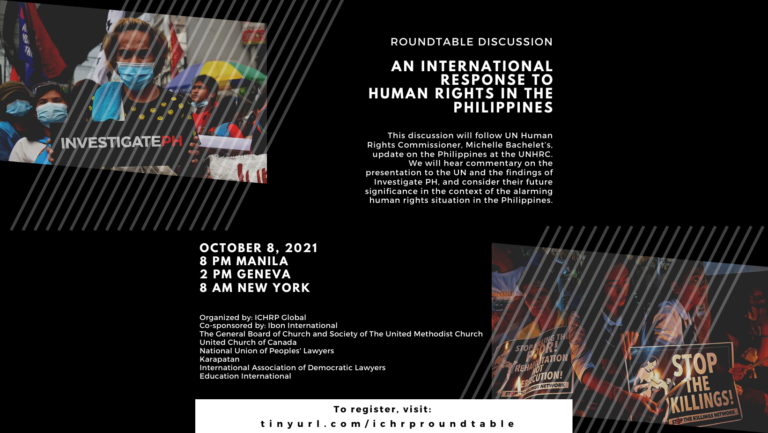
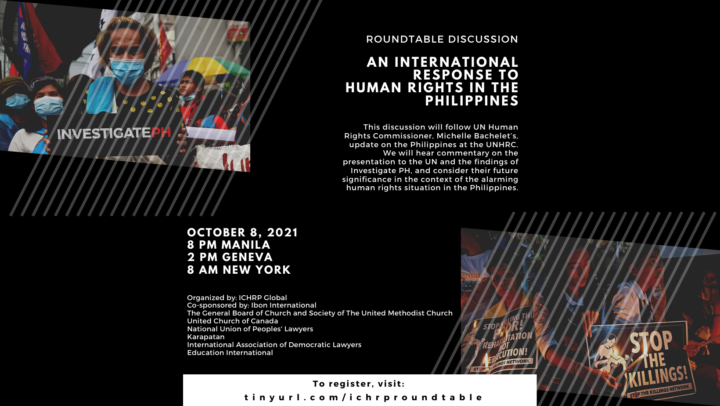
* Investigate PH is the popular name of the Independent International Commission of Investigation into Human Rights Violations in the Philippines, which is led by ‘High Commissioners’ who are prominent personalities of the international community. Its recent report is the second in a series of three reports, and builds on the findings of the first report launched in March 2021, which picked up from and further substantiated the UN Office of the High Commissioner on Human Rights’ June 2020 report on the Philippine human rights situation. 

ICHRP calls for Protest Action on July 10, on the Release of July 6 Damning Civil Society Report on Human Rights in the Philippines

0

Duterte’s reign of state terror and brutality documented in a damning second report of the Human Rights situation in the Philippines 

No amount of denials and lies by the regime can whitewash the crimes exposed by the work of Investigate PH. –Peter Murphy, ICHRP Chairperson

ICHRP congratulates Investigate PH’s release of its detailed, factual and well documented second report into the Human Rights situation in the Philippines.  Investigate PH is an International Commission of Inquiry representing a broad range of civil society leaders and organizations that have taken up the challenge of conducting an independent investigation into the Human Rights situation in the Philippines. The Report adds to the mounting body of evidence of the culpability of the Duterte Regime as a serial violator of basic human rights. 

The release of the second report comes just three weeks after the International Criminal Court opened an investigation of crimes against humanity against the Duterte Regime.  The report details the depravity of the Duterte government’s abuses using an investigation of three areas of conflict occurring across the Philippines 1) The War on Drugs, effectively a war on poor people, 2) the War on the Moro People, a colonial war being fought against Islamic Peoples of the Philippines, and 3) the War on Dissent, effectively implementation of a counter-insurgency strategy waged by the state against civil society and non-combatants, fundamentally a war against political opposition and dissident voices. 

The second report provides further evidence of ongoing gross violations of rights that were highlighted in the first report.  The second report highlights three main areas of concern:

Lack of redress persists for abuses by State agents, and the Philippine National Police (PNP) continue to obstruct justice. Police routinely coverup the circumstances of killings in anti-drug operations, intimidate families and potential witnesses, and obstruct the review of most killings by the Department of Justice.

The armed forces have become more emboldened in killing dissenters. Police and soldiers are now executing political dissenters in a manner similar to extrajudicial killings in anti-drug operations. Duterte’s NTF-ELCAC, the July 2020 Anti-Terrorism Act, and increasingly the justice system have not only facilitated these killings, but are institutionalizing repression that broadly harms civil society, from alleged communists to churches to long-standing democratic institutions. These actions erode the very foundation and façade of democracy. 

Military action in Mindanao is perpetuating violence against and entrenching the marginalization of Moro communities, with steady military aid from the U.S. Military operations in Mindanao, as part of the U.S.-backed “War on Terror,” have failed to distinguish between civilians and combatants, and also caused mass displacement of Moro communities. Government policy neglects the needs of displaced people and undermines Moro communities’ right to self-determination. U.S. military aid, as well as military support from other countries, is abetting human rights violations.

The report highlights that Philippine security forces are perpetrating extrajudicial killings — and obstructing justice. The hearings produced eye witness accounts of state sanctioned killings conducted by the police and military.  It also produced independent forensic evidence that countered police claims that victims had fought back.  The report demonstrates a complete lack of accountability for the killings in the Drug War.  As of June 2021, the Philippine National Police (PNP) continue to defy Supreme Court directives to hand over case files in the more than 7,000 officially acknowledged drug killings.1

Equally disturbing is the evidence presented that shows the state killing machine perfected in the War on Poor People is now being turned on human rights defenders and a broad range of political opponents of government policy. In “tokhang”-style raids in recent months, police and military in Negros, Panay, and Southern Tagalog have extrajudicially killed farmer leaders, city councillors, teachers, lawyers, doctors, peasant leaders, human rights defenders, trade unionists, indigenous leaders and urban poor organizers in their own homes or going to or from their work. The justice system supports and participates in the suppression of dissent both by weaponizing the law to facilitate human rights abuses, and by failing to enforce legal protections.

The report highlights the failure of military operations in Mindanao to distinguished between civilians and combatants. It documented the use of indiscriminate forms of warfare such as mortar fire, artillery fire and aerial bombing on densely populated by civilian areas. The report notes such actions are in breach of International Humanitarian Law. U.S. and other foreign governments who supply weapons, intelligence and training are also in breach of International Humanitarian Law. 

The second report highlights the judicial system’s role in the institutionalization of impunity, the failure of domestic remedies, the weaponization of the law to violate rights and the persistent culture of impunity that is a hallmark of military rule. 

ICHRP stresses that the Investigate PH report further highlights the current reality in the Philippines “is one of impunity, mass killings and escalating human rights abuses. The behavior of the Duterte Regime is an affront to the efforts of the UN Human Rights Council and the entire international community.”

We call on the UN Human Rights Council and the International Criminal Court to respond to the evidence presented in the Investigate PH report to support its own investigation to hold the Duterte Government accountable for its crimes against humanity. According to ICHRP chairperson Peter Murphy, “The UN bodies and world should know that Duterte’s actions have led directly to the murder of Filipinos, he’s out for blood”.

We call on people from around the world to take notice of these crimes against humanity and express their indignation on July 10th. 

We call for an end to the war on drugs!

We call for an end to the war on dissent and all associated military operations!

We call for compensation and the right to return for all Maranaos!

We call for a suspension of all military aid and equipment to the police and armed forces of the Philippines!

We call for justice for the victims of these crimes, prosecute the perpetrators! 

Contact: Peter Murphy +61 418 312 301

1https://www.rappler.com/newsbreak/investigative/duterte-government-rubbish-files-stall-supreme-court-drug-war-case-part-on

ICHRP Statement on the Death of Jesus Alegre

It is with sadness this week that the International Coalition for Human Rights in the Philippines (ICHRP) marks the passing of political detainee Jesus Alegre, aged 75. Alegre died on June 13 at the Ospital ng Muntinlupa after being in and out of the hospital with diabetes and other ailments over the past few months. Alegre had spent the last 16 years of his life in the notorious New Bilibid prison in Muntinlupa where the mortality rate among the overcrowded prisoner population is said to be 20% per year.  Alegre, his wife Moreta, and his son Selman were all wrongfully convicted of murder in 2005. 

The Alegres are a family from Sagay, Negros Occidental, they had seven children.  Before their incarceration, they were simple fisherfolk and did farming on their small landholding when not fishing. The family were members of Pamalakaya, Negros (National Federation of Small Fisherfolk in the Philippines).

Jesus and Moreta were arrested in April 2005, along with their son Selman. Their imprisonment was a result of a land dispute with a local landlord, Avelino Gaspar, who was encroaching on their small plot of land. The Alegres filed a formal protest to the Bureau of Lands which stopped Gaspar from gaining title to their land, and this caused serious friction between the two.  The dispute lasted over several years and resulted in the death of one of the Alegre sons while trying to protect their land.

Despite the ongoing harassments and threats from Gaspar, the Alegres refused to leave their land and attempted to fight the landlord through the courts. Unfortunately, one of the landlord’s men was killed by an unidentified individual and the Alegre family were accused of murder and found guilty. The main witness to the presumed killing was Gaspar, the landlord.

The couple spent four years at the Sagay Prison in Negros Occidental and then transferred to Metro Manila where they were separated.  Jesus Alegre reflected poignantly on their incarceration, “We are made to suffer for sins we did not commit. It’s because we do not have money and power and we just want to live simply tilling our small land so we can live. Where is justice? We lost our son Romeo trying to defend that small piece of land. When he died no one ever seek justice for him. Our family just cried in silence. I know this was their way of getting rid of us in that small piece we were tilling. But his death was not enough. Our whole family had to take on the cudgels of prison life.”  By eliminating the entire Alegre family, the question of land ownership was resolved for Gaspar.

The Alegres’ conviction and long prison sentence are an example of the failure of the Philippine justice system to provide protection for the poor and oppressed of Negros.  The refusal of the Duterte regime to grant any sort of relief to these aging and sick inmates despite repeated requests during the Covid Pandemic is testament to their barbarity.  ICHRP Global Chairperson Peter Murphy notes: “Jesus Alegre had committed no crime; his imprisonment is a monument to the injustices of the judicial system in the Philippines.  Political detention continues to be an instrument of state terror!”

Release all political prisoners! Stop Landlord abuses in Negros!