
Home Blog Page 242

“No Justice Just Adds to the Pain” – Killings, Disappearances, and Impunity in the Philippines

0

http://www.hrw.org/en/reports/2011/07/18/no-justice-just-adds-pain-0

(Manila) – The Philippine government’s failure to investigate and prosecute extrajudicial killings fuels further military abuses, Human Rights Watch said in a report released today. The government should ensure that officials vigorously investigate serious human rights violations or face disciplinary action, Human Rights Watch said.

The 98-page report, “‘No Justice Just Adds to the Pain’: Killings, Disappearances, and Impunity in the Philippines,” details strong evidence of military involvement in seven killings and three enforced disappearances of leftist activists since President Benigno Aquino III took office on June 30, 2010.

“Activists are being gunned down in the street, while implicated soldiers walk free,” said Elaine Pearson, deputy Asia director at Human Rights Watch. “The Philippines can only bring an end to these horrific abuses if it is clear that anyone who orders or commits them will be jailed and their military careers will be over.”

The report is based on more than 80 interviews across 11 provinces with victims of abuses, their family members, witnesses, and police and military officials, including a former soldier who said military commanders ordered him to kill leftist activists and intimidate witnesses.

Human Rights Watch was unable to investigate several other suspected extrajudicial killings reported recently by local media due to time constraints and security concerns.

The Philippines faces multiple insurgencies from the communist New People’s Army (NPA) and other armed groups that have been responsible for many serious abuses. In addressing these insurgencies, the government should respect its legal obligations under international human rights and humanitarian law, Human Rights Watch said.

The military appears to have targeted several of these victims as suspected members of the NPA because of their involvement with leftist organizations, work on land reform, or opposition to the military’s presence in their communities. Military units operating in conflict-affected areas often consider all leftist organizations to be fronts for the rebel group and anyone who opposes the military presence to be NPA members.

“My husband was lying with open [gunshot] wounds on his chest and neck,” said Mercy Dejos, describing how she had found the body of her husband, a community human rights officer, and that of her son. “His fingernails were removed.”  Her son appeared to have been shot in the back, she said.

Several of the victims were killed or abducted in front of witnesses, either when armed men entered the victim’s property and shot the person in cold blood, or shot the victim from a motorbike. Some attackers wore civilian clothes and covered their faces, while others wore military uniforms and made no attempt to hide their identities.  In several cases there is evidence that soldiers worked with members of paramilitary forces – primarily the Citizen Armed Force Geographical Units (CAFGUs) – or paid military “assets,” including “rebel returnees,” former members of the rebel group.

A former soldier told Human Rights Watch that military commanders had ordered him to kill leftist activists and to hide or burn the bodies. He said the military had trained him and other soldiers to make targeted killings look like the work of the rebel group’s Special Partisan Unit (SPARU) by using .45 caliber pistols and wearing balaclavas thought to be favored by the rebels.

“The brazen nature of some of these abuses – in broad daylight and in front of witnesses – shows how members of the military can kill and ‘disappear’ people with little regard for the consequences,” Pearson said. “Tagging someone as a leftist activist is like sounding the alarm that they are on a military hit list.”

The government has failed to effectively investigate and prosecute the killings and enforced disappearances perpetrated during the last decade, Human Rights Watch said. Neither has it held accountable those responsible for the most recent abuses.

Only seven extrajudicial killing cases have been successfully prosecuted in the past decade, resulting in the conviction of 12 defendants, none since Aquino took office. There has not been a single conviction of anyone who was an active member of the military at the time of the killing. No senior military officers have been convicted either for direct involvement in these violations or as a matter of command responsibility.

Police investigations have stalled – especially when evidence leads to the military. Arrest warrants against those allegedly responsible have not been executed and internal military investigations are nearly nonexistent. The Philippine Justice Department’s inadequate protection program for witnesses, who have been subject to harassment and intimidation, has further hindered efforts to bring those responsible to justice.

Extrajudicial killings have long been a problem in the Philippines. Hundreds of members of left-wing political parties, political activists, critical journalists, and outspoken clergy have been killed or forcibly disappeared in the Philippines during the past decade.

In 2006 and 2007, when the United Nations, the United States, the European Union, and several other major donors publicly raised concerns over the politically motivated killings under then-President Gloria Macapagal-Arroyo, the number of killings dropped drastically. Under President Aquino, though, it is international pressure that has dropped, while the killings continue, Human Rights Watch said.

The US, the EU, Japan, Australia, and other governments should press the Philippine government to investigate these killings thoroughly, prosecute those responsible, require rigorous accountability in the military, and articulate clearly the consequences if these steps are not taken, Human Rights Watch said.

Human Rights Watch called on Aquino to fulfill his campaign pledge to end serious violations of human rights in the Philippines by directing the police and the National Bureau of Investigation (NBI) to vigorously pursue crimes allegedly committed by the military or themselves be subject to disciplinary measures. The military should conduct transparent internal investigations and discipline officers and soldiers responsible for extrajudicial killings and enforced disappearances, including under principles of command responsibility.

“President Aquino should work toward leaving behind a professional, accountable military as his government’s legacy,” Pearson said. “The US, EU, and other donors should be asking the Philippine government hard questions about why killings and disappearances continue one year into the Aquino administration.”

Accounts from “‘No Justice Just Adds to the Pain’: Killings, Disappearances, and Impunity in the Philippines”:

“I saw droplets of blood. When I walked around the corner, I saw the bodies of my husband and son. My husband was lying with open wounds on his chest and neck…. His fingernails were removed…. His forearms were scratched like his arms had been tied up…. His chest was bruised as if he had been beaten with the butt of a rifle. My son, Rudyric, was curled up on his side and I could see bullet wounds on his back with exit wounds on his upper chest…. I then fell unconscious.”
– Mercy Dejos, who found her husband and son after they had been killed on February 27, 2011, in Davao del Sur province. She said soldiers had threatened her husband, a community human rights officer, on several occasions before he was killed.

“Around 2 a.m. [I awoke to hear] someone banging on the door [of the house]….  The armed men used their rifle butts to enter the house. The soldiers saw Toto immediately and used their rifles to beat him. They beat him continuously; he was trying to escape to the second floor of the house, but they kept pulling him back and beating him…. They pulled him away from us and pushed him to the ground floor. Then the soldiers jumped down. One soldier shouted to another to hold on to him; then they shot him [three times]. The commander then ordered the soldiers to move, so they left.  We were very scared. We couldn’t do anything, not even shout or utter a word.”
– A witness to the September 30, 2010 killing of Rene “Toto” Quirante in Negros Oriental province.

“[Most of my fellow police officers] have created a threatening environment for me….  One time when I arrived at the police station, one police officer shouted at me that I am an enemy of the state…. There is a group influence…. I just avoid them and … do my work. One day in the station a fellow officer said to me, ‘There will be a time of reckoning because you’re going out of your way [to investigate this case].'”
– A police officer investigating the killing of a leftist activist, describing how his colleagues have threatened and harassed him because he is actively investigating the crime.

“[She] told me five men came to her house…. They were from the military.  [One of them] threatened her that if she [testified], something would happen to her family…. He said, ‘I am not bluffing and very serious about this conversation.’ Since then, people have told her that people have been regularly visiting [her place]. She’s not been staying in her house since.
– A local government official describing how soldiers threatened a witness to a human rights violation who was planning to testify against the military

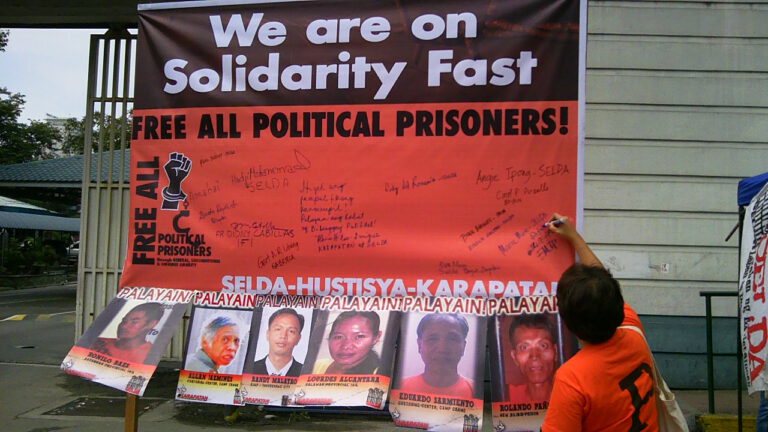
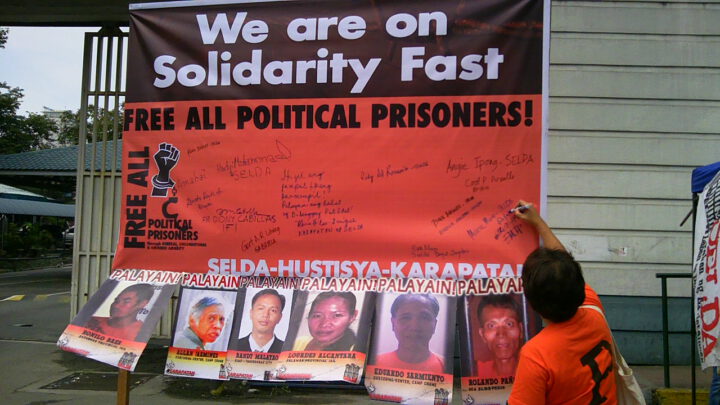
Online petition to free all political prisoners in the Philippines

Dear Friends and supporters,

Let us show our support to all political prisoners whose civil and political
rights have been violated. Pls. sign up and be counted in our online
petition to Free All Political Prisoners in the Philippines through a
general, unconditional and omnibus amnesty. Pls. follow this link,

http://www.ipetitions.com/petition/free_all_political_prisoners/#<http://www.ipetitions.com/petition/free_all_political_prisoners/#sign_petition>
sign_petition<http://www.ipetitions.com/petition/free_all_political_prisoners/#sign_petition>

Best,

Jigs Clamor
Deputy Secretary General
Karapatan

*———————————————————————
PUBLIC INFORMATION DESK
publicinfo@karapatan.org
———————————————————————
Alliance for the Advancement of People’s Rights
2nd Flr. Erythrina Bldg., #1 Maaralin corner Matatag Sts., Central District
Diliman, Quezon City, PHILIPPINES 1101
Telefax: (+63 2) 4354146
Web: http://www.karapatan.org

KARAPATAN is an alliance of human rights organizations and programs, human
rights desks and committees of people?s organizations, and individual
advocates committed to the defense and promotion of people?s rights and
civil liberties.  It monitors and documents cases of human rights
violations, assists and defends victims and conducts education, training and
campaign.

Urgent Alert: Indigenous women leader arrested, interrogated

Posted by Madagway Babaeyon

A Lumad community worker, Lynlyn Lumente of Barangay Comota in La Paz, Agusan del Sur was arrested in the municipality of Talacogon and brought to the military camp for questioning.

On July 8, 2011, Ms. Lumente was visiting offices and individuals to raise funds for the ongoing dialogues (‘husay’) to solve a clan war (‘rido’) between the community of Minangkig, Angeles and Comota in La Paz.  Three deaths have already resulted from the rido and the municipality remains dangerous even for guests and passing travelers.  She was arrested in the municipality of Talacogon by a believed member of the intelligence of the Philippine Army.  After being subjected to half an hour of interrogation, she was released, her captors not finding any evidence that linked her to rebel groups in the area.

Ms. Lumente is a member of Madagway Babaeyon chapter of La Paz and is also an active member of Pigdiwatahan, a Manobo organization in the municipality.

Pigdiwatahan, as the lead Lumad organization in the area, is among the primary facilitators of the dialogues.  The organization was established just last year after its predecessor, Katiboan, broke up due to continuous threats and harassments suffered by its members who were tagged by the military as supporters of the communist New Peoples Army.  This, after the organization made it clear that it will not allow into its territories logging concessions, mining companies and plantations.  Pigdiwatahan, which similarly campaigns for the Lumads’ right to self determination, ancestral domain and cultural integrity, is subjected to the same experience, its members under constant suspicion and red-tagging.

Madagway Babaeyon expresses outrage over the treatment of the Lumads, especially the women who are most important during clan wars.  Traditionally excluded from being targets, it is the women who are often left to see to the community’s needs.  They are also relatively free to move around and arrange dialogues and negotiations between the warring groups.

“How can we work for peace in our communities when aside from the clan wars we are constantly under threat from the military and their trained armed groups?” reasoned Bae Adelfa Belayong chairperson of Madagway.  “If the military is serious in pursuing rebel groups in our area, they should stop pointing their guns at us, civilians.  Or are the targets really us who are resisting the companies they want to force into our lands?”

*Madagway Babaeyon (Beautiful Women) works for the empowerment of Lumad women in their defense of their Ancestral Domains against development aggressions that destroy their lands and consequently transgress against the very fabric of their culture which is primarily dependent on nature.

KARAPATAN on Supreme Court decision on Jonas Burgos’ disappearnce

PRESS RELEASE
15 July 2011

Reference:      Marie Hilao-Enriquez, Chairperson, KARAPATAN, Mobile : +639175616800

KARAPATAN welcomes the Supreme Court’s decision ordering the Armed Forces of the Philippines (AFP), specifically Lt. Harry Baliaga and the incumbent Chief of Staff, to surface activist Jonas Burgos who has been missing since 2007.

The decision affirms what KARAPATAN has long found out: that state security forces are responsible for the disappearance of Jonas Burgos, along with the many other cases of enforced disappearances that happened under the GMA regime and are still happening until the present.

By this time, the AFP should stop denying responsibility over the disappearance of Jonas Burgos in the same way it denied having Sherlyn Cadapan and Karen Empeño in their custody when the Supreme Court ordered the same last May.

We reiterate that Jonas, Sherlyn, Karen and thousands like them became victims of human rights violations because of the counter-insurgency program implemented by the Arroyo administration – the Oplan Bantay Laya I and II – that targeted activists and other human rights defenders.  We urge the Aquino government to learn the lesson of the past regime and immediately rethink implementing the same policies of the past government and his own brand of the counter insurgency program – Oplan Bayanihan – which engender unreported displacement of communities in areas pinpointed by the military as allegedly under the strong influence of rebels.

We call on President Noynoy Aquino to use his power as Commander-in-chief of the AFP to order the military to abide by the Supreme Court’s order to surface Jonas Burgos and ensure that those responsible for his abduction and disappearance will be punished. Only then can decisions of the Courts have teeth and effect the lessening of, if not totally ending, impunity.

We strongly urge President Noynoy Aquino to go after Gloria Macapagal-Arroyo, who was dropped by the courts as a respondent to the case. One year is more than enough time for President Noynoy to act on serving justice to all the victims of human rights violations of the past regime. It is hard to believe that GMA is ignorant of these heinous cases of human rights violations that happened when she was the commander-in-chief of the Philippine Armed Forces.###

———————————————————————
PUBLIC INFORMATION DESK
publicinfo@karapatan.org
———————————————————————
Alliance for the Advancement of People’s Rights
2nd Flr. Erythrina Bldg., #1 Maaralin corner Matatag Sts., Central District
Diliman, Quezon City, PHILIPPINES 1101
Telefax: (+63 2) 4354146
Web: http://www.karapatan.org/

KARAPATAN is an alliance of human rights organizations and programs, human rights desks and committees of people’s organizations, and individual advocates committed to the defense and promotion of people’s rights and civil liberties.  It monitors and documents cases of human rights violations, assists and defends victims and conducts education, training and campaign.

Refusing to live in fear: Portrait of a human rights defender

0

INA ALLECO R. SILVERIO
Bulatlat.com

It has been almost three decades since the downfall of the Marcos dictatorship, but Maria Isabel Aurelia Aquino’s psychological wounds caused by her experiences during those dark days remain as fresh as if they were inflicted yesterday. In her day to day dealings, however, she is able to be sincere to her facade of cheerfulness and calm.

A human rights activist, she knows that fighting for human rights takes courage and persistence.

“But it also takes much personal strength. It’s not always easy to put up a brave face when your work is about defending other people’s rights to live in dignity and to stop physical abuse and exploitation. It can take a toll on you, the knowledge of how so many Filipinos are forced to live not knowing their rights or having their rights violated in a myriad of ways. And then when you consider your own experiences, it’s sometimes gets even harder,” she said ruefully.

Born in Manila to an upper middle class family, Ma. Isabel grew up in an old Spanish house along Severino Street near Claro M. Recto Avenue in Manila. It was an area that saw many street protests and battles between anti-Marcos activists and the Metrocom (now the Philippine National Police), and a stone’s throw away from Don Chino Roces bridge, or more popularly known as Mendiola bridge. She attended a private school nearby, and in the countdown to martial law and in the beginnings of the First Quarter Storm Movement, she became an activist leading students in the struggle against the dictatorship.

“There are those who would say that the days of dictatorship are long gone; but from the state of human rights in the Philippines these days, it is impossible to dismiss the truth that much remains to be desired by way of bringing genuine justice in the country,” she said.

Data gathered by Karapatan human rights organization for the second quarter of the year show the same growing list of human rights violations under President Benigno Aquino III’s Oplan Bayanihan (OPB), his administration’s counterinsurgency program which is deemed no different from the previous Macapagal-Arroyo regime’s Oplan Bantay Laya (OBL).

From July 2010 to June 2011, a shocking 48 activists have fallen victim to extrajudicial killings while three others have become victims of enforced disappearance.

Maria Isabel herself almost became a statistic back in March 2010.

On March 10, 2010, armed men arrived at her parents’ house in Severino street looking for her. She was able to elude them because her sister and a caretaker were able to immediately warn her and she was able to leave the house undetected through a separate, back exit. Her elderly parents were shaken and feared for her life but begged her to not raise the issue to the media.

“My family has been through much in the last years. In 2009, my brother Tomas Aquino disappeared and we strongly suspect that his disappearance was courtesy of the military. He was not an activist, but he was openly supportive of my human rights advocacy and very critical of the government,” she said.

Now Maria Isabel has found temporary sanctuary, and enough security to tell her story. From experience she knows that she has to assert herself and speak out about her own circumstances and the worsening human rights situation in the Philippines.?

“It’s never right to live in fear. Those who attack the civil, political and human rights of the Filipino people thrive on fear and persist in their attacks because of a culture of impunity. To remain silent is to play along with your own victimization,” she said.

In 1985, her husband Venerando Villacillo was abducted by a dozen armed men while he was standing with Ma. Isabel in front of her parents’ house. She was only able to get away with the help of relatives who saw the commotion and pushed and pulled against the assailants.

Venerando disappeared and has not been found since. He was alleged to be a high ranking official of the revolutionary movement in Isabela and Cagayan at the time he was abducted.

Her life has since then been a long series of hours waiting and searching for her husband and any news of him. She did not allow grief and worry to defeat her and instead used both to strengthen her own commitment to defend human rights in the country. She became a co-founder and consultant of Karapatan, Desaperacidos and other human rights organizations in the country including those based in Mindanao and Cagayan Valley.

Through the years, too, she has had constant reminders that to be an activist in the Philippines is to be a target of those who violate human rights. She has received death threats via cell phone messages; been followed by strange men; and almost became a victim of a hit and run. She has considered all these as part and parcel of a live devoted to fighting against human rights violators.

“I have had co-workers, colleagues and friends abducted, tortured and killed. I have known how it is to constantly look over my shoulder and be suspicious of people I sit next to on the bus. How I have survived through the years is through sheer luck, but also because of the constant support of fellow activists and the people we seek to always serve,” she said.

When in the cities, she wore veils and other disguises. In the provinces where her light skin easily stood out among the sun-darkened skin of the local residents she wore shirts with long sleeves. She’s had more names than she cared to remember and changed the number on her cellphone as frequently as possible.

“I am most grateful to the friends, comrades and ordinary folk in the provinces who have helped me through the years. They have kept me alive with their vigilance and their concern for my safety,” she said. But like other activists, she is also human, too.

“Sometimes things can be too much to bear. I remember my husband and my brother, and my heart bleeds as I imagine what happened to them. I fear for my own parents, my relatives and my colleagues and their safety and security. My worries for myself come last, but there are days when I am so shaken by what could happen to me that I have to struggle hard to keep from completely breaking down,”she said. Sometimes she gets intense headaches, and has attacks of extreme acid reflux.

According to the Center for Victims of Torture (CVT), psychological torture includes verbal abuse, threats against family, friends and loved ones, false accusations, forced choices, mock executions, and being forced to witness torture, mutilation and murder of others.

The CVT says that psychological torture can be more damaging and cause more severe and long-lasting damage even than the pain of physical torture. It cited a 2007 study that concluded that degrading treatment and psychological manipulation cause as much emotional suffering and long-term mental health harm as physical torture. (Torture vs Other Cruel, Inhuman, and Degrading Treatment. Basoglu et al. Archives of General Psychiatry, Volume 64, March 2007).

Ma. Isabel has also undergone a tumor operation on her knee and is less mobile. Despite this new handicap and the threats to her own safety and security, she still wants to continue her work as a human rights worker and contribute to efforts to transform society. This, however, can only be done if she is able to come to terms with the emotional stress and mental anguish she suffers at the constant knowledge that she is a target. (http://bulatlat.com)