
Home Blog Page 99

Philippine UPR Watch Delegation hold meeting with Swedish Mission in Geneva

0

News Release (September 20, 2017)

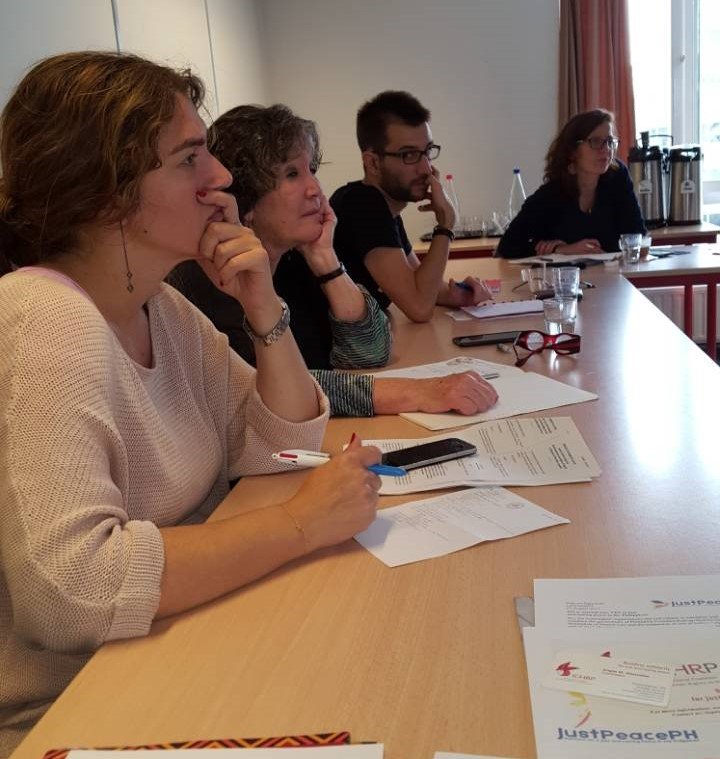
The Swedish Mission to the United Nations expressed concern over the increasing human rights violations perpetrated by the Duterte administration against the Filipino people. Ms. Anna Envall, head of the Swedish Mission to the United Nations held a dialogue with members of the Philippine Universal Pediodic Review (UPR) Watch to discuss the human rights situation in the Philippines.

Roneo Clamor, deputy secretary general of Karapatan, provided updates on the increasing number of abductions and killings linked to the Duterte administration’s counter insurgency and war on drugs campaigns.

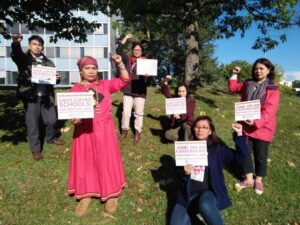
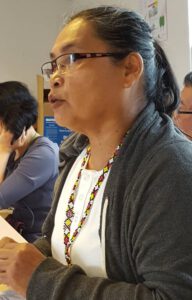
Amirah Lidasan of Sandugo, a broad coalition of indigenous organizations in the Philippines, stressed that the indigenous peoples and communities face the threat of ethnocide as they are displaced from their ancestral lands because of the continuing martial law in Mindanao and military bombings of indigenous communities. Lidasan also denounced the deliberate omission of the ongoing attacks on Lumad schools in Mindanao in the Philippine government representative’s report to the Special Rapporteur on Indigenous Peoples in the afternoon of September 20.

Eule Bonganay of the Children’s Rehabilitation Center shared how Lumad school teachers who painstakingly serve the Lumad children in remote areas of Mindanao have been charged by the Duterte administration with trumped-up charges of illegal possession of firearms, arson, and child trafficking. At present, about 70% of Lumad schools had been closed or rendered non-operational because of military occupation by soldiers of the Armed Forces of the Philippine. These Lumad schools are duly recognized by the Department of Education and local government, and some had even received awards from these bodies for excellent service.

Envall expressed the mission’s support in the Filipino campaign for respect for human rights as she reiterated the importance of listening to reports from the ground which provide a clearer picture of the human rights situation in the Philippines.

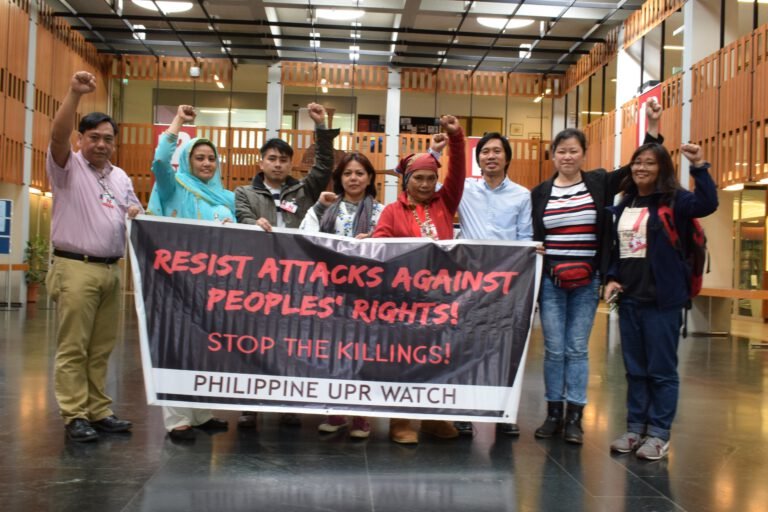
The Philippine UPR Watch delegation interacted with other international human rights advocates and organizations to bring to the attention of the international community, the grim situation of human rights in the Philippines as well as gather support for the Filipino peoples’ for the struggle against the imminent return of tyrannical rule through the Duterte administration.

The Philippine UPR Watch delegation co-headed by Atty. Ephraim Cortez of the National Union of Peoples’ Lawyers and Roneo Clamor of Karapatan is composed of 13 representatives from different sectoral and human rights organizations. They will continue to engage in dialogues with different Special Rapporteurs and organizations to highlight the Philippine case and campaign for the adoption of relevant provisions that address the dire human rights situation in the Philippines.#

Philippine UPR Watch

References (Heads of Delegation):
Atty. Ephraim Cortez, secretary general, National Union of Peoples Lawyers, (+63) 9175465798
Roneo Clamor, deputy secretary general, Karapatan, (+63) 9997721233

Philippine UPR Watch calls for international support to Filipino people’s campaign against tyrannical rule of Duterte administration

Press Release

19 September 2017


References (Heads of Delegation):

Atty. Ephraim Cortez, Secretary General, National Union of Peoples Lawyers, (+63)9175465798

Roneo Clamor, Deputy Secretary General, Karapatan, (+63)9997721233


The Philippine Universal Periodic Review (UPR) Watch calls on the member states of the United Nations Human Rights Council to express their support for the Filipino peoples’ campaign against President Rodrigo Duterte’s tyrannical rule.

In barely four months, after the UPR of the Philippines at the UN Human Rights Council last May 2017, human and people’s rights violations have spiralled, with the drug war, counter-insurgency program and martial law in Mindanao, the group said. On September 22, 2017, the recommendations made to the Philippine government on its 3rd cycle of the Universal Periodic Review will be adopted this coming 36th Session of the United Nations Human Rights Council on 22 September 2017. “The Duterte regime has been totally disregarding these recommendations urging the State to protect and uphold international human rights obligations,” said Atty. Ephraim Cortez, secretary general of the National Union of Peoples’ Lawyers (NUPL) and  co-head of the Philippine UPR Watch delegation.

A total of 103 State parties forwarded at least 257 recommendations to the Philippine government during the 27th session of the United Nations Human Rights Council. At least thirty-four (34) States raised concerns on the continuing extrajudicial killings in the country and reminded the Philippine government to ensure prosecution and accountability of perpetrators. Eight (8) States called for an end to extrajudicial killings in line with the Duterte administration’s campaign against crime and drugs.

“However, in May 2017, after the UPR on the Philippine government, the Duterte administration openly imposed martial law in Mindanao. This despite the fact that the factual basis can’t be substantiated even when the Philippine Supreme Court came up with resolution on the constitutionality of the imposition,” Cortez added.

“After more than four decades, the Filipino people will commemorate the imposition of dictator Marcos’s Martial law on September 21, 2017 with an ongoing martial law in Mindanao. This imposition of martial law in Mindanao has emboldened the Philippine state security forces to commit more human rights violations with impunity. President Rodrigo Duterte recently threatened to impose a nationwide martial law in the country. Duterte totally disregard the clamor of the Filipino people, including that of human rights defenders and social movements whom he sees as enemies of the State. Recently, he stepped up his rants against those who have condemned and called for the justice of the victims of extrajudicial killings. He sees these groups as a hindrance in his drug war and his all-out war,” said Roneo Clamor, deputy secretary general of Karapatan and co-head of the delegation.

“We stand with the victims of extrajudicial killings and other forms of human rights violations. The stones would cry out even if the Duterte administration would want to silence them. We call on the international community, especially member States of the UN Human Rights Council, to continue and strengthen their support against tyrannical rule of the Duterte administration,” Clamor said.

The Philippine UPR Watch is composed of the 13-member delegation of rights defenders and sectoral representatives from peoples’ organizations, churches and institutions, some of whom have also been recently subjected to rights violations. They are as follows: Atty. Ephraim Cortez, National Union of Peoples’ Lawyers (co-head of the delegation); Roneo Clamor, Karapatan (co-head of the delegation); members:  Eufemia Cullamat and Amirah Lidasan, Sandugo; Sharon Cabusao, Gabriela; Mary Joan Guan, Center for Women’s Resources (CWR); Eule Bonganay, Childrens’ Rehabilitation Center (CRC); Johanna Dela Cruz and Maria Teofelina Morales (wife of Bishop Carlo Morales), National Council of Churches in the Philippines (NCCP); Beverly Longid, International Indigenous Peoples Movement for Self Determination and Liberation – Rural Missionaries of the Philippines (IPMSDL-RMP); Antonio Flores, Kilusang Magbubukid ng Pilipinas (KMP); and, Angie Gonzales and Doris Wilson, International Coalition for Human Rights in the Philippines (ICHRP).

Other member organizations of the UPR Watch are: Bagong Alyansang Makabayan (BAYAN), Center for Trade Union and Human Rights (CTUHR), Confederation for Unity Recognition and Advancement of Government Employees (COURAGE), Cordillera People’s Alliance (CPA), IBON Foundation, Initiatives Peace Mindanao (InPEACE Mindanao), KALUMARAN, Migrante International, Moro-Christian Peoples’ Alliance (MCPA), Ramento Project for Rights Defenders-Iglesia Filipina Independiente, SALINLAHI Alliance for Children’s Concerns, KAWAGIB – Alliance for the Advancement of Moro Human Rights. ###

Independent and Peaceful Australia Network Statement on the Philippines

Australians are rightly concerned that their government is committing Special Forces to the Philippines, allegedly as advisors or trainers, in a reaction to the fighting in Marawi City. Independent and Peaceful Australia Network (IPAN) is an anti-war organisation of over 60 organisations, which has grown in the last four years in response to the positioning of a US Marine Combat Regiment and associated air forces in Darwin. IPAN held its second national conference in Melbourne on September 8-10 and called on the Australian government to abandon its support for the Armed Forces of the Philippines (AFP) which has abjectly failed to uphold human rights, and instead, put all its efforts into programs to promote peace and justice in the Philippines and to directly sponsor the peace talks to promote genuine peace and lasting prosperity for the people.

* * *

Whereas, a vibrant, inclusive and just social order where human rights and dignity are respected is the best defence against all forms of terrorism employing violence and fear to cower a people; and

Whereas, true peace based on justice can only be realised through building up a just society and not by the way of violence, war and terror; and

Whereas, Philippine President Rodrigo Duterte has promoted extra-judicial killings, violence, and direct attacks on human rights and the defenders of a justice, continuing a bloody heritage of Philippine Presidents and traditional clan based politicians; and

Whereas, the Armed Forces of the Philippines (AFP) and the Philippine National Police (PNP) have over the decades used violence and fear to attack human rights and communities promoting justice and genuine development; and

Whereas, vast amounts of Australian military aid, and training of Philippine military and police have only increased the violent and anti-democratic nature of the AFP and PNP, and

Whereas, Australian assistance and cooperation should be non-military and directed towards building up just and inclusive societies respecting the rule of law and human dignity as the best answer to hate, terror and conflict;

WE, the participants of the IPAN National Conference, 8 – 10 September 2017 in Melbourne, affirm our commitment to justice and peace in the Philippines over violence, hatred and war, and call on the Australian government to

  • Transform all military aid and training to development assistance directed to promoting peace based on justice;
  • Condemn the violence and injustice of the Duterte regime’s so-called war on drugs which is a war on the poor;
  • Condemn the Duterte government’s militarisation of rural communities and the counter-insurgency program which target activists, human rights advocates and indigenous Filipinos for various forms of human rights violations and extrajudicial killings;
  • Support non-government organisations in the Philippines confronting all forms of terror and violence through their vision of a just society where opportunity and the national wealth is shared fairly; and
  • Act as a good-faith collaborator in promoting genuine peace talks in the Philippines to find solutions to the basic problems on the ground as the basis of genuine, and lasting peace and prosperity.
(Image sourced from the IPAN website)

Calls of the National Democratic Front of the Philippines

Delivered by:

Coni Ledesma

NDFP Peace Negotiating Panel member


  1. The NDFP calls on all friends and compatriots to support the Filipino people’s struggle for fundamental reforms. Support the movement for social, economic, political and constitutional reforms in order to achieve a just and lasting peace. Social and economic reforms, especially a land reform program of free distribution of land for the landless; a national industrialization program where the natural resources of the country will be used for the benefit of the Filipino people, and the implementation of social programs like health care, education and housing for everyone. This is what a just and lasting peace will mean for the Filipino people.


  1. We call on our friends and compatriots to continue the campaign to stop the US-instigated counterinsurgency Oplan Kapayapaan.

Stop Duterte’s dirty war against the Filipino people and the progressive and revolutionary forces!

Continue the campaign to stop Extra Judicial Killings and continue to demand justice for all the victims of EJK’s.  The anger of the people against the killing of Kian Lloyd should bring about a growing national and international mass movement against EJK’s.


  1. We also call on our friends and compatriots to continue to call for the resumption of peace talks.  The current problems in the Philippines can be discussed on the negotiating table even while the civil war continues.  The important thing is the political will to bring about a just and lasting peace.

NDFP’s Proposal for Comprehensive Agreement on Social and Economic Reforms (CASER)

by Juliet de Lima

Chairperson, Reciprocal Working Committee on Social & Economic Reforms (RWC-SER) & Member National Democratic Front of the Philippines (NDFP) Negotiating Panel


Friends, warm greetings from our overworked, overtasked and determined but not grim GO CASER team as we have named ourselves.


We are the NDFP Reciprocal Working Committee on Social and Economic Reforms and divided into technical working groups (TWG). Under the guidance of the NDFP negotiating panel, we conduct consultations with the masses and the mass organizations, work the result of consultations into the draft, discuss with our Government of the Republic of the Philippines (GRP) counterparts to reconcile the GRP & NDFP drafts and forge a common draft to submit to our respective panels for them to negotiate on what would be the GRP-NDFP Comprehensive Agreement on Social and Economic Reforms to be signed by their respective principals.


Here today, we shall examine the proposed social and economic reforms of the National Democratic Front of the Philippines, its place in the mass movement, in the GRP-NDFP peace negotiations to address the Filipino people´s aspirations for just and lasting peace.


I agree with the organizers that the focus of this forum should be on strengthening the mass movement to achieve the reforms and on how the peace negotiations can be one of the means by which these reforms may be achieved. We expect that our discussions today will not just be an academic exercise but would lead to concrete actions to rally support for the Filipino people in their struggle for reforms.


Conditions in the Philippines are developing fast, making events and campaigns to encourage and strengthen the people´s movement for reforms ever more urgent. The current administration has consistently demonstrated and proven its violations of, and total disregard for the people´s rights and demands on a very broad range of fundamental issues.  It is increasingly taking the path to fascist tyranny.  The extrajudicial killings and other gross human rights violations perpetrated by this regime in its so-called war on drugs as well as its war against progressive and revolutionary forces have far exceeded those by the 20-year regime of the deposed dictator Marcos. These are giving rise to a broad antifascist movement, which urgently needs international support.


Let us proceed to the NDFP draft Comprehensive Agreement on Social and Economic Reforms (CASER) as the most essential or fundamental reform document for addressing the root causes of the armed conflict in the Philippines and the Filipino people’s demands and aspirations for a just and lasting peace.


The prospective CASER would be basically a policy document and thus has to be supplemented by annexes for implementing the policies through executive orders, amendments of existing legislations or new legislations; access to public funding and the pertinent social and economic councils/agencies for harmonizing bilateral cooperation as well as joint and separate responsibilities; and through the mobilization of the people and resources to realize the reforms. This way, the people can immediately avail of and enjoy the social and economic benefits due them and give impetus to their potential for propelling social and economic development in the country and assuring themselves of a prosperous future and a just and lasting peace.


The GRP-NDFP negotiations on an agreement on social and economic reform started with the exchange of preliminary drafts in 1998 at the signing ceremony of the Comprehensive Agreement on Respect for Human Rights and International Humanitarian Law (CARHRIHL) on March 16, 1998.  The draft was subjected to a series of consultations with the public, starting with a 4-day national consultation involving various sectors of Philippine society and followed by sectoral consultations at the regional and provincial levels to ensure that all issues and concerns were covered. The NDFP RWC-SER reworked the draft to incorporate the results of the consultations and we continue to rework the draft according to further consultations under developing circumstances.


The negotiations on CASER must go through several phases: the first one being the bilateral discussions on the exchanged drafts at the level of the RWCs-SER to forge a common draft for submission to the Negotiating Panels; the second being the negotiations to forge and initial the agreement at the level of the two panels; and the third being the submission of the agreement for signing by the principals. The RWC common draft may be submitted to the panel part by part so that negotiations at the level of the negotiating panels can already proceed while the RWCs are still working out the common draft on other parts. The fourth and final phase of the CASER negotiations would be the panel-level post-agreement discussions and further agreement on the setting up of implementing mechanism and bilateral monitoring agencies; as well as on implementation with detailed fulfillment or compliance schedule and finally the constitutionalization of the reforms and the bilateral agencies required by the implementation of the reforms.


This way. we consciously avoid or we reject the DDR (Disarmament, Demobilisation and Reintegration) framework –consistently proven as failure at resolving the roots of armed conflicts all over the world– that the GRP has been trying to impose on the NDFP under various pretexts, such as prolonged ceasefires supposedly as ´enabling environment´ for the peace negotiations, actually pacification through virtual surrender of arms or a silencing of the guns of the people´s army, while the dominant state forces continued with the US-instigated ´counterinsurgency´ plan under such names as Oplan Bantay Laya under Arroyo, Bayanihan under Aquino and now the dirty war called Kapayapaan.  DDR is nothing more than a framework to pacify the oppressed by the oppressors. We can discuss this further in the open forum.


Now let us proceed with a powerpoint presentation of an overview of the NDFP draft CASER:


Content of NDFP draft CASER


Preamble of 11 paragraphs stating necessity and general objectives of reforms; objective and subjective factors, mechanisms for undertaking the reforms


Part i: Declaration of principles of 13 sections on the general principles for entering


Part ii: Bases, scope and applicability of 7 sections why, scope/coverage and means of implementing the reforms


Part iii: Developing the national economy:


Part iii – a: Agrarian reform and rural development with:

5 paragraph Introduction

Article i of 5 sections enumerating governing principles

Article ii:  Definition of terms

Article iii: Scope and coverage –  2 sections

Article iv: Distribution and sale of land – 7 sections

Article v: Compensation and land use – 4 sections

Article vi: Marine & aquatic reforms – 6 sections

Article vii: Protection of rights & welfare – 6 sections

Article viii: Cooperatives, credit and support services – 9 sections

Article ix: Prohibited acts and practices – 8 sections

Article x: Rural industrialization – 9 sections

Article xi: Other provisions – 3 sections

Article xii: Implementation – 8 sections


Part iii – b: National industrialization and economic development

introduction – 6 paragraph

Article i: General provisions for national industrialization -17 sections

Article ii: Definition of terms

Article iii: Break imperialist and comprador domination of the economy – 8 sections

Article iv: Modes of ownership and participation of mass organizations -11 sections

Article v:  Integrated regional and sectoral development – 7 sections

Article vi: Developing filipino industrial science and technology – 9 sections

Article vii: Financing national industrialization – 6 sections

Article viii: Role of the NPA and progressive  and revolutionary mass organizations

Article ix: Role of demobilized grp military personnel

Article x: Related legislative and policy reforms – 2 sections


Part iii – c: Environmental protection, rehabilitation and compensation

Introduction – 7 paragraphs

Article i: Principles of environmental protection and economic development

Article ii: Defintion of terms

Article iii: Measures for managing the environment and ensuring resiliency – 13                sections

Article iv: End environmentally destructive practices – 9 sections

Article v: Regulation of mining and marine wealth extraction – 6 sections

Article vi: Ban on alienation of natural resources and patent control – 3 sections

Article vii: On implementation and policy reforms


Part iv – Upholding people rights

Introduction – 2 paragraphs


part iv – a: Rights of the working people

6 paragraph Introduction

Article i: Definition of terms

Article ii: Rights of peasants, farm workers and fisherfolk  – 3 sections

Article iii: Rights of workers and private and public sector employees  – 7 sections

Article iv: Rights  working people of various professions and occupations, including semiworkers – 2 or 3 sections

Article v: Rights of overseas workers – 7 sections

Article vi: Womenś rights and gender equality – 13 sections

Article vii: Rights of children – 6 sections

Article viii: Rights of the elderly – 3 sections

Article ix: Rights of persons with special needs/disability – 2 sections

Article x: Right to adequate social services and public utilities – 2 sections

Article xi: Right to education – 7 sections

Article xii: Right to health – 7 sections

Article xiii: Right to housing – 3 sections

Article xiv: Right to water – 2 sections

Article xv: Right to adequate, affordable & clean energy   4 sections

Article xvi: Right to adequate, affordable and efficient mass transport system– 5 sections

Article xvii: Right to reliable, efficient and affordable communications services – 3 sections

Article xviii: Right to adequate and ecologically sound waste management services

Article xix: Right to disaster preparedness and response – 5 sections


Part iv – b: Promoting patriotic, progressive and pro-people culture-responsive

Introduction – 6 paragraphs

Article i: Program for advancing cultural development – 7 sections

Article ii  promoting patriotic, scientific, mass-oriented education -7 sections

Article iii  developing progressive and people-oriented media – 5 sections

Article iv promoting patriotic, progressive and pro-people arts and literature – 6 sections

Article v  advancing the rights and welfare of educators, media practitioners, artists and cultural workers – 6 sections

Part iv – c: Recognition of ancestral domain

Introduction – 7 paragraphs

Article i: Recognizing the right to self-determination – 9 sections

Article ii: Participation in economic development – 5 sections

Article iii: Protection from all forms of discrimination and rights violation

Article iv: Implementing & verification mechanism/measures


Part v: Economic sovereignty for national development


Part v – a: Foreign economic and trade relations

Intro – 6 paragraphs

Article i: Definition of terms

Article ii: General provisions for foreign economic relations – 8 sections

Article iii: Upholding sovereignty in policymaking – 5 articles

Article iv: Independent foreign trade and investment policies – 10 sections


Part v – b: Financial, monetary and fiscal policies

Intro – 6 paragraphs

Article i: Definition of terms

Article ii: Financing national development – 11 sections

Article iii: Independent monetary and exchange rate policies  – 4 sections

Article iv: Fiscal policy for socioeconomic development – 20 sections


Part vi: Final provisions – 7 sections


Implementation programs for social and economic development

 March 1, 2016 draft


  1. Program for agrarian reform and agricultural development
  • plans for developing specific crops/sectors


  1. Program for national industrialization
  • plans for developing specific industries/sectors
  • plans for promoting Filipino science and technology


  1. Program for a nationalized energy industry
  2. Program for nationalized water utilities
  3. Program for nationalized mass transport


  1. Program for strengthening the public health system
  2. Program for strengthening the public education system
  3. Program for promoting nationalist and pro-people culture
  4. Program for public housing


  1. Program for ensuring the economic rights of the working people
  • protection of workers
  • protection of Filipino migrant workers
  • protection of children and the elderly


  1. Program for environmental protection and rehabilitation
  2. Program for disaster preparedness and response


  1. Program for a progressive tax system and fiscal responsibility
  2. Program for nationalized banking and finance
  3. Program of independent monetary and exchange rate policies
  4. Program of foreign trade and investment relations for national development


  1. Program for promoting gender equality
  2. Program for the self-determination and autonomy of national minorities