
Home Blog Page 7

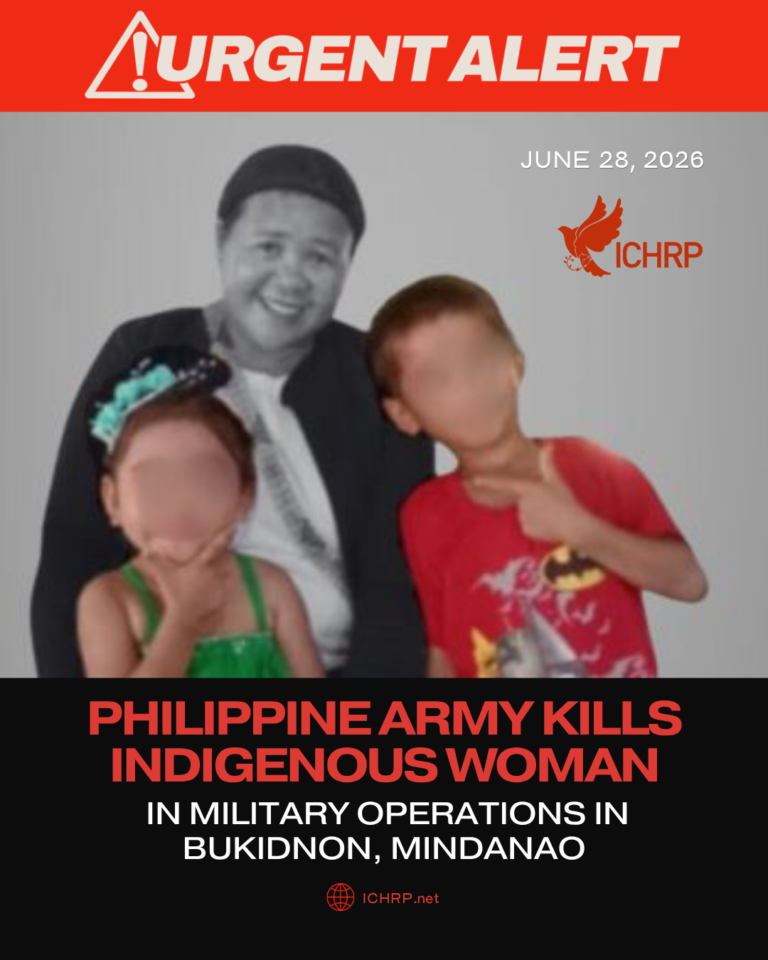
AFP’s 88th IB kills indigenous woman in military operations in Bukidnon, Mindanao

Urgent Alert
June 28, 2026

The International Coalition for Human Rights in the Philippines (ICHRP) strongly condemns the wilful killing of indigenous woman Nenita Buscada in Bukidnon, Mindanao by the hands of the AFP’s 88th Infantry Battalion (IB) last June 15.

Buscada went to gather wood with her husband and two other civilians so they could buy school supplies for their children. Soldiers from the 88th IB, who were conducting military operations in the area, mistook her for a New People’s Army (NPA) fighter and fired shots. She was declared dead on arrival in the hospital, while her husband suffered wounds.

The incident is a blatant violation of the principle of distinction between combatants and civilians in international humanitarian law (IHL) as well as in the Comprehensive Agreement on Respect for Human Rights and International Humanitarian Law (CAHRIHL), which apply to the ongoing armed conflict between the Philippine government and the National Democratic Front of the Philippines (NDFP). Commander of the 88th IB Lt. Col. Arnold Bautista offered hollow apologies after Buscada’s killing. 

ICHRP demands that the 88th IB be held accountable for their war crimes. We also condemn the worsening militarization in Mindanao and in other parts of the Philippine countryside, particularly in peasant and indigenous communities—areas which face the worst fascist attacks under brutal counterinsurgency operations by the Philippine state.

Justice for Nenita Buscada!

Call for Donations to Support Earthquake Victims in the Philippines!

Submit a donation using the form on this page to support relief efforts for victims of the earthquake that hit Mindanao.

Last June 8, a magnitude 7.8 earthquake struck the southern coast of Mindanao in the Philippines. The disaster has damaged or destroyed nearly 60,000 homes, facilities, and buildings across Mindanao. Among the worst hit areas are General Santos City, and the provinces of Sarangani, South Cotabato, and Davao Occidental.

As of June 15, a total of 176,186 families or 736,386 individuals are affected. The death toll currently stands at 65, while 1,447 are injured and 36 remain missing. The Department of Education reports that over 3.2 million students and 6,224 public schools across several regions have been affected by class suspensions due to structural damage on school buildings.

The widespread destruction to infrastructure and businesses, particularly in the agriculture and fisheries sectors, are expected to cause long-term economic impacts. The livelihood and welfare of thousands of Filipino workers are severely threatened.

ICHRP knocks on the kind hearts of everyone in the international community to extend solidarity and support to the affected communities during this difficult time.

Philippines celebrates sham “independence” despite increasing dependence and integration into US imperial ambitions

Statement
June 12, 2026

The International Coalition for Human Rights in the Philippines (ICHRP) honors the revolutionary spirit and sacrifice of the Katipuneros of 1896, but condemns the ongoing selling out of Philippine sovereignty since the so-called “independence” of the country in 1946. Until now, the Philippines remains utterly subject to US economic and military interests.

Since the Philippines was declared an independent republic in 1946, various unequal agreements have solidified its semicolonial relationship with the US. Treaty, basing, and access arrangements such as the 1951 Mutual Defense Treaty oblige “mutual defense”. The 1999 Visiting Forces Agreement and the 2014 Enhanced Defense Cooperation Agreement (EDCA) give US forces rotational access, prepositioning rights and construction and use of agreed sites on Philippine bases. The latter two agreements restore a significant US operational footprint without permanent bases, after the closing of US bases in the Philippines in 1992.

U.S. security assistance and funding for EDCA site improvements (for coast guard/navy capability) create local economic inputs while tying Philippine defense modernization to U.S. suppliers and contractors. Expanded EDCA sites (including new northern Luzon and Palawan locations), larger Balikatan and other joint exercises, and prepositioned equipment increase U.S. ability to project force, conduct surveillance, and respond in the South China Sea–Taiwan theater.

Deeper and further integration is implicit in recent developments with the US-led Luzon Economic Corridor and Pax Silica initiatives. These initiatives will displace farmers and indigenous people while further establishing the Philippines as the largest aircraft carrier of the US military. Pax Silica is set to establish a special economic zone in New Clark City, carved out of the former US Military base, as well as the ancestral lands of the Aeta indigenous people and Filipino farmers.

The US is already a major trade partner and investor in the Philippines that receives preferential market access. The ongoing business ties create economic dependence that shapes Philippine policy choices.

Pax Silica is packaged as technological progress and economic security, yet it advances a deeper form of foreign domination—placing vast tracts of Philippine land through the Luzon Economic Corridor, critical mineral industries, and national policy at the service of U.S. geopolitical and military interests.

Pax Silica reorganizes the Philippine economy around the demands of U.S. semiconductor, artificial intelligence, and strategic mineral supply chains while intensifying neocolonial subordination, land dispossession, ecological destruction, and militarization. This is the pattern of US-imposed neoliberal economic policy on the Philippines, which has declining agricultural and industrial output, but ever increasing export of contract workers and profound widespread poverty and landlessness.

Israel, known as one of the most egregious violators of human rights in the world, is also seeking to capitalize on Pax Silica, accessing critical minerals in the Philippines used for weapons and developing an AI hub, a technology that has been broadly used in its war crimes against the Palestinian people.

This is all happening while US forces in the Philippines are rapidly preparing for war against China, marked by the largest Balikatan exercises ever and recently the Salaknib exercises—joint training and operations between Australian, NZ, US, Japanese, and Philippines forces. While Balikatan has largely dealt with war preparations against China, Salaknib exercises focus on counterinsurgency operations and jungle warfare, highlighting foreign participation in the ever-intensifying COIN operations that continue to result in massive war crimes, such as the April 19 Toboso Massacre in Negros.

Overall, the Pax Silica strengthens the US First Island Chain Strategy against China but also ties Philippine security choices to US strategic priorities and draws the Philippines further into great power confrontations. Economically, the Pax Silica Declaration accelerates integration of Philippine industry, regulation, infrastructure, and security arrangements into a U.S.-centered tech and supplychain ecosystem/ This creates material economic dependencies, aligning technical and legal standards with U.S. policy, and increasing U.S. military and security involvement to protect those strategic assets.

ICHRP supports the call of the Filipino People for genuine Independence and a decoupling from the reckless militarism of a decaying US empire.

ICHRP supports the Filipino people in their call to Shut Down Pax Silica and remove US and foreign troops from the Philippines as major affronts to Philippine sovereignty.

Registration now open for the Kapit Bisig global conference and ICHRP 5th General Assembly!

Find more information and register at ichrp.net/KapitBisig!

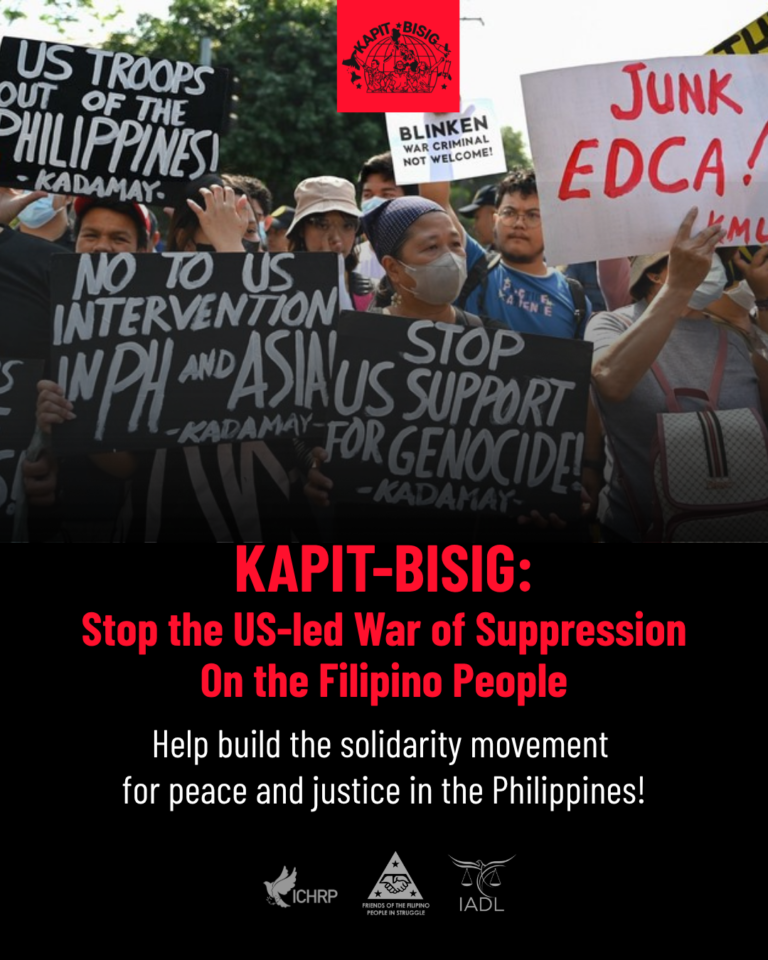
The International Coalition for Human Rights in the Philippines (ICHRP), in partnership with the Friends of the Filipino People in Struggle (FFPS), will be holding a conference titled Kapit Bisig: Linking Arms Across the World Against the US War of Suppression on the Filipino People on September 25 to 26. Afterwards on September 27, ICHRP will hold its 5th General Assembly. The events will feature guest speakers and workshops on the struggle for human rights in the Philippines, cultural performances, and strategic planning for the future of ICHRP.

In the context of instability, intensifying inter-imperialist conflict, and the escalating attacks on political, social, and economic rights of the Filipino people, the imperative for solidarity and resistance grows. The path toward peace, human rights, and justice, long established by the Filipino people, continues to garner the support of the international community. The conference and 5th General Assembly is an opportunity to seize the moment to collectively educate ourselves on the changing global context and forge stronger unity against the worsening US war of suppression on the Filipino people.

Find more information and register at ichrp.net/KapitBisig!

ICHRP welcomes rejection of Marcos bid for UN Security Council seat

Gross human rights violations under Marcos Jr should not be rewarded

Press Statement
June 3, 2026

The International Coalition for Human Rights in the Philippines (ICHRP) today welcomes the rejection by the United Nations General Assembly of the Marcos Jr administration bid for one of the non-permanent seats on the council.

ICHRP recognizes the role of people’s organizations which advocated and launched rallies against the Marcos bid for a seat. Marcos Jr is indeed the opposite of a peacemaker and instead a “pathfinder to disaster for his country and the region.”

The Philippines lost the bid to Kyrgyzstan, which won 142 votes in the fourth round of voting compared to the Philippines’ 49. The Philippines formerly held a Security Council seat in 1980-81, under Marcos Sr. during the notorious Martial Law period; and in 2004-05, during the bloodthirsty administration of Gloria Macapagal Arroyo. 

“When the Philippine bid was launched in December 2023, the Philippine Ambassador to the UN claimed that his government was a ‘partner, pathfinder and peacemaker’, but the UN General Assembly should know now that President Marcos Jr’s government is at war with its civilians, at war with the Duterte family, and drowning in corruption scandals,” said Peter Murphy, ICHRP Chairperson.

“The loss of this bid shows the failure of Marcos Jr to sanitize his family’s bad reputation as well as that of his own administration. This poor reputation follows the notoriety of his predecessor, Rodrigo Duterte, now committed to trial for the crime against humanity of murder at the International Criminal Court (ICC),” said Murphy.

“ICHRP is particularly angered by the massacre of 19 Filipino people by the Armed Forces of the Philippines at Toboso, Negros Occidental, on April 19 this year. Nine of those killed were civilians,” said Murphy.

“Evidence from independent missions and autopsies reveals disturbing instances of body mishandling and violations of the laws of war, where victims were left to bleed to death. We commend the international community for refusing to reward gross violations of International Humanitarian Law like this.”

According to data from the human rights alliance Karapatan, from the beginning of the Marcos Jr presidency up to the end of December 2025, there were 135 cases of extrajudicial killing, 16 cases of enforced disappearances, 826 cases of arbitrary arrest, and a total of 699 political prisoners, of whom 125 were arrested under Marcos Jr. The Philippines is one of the most repressive regimes in the Southeast Asia region.

ICHRP also emphasized that a government like that of Marcos which covers up civilian deaths and suppresses dissent should not be rewarded with a seat on the UN Security Council. Such a position risks emboldening the Marcos administration to intensify its war of suppression against the poor and Filipinos who advocate for their rights.

Besides this terrible domestic record of the Marcos Jr administration, its international initiatives include ever larger and almost permanent military exercises in the Philippines with US, Australian and Japanese troops, to prepare for a US war against China. 

“Marcos Jr is the opposite of a peacemaker, and he is a pathfinder to disaster for his country and the region,” said Murphy.

The UN General Assembly elects five non-permanent members to the 15-member UN Security Council each year for two-year terms. Alongside the council’s five permanent members, currently China, France, Russia, the United Kingdom, and the United States, the elected seats are distributed by region to ensure geographical balance.

Under UN rules, member states seeking election are also assessed based on their contributions to international peace and security, as well as their support for the broader purposes and principles of the United Nations.

“The Marcos government would not be an independent actor at the UN Security Council. Its growing dependence on US military, economic, and diplomatic support means that a Philippine seat would, in practice, function as a de facto extension of Washington’s influence, giving the United States not just one vote, but an echo vote inside the Council to justify its war crimes,” Murphy argues.

“The Philippines today is a rogue state in the international community and should never be treated as if it is upholding its international obligations and its own constitutional commitments to the rule of law. ICHRP calls for the international community to be critical of both Marcos and US maneuvers in the UNSC, given Trump-Marcos atrocities and complicity in wars of aggression and in the Philippine human rights crisis,” concluded Murphy.