
Home Blog Page 60

International observers to monitor human rights violations in 2022 Philippine election campaign

Watch the recorded Asia-Pacific and North-America / Europe launch events here

February 7, 2022

Concerns of possible violence and voter and candidate intimidation in the run-up to the May 9th vote in the Philippines: “…it is the government itself that is the problem, for six years it has cultivated a climate of fear and violence and that is now the backdrop for the upcoming election. Peter Murphy, ICHRP

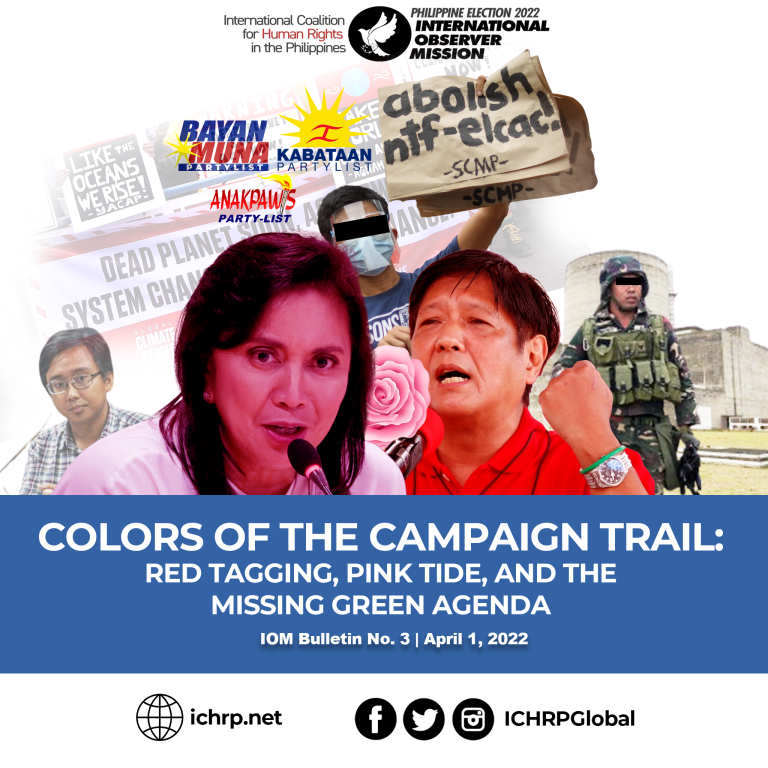
Today the International Coalition for Human Rights in the Philippines (ICHRP) launched the Philippine Election 2022 – International Observer Mission (IOM), which will provide independent monitoring of the Philippine Elections from the start of the campaign period in February to the May 9 vote, and the subsequent vote counting and the confirmation of elected candidates in June 2022.  The reasons ICHRP initiated the International Observer Mission are two-fold:

  • Historically, Philippine elections have been characterized by inter-elite rivalry, warlordism, assassination, vote-buying corruption, intimidation and other forms of violence (Guns, Goons and Gold).  
  • The current elections are occurring under a government whose members are under investigation by the International Criminal Court (ICC), that was documented by INVESTIGATE PH (2021) to be not only perpetrating human rights violations but to be actively suppressing dissent and the opposition.

These concerns compel the international community to cast an inquiring eye on the Philippine elections to monitor the campaign, the vote and the outcome. 

ICHRP has initiated the IOM in partnership with Kontra Daya, a Philippine based election watchdog.  ICHRP is a global network of organizations, concerned for human rights in the Philippines and committed to campaigning for just and lasting peace in the country.  Previous elections have witnessed high levels of violence against candidates, voters and even journalists. On the 23rd of November 2009, 32 journalists along with 26 other civilians were killed in an election-related massacre in Maguindanao, Mindanao, perpetrated by an incumbent candidate of the ruling party. It was the deadliest  incident in the history of the mass media, but it is not an isolated incident.  In the most recent elections in May 2019, at least 33 people were killed and 19 others wounded in several poll-related incidents leading up to voting day.  The victims included 18 incumbents, four candidates, three former elected officials including a member of Congress and eight civilians including a broadcaster.  

According to IOM Commissioner Rev. Michael Yoshii, “the election context itself is deeply troubling. As noted last year in the reports of INVESTIGATE PH findings, “state policies including the Anti-Terrorism Act have emboldened the police and military to attack activists, peasant leaders, and Indigenous Peoples. This suggests that those charged with protecting the polls are potential perpetrators of election violence”. 

The INVESTIGATE PH report provides testimony about how the Philippine National Police (PNP) and The Armed Forces of the Philippines (AFP) have been activated to conduct a war on dissenters morphing from killings in ‘anti-drug operations’ to killings of oppositionists and political opponents of the government.  These reports highlight the heightened danger of the electoral process under the Duterte presidency. 

IOM Commissioner Ms Sharan Burrow of the International Trade Union Confederation said, “It is expected that the government will favour candidates who will assist Duterte in escaping culpability for the alleged crimes against humanity his government has committed in its six-year reign of terror”.

There appears to be no shortage of candidates willing to shield Duterte from prosecution.  The leading Presidential candidate Ferdinand (Bongbong) Marcos Jr, son of deposed dictator Ferdinand Marcos, has indicated “that should he be elected as president, he will not assist the investigation of the ICC in the Philippines”.  The leading candidate for vice-president is Sara Duterte, the daughter of the current President, who is also certain to try to shield her father from prosecution.

The Philippine Election 2022 International Observer Mission will have teams on the ground in all 12 regions throughout the campaign and post-campaign, gathering evidence, taking testimony from participants in the process and issue reports throughout the election period. The final report of the Election International Observer Mission will be submitted to the Office of the High Commissioner for Human Rights, member states of the Human Rights Council, the UN Human Rights Commission and the International Criminal Court.

Media inquires can be sent to:

Peter Murphy, Chairperson, ICHRP Global Council +61 418 312 301 chairperson@ichrp.net
Condemn indiscriminate bombing and strafing in Cagayan Valley, Philippines

0

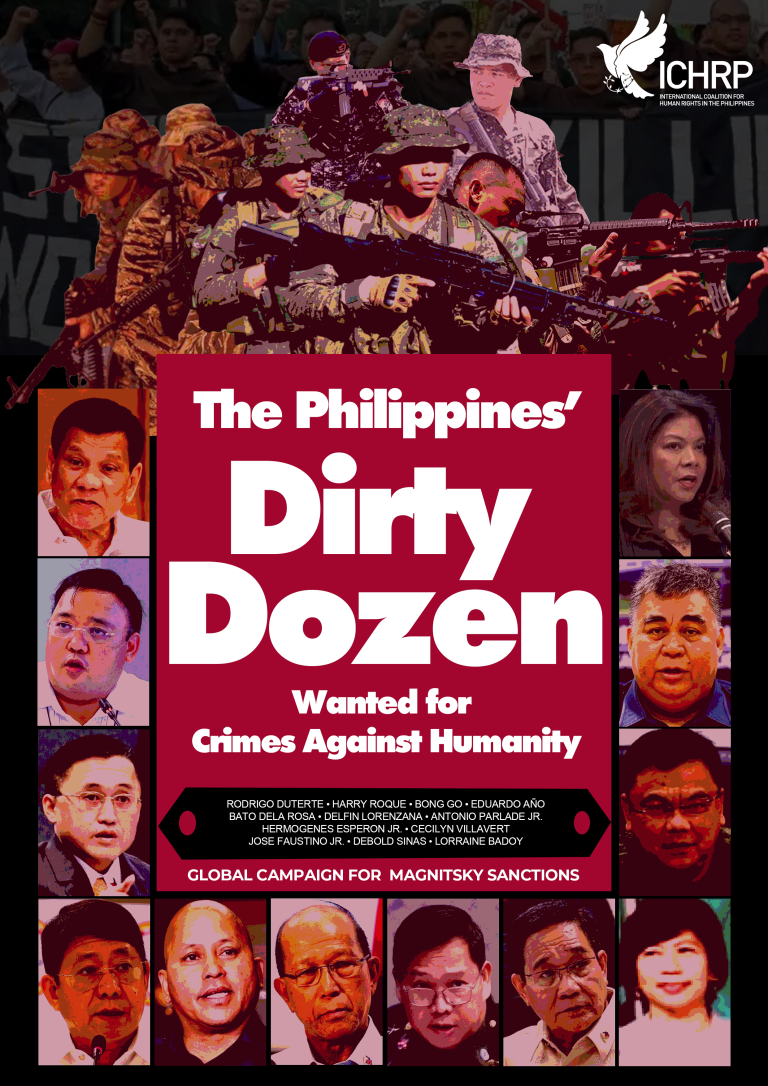
“We condemn the horrible aerial bombardment of four barangays in Gonzaga, Cagayan province in January 29, 2022, by the Armed Forces of the Philippines, as a violation of international humanitarian law. We call for an immediate thorough independent investigation and the immediate access of humanitarian relief to the area,” said Peter Murphy, Chairperson of the International Coalition for Human Rights in the Philippines.

According to an eye witness, two FA fighter jets dropped not less than 30 bombs in four waves, at 4:30am, 5am, 9:40 am and 12 noon in the Municipality of Gonzaga that has a population of 41,680 people in 25 barangays. Along with this, there were three helicopters that carried out indiscriminate aerial straffing with 50 calibre machine guns. Four barangays were struck heavily – Sitio Bagsang, Brgy Clara, Brgy Sta. Isabel, Brgy Sta Teresita and Brgy Magrafil. Gonzaga is one of the towns in Cagayan Province, in the Cagayan Valley Region, north-east of Luzon.

“The 5th Infantry Division had already claimed to have wiped out the New People’s Army in the area and there have been no reports of NPA operations in the area in the most recent months. This is a case of indiscriminate military attack on a civilian population,” said Peter Murphy. “The population of farmers and indigenous people have been subjected to ‘red tagging’ and forced/fake surrender of alleged NPA fighters, which are notorious forms of political repression in the Philippines.”
Gonzaga is part of the Cagayan Economic Zone Authority (CEZA) and is being developed as part of an ecotourism belt. This includes road widening, building hotels and expansion of the airport.

For comment: Peter Murphy, Chairperson, ICHRP Global Council +61 418 312 301 chairperson@ichrp.net
#EyesOnPHElection: Launch of Philippine Election 2022 International Observer Mission

WHEN: February 7, 2022, at the following times:

  • Asia-Pacific launch: 9am Manila | 12pm Sydney | 2pm Auckland | 3pm Honolulu (Feb 6) | 5pm Los Angeles (Feb 6)
  • North America / Europe launch: 8am Los Angeles | 11am New York | 4pm London | 5pm Geneva

WHERE: Online via Zoom:

You are invited to join the official launch of ICHRP’s Philippine Election International Observer Mission, which will take place online in two media events on February 7, 2022.

The International Observer Mission (IOM) will provide independent monitoring of the Philippine Elections from February up to the May 9 vote counting and the confirmation of elected candidates in June. The need for such a monitoring campaign is clear in the context of the worsening human rights situation under the Duterte government, and given the widespread corruption and violence present in past Philippine elections.

The launch speakers will be announced in the coming week.

For more information or to schedule media interviews, please contact ICHRP Chairperson Peter Murphy at +61 418 312 301, chairperson@ichrp.net.

International human rights network cautions against intensified election-related violence after killings of partylist members in Sorsogon

0

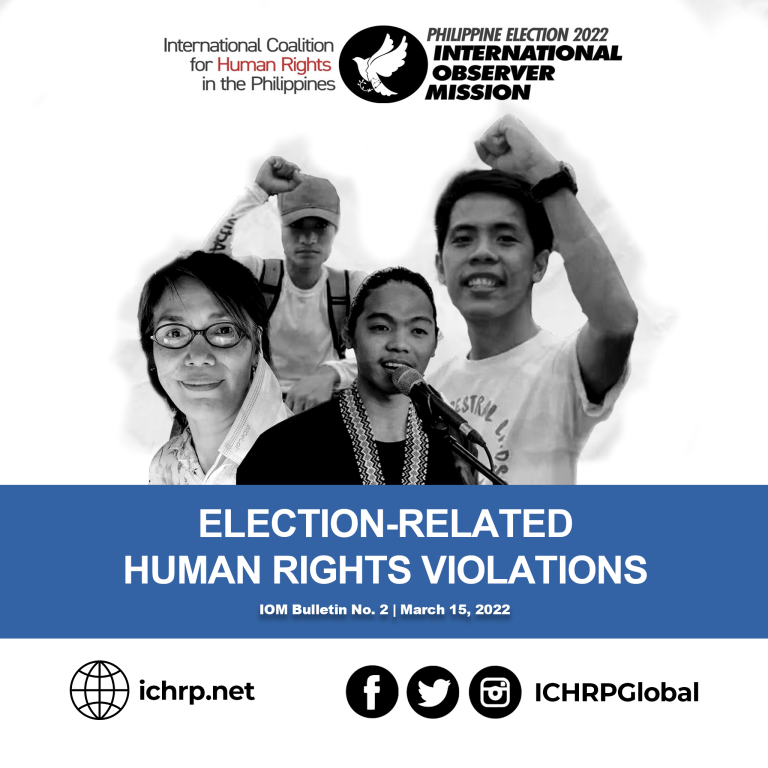
The International Coalition for Human Rights in the Philippines, a global network of various organizations investigating the human rights situation in the Philippines, vigorously condemned the killing of an elderly couple in Sorsogon who were known political activists connected to the partylist group, Anakpawis.

Rosemarie Galias, 68, and Silvestre Fortades Jr, 70, were killed by four motorcycle riding gunmen in Barcelona, Sorsogon on January 15, 2022. Both were members of Anakpawis, the progressive partylist which represents the interests of peasants and workers in Congress, as part of the Makabayan Bloc.

“The murder of the elderly political activist couple, is the beginning of state murders in the presidential election campaign period, and must be vigorously condemned,” said ICHRP Chairperson Peter Murphy. “Our heart goes out to the families and comrades of these two martyrs of the people’s cause,” he added.

The students, peasants, workers and human rights organisations in Sorsogon and the whole Bicol Region have suffered terrible repression during the Duterte period. Up to August last year, there were 60 political killings in Bicol out of a total of 421 nationwide. There are also 43 political prisoners from the region, 10 of whome are women, and 29 have been arrested during the Duterte presidency.

The Sorsogon killings come in the heels of the illegal arrest and detention of five residents in the fishing community of Patungan Cove in Cavite after a violent demolition on January 13.

“ICHRP is gravely concerned that the repression under Duterte which we have investigated thoroughly last year will only intensify in this election campaign period because the President’s strategy to protect himself politically with the next President has already fallen apart,” said Murphy.

“ICHRP shares the grave concerns of Filipinos at the prospect of a Marcos presidency and is on high alert to expose violations of human rights, intimidation and cheating in the campaign now unfolding,” Murphy concluded.

For comment: Peter Murphy, Chairperson, ICHRP Global Council +61 418 312 301 chairperson@ichrp.net
From Aquino to Duterte: Remember all the martyrs in the struggle for genuine land reform from Mendiola to today

0

ICHRP Statement on the 35th Anniversary of the Mendiola Massacre

Today marks the 35th anniversary of a horrific crime perpetrated by Philippine state security forces against a peaceful farmers’ protest calling for land reform on Mendiola outside the Presidential Palace on January 22, 1987. The Mendiola Massacre clearly showed that the response of Corazon Aquino’s government to peasant demands for land reform was no different than that of her predecessor, the ousted dictator Ferdinand Marcos. In the intervening years, peasants have been continually denied the promise of land to the tiller. Every time they attempt to pursue their claims for land reform, they are attacked by state security forces and landlord goon squads.

Today, we remember the 13 martyrs who were struck down in the struggle for land reform at Mendiola: Danilo Arjona, Leopoldo Alonzo, Adelfa Aribe, Dionisio Bautista, Roberto Caylao, Vicente Campomanes, Ronilo Dumanico, Dante Evangelio, Angelito Gutierrez, Rodrigo Grampan, Bernabe Laquindanum, Sonny Boy Perez, and Roberto Yumul. These landless peasants stood for justice 35 years ago, peacefully protesting for the just claim of land to the tiller, but were instead given land six feet below the ground. They were struck down as military and police opened fire on crowds of protesters at Mendiola. 

The Aquino government came to power on the coat tails of the popular People Power uprising against the Marcos Regime. Mrs. Aquino rightfully critiqued the Marcos agrarian reforms as a “mockery” and not “genuine” during her campaign against the dictator. Eleven months into her presidency, however, Aquino had made no progress despite the constitutional power to mandate a genuine agrarian reform program. Aquino left it to the landlord-dominated Congress to decide on the issue and the lack of progress did not sit well with the farmers.  

Street protests led by the Kilusang Magbubukid sa Pilipinas (KMP) started on January 15, 1987, when the KMP camped outside the offices of the Ministry of Agrarian Reform in Quezon City. Among their demands were land to the tiller with no compensation and zero retention limits for landlords. The lack of progress on their demands for land reform eventually led to the march on Malacañang on January 22 involving about 12 to 15,000 protesters. They had marched to within about 50 meters of police and military lines, when the soldiers opened fire. 

Among the protesters, 13 people died on the streets, and 39 were severely injured as a result of gunshot wounds. There are accounts stating that  another 12 to 19 additional protesters eventually succumbed to their wounds. Twelve more sustained minor injuries. According to some accounts, as many as 62 were injured. There were no one deaths on the other side of the barricade among police and military forces. 

The massacre was a fascist attack on the people’s democratic rights, not even a year after the overthrow of the Marcos dictatorship. The casualties went beyond the immediate victims. The massacre sabotaged nascent peace negotiations between the National Democratic Front of the Philippines (NDFP) and the Aquino government. It was a sign that the increasingly powerful military established under the US-Marcos dictatorship would continue to be a looming shadow over the political process and would actively work to undo any threat to the semi-feudal semi-colonial system.

The Duterte regime has perpetuated violence against peasant land reform and peasant advocates. The entirety of his almost six-year repressive regime has seen widespread human rights violations perpetrated by security forces under Duterte’s “shoot-to-kill” and arbitrary arrest policies. This could be described as the Duterte Massacre. Philippine sources (Karapatan) have reported over 23,000 killed in the anti-poor War on Drugs, over 1,000 civilians killed in the War on the Moro People, and a sharp rise in political killings. As of August 2021, there have been 421 extrajudicial killings. Up to June 2021 there have been no less than 25 massacres documented by human rights organizations under the Duterte administration.

35 years after Mendiola the Philippines is a killing ground for alleged drug suspects, peasant activists, political dissidents, community organizers, indigenous peoples and human rights advocates. The Duterte Regime has institutionalized the killing of dissenters, placing human rights defenders and government critics and all those working to improve the lives of ordinary Filipinos in grave danger. As we mark a day of remembrance for the victims of Mendiola, ICHRP also denounces the ongoing human rights tragedy that has unfolded in the Philippines under the Duterte Regime.  

On this the anniversary of the Mendiola Massacre we renew the call for land to the tiller, for genuine land reform. We call for an end to the regressive semi-feudal system in the Philippines that has institutionalized human rights violations.  

Bring Justice for Mendiola Massacre Victims!

Land to the Landless!