
Home Blog Page 217

FROM DEFENDERS TO VICTIMS: The Plight of Human Rights Defenders in the Philippines Amidst Continuing Impunity[1]

0

(Paper presented by Atty. Edre U. Olalia, Secretary General of the National Union of Peoples’ Lawyers (NUPL) and Cristina E. Palabay, Spokesperson of Karapatan, at the Conference on Defending Human Rights Defenders  in London, 24 February 2012, organized by the Haldane Society of Socialist Lawyers, Amnesty International UK and the European Association of Lawyers for Human Rights and Democracy.)

“We leave unmolested those who set fire to the house, and prosecute those who sound the alarm”, It is an apt description to the attacks against human rights defenders in the Philippines.

The government of former President Arroyo has gone from denial to outright gun threat against the messengers exposing systematic extrajudicial killings, disappearances, torture and other horrible violations of human rights committed against activists, farmers, workers and members of people’s and mass organizations. This has been the case since we brought these issues out to the attention of the national and international community.

Being a human rights defender in a country fraught with a hideous human rights record means putting oneself in the line of fire.

Rights Lawyers are Not Insulated

Human rights lawyers were not spared from the repression. Our clients are the poor and oppressed, who resist exploitation and oppression and whose rights are trampled upon in a society controlled by the few elite and foreign interests.

Available data indicates that at least 27 lawyers were killed in the past decade. Eight of these were directly involved in human rights issues.

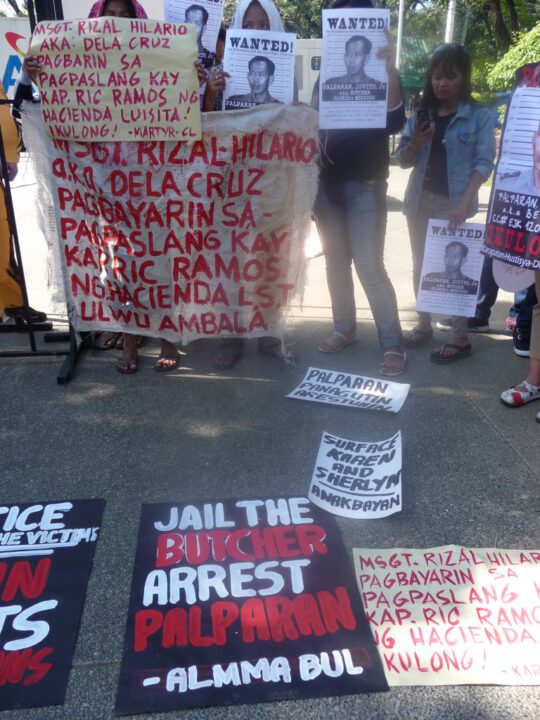
Among them was Juvy Magsino, counsel for progressive organizations who was vocal against military abuses and large-scale mining projects affecting the people. She was riddled with bullets while driving her car. Prior to her death, she had been openly threatened by the notorious General Jovito Palparan who is now in hiding after an arrest warrant has finally been issued against him for the disappearance of two university students.

Another is Felidito Dacut, counsel for progressive unions, urban poor and people’s organizations. He was shot by armed men while inside a public utility vehicle on his way to buy milk for his 3-year old daughter after he momentarily excused himself from a union meeting.

Still another is Gil Gojol, law professor and legal counsel of progressive party-list and peoples’ organizations.  He had just come from a court hearing when men shot at his vehicle.

And there is Concepcion Brizuela. the feisty yet motherly founding member of the NUPL. She was even interviewed by a foreign mission of judges and lawyers regarding the threat on her life before she was killed in the now infamous Maguindanao massacre, the cruel murders of an unprecedented number of journalists by political warlords closely affiliated with the former government.

During the same period, at least 42 lawyers who were involved in human rights issues  were subjected to different attacks. These lawyers and their families received death threats and were subjected to surveillance. Some were harassed, intimidated, labelled and placed in the military’s Order of Battle, their offices ransacked by armed men or their vehicles burned. A number have survived persistent assassination attempts like the Filipino premier people’s lawyer Romeo Capulong, who is even a UN judge ad litem.

Most of these incidents have not resulted in any real accountability for the perpetrators, much less were they effectively investigated, and have been reduced to “cold cases” after public attention has waned.

Under the present government of Benigno Aquino III, the vilification continues, particularly of human rights lawyers defending political prisoners. They are called “left-leaning,” or “communists”. Some are openly demonized in the media while others end up being the accused themselves.

Thus is the case of labor lawyer for progressive unions Remigio Saladero. He also represented alleged communist rebels. Together with leaders of mass organizations, he was slapped trumped-up charges for the non-bailable crime of multiple murder, another anomalous example of the practice of criminalization of alleged political acts.

He was imprisoned during the past government but the charges were dismissed.  The charges have been revived under the present government, and the issuance of totally groundless arrest warrants anytime remain a Damocles’ sword.

These incidents — consistent with the objectives of the counterinsurgency programs of the government – also victimized rights lawyers. Like their non-lawyer counterparts, they have been labeled as “enemies of the state”.

Rights Workers in the Direct Line of Fire

Karapatan’s members and volunteers have fallen prey to the continuing culture of impunity that has been bred for the longest time by official acts of commission or omission.

Even with a new government that promised  to pursue reforms in governance, the killings, disappearances and violations continue. Being a human rights defender still mean putting one’s life on the line. Under the previous government, Karapatan lost 34 human rights workers of its own in the course of their work.

Karapatan’s offices were raided, lobbed with explosives or burned to sow terror. Most of the offices were subjected to surveillance; with suspicious persons casing the offices and threatening their personnel with calls or text messages. Their personnel are stalked and harassed.

Karapatan has been subjected to vilification campaigns during the course of military operations. Labelled as communist fronts and tagged as ‘terrorist lovers,’ its members have been subjected to intimidation, illegal arrests and detention, torture, enforced disappearances and extrajudicial killings.

Karapatan volunteers have been slapped with fabricated charges, in order to instill fear and silence human rights defenders or prevent them from doing their work.  The practice of improvidently using generic designations (“John or Jane Does etc.”) in criminal charges and perfunctorily substituting later the real names of activist leaders wholesale without evidence aggravates the situation. This is on top of the application of subsisting repressive jurisprudence some dating back to the Marcos dictatorship that throws a monkey wrench to effective legal remedies.

Fabricated charges are packaged as common crimes to conveniently hide the political nature of their alleged acts, deny them bail, make the conviction for simulated evidence even easier, or even scoff at their noble work.

The cases of Karapatan leaders Benjaline Hernandez and Eden Marcellana were among the much-publicized cases of extrajudicial killings of human rights defenders under the past government. Hernandez was killed by military and paramilitary forces while leading a fact-finding mission on the problems of indigenous peoples.

Marcellana was killed by the roving band of General Palparan while conducting an investigation on reports of rights violations. She had been threatened and ridiculed by Palparan prior to her abduction and killing.

Frustrated at the flat tires of the wheels of justice in the local front, both cases were brought to the UN Human Rights Committee where the accountability of the Philippine government was established. The Philippine government has largely ignored and has not positively acted on the recommendations of the Committee. These cases, as with hundreds more, remain unresolved at the local front, with the local remedies proving to be ineffective. The perpetrators are left unpunished to go on with their unscrupulous ways and find new victims to terrorize.

The three are among the 1,206 victims of extrajudicial killings under the previous government, 153 of whom are women and 476 are human rights defenders. There were 206 victims of enforced disappearance, 31 of whom are women and 68 are human rights defenders.

The findings of Prof. Alston, then UN Special Rapporteur on summary, extrajudicial or arbitrary executions and his reports to the UN Human Rights Council directly attributed the extrajudicial killings and rights violations to the military and the Philippine government’s counterinsurgency program cynically called Operation Freedom Watch.

Present Government: Is it turning a Blind Eye or is it Complicit?

The new president came into power riding on the crest of promise for reforms. But since then, there has been no fundamental departure from the human rights policy, and neither is there any change in the basic socio-economic conditions that breed these human rights violations. While the numbers have not yet reached the horrendous frequency and levels during the previous government, the situation is still disturbing. There has been no let-up in the terror and violence especially against human rights defenders.

Italian priest Fausto Tentorio, or Father Pops as he was fondly called, was shot dead inside his church compound. As a missionary in the Philippines, Fr. Pops organized various groups which provided assistance to the indigenous peoples, specifically through the building of schools and providing scholarships to children, and his strong opposition to the intensifying mining activities in the region and militarization.

Fr. Pops is among the 37 human rights defenders who are victims of extrajudicial killings under the present Aquino government, with the total number of victims at 67 in the one and a half years of his presidency. There is approximately one killing per week. Three out of nine victims of enforced disappearances are human rights defenders. Most of them are farmers, indigenous peoples, workers and the urban poor who are defending their right to land, ancestral domain, livelihood, decent housing, jobs and other basic rights.

Since 1986, reports of media groups indicate that about 150 journalists have been killed, a significant number of which were directly related to their exposure of anomalies in governance at the community level.

Already, ten journalists have been killed under the present government, the most outrageous of which was the murder of radio commentator Gerry Ortega, an anti-mining advocate who was also critical of graft and corruption.

The infamous Maguindanao massacre of November 2009 resulted in the daylight carnage of about 32 media persons out of about 54 in their convoy. The case has been dragging and has been bogged down, as with most legal cases in the Philippines, by an inefficient and tedious legal procedure within a justice system that many view as slanted towards or taken advantage of by the political and economic elite.

There are hundreds more not so prominent human rights defenders that endured or labored, or still endure and labor. This has been made possible by an oppressive and exploitative economic system and milieu that is engendered by a political framework and legal system that unleashes repression, or at least turns a blind eye to it or presents almost insurmountable obstacles under already difficult and dangerous conditions.

There remains a marked passivity and even nonchalance on the part of the present government as a whole as it largely fails to measure up to its own rhetoric to run after human rights violators, let alone the most remorseless ones. It leaves the herculean tasks to the victims themselves or their relatives and human rights groups to search for justice. Worse, these perpetrators remain in the security forces, ever ready to pounce on new hapless victims.

Key Threats and Challenges

We can perhaps glean from this foregoing sketch some of the key threats and challenges to human rights defenders:

Threats to life and limb, including harassment and intimidation by state forces;
Violation of their civil and political rights and rights as human rights defenders;
3.   Baseless labelling, vilification and political persecution through the slapping of trumped-up charges;
4.   Ineffective or impractical local remedies as well as double standard and even bias of a political milieu, judicial framework and penal system that frustrate any serious effort at accountability and which contribute to and engender impunity; and
5. Counterinsurgency programs that cripple human, including the people’s right to be organized and freedom to peaceably assemble.

Responding to Defenders under Attack

It is important and helpful that a strategic, sustained and effective response be developed lest more human rights defenders be human rights victims themselves. We venture to suggest some:

1. The campaign and advocacy against impunity should be strengthened and expanded even more on the national and international fronts. Publicity must also be maximized in intergovernmental bodies, fora and international media. This shall not only raise public awareness but also help shape the policies and responses of government;

2. Sustained and dedicated organizing among human rights defenders is imperative in strengthening the campaign. Linkages and networking with international human rights organizations, lawyers groups, parliamentarians and policy-makers should be likewise established, developed and sustained at the national, bilateral and multilateral levels;

3. A centralized monitoring centre to receive and monitor cases of attacks against human rights defenders would be useful. These centers should be accompanied by Quick Response Teams which should be able to give an immediate and timely response;

4. Legal assistance should be provided for human rights defenders or their families in defending them against fabricated or unwarranted charges AND prosecuting cases against those responsible for violating their rights. There must also be systematized monitoring of such cases and timely material, moral and political support. Genuine and lasting reforms must be pushed to strengthen and develop effective local remedies; and

5. A sanctuary or practical support mechanism should be prepared or provided human rights defenders under serious attack and their families and those who are key witnesses in cases involving issues on human rights.

To Defend the Defenders is to defend the Victims

Much has to be done. Clearly, with the Philippine government barely lifting a finger to end the climate of impunity, ending the spate of killings, disappearances and other rights violations rests on the perseverance and struggle of the people’s movement, of which people’s lawyers and human rights workers are part of, and the solidarity of all peoples against tyranny.

The necessity of defending human rights defenders is made imperative by the fact that it actually and basically means defending the victims themselves and upholding human rights. We must all get together and continue our solidarity. We shall overcome because we stand by and are on the side not only of the victims but the defenders who fight against the onslaughts on human rights in the battlefield towards social justice.

Human rights defenders may continue to face the perils in their line of work but it will never be enough to water down their passion in working for the causes that they believe in. It is most especially when human rights defenders become victims of human rights violations themselves that we must close ranks and consolidate in order to stand our ground amidst the vicious attacks by those who deny us of our humanity. Their idea is to sow terror and make us cow in fear. This we shall absolutely never allow. #


National Secretariat
National Union of Peoples’ Lawyers(NUPL)
3F Erythrina Bldg., Maaralin corner Matatag Sts. Central District,Quezon City, Philippines
Tel.No.920-6660,Telefax No. 927- 2812
Email addresses:nupl2007@gmail.com and nuplphilippines@yahoo.com
“Visit the NUPL  at http://www.nupl.net/

By calling yourselves the ‘people’s lawyer,’ you have made a remarkable choice. You decided not to remain in the sidelines. Where human rights are assaulted, you have chosen to sacrifice the comfort of the fence for the dangers of the battlefield. But only those who choose to fight on the battlefield live beyond irrelevance.”  Supreme Court Chief Justice Reynato S. Puno, in his message to the NUPL Founding Congress,Sept. 15, 2007

Filipino Rights Workers say to London and Oxford Conference: Impunity continues in PH, victimizes rights defenders while violators are scot-free

0

News Release – International Notice for Fugitive Gen. Palparan – Filipino Rights Workers say to London and Oxford Conference: Impunity continues in PH, Victimizes rights defenders while Violators are Scot-free

“We leave unmolested those who set fire to the house, and prosecute those who sound the alarm.” This was the statement recently at the Defending Human Rights Defender’s Conference of Atty. Edre Olalia, Secretary General of the NUPL, quoting playwright Sebastien Roch Nicholas Chamfort. The statement is an apt description to the continuing attacks against human rights defenders in the Philippines today.

The conference organized by the London-based Haldane Society of Socialist Lawyers, Amnesty International (UK) and the 19-country member European Lawyers for Democracy and Human Rights (ELDHR) was held at the Amnesty International UK Human Rights Action Centre in London.

Atty. Olalia is an invited delegate to the conference together with Cristina Palabay, Spokesperson of the human rights watchdog Karapatan. They also spoke before a large public service union in UK and at the Oxford Philippine Society before Filipino “Oxonians” or students studying at the prestigious university.

“Human rights defenders work to protect and promote human rights and fundamental freedoms. Unfortunately, being a human rights defender in a country such as the Philippines fraught with a hideous human rights record means putting oneself in the line of fire, as rights violations which one seeks to oppose are heaped on the defender,” the paper read.

Under the administration of former President Gloria Arroyo, the human rights-group Karapatan reported to have 34 human rights workers extrajudicially killed and 68 involuntarily disappeared. On the other hand, eight human rights lawyers have been killed.

“Even with the privileged status they enjoy in Philippine society and with their mandate as officers of the courts of law, legal practitioners are not insulated from the rights violations that continue even with a new administration riding on the crest of promise for reforms,” Atty. Olalia added.

In the one and a half years of the present Aquino administration, there has been no let-up in the terror and violence especially against human rights defenders. With the government barely lifting a finger to end the climate of impunity, Karapatan has documented 67 victims of extrajudicial killings, 37 of whom are human rights defenders. Also, there are nine cases of enforced disappearances since July 2010.

“Defending human rights defenders is imperative as it ultimately meant defending the victims themselves and upholding human rights,” Atty. Olalia said.

Atty. Olalia said that ending the spate of killings, disappearances and other rights violations rests on the perseverance and struggle of the people’s movement, of which people’s lawyers and human rights workers are part of, and the solidarity of all peoples against tyranny.

“Human rights defenders may continue to face the perils in their line of work but it will never be enough to water down their passion in working for the causes that they believe in. Their idea is to sow terror and make us cow in fear. This we shall never allow,” Atty. Olalia quoted from the paper.

Meanwhile, Atty. Olalia informed the delegates from several European rights organizations, unions and prominent lawyers like Michael Mansfield and Gareth Pierce and lawyers’ groups, British media as well as key Members of Parliament of the House of Lords about the fugitive Gen. Jovito Palparan. He asked for support to call on the government to step up its efforts to arrest him and to be on the look-out for him should they find him somehow somewhere. Not a few delegates likened the case of Palparan to the case of Chilean dictator Augusto Pinochet who had evaded arrest and punishment for the longest time.

Olalia is presently in Dublin, Ireland and would travel to Geneva for the UN Human Rights Council session and then to Brussels for the Bureau meeting of the UN-accredited 90-country member International Association of Democratic Lawyers (IADL) where he is expected to bring up these issues.#

Reference: Atty. Edre U. Olalia, NUPL Secretary General, +639175113373

Aquino’s disturbing indifference

0

We at the Campaign for Human Rights in the Philippines in the United Kingdom are deeply concerned with the Philippine government’s seeming lack of interest on reported irregularities and rights abuses in the arrest and continued illegal detention of Filipino artist Ericson Acosta.

Acosta was arrested without warrant on Feb. 13, 2011 in San Jorge, Samar, in an upland militarized village where he was conducting research on the local human rights and environmental situation in the region. In his counter-affidavit, Acosta said he stayed in a military camp for three days where he was interrogated and tortured for 44 hours straight. He was charged with illegal possession of explosives to justify his illegal arrest. He is currently detained at the Calbayog sub-provincial jail, where troopers from the 8th Infantry Division of the Philippine Army has camped out within jail premises, thus keeping up the harassment and intimidation that Acosta, his family and visitors have been subjected to.

Acosta has complained about this and appealed his case directly to visiting local officers of the  Commission on Human Rights (PCHR) in the Eastern Visayas. These PCHR officials saw with their own eyes the highly irregular military deployment inside a civilian detention facility. However, the PCHR has not made any report public, and it has neither publicly condemned these rights abuses.

A petition for review which cites serious irregularities and rights abuses was filed by Acosta’s counsel, the National Union of Peoples’ Lawyers (NUPL), before the Department of Justice in September 2011. Acosta’s complainants have failed to file any comment on this petition. Without such opposition, the review petition should have been resolved within 60 days. However, the DOJ has issued no resolution on the petition. The NUPL recently filed a motion for the immediate resolution of the petition.

No less than President Aquino’s spokesperson, Edwin Lacierda, has told local reporters that “there are no political prisoners” in the Philippines. When asked about government’s response to the plight of Acosta and some 350 other persons who are now in jail for their political beliefs, Lacierda could only reply with empty rhetoric. Government indifference to the plight of the detainees has caused very real suffering to them and their families.

We urge concerned Philippine authorities, especially DOJ officials, to act without delay on Acosta’s petition for review and to immediately release him. His rights continue to be violated each day he is kept in jail. The reported rights abuses and irregularities must be thoroughly investigated and acted upon.

Indeed, it is very disturbing to see that a government led by the son of a revered political prisoner and democracy icon has turned a blind eye to the plight of Ericson Acosta and political detainees in the Philippines.

—REV. CANON BARRY NAYLOR,honorary president, Campaign for Human Rights in the Philippines (CHRP-UK); urban canon and parish priest of the Abbey and Holy Spirit Ministries, Leicester (published in the Philippine Daily Inquirer
February 20th, 2012)

Suspicions about military’s involvement in Italian priest’s murder persist

0

DAVAO CITY—The verbal tussle between the military and groups seeking justice for slain Italian priest Father Fausto Tentorio has continued, four months after the priest was murdered and even after the arrest of Jimmy Ato, whose confession had somewhat cleared the military of responsibility for the murder.

In his affidavit submitted before the National Bureau of Investigation (NBI) when he was arrested a few months ago, Ato said Tentorio was ordered killed by some landowners in Arakan, North Cotabato, who were hurting from the priest’s opposition to a hydropower plant project. The landowners were to gain from the project through compensation of their properties.

Italian priest Fr. Peter Geremia, a colleague of Tentorio at the Pontifical Institute for Foreign Missions, said, however, that suspicions about the military’s involvement in the death of the priest in October have deepened when it was found out that military assets were posted inside the Arakan parish compound at the time of the killing.

He said the deployment of the military assets has to be explained.

Geremia said while the gunman was shooting Tentorio, who was preparing to leave the convent for a religious meeting in Kidapawan City, also in North Cotabato, soldiers participating in a bayanihan (community) activity in a school across the Arakan parish compound ignored the fact that someone had just been murdered.

He said he had written Justice Secretary Leila de Lima to look into these facts and to ask the military why the soldiers did not rush to the scene of the crime.

“Let those soldiers explain why they failed to respond or to track down the killer,” he said.

Colonel Leopoldo Galon, spokesman of the military’s Eastern Mindanao Command based here, did not comment on the supposed deployment of military assets inside the Arakan parish compound on the day Tentorio was killed.

But Galon said the soldiers participating at the bayanihan activity were equally surprised as everyone else.

The soldiers, he said, did not respond because there was no military officer in the area to command them at the time of the killing. Besides, he said it was not the soldiers’ duty to respond to a crime incident.

Galon said he could not understand why the military was being blamed for the murder of Tentorio when the arrested suspect had already identified the masterminds.

As this developed, Catholics under the Diocese of Kidapawan lighted candles and attended a Mass on the fourth month of Tentorio’s murder.
Fr. Pol Paracha, head of the Justice for Fr. Pop’s Movement in North Cotabato, said the candles would serve as reminder for their undying love and continued quest for justice for Tentorio’s death.

Paracha also hinted that they were not contented with Ato’s confession when he said that they were hoping the national government would conduct a deeper probe of the Tentorio murder case. (by Germelina Lacorte, Williamor Magbanua, Inquirer Mindanao, Sunday, February 19th, 2012)

A year after illegal arrest, groups clamor for detained poet’s release; NUPL files motion for immediate resolution of Ericson Acosta case before DOJ

0

A year after the illegal arrest of poet and former UP Collegian editor Ericson Acosta, his family, colleagues, human rights advocates and supporters “demand nothing less than his immediate and unconditional release.”

“Ericson’s sense of responsibility as Iskolar ng Bayan has led him to work in the grassroots and create art with the people.  (His) right to participate productively as a free citizen of this country is violated each day he remains in detention,” read a statement released by the Free Ericson Acosta Campaign (FEAC) in a press conference and music jam at the University of the Philippines Palma Hall lobby last Friday, February 10.

The event was organized by the All-UP Academic Employees Union and Acosta’s former colleagues at the university, and was attended by prominent Filipino cultural icons – US-based cultural critic and thinker Prof. Epifanio San Juan, Jr; women’s studies author Delia Aguilar; award-winning scriptwriter and authorRicky Lee; actress, screenwriter and UP Regent Bibeth Orteza; UP College of Mass Communications Dean and popular culture critic Roland Tolentino; and protest songwriter and poet Jess Santiago, among others.

“The illegal arrest and continued unjust detention of cultural worker Ericson Acosta is concrete proof of the existence of political prisoners. There is nothing righteous with having our artists like Acosta suffer in incarceration,” Samahan ng Ex-Detainees Laban sa Detensyon at Aresto (SELDA) Secretary-General Angie Ipong said in a news release.

Acosta was arrested without warrant by the military on February 13, 2011, in Brgy. Bay-ang, San Jorge, Samar just because the laptop he carried roused the suspicion of soldiers. Due to serious irregularities and rights abuses in the conduct of his arrest, his counsel led by Atty. Jun Oliva of the National Union of Peoples’ Lawyers (NUPL), filed a Petition for Review before the DOJ in September 2011, and moved to defer court proceedings pending resolution of the said petition. Ideally, a review petition should be resolved within 60 days.

“It is important for us to bear witness to the truth of the injustice done to Acosta,” Prof. E. San Juan, Jr. said.

Exactly a year after Acosta’s illegal arrest, the NUPL will today file a motion for the immediate resolution of the Review Petition. Aside from difficulties faced by his family after Acosta’s detention in Samar, they also protest continued military harassment and intimidation by troopers from the 8th ID deployed within the jail facility.

“Instead of settling for a stable, well-paying job, or going abroad like his brothers, our son Ericson chose to teach literacy and work for the oppressed in far-flung provinces. Something is terribly wrong when he is made to suffer a year in prison for doing what he thinks is right,” lamented Acosta’s father Isaias, who is now in his late ‘70s.

Acosta was named finalist of the 2011 Imprisoned Artist Prize at the Freedom to Create Awards Festival in Cape Town South Africa last November, along with imprisoned artists from Burma and Tibet. Various human rights groups and cultural institutions, including the Amnesty International, Campaign for Human Rights in the Philippines-United Kingdom, University Council of UP Diliman, National Commission for Culture and the Arts (NCCA) and the Philippine Center of the International PEN (Poets, Essayists, Novelists) support the call for his release.

“Even if it has become dangerous to integrate with the masses, the scholars of the nation know it has to be done,” Dean Roland Tolentino said in his speech at the UP.

Acosta’s songs and writings from prison is posted by the Free Ericson Acosta Campaign on his JAILHOUSE BLOG (http://www.acostaprisondiary.blogspot.com). Pictures can be downloaded from the Free Ericson Acosta Facebook page and campaign blog (http://www.freeacosta.blogspot.com).

February 13, 2012
FOR IMMEDIATE RELEASE
Reference: Atty Jun Oliva (NUPL)
(02) 9206660

———————————————————————
PUBLIC INFORMATION DESK
publicinfo@karapatan.org
———————————————————————
Alliance for the Advancement of People’s Rights
2nd Flr. Erythrina Bldg., #1 Maaralin corner Matatag Sts., Central District
Diliman, Quezon City, PHILIPPINES 1101
Telefax: (+63 2) 4354146
Web: http://www.karapatan.org

KARAPATAN is an alliance of human rights organizations and programs, human rights desks and committees of people’s organizations, and individual advocates committed to the defense and promotion of people’s rights and civil liberties.  It monitors and documents cases of human rights violations, assists and defends victims and conducts education, training and campaign.