Home Blog Page 192

Former government negotiator calls for resumption of GPH-NDFP peace talks

Political prisoner on hunger strike, protests violations of GPH-NDFP peace agreements

A former government negotiator in peace talks with the National Democratic Front of the Philippines (NDFP) is urging the Aquino government to honor the 10 previously signed agreements between the GPH and the rebel group in order for the talks to resume.

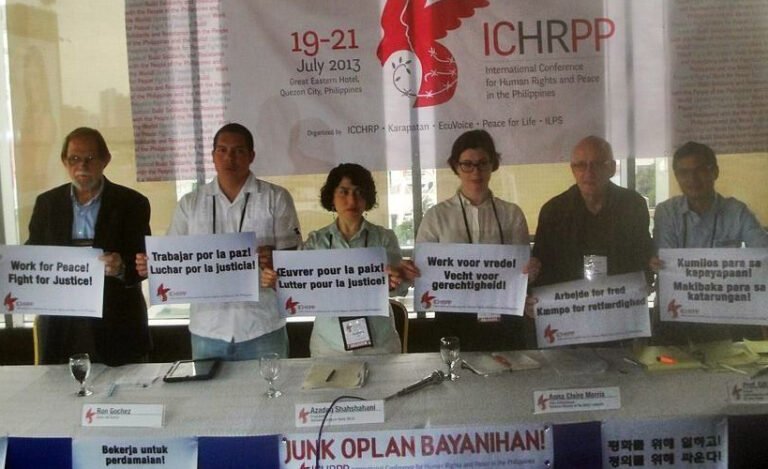
At the sidelines of the International Conference on Human Rights and Peace (ICHRPP) at the Great Eastern Hotel in Quezon City, Silvestre Bello III, who was negotiator for the GPH since the first Aquino administration to the Arroyo government, said both parties should “move the talks forward to its logical conclusion which is lasting peace for our people.”

He urged both the government and the rebel group to resume the stalled peace negotiations without any preconditions and to respect previously signed agreements including the 1992 Hague Joint Declaration and the Comprehensive Agreement on Human Rights and International Humanitarian Law (CAHRIHL).

Bello, now a partylist representative in Congress, was among the ICHRPP’s guest in its opening ceremonies yesterday.
“Even President Ramos followed agreements (made) during Cory Aquino’s period, Erap (President Estrada) followed the agreements and process despite disagreements, and even GMA (President Gloria Arroyo) because if we don’t do that, who would ever sign a contract or agreement with us?” Bello emphasized.

In his keynote address to the international conference, NDFP chief political consultant Jose Maria Sison said the NDFP has been ready to resume the talks but that as early as the first formal meeting of the negotiating panels in February 2011, the Aquino government attacked the 1992 Hague Joint Declaration, which sets the framework for the talks, as a “document of perpetual division.”

He added that the government misrepresented as a precondition the NDFP’s demand to release detained consultants in compliance with the Joint Agreement on Safety and Immunity Guarantees (JASIG).

Bello said he doesn’t think Aquino wants to junk all previous agreements and begin the peace process again from scratch. “The Aquino government is aware that it is not correct to junk the Hague Joint Declaration which serves as the framework for the peace talks. Any person who knows his business should know that in order to be credible, you have to honor your agreements,” he stressed.

Bello added that the Presidential Adviser on the peace process may have played a role in the government’s flawed position on the talks. He said President Aquino should consider getting the advice of other members of his cabinet and people who have a deeper background on peace negotiations.

Asked if he would be willing to become a member of the GPH peace panel again if requested, Bello replied: “Only if I don’t lose my congressional seat because I have a mandate. I could probably join as an adviser, not as panelist.”

Hunger strike for peace

Bello’s call for the resumption of the peace talks with the NDFP echoes similar calls of detained NDFP peace consultants Ramon Patriarca who is detained at Camp Lapu-Lapu in Cebu City and Pedro Codaste who is detained at the Malaybalay City Jail. Patriarca began a hunger strike last July 11 that will end on July 22 when President Aquino delivers his State of the Nation Address.

The detained NDFP peace consultants accused President Aquino of not respecting the Joint Agreement on Safety and Immunity Guarantees (JASIG), and has instead continued abducting, torturing and detaining NDFP personnel involved with the peace negotiations.

The search for a just and lasting peace is one of the important panel discussions in the International Conference on Human Rights and Peace that is being participated in by more than 250 human rights and peace advocates from the US, Canada, Asia-Pacific, Europe and the Middle East. Conference participants are expected to join the people’s mobilization on July 22 during the State of the Nation Address (SONA) of President Aquino at the House of Representatives.

Government death squads “a loud secret” — International peace activist

El Salvadoran peace activist Marta Benavides likened the killing of Italian priest Fausto Tentorio and the continuing impunity in the Philippines to the 1980 assassination of Archbishop Monsignor Oscar Romero in El Salvador.

“It is the same thing that happened to all the martyrs in Latin America, the same thing that happened in El Salvador with the murder of Monsignor Romero.  We call it a ‘loud secret.’  We all know, the whole population knows, what happened, who was behind it  … the death squads.  (We may not know exactly) who went to kill him, but who was behind it.  We think it’s the same thing here,” said Marta Benavides, an El Salvadoran theologist and internationally-acclaimed peace activist, who was a friend of Monsignor Romero.  She is one of the few surviving human rights activists that began their work in El Salvador in the 70s.

Benavides is one of the internationalists attending the International Conference on Human Rights and Peace  in the Philippines from July 19 to 21 in Quezon City.

Romero was a vocal critic of the US-supported military junta that took power in El Salvador in the late 70s and the human rights violations by right-wing paramilitary; he was shot dead on March 24, 1979 while he was giving mass in his chapel. Tentorio was killed on October 17, 2011, as he was leaving his convent in Arakan, North Cotabato.

Fr. Fausto Tentorio, PIME was a prominent anti-mining advocate and critic of the human rights violations in Mindanao, and had received death threats from suspected military-backed paramilitary before he was killed.  He was the first foreign missionary killed under the Aquino regime and since Fr. Tulio Favali, PIME who was killed in the mid-80s under the Marcos Dictatorship. In 2012, a second foreign missionary, Dutch environmentalist Willem Geertman was assassinated in his office in Angeles City, Pampanga.  He was the executive director of Alay Bayan Inc., and a staunch critic of development aggression in Aurora province.

Benavides said that political repression will continue because global crises are affecting the poorest nations, and people will always rise up in resistance. “That’s how these governments exist in the world right now.  They don’t exist for the people and with the people.   They have to maintain the system as it is so they can … maintain themselves in government… and the system finds the needs to repress them, to suppress and repress so that they can continue to oppress.”

Benavides, who was 37 when Romero was killed, recalled the climate of impunity in Latin America :  “It was very bad, it was very repressive at that time, and you could feel it in the air. Everybody have to be very careful. Most people that are doing anything that was good for the people, you have to be clandestine, or semi-clandestine. The death squads were after many people.  And this was also happening in Guatemala, and also in Honduras. But the thing is at that time, even though it was very dangerous, people were very brave.” [KARAPATAN, 20 June 2013]


Int’l community press for the resumption of GPH-NDFP peace talks

Hoping that international pressure would bring the GPH-NDFP talks back on track, peace advocates and rights defenders at the International Conference for Human Rights and Peace in the Philippines (ICHRPP) called on the Aquino government to resume peace talks with the National Democratic Front, citing poverty and the re-escalation of human rights abuses as the most compelling reasons to go back to the negotiating table
.
“The landlessness of peasants, the lack of decent wages and job opportunities, decent housing and basic social services are weighing down on the lives of the Filipino people and violate their socio-economic rights. Those who resist and work for change are met with political repression by the State. We want the peace negotiations resumed to help resolve such issues,” the delegates said in a press conference.

The ICHRPP added its  voice to the call by local peace advocates for the resumption of the stalled talks on the basis of previously signed agreements, specifically the 1992 Hague Joint  Declaration, the Comprehensive Agreement on Human Rights and International Humanitarian Law (CAHRIHL) and the Joint Agreement on Safety and Immunity Guarantees (JASIG).

“We lament the fact that the Aquino government has practically terminated the talks by ignoring or violating the 10 or so agreements previously signed by the GPH and NDFP. Aquino’s so-called ‘new approach’ of localized talks combined with counterinsurgency operations disregards and undermines all previous agreements, making the talks impossible,” said ICHRPP Spokesperson Teddy Casino.

“The ICHRPP plans to focus international attention on the talks and compel both sides to go back to the negotiating table. International pressure worked in the past on the issue of human rights. We hope it works this time for the sake of peace,” said Casino.

Earlier this month, eight peace groups – the Sulong CARHRIHL, Pilgrims for Peace, Philippine Ecumenical Peace Platform (PEPP),Waging Peace Philippines, Generation Peace Youth Network, Women Engaged in Action 1325, Initiatives for International Dialogue, and Philippine Peace Center – issued a joint statement demanding a resumption of the talks, saying, “Time is of the essence. End the prolonged impasse. Resume the talks, now.”

The ICHRPP is now on its second day. Conference delegates today are expected to tackle the issue on the struggle for a just and lasting peace. Speakers will share experiences on the search for peace in South Africa, the middle East and the Philippines.

The more than 250 peace and human rights advocates are also expected to join the people’s mobilization during the State of the Nation Address on Monday, July 22. ###

Peaceful development, reunification between the Strait, and US intervention

Presentation at the International Conference for Human Rights and Peace in the Philippines

Quezon City, Philippines
19 July 2013

PANEL 2. US geopolitical and military strategies in the Asia-Pacific and the Aquino government’s Oplan Bayanihan

By KAO, WEI-KAI
Member, Standing Committee of the Labor Party
Councilor of Hsinchu County, Taiwan, China

The Taiwan Strait standoff is a continuation of a Chinese civil war. Since the cold war, Taiwan has become part of a US West Pacific strategy, so it was “natural” for it to side with the US and confront with mainland China. The United States and its military have been playing a certain role in the Chinese civil war, starting from the end of World War II up until now.

The period between 1945 and 1949

In the anti-Japanese warfare, the KMT and the Chinese communists formed a united front to fight against the Japanese, but they also confronted each other and even fought vehemently with each other. They fought for the occupancy of territory, as well as the takeover of arms or land surrendered by Japanese military. They held peace talks; peace talks failed; and war erupted. The civil war at that time was characterized by a conflict between the power of peasants and workers against the power of landlords and tycoons. It was also in that time that the Chinese communists achieved an initial result in land reform, which eliminated the landlord-tenant system, and the KMT, waning gradually, deepened its dependence on imperialist support. The United Stated played the role of a mediator; militarily supported the KMT; and gave up the KMT at last as the KMT was too corrupt to be saved. (What is also worth noticing is that the Japanese military, based on its rich experiences of fighting with the Chinese communist army, also began to shift its support to the KMT at that time). The KMT began to retreat from mainland China to Taiwan (the Hainan Island and several small islets off the southeast coast of mainland China still belonged to mainland China.) Since the conclusion of the World War II, the US strategy of “enhancing Taiwan independence, fostering a weak and pro-US regime” has thus begun.

In the period between 1950 and 1953

The Chinese communist troops occupied the Hainan Island and the Zhoushan Islets – the second largest islands of China, only next to Taiwan. The Korean War ensued, and the US military began to help defend Taiwan. The United States and China plunged themselves into the Korean War. The Chinese civil war consequently “froze.” While the mainland China began to handle issues such as KMT captives, KMT’s remaining troops, and the Korean War, the KMT began to put into force a martial law and unfolded white terror, including the cleansing of the people connecting with, or suspected of connecting with, Chinese communists-related organizations in the Japanese occupancy period. Taiwan began to receive ammunitions, warships, and warplanes from the United States since 1951, in addition to the reception of strategic or living necessities, worth $100 million per year, until the year 1965.

In the period from 1954 to 1971

In the period, the battles between the KMT and the Chinese communists, instead of being a comprehensive warfare, were regional armed conflicts. A maritime warfare happened between 1954 and 1955, which made the KMT retreat from the Dachen Island as well as two Kinmen artillery wars, in 1954 and 1957 respectively, were examples to explain the situation. The KMT began to implement a land reform in 1949, and successfully tackled the landlord-tenant issue. The landlord-tenant issue had been the greatest contradiction in a 2000-year-old Chinese history, as well as in the civil war between the KMT and Chinese communists. It was the major reason for almost all of the rising of peasant rebellions in the Chinese history.

In the year 1955, the KMT regime and the United States signed a common defense pact, but the pact did not include Mazu and Kinmen, islets southeast of China, though the two islets are under the KMT rule. Besides the purpose of containing the Soviet Union and China, the Unites also wielded its military intervention in the Taiwan Strait in an effort to maintain a “peaceful but divided” status heading toward the direction of “two countries.” Reportedly, in order to maintain the “one China” principle, Mao Zedong and Chiang Kai-shek maintained the form of a civil war through launching the 1957 artillery warfare.

Under a US planning, Taiwan began to develop towards an export-oriented economy. It received industrial technology, capital, and market support from the United States, and developed into one of the four Asian Little Dragons at the cost of high energy consumption, high pollution, and low wage level. The KMT regime suppressed dissidents, but the soaring industrialization and service trade, whose pays were relatively high if compared with traditional agricultural income, lowered people’s dissatisfaction. Taiwan has thus become an anti-communist and pro-US area in the absence of a left wing. Moreover, in the Vietnam War, Taiwan served as a US military base as well as a rest and recreational place for US troops. The Chinese communists, supported by many of the third world countries, gained an upper hand over Taiwan diplomatically and replaced the KMT regime’s seat in the UN.

In the period from 1972 to 2000

The United Stated began talks with mainland China, and during 1972 to 1982, expressed the stances of “recognizing, not to challenge, and acknowledging” the “one China” principle. In 1979, the United States shifted diplomatic recognition from Taiwan to mainland China, and ceased the common defense pact. However, in the meantime, the United States also announced a Taiwan Relations Act (TRA). Three years following the announcement of the TRA, the United States promised it would gradually decrease armament supply to Taiwan. The promise was not realized.

Before achieving reunification, the two sides of the Taiwan Strait still have to tackle differences in terms of the economy, culture, or transportation, and world countries have to treat the Taiwan authorities as a valid government. However, the TRA as well as the real US intention mean far beyond that. The TRA is a US law (it is not a pact signed by the US and another country). It allows the United States to recognize one China, and admits Beijing the only regime that represents China. However, in the meantime, the United States sells arms to Taiwan – a civil war-bounded area. The act is certainly not novel for the United States though.

In the last 15 years of the previous century, the families in the two sides of the Taiwan Strait, who had been separated because of a civil war for 30 years, began to be allowed to contact each other, and accompanied by mainland China’s bid of reform and opening up, the economic and tourism exchanges between the two sides of the Taiwan Strait also thrived. Being advantaged with a low-wage condition, mainland China, like many Southeast Asian and Latin American countries, became the best destination for Taiwan and many other multinational companies’ capital immigration. The situation created a certain impact on Taiwan’s economy and Taiwan people’s feelings.

With a widened gap between the two sides of the Taiwan Strait in terms of military and composite national strength, as well as the development of “socialism with Chinese characteristics,” the KMT’s stance in a civil war has shifted from “reclaiming the mainland” to “unifying China with the Three Principles of the People (a political philosophy developed by Sun Yat-sent to make China a free, prosperous, and powerful nation),” and then to “refusing to be unified through military force.” In this century, it has formally being rephrased into “refusing unification.” The KMT-Chinese communist civil war, which had been characterized by a class confrontation, has thus being superficially turned to a contradiction between unification and refusing unification or opposing splittism and maintaining split.

After 2000, and NOW

The Democratic Progressive Party (DPP) had run presidential office for 8 years from 2000 to 2008, and the KMT has taken office since then. The DPP administration, by means of trying PROC’s patience, stirs up people’s emotion for the purpose of winning elections, while The KMT administration tends to take a peaceful and open-to-communication way in cross-strait affairs. The two administrations also take different policies on national defense budget. In order to abate cross-Strait confrontation, the Ma Ying-jeou regime slashed the national defense budget. In the year 2008, the national defense budget accounted for 19.8 percent of the central government’s overall yearly budgeting. After Ma Ying-jeou took office, the defense budget was cut in a planned manner, and in the year 2013, the national defense budget has been slashed to 15.8 percent, a 20-percent cut as compared with the budgeting in the year 2008. In contrast, when the DPP was in power, the defense budget was adjusted upward from 14.9 percent in the year 2001 to 19.8 percent in the year 2008, a 32-percent hike.

Despite their differences, when it comes to politics, both parties agree that Taiwan has no relation to mainland China. Taiwanese administration’s anti-communism propaganda has changed from “against class struggle,” “communist is loss of humanity,” ”Democracy and freedom triumph” to “people from mainland are tasteless,” “Taiwanese capitals are moved to mainland,” “laborers from mainland will steal away our jobs,” and, of course, the so-called Tienanmen Massacre. From the aspect of culture, education and ideology, desinicization and showing approval of Japanese colonization become official and social mainstream.

Despite the fact that the deficit is getting bigger and bigger, it never hinders Taiwanese officials’ will to make large purchase of arms from America. In 2004, the DPP even proposed historic arms budgets, planning to spend 200 hundred million US dollars to buy arms from America (including diesel-powered submarines, maritime patrol aircraft and Patriot PAC-3 anti-missile batteries.) Nevertheless, the Ma Ying-jeou regime, being unable to resist US pressuring, has also said yes to two batches of US arms acquisition plans in its five-year administration, which involved 183 million US dollars. The arms acquisition plans included offensive weapons such as the Apache helicopters and the Patriot III missiles. The DPP’s 200-hundred-million arms procurement budget was strongly opposed by Taiwanese people. Even though the KMT is not against arms procurement, it seized the chance to go against the DPP and block the arms budgets. Due to the budgets was kept being blocked, AIT director Stephen M. Young even warned that “The US is watching closely and judging who takes responsible positions as well as those who play politics on this critical issue.”

By the end of last century, the US initiated two military conflicts against China – the bombing of the Chinese embassy in Belgrade in 1999, and the mid-air collision between US spy plane and Chinese fighter jet in 2001. Besides, under the US-Japan Security Treaty, the US is able to cooperate with Japan to respond “situations in areas surrounding Japan.” In the recent 2 years, The Diayou island dispute between China (Taiwan) and Japan makes the East China Sea area become a flashpoint, which even temporarily distracts world’s attention from Korea peninsula. Without a doubt, the US will also have influence on the sovereignty disputes between China (Taiwan) and the Philippines through PR-US Visiting Forces Agreement.

Because the US broke the Mutual Defense Treaty between the US and ROC in 1979, there has been no US-ROC joint war games since then. However, in 2006, the US, for the first time, acknowledged that US generals will inspect and instruct Taiwan war games as the after-sales service of its arms sales to Taiwan. The Joint Theater Level Simulation (JTLS) is one of the products that the US sold to Taiwan. Just before our conference, Taiwan held a JLTS simulated war games, “Han Kuang 29,” with the assistance of US, targeting the mainland’s aircraft carrier Liaoning as a potential enemy. The JTLS will enable Taiwan’s military to link with the US Pacific Command and Japanese and South Korean forces, and, together with the militaries of Japan, Okinawa, South Korea, the Philippines, and even Oceania, Taiwan will be a part of the US forces. Without a doubt, the most crucial imagery enemies of the joint forces are China and the North Korea ruled by the Communist Party.

Even though the anti-communist propagandas are different from what they were, what makes it sad is that the anti-communist position has remained the same. Therefore, it appears that people in Taiwan “willingly” join the US forces, and “willingly” want to be protected by the Big Brother. In order to legitimate its ambition to strengthen its military powers and joint forces in Asia-Pacific area, the US needs demonized imagery enemies. Consequently, China and the North Korea are regarded as the potential destroyers of the safety in this area. And, the civil war and separation happened in both countries are the consequences of America’s military strategies. On the contrary, if the two separated parties in both countries can promote peaceful communication and mutual development with each other, lower the antagonism to the minimum, and, in the end, achieve reunification, it will be a huge setback for America’s Asia-Pacific strategies.

Oceania and the Philippines

Presentation at the International Conference for Human Rights and Peace in the Philippines

Quezon City, Philippines
19 July 2013

PANEL 2. US geo-political and military strategies in the Asia-Pacific and the Aquino government’s Oplan Bayanihan

By LEN COOPER
Vice chairperson, International Coordinating Committee
of the International League of Peoples’ Struggle (ILPS)

Chairperson, ILPS-Australia Chapter
Divisional President, Communications Electrical and Plumbing Union (CEPU)

Fraternal greetings and thank you for the opportunity to attend such an important conference and to learn from you during my stay.

I come from Australia, which is a country that was invaded by Europeans, beginning about 120 years ago and prior to that it was settled by the aboriginal native people for tens of thousands of years.

Since the European invasion of Australia, the ruling classes have been committed to and dominated by the priorities, policies, requirements and military actions and activities of one or other of the so called great powers. Initially the Australian ruling class was a puppet of British colonialism and neo colonialism and then, as it is now, it became more and more of a puppet of US Imperialism, particularly following the second world war and the decline of Britain as the main imperialist power.

Australia is a very large Island state, rich in minerals, agricultural production, manufacturing and services. It has a relatively small population of about 28 million people, with a workforce of over 10 million.

Australia is a relatively wealthy capitalist country which is suffering from most of the symptoms of the global capitalist crisis. Growing unemployment, over 2 million people living in poverty, a starving of the funding for many peoples needs, super exploitation of and oppression of the aboriginal first nation people, privatisation of the government assets and businesses, inhumane and un- democratic treatment of refugees and asylum seekers, attacks on workers wages, conditions and rights and so on.

To a degree and for a period Australia has been protected from the worst aspects of the capitalist crises by business activity and growth in China. This has enabled Australia to grow and prosper from trade with, and massive exports of minerals to China. But that period is coming to a close as China’s demand drops and the severe conditions of the capitalist global crisis start to bite even further into the Chinese economy.

Australia currently has a so called Labor government in power although a Federal election is imminent. During the term of the so called Labor government the large capitalist enterprises have prospered and Australia has moved even more firmly into the web of US Imperialism.

The Australian authorities, under pressure from US big business are working to deliver the Trans Pacific Partnership Free Trade Agreement (TPPA) which at present involves several countries bordering on the Pacific. The TPPA is an extension of the US / Australia free trade agreement of 2004.

The TPPA is also an extension of the Neo Liberal economic programme put in place by imperialism from the 1970’s. In essence the economic programme wants unrestricted access to the markets in all countries outside the imperialists home countries, an unrestricted flow of goods, services, and capital by imperialism and complete freedom for US big business and others to exploit natural resources, source the cheapest Labour in the world, and remove all restrictions for the big and powerful to exploit the weaker and particularly the working people, the farmers the peasants and small business.

If imperialism achieves its objectives in the TPPA talks there will be far reaching detrimental, effects on jobs, working conditions ,health and safety, the cost of health services, education services, the cost of medicines, the environment, agriculture, manufacturing, protective regulations, and the independence and sovereignty of people and governments in the targeted countries.

Even former World Bank President Joseph Stiglitz has said that “most of these free trade agreements are managed to the advantage of the US which has the bulk of the negotiating power.”

Various governments are resisting various aspects of the US agenda in the TPPA talks however what is needed is more unity and mobilisation of the people across Asia and the Pacific to fight this free trade deal in particular and the neo liberal agenda in general.

Much good work is being done by people in many countries on this score with mobilisation and united action growing. There is a potential to unite unions, small farmers and small business, health workers, education workers, environmentalists and more.

The people in the Philippines and Oceania have this struggle and many more in common.

There is the vexed question of US military domination of the Asia Pacific.

Australia has a formal alliance agreement with the United States. It is known as the Australian New Zealand United States Alliance (ANZUS). This has existed for over 50 years.

As a result there are over 35 to 40 US military and intelligence sites and bases across Australia, covering all states. Some of the US facilities in Australia are a very important part of the US strategy to dominate and militarise space.

The Australian authorities have supported and been involved in, most of the military aggression and slaughter by US imperialism at least since the Second World War. Aggression against Korea, Vietnam, Iraq, Afghanistan and others.

Now of course due to President Obamas ‘ so called pivot towards the Asia Pacific the US is now stationing military assets more permanently on Australian soil and has drawn Australia more firmly into joint military exercises with the US and others and more central to the US military intelligence apparatus.

Just recently former Conservative Prime Minister Malcolm Fraser, writing in the Age newspaper on Feb.6th 2013 said this:

“It is time Australia started to have a mind of its own. We should not follow a superpower into war, merely because it wants us to, or because of ANZUS.” We agree.

We must continue to say we will not be part of US Imperialisms’ plans to dominate our region, we will not be part of US Imperialisms war plans against China and other countries. We must continue to demand that the US and any other Imperialist power get out of our region now.

There have been reports in the Australian media just this week that the” United States is negotiating an agreement to allow it to position military equipment and rotating personnel in the Philippines while avoiding the controversial issue of re-establishing US bases in the country officials from both countries say.” Says the Sunday AGE newspaper in Australia. (July 14th 2013)

Clearly both the Philippines and Australia are being treated like vassal states by US Imperialism. The Filipino people have already pushed US bases out of the country previously and it looks like they will have to do so again.

In Australia, we witnessed the biggest street demonstrations in our history when hundreds of thousands of people demonstrated against the Iraq war. There is today a beginning of a re awakening in Australia of that protest action against foreign military bases and for an independent Australian foreign policy.

The Filipino people have been struggling for independence and Liberation beginning in the 1800’s.They continue that struggle today, more determined, even more effectively and with the absolute certainty that will succeed. They are our inspiration.

The democratic, human, and social rights of people across the globe are under challenge in a way unseen since at least the growth and spread of Fascism before and during the Second World War of last century.

The capitalist crisis and Imperialism pose a grave threat to the globe and the people of the world.

Only the people themselves can solve this crisis and prevent this grave threat. The peoples of Egypt, Greece, Mexico, Philippines, India, Turkey, and many others are showing the way today. They are working towards a solution and we salute them. A solution that involves genuine democracy not a sham. A solution that represents freedom not oppression. A solution that represents social liberation for the people. They are the inspiration. That is our task.

Thank you.