
Home Blog Page 84

The battle for Marawi

As terrorism and politics collide in the southern Philippines city of Marawi, evacuees go hungry while new battlelines are drawn.
By Peter Murphy.
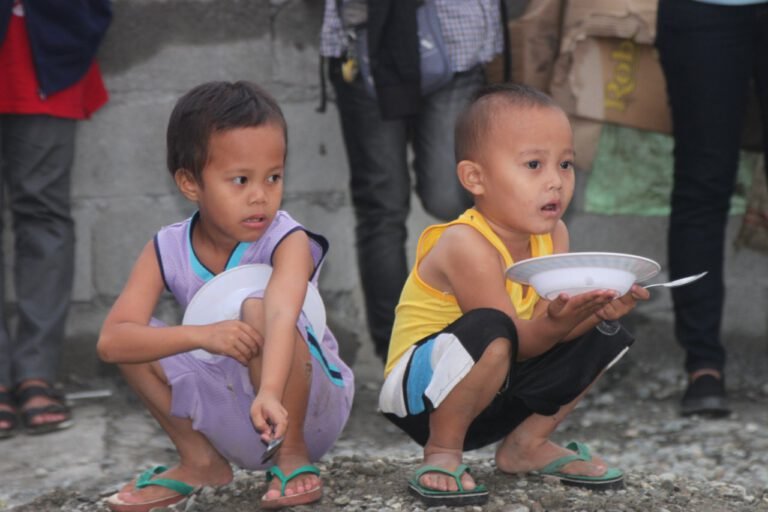
Children wait for their evening meal at a private evacuation centre in Iligan City in the southern Philippines.

CREDIT: PETER MURPHY

From May to October last year, there were almost daily reports in the Australian media of the battle against Daesh in Marawi City. Then, on October 17, the battle was over, with the most prominent rebel leaders killed.

This city is located on the northern shore of Lake Lanao, in the province of Lanao del Sur, Mindanao, the Philippines. The Turnbull government had declared the fighting a “direct threat” to Australia’s security and sent in military support, as well as some aid for the 400,000 people displaced.

The evacuees, located in nearby Iligan City, and the municipality of Saguiaran, and on the rural outskirts of Marawi itself, were angry at the total destruction of their homes and looting of their possessions, which they had confirmed by visits back to Marawi. They were even more disturbed to find that 75 per cent of the city has been declared a “military reservation”, with no civilians allowed to return to the area, but that a $10 million military camp is being built there.

Evacuee families of 10 people were receiving just five kilograms of poor quality rice every 15 days. This is consumed in just two days. Australia has promised $26 million in aid over four years.

But in January 2018, the Philippine Department of Social Welfare and Development cut off all relief goods in Iligan City, and reduced the meagre supplies in Saguiaran. At the start of March, only 27,000 people had returned or were in the process of returning to Marawi City, and 312,000 were completely in the dark about where they might end up. Perhaps another 50,000 people had given up and relocated to Cebu or Manila, or emigrated.

Several said that if they were not allowed to return to their homes, and the Duterte government grabbed the urban land for commercial redevelopment, there would be a far bigger war.

Since 1999, the Moro areas of south-west Mindanao have seen bloody battles, then peace talks, then more battles between the Moro Islamic Liberation Front (MILF) and the government in Manila.

The MILF, with about 15,000 fighters, although founded in 1984, emerged immediately after its predecessor, the Moro National Liberation Front (MNLF), signed a “final peace agreement” with the Ramos government in 1996. This MNLF peace agreement had obviously failed to address the grievances of most Moros.

Whatever the merits of the MILF peace agreements, the terms were first watered down and then the bills died in Congress in 2015, leaving the MILF and the entire Moro peace process adrift. Australia had provided aid to underwrite this process.

First in 2010 the Bangsamoro Islamic Freedom Fighters broke away from the MILF, and then in 2013, the MNLF also condemned the Aquino government deal with the MILF. It initiated flag-raising ceremonies and marches to assert independence. The first such rally was blocked by the police and MNLF leaders were arrested, leading to a massive and destructive firefight in the heart of Zamboanga City.

Then in January 2015, a 400-strong elite police unit acting under US direction raided the town of Mamasapano in Maguindanao province, allegedly to arrest an Indonesian terrorist, “Marwan”. Forty-four of the elite police, 18 MILF fighters and five civilians were killed in a major firefight.

A month later, the Philippine armed forces launched a number of operations against the Bangsamoro Islamic Freedom Fighters in central Mindanao, leading to massive destruction and evacuations.

Thus the Marawi City fighting in 2017, while being the worst, is part of an ongoing pattern of armed clashes between Moro forces and the central government as the MILF peace process first reached its peak in 2012 and then unravelled.

Moro clans in the province of Lanao del Sur did not join the Bangsamoro Islamic Freedom Fighters, but they were in a political vacuum into which the now notorious Maute brothers, Omarkhayam and Abdullah, and Isnilon Hapilon, could step.

Hapilon, originally an MNLF member, decided to join the Abu Sayyaf Group after meeting its then leader, Abdurajak Janjalani, in 1994, on Basilan Island. The Abu Sayyaf Group, while having well-educated leaders able to project an Islamic message, mainly operated by robbery, kidnap-for-ransom and extortion, and so caused a lot of difficulties for local communities, and
for the MNLF and MILF.

Hapilon eventually became a significant leader, notorious for kidnapping and beheading. Soon after the emergence of Daesh in the Iraqi city of Mosul in mid 2014, Hapilon swore allegiance to Abu Bakr al-Baghdadi. The US put a $6.7 million reward on his head, and the Philippine government $250,000.

In 2016, the Philipine armed forces forced the Abu Sayyaf Group from Basilan to Sulu Island. There Hapilon tried to align the Abu Sayyaf fighters to Daesh, but they rejected him.

Hapilon then appeared in Butig, a small town south of Lake Lanao, in November 2016, when the Maute brothers and their Daesh-aligned fighters declared control, only to be forced out by the military, with fighting continuing into January 2017.

There were seven Maute brothers, part of an influential family based at Butig, with investments in Marawi City and in Manila. The most prominent brothers, Omarkhayam and Abdullah, had been members of MILF, but left it in 2012. They swore allegiance to Daesh in 2015.

The capture of their parents, Cayamora and Farhana Maute, with a load of arms and explosives in June 2017 certainly demonstrated that the family itself invested in the armed group.

But evidence emerged around then that both Philippine Liberal Party politicians associated with former president Benigno Aquino, and officials close to President Duterte, had been in Marawi City prior to the outbreak of violence.

On the other hand, a July 2017 report by Sidney Jones’s Institute for Policy Analysis of Conflict in Indonesia provided evidence of Daesh funding. Between January and March 2017 $US55,000 ($A73,000) was transferred from Syria through Indonesia to Hapilon and the Maute brothers by Daesh. Jones’s report discounted any significant role for foreign fighters, emphasising the local context.

In fact there is no shortage of weapons in Mindanao, where large private armies are well equipped by their political sponsors, up to the level of the president.

It appears that the national government, and particularly the military command, outmanoeuvred both the Islamic extremists and the Liberal Party opposition in manipulating the dangerous situation in Lanao del Sur.

All this suggests that the Turnbull government’s decision to deploy 80 special forces soldiers to the Philippines to provide urban warfare training could involve Australian troops in a longstanding, deep conflict over Moro rights to land.

Marawi marked a sudden turn in Duterte’s international and domestic policy. He switched from criticism of the US military alliance to embracing it, from support for peace talks with the National Democratic Front of the Philippines to open conflict with them. In turn, international criticism of Duterte’s mass murder of drug suspects died down.

By January 2018, three-quarters of all Armed Forces of the Philippines combat battalions were deployed in Mindanao, with about 45 positioned against the New People’s Army and 25 against the Moro communities. South-east Mindanao is not a strong Moro region, but is notable for the indigenous Lumad tribes there and their relatively unexploited forests, agricultural lands and mineral resources. This is also where the New People’s Army is reputed to be strongest.

This article was first published in the print edition of The Saturday Paper on Mar 10, 2018 as “Battle for Marawi”. The online edition is available here.

Peter Murphy is a Sydney-based journalist and chairperson of the International Coalition for Human Rights in the Philippines.
Int’l rights group vows to heighten global campaign on Duterte’s crimes vs Filipino people

ICHRP STATEMENT
26 February 2018


The International Coalition on Human Rights in the Philippines (ICHRP), a global network of solidarity groups, organizations and rights advocates outside the Philippines, today released its findings on the impact of martial law on human and people’s rights in the Philippines, after its International Solidarity Mission (ISM) in a total of four regions in Mindanao from February 18 to 25, 2018.

“First and foremost, we deplore the cases of harassment and threats faced by international human rights monitors of the ICHRP during the course of the ISM in Mindanao. We believe that peoples, activists and human rights defenders from outside the Philippines have the right to extend international solidarity to the individuals, groups and communities in the Philippines facing various attacks and threats to their political, civil, social and economic rights. We also believe that these harassment and threats are sorry attempts by the Duterte administration and its State agents to cover-up the real situation in the Philippines,” said Peter Murphy, an Australian activist and Chairperson of the International Coalition for Human Rights in the Philippines (ICHRP).

On February 22, ISM delegates, including five foreign human rights observers, were on their way to General Santos City, when they were held at a police-manned checkpoint at Brgy. Palian, Tupi, South Cotabato. All participants were ordered to show their identification cards, including that of the five foreign rights advocates. The IDs issued by the Bureau of Immigration for two foreign church workers of the United Methodist Church were confiscated by police. They were all then escorted to Bureau of Immigration Region 12 field office in General Santos City reportedly for “verification.” Police personnel who accosted the mission delegates did not present any written document to specify reasons for their actions. They were released from police custody after negotiations.

Also, on February 19, other participants to the said mission were denied entry to the Lumad communities in Brgy. Diatagon, Lianga, Surigao del Sur by soldiers from the 75th Infantry Battalion-Philippine Army. The ten mission delegates, five of whom are internationals, were accompanied by Lianga councilor Sammy Dollano and Friends of the Lumad in Caraga chairperson Bishop Modesto Villasanta. Further, on February 21, a government appointed “tribal chieftain”, accompanied by military in civilian clothes, entered the community of Hayon to warn the group that they did not ask for his permission to be there. After leaving the community, the delegation was stopped at two different military checkpoints, and in the last one, even held for over two hours.

The ISM delegates released the following (initial) findings based on their factfinding missions in Caraga, SocSKSargends, Northern Mindanao region and Southern Mindanao region:

1. Military operations of the Armed Forces of the Philippines in the Caraga region, even exacerbated after the declaration of Martial Law in Mindanao, have endangered the lives, livelihood and rights of poor peasants asserting their right to own the land they till, of indigenous people’s communities, causing forcible evacuation of Lumad communities resisting the entry of destructive mining and other businesses in the region. Students and teachers of alternative learning institutions are also in peril, because of pronouncements by Duterte himself and his military that these schools are training grounds of the New People’s Army (NPA) and, thus, should be bombed. Peasant and indigenous people’s leaders, Lumad school teachers and other human rights defenders face trumped up criminal charges which were initiated by the military, police and the Department of Justice to harass and malign defenders, in an attempt to silence them into passivity. [Refer also to the 2018 Feb 23 ISM Caraga statement]

2. The Armed Forces of the Philippines, in cahoots in foreign and local big businesses, have instigated a brutal war against indigenous people’s communities in the SocSKSargends region, which resulted in the massacre of eight Lumad leaders in Lake Sebu, South Cotabato. Efforts to provide free and relevant education through alternative learning institutions put up by indigenous peoples such as the Center for Lumad Advocacy and Services, Inc. are being frustrated by repeated attempts to criminalise these institution’s teachers such as Jolita Tolino, who was illegally arrested on February 8, 2018, and Pastor Kama Sanong, an officer of the Parent-Teacher-Community Association of CLANS who was arrested on July 11, 2017.

3. The delegation to the Northern Mindanao region visited Marawi City evacuees in Iligan City, Saguiaran and just inside the northern boundary of Marawi City. They found the evacuees highly stressed and agitated because relief goods from the Dept of Social Welfare and Development had been cut of in mid-January in Iligan City, and sharply reduced in Saguiaran and Marawi City itself. Evacuees in Iligan City have been ordered to leave the city by February 28, by the Mayor but have no indication about where they may be re-located. In fact, they all wish to return to their areas in Marawi City and start again with whatever resources they have, but realise that this is unlikely. Evacuees in Saguiaran Municipality have also been told that they must re-locate in March, but also have no information about where. A new site, dubbed a Temporary Evacuation Centre, is being constructed at the edge of the Marawi City area, composed of several hundred small bunkhouses, set on concrete slabs and serviced with sealed roads and a sewerage system. It appears anything but temporary. Evacuees continue to say guardedly that they will not tolerate the grabbing of huge parts of the urban area of Marawi City, and hint that President Duterte will face a bigger conflict there. They view Martial Law as a device to block their return to Marawi City and call for it to be abolished.

4. The ISM delegates from the different regions converged in Davao City to attend the Human Rights Summit on February 23. They were supposed to visit communities at Compostela Valley where human rights violations are so rampant. However, reports reached the organizers that the community members were called by the AFP nearest battalion telling the people to “clear their names”. They advised against the mission going to their areas and just agreed to send some families to meet with the delegation. They were eventually able to meet with the missioners the day after, even as they expressed fears that their movements were being monitored by the AFP. Peasant organizers are subject to the “crackdown/lockdown” of the martial law, and as widely known are frequent targets of EJKs, trumped up charges among other grave human rights violations. It has been learned that several families from Talaingod and other communities in Compostela Valley are evacuating because of hamletting and threats. There are around 60 families of Lumads who are now in the Sanctuary area, and still counting. This is due to the massive militarization happening in their ancestral lands prohibiting them to go their farms.

“Aside from State policies regarding martial law and Oplan Kapayapaan, Pres. Duterte’s pronouncements clearly incite his State forces to commit human rights violations and war crimes, including his orders to shoot female rebels in their vaginas. His proscription of the Communist Party of the Philippines (CPP) and the New People’s Army (NPA) as terrorist organizations bode ill for the peace process between the Government of the Republic of the Philippines (GRP) and the National Democratic Front of the Philippines (NDFP). Clearly, he is fomenting war and unpeace against his own people,” said Julie Jamora, a US-based rights activist and member of Gabriela-USA.

ICHRP, together with Ibon International, also launched a booklet entitled ”Duterte Killings Continue: State Terror and Human Rights in the Philippines.”

“With this publication and the facts we gathered in this recent ISM, we plan to bring our observations and recommendations to the parliaments and governments of different countries such as Australia, the US, Canada, Japan, New Zealand, South Korea, and European member states like Belgium, the Netherlands, Switzerland, Austria, Germany, Luxembourg, Italy, Spain, United Kingdom, Norway, Sweden, Denmark, among others. We call on peoples from various countries to pressure their governments to withdraw State funding for military operations in the Philippines. We should never be a party to the slaughter of and other human rights violations against the Filipino people,” Murphy emphasized.

Murphy also announced plans of the coalition to initiate an International Peoples’ Tribunal, which will hold to account Pres. Duterte on people’s rights violations in the Philippines.

“International solidarity is the response of oppressed peoples and advocates of just and lasting peace to fascist and authoritarian regimes like Duterte’s. We will not relent in our consistent support for the campaigns of the Filipino people for human and people’s rights in the Philippines and elsewhere,” Murphy concluded. ###

View short video here: https://vimeo.com/ichrp

Reference:
Peter Murphy
Chairperson, Global Council
International Coalition for Human Rights in the Philippines (ICHRP)
Mobile: +61 418312301

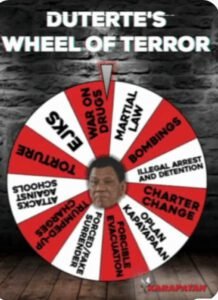
Duterte lets loose its wheel of terror in Mindanao

0

Media Advisory

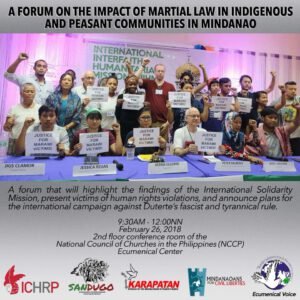
Rights groups, international coalition, and victims of rights violations hold a forum on the real impact of martial law in Mindanao

The International Coalition for Human Rights in the Philippines (ICHRP), Ecumenical Voice for Peace and Human Rights in the Philippines (EcuVoice), Karapatan, Sandugo, and Mindanaoans for Civil Liberties invite you to a forum on the impact of martial law in indigenous and peasant communities in Mindanao on February 26, 2018, Monday, 9:30-12nn, at the 2nd floor conference room of the National Council of Churches in the Philippines (NCCP), Ecumenical Center, 879 Epifanio de los Santos Ave, Quezon City

Photo opportunities and interviews are available.

#EndMartialLaw#ResistFascism

Reference: Karapatan Public Information Desk, 0918-9790580

———————————————————————

PUBLIC INFORMATION DESK
publicinfo@karapatan.org
———————————————————————

Alliance for the Advancement of People’s Rights
2nd Flr. Erythrina Bldg., #1 Maaralin corner Matatag Sts., Central District
Diliman, Quezon City, PHILIPPINES 1101
Telefax: (+63 2) 4354146
Web: http://www.karapatan.org

KARAPATAN is an alliance of human rights organizations and programs, human rights desks and committees of people’s organizations, and individual advocates committed to the defense and promotion of people’s rights and civil liberties. It monitors and documents cases of human rights violations, assists and defends victims and conducts education, training and campaign.

An Open Letter to Philippine President Rodrigo Duterte

RE: Illegal arrest and detention and trumped-up charges against trade union organizer Marklen Maojo Maga

24 February 2018

Dear Mr. President,

The Canada Philippines Solidarity for Human Rights (CPSHR) strongly condemns the recent abduction and illegal arrest of union organizer, MARKLEN MAOJO MAGA on February 22nd 2018 by elements of the Philippine National Police (PNP). Maojo Maga, is a union organizer with Kilusang Mayo Uno (KMU)/First Labor Movement, an independent national labour centre in the Philippines. Majo Maga, is a full- time union organizer in Central Luzon, which is home to at least 1,757 factories and nearly 143,698 workers. Majo Maga organizes workers in the port areas and in the factory belts in Central Luzon.

After dropping off his son at school in San Mateo, Rizal, Maojo Maga was
abducted by plainclothes men who later identified themselves as elements of the Philippine National Police (PNP). He was neither told that he was being arrested nor was he read out his rights. He was handcuffed and blindfolded and his family and lawyers were only notified of his arrest much later that night. Maojo Maga is charged with the murder of an unnamed soldier in Agusan Del Sur, Mindanao in the southernmost area of the Philippines. He is also charged with illegal possession of a .45 caliber pistol with a clip of seven bullets of ammunition, the standard short arm of the PNP. His family and colleagues believe that the gun was planted by the military when he was taken and that these charges are trumped up charges, as shown in other arrests of activists and community organizers. Two days before Maojo Maga was taken, the PNP had accused him of being a member of the Communist Party of the Philippines (CPP) and of the New People’s Army (NPA), which have been labelled as “terrorist” organizations by the Duterte government.

The criminalization of union organizing and other forms of dissent in the Philippines is an old tactic used by the Philippine government, the military and the police to delegitimize the people’s right to dissent, unionize and demand their rights as workers. This was evident in the mass arrests of union workers in the banana plantation in Compostela Valley, Mindanao as members of the NPA. Since Rodrigo Duterte’s taking power, 22 union activists have already been killed.

The arrest of Maojo Maga follows that of his father-in-law Rafael Baylosis who was earlier arrested and detained on charges of illegal possession of firearms. Baylosis is a consultant of the member of the National Democratic Front of the Philippines (NDFP) in the Peace Negotiations with the Government of the Republic of the Philippines. The arrest and detention of Baylosis violates the Joint Agreement on Safety and Immunity Guarantees (JASIG), a peace agreement that assures all consultants and members of the NDFP negotiating panel immunity from surveillance, harassment, search, arrest, detention, prosecution and interrogation.

Mr. President, as defenders of human rights, we want to let you know that your fascist attacks against the Filipino people, the people you sworn to protect, will not be tolerated, particularly in the international community.

CPSHR demands the immediate release of Marklen Maojo Maga, Rafael Baylosis and all political prisoners in the Philippines. We demand a stop to the use of trumped up charges against members of unions and people’s organizations thus, criminalizing legitimate dissent.

We demand a stop to the systematic repression of progressive forces who that dare to speak out against the violent and anti-people policies of the government.

We remind the government that 32 years ago, in 1986, a people’s uprising took down the Marcos dictatorship. The Duterte government cannot suppress a people’s movement that grows in strength and power, which expands in every city and village and is strongly embraced by the masses because its resistance and defiance is just and righteous.

Furthermore WE CALL for the Philippine government to:

Continue the peace talks and build towards the advancement of Comprehensive Agreement on Social and Economic Reforms (CASER), which includes the issue of free land distribution to farmers and  farm workers;

Pursue its commitments under the Comprehensive Agreement on the Respect of Human Rights and International Humanitarian Law (CARHRIHL) which includes the right to freedom of thought and expression, freedom of conscience, political beliefs and practices and the right not to be punished or held accountable for the exercise of these rights, and the right to free speech, press, association and assembly; and

Adhere and respect the Universal Declaration of Human Rights and all major Human Rights instruments that it is a party and signatory.


Respectfully,

CANADA-PHILIPPINE SOLIDARITY FOR HUMAN RIGHTS

*The Canada-Philippines Solidarity for Human Rights (CPSHR), is a solidarity organization that works for the defence and protection of human rights in the Philippines.


H.E. Rodrigo Duterte
President of the Republic
Malacañang Palace,
JP Laurel St., San Miguel
Manila Philippines
Voice: (+632) 564 1451 to 80
Fax: (+632) 742-1641 / 929-3968
E-mail: op@president.gov.ph or send message through http://president.gov.ph/contact-us/

Hon. Jesus Dureza
Presidential Adviser on the Peace Process
Office of the Presidential Adviser on the Peace Process (OPAPP)
7th Floor Agustin Building I
Emerald Avenue
Pasig City 1605
Voice:+63 (2) 636 0701 to 066
Fax:+63 (2) 638 2216
Email: stqd.papp@opapp.gov.ph, feedback@opapp.net

Ret. Maj. Gen. Delfin Lorenzana
Secretary, Department of National Defense
Room 301 DND Building, Camp Emilio Aguinaldo,
E. de los Santos Avenue, Quezon City
Voice:+63(2) 911-6193 / 911-0488 / 982-5600
Fax:+63(2) 982-5600
Email: info@dnd.gov.ph, webmaster@dnd.gov.ph

Hon. Vitaliano Aguirre
Secretary, Department of Justice
Padre Faura St., Manila
Direct Line 521-8344; 5213721
Trunkline: 523-84-81 loc.214
Fax: (+632) 521-1614
Email: communications@doj.gov.ph

Hon. Jose Luis Martin Gascon
Chairperson, Commission on Human Rights
SAAC Bldg., UP Complex, Commonwealth Avenue
Diliman, Quezon City, Philippines
Voice: (+632) 928-5655, 926-6188
Fax: (+632) 929 0102
Email: chairgascon.chr@gmail.com

Hon. Petronila P. Garcia
Ambassador, Philippine Embassy Ottawa
email: embassyofphilippines@rogers.com

Hon. Frank Neil Ferrer
Consul General, Philippine Consulate General in Vancouver, BC
Email: vancouverpcg@telus.net


Canada-Philippines Solidarity for Human Rights (CPSHR)

4794 Fraser Street, Vancouver, BC V5V 4H3
Email: cps_hr@yahoo.ca

For reference: Adrian She

http://www.facebook.com/pages/Canada-Philippines-Solidarity-for-Human-Rights/


Member: International Coalition for Human Rights in the Philippines (ICHRP-Canada)/
Stop the Killings Network (STKN-Canada)/ International League of Peoples’ Struggle (ILPS-Canada)/International Women’s Alliance (IWA)/ Mining Justice Alliance (MJA)

Associate Member: International Migrants’ Alliance (IMA)
Partner: Eco-Justice Working Unit, Anglican Diocese of New Westminster/ Justice Advisory Circle- United Church of Canada/Alliance for People’s Health (APH)
Proud Supporter of Bayan-Canada/Migrante-Canada

America’s Indefensible Alliance With The Philippines

REUTERS
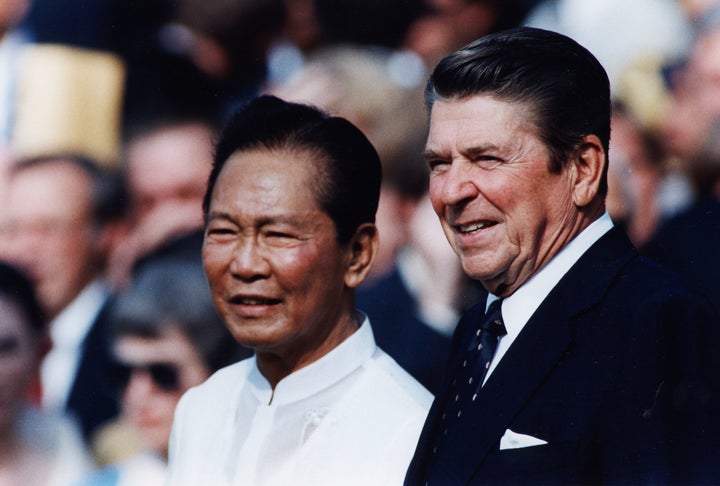
Former U.S. President Ronald Reagan with former Philippine President Ferdinand Marcos on Sept. 16, 1982.

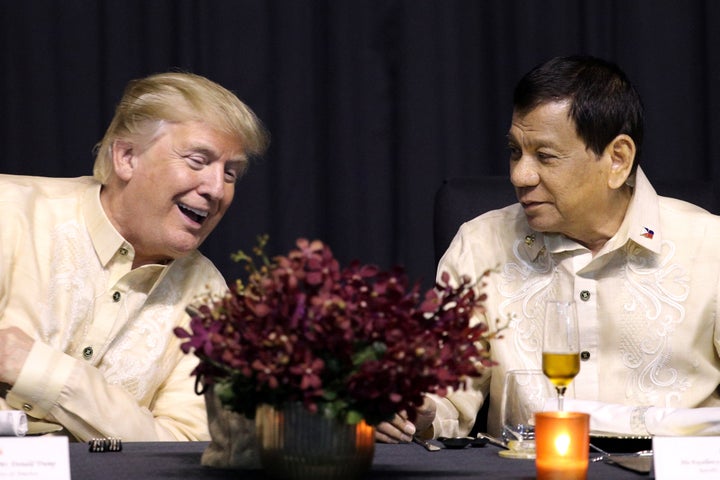
The burgeoning alliance between President Donald Trump and Philippine President Rodrigo Duterte appears destined to become the 21st century version of the Ronald Reagan-Ferdinand Marcos alliance.

That union in the 1980s allowed the Marcos dictatorship to last 14 years, despite Marcos’ notoriety for murdering over 3,000 people as well as jailing 70,000 and torturing 34,000 of his political rivals and other innocent people. Reagan stood by his Filipino ally to the bitter end, even granting Marcos asylum in Hawaii when it became clear that “people power” would soon topple the unsustainable dictatorship. According to Reagan, granting a haven to Marcos and 90 of his family members and close associates was “in the best interests” of U.S.-Filipino relations. Those interests included a network of some of the largest U.S. military bases in the world at the time.

Such die-hard support for a brutal dictator was immoral back then.

Knowing the legacy of trauma that the Marcos dictatorship inflicted on the Filipino people and the country as a whole makes supporting the admittedly fascist upstart dictator Duterte completely unjustifiable today.

When Reagan took power in 1980, Marcos had already been ruling the Philippines under martial law for eight years, with the full support of former Presidents Richard Nixon, Gerald R. Ford and Jimmy Carter. Reagan’s support for an additional six years meant Marcos and his military could rack up more human rights abuses with impunity.

Today, Duterte is well on track to surpass the body count of his self-proclaimed idol. An estimated 13,000 people have been killed in the war on drugs; 113 activists have been killed under the U.S.-designed counterinsurgency program of the Philippine government; and more than 400,000 people have been forcibly displaced due to the Philippine military’s aerial bombing of Marawi City and nearby communities of indigenous people throughout the southern island of Mindanao, under the guise of the war on terrorism. At the rate Duterte is going, this could mean the murder of 52,000 more people over the remainder of his six-year term.

The Philippines is home to 100 million people, the majority of whom are dirt poor, largely due to 119 years of U.S. policy toward the country.

For his part, Trump has bluntly stated his interest in the Philippines. “It is a strategic location ― the most strategic location. And, if you look at it, it’s called the most prime piece of real estate from a military standpoint,” Trump said during his visit to the Philippines in November. No need to mince words: for the U.S., the Philippines remains, as it has always been, an essential cog in the U.S. war machine.

Never mind that today the Philippines is home to 100 million people, the majority of whom are dirt poor, largely due to 119 years of U.S. policy toward the country. With no sustainable domestic industry to speak of and an economy grossly dependent on exports in large part because of the colonial legacy left behind by first Spain and then the U.S., the Philippines under Marcos began to systematically export its people to work in foreign countries — and send remittances home to keep the Philippine economy afloat. Today, poverty is so severe that nearly 6,000 Filipinos leave the country every single day in search of work; the Philippine economy would collapse were it not for $27 billion in remittances these migrant workers send home annually.

At the turn of the 20th century, the U.S. acquired the Philippines as a colony and relinquished the country only after World War II, when dependable local puppet leaders could be installed and economic and military treaties cementing the Philippines to U.S. interests could be imposed. These include patently unequal military agreements that tie the Philippines to the whims of U.S. imperial ambitions: the Mutual Defense Treaty, Mutual Logistics Support Agreement, Visiting Forces Agreement and, most recently, the Enhanced Defense Cooperation Agreement. These agreements grant the U.S. military expansive access to military facilities, land, water and airspace in the Philippines for an indeterminate length of time under the guise of “mutual benefit.” Conveniently, the U.S. military presence has been focused in resource-rich regions of the Philippines, facilitating land-grabbing and extraction of the country’s natural wealth by multinational corporations.

Challenges to the constitutionality of the agreements have been brought to the Philippine Supreme Court repeatedly as the Filipino masses have staunchly protested U.S. military presence and operations on Philippine territory for decades. After all, they have experienced the brunt of the violence against women and children, toxic waste, forced displacement from land and other crimes committed by the U.S. military.

For the U.S. in the 1970s and ’80s, propping up the Marcos regime served the purpose of securing its military stronghold in the Pacific as the Cold War approached its climax. Neighboring Vietnam had resoundingly defeated the imperialist American invaders just a few years earlier. The U.S. and Soviet Union were engaged in a nuclear arms race.

Today, Trump needs Duterte and the Philippines to remain a dependable ally for U.S. imperial interests in the Asia Pacific region. Trump’s current brinkmanship with North Korea means that the threat of nuclear war looms large. Trump has named China repeatedly as one of the biggest rivals to U.S. economic superiority in not only the region but the world. China, the Philippines and neighboring countries dispute territorial control of the waters and islands in the South China/West Philippine Sea, which contains vast petrochemical and gas deposits, rich marine biodiversity, and sea lanes that facilitate much of the global trade and shipping for the entire region.

In January, the U.S. Defense Department announced it had launched the counterterrorism mission “Pacific Eagle: Philippines,” which is designated as an Overseas Contingency Operation, thereby making it eligible for exemptions from spending limits. The operation will only strengthen the Duterte regime as it continues to crack down on vulnerable minority populations.

The 1 percent may agree with Trump that it is in the best interests of theirAmerica to continue supporting Duterte. The rest of us should not be complicit in the slaughter.

ATHIT PERAWONGMETHA / REUTERS
U.S. President Donald Trump with Philippine President Rodrigo Duterte at a gala dinner in Manila on Nov. 12.

Last week, the International Criminal Court officially opened a preliminary investigation into allegations of state-sanctioned killings and other human rights violations committed by the Philippine National Police under the direction of Duterte.

Now, U.S. lawmakers should join others in the international community and stop enabling Trump’s agenda in the Asia Pacific to be propped up by the rising body count of Filipinos killed under Duterte’s war on drugs and war on terrorism. Funding for Duterte’s death squads in the form of U.S. Foreign Military Financing aid to the Philippine military and police should be struck altogether from future U.S. budget allocations.

Congress should go a step further and study the effect of such agreements between the U.S. and the Philippines, such as the Mutual Defense Treaty, Visiting Forces Agreement and Enhanced Defense Cooperation Agreement. These provide the basis for continued support to the Philippine military in the first place, even when these same state security forces are implicated in the majority of extrajudicial killings and other human rights violations. Moreover, these agreements have been used to shield the U.S. military and its personnel from accountability for crimes committed in Philippine territory, essentially subordinating Philippine sovereignty to U.S. military interests. Is that really any different from Reagan’s justification for his granting of asylum to a murderous dictator?

Can the U.S. depart from over 100 years of colonial treatment of the Philippines and instead deploy a framework of mutual respect, mutual benefit and respect for national sovereignty? Absent this, we should expect to birth more puppet presidents and dictators in the Philippines.


**Rhonda Ramiro is the vice chair of BAYAN-USA, an alliance of 20 Filipino organizations in the U.S. Azadeh Shahshahani (@ashahshahani) is legal and advocacy director at Project South, a past president of the National Lawyers Guild, and Global Council member of the International Coalition for Human Rights in the Philippines (ICHRP).