
Home Blog Page 81

Sultan of Marawi to testify against Duterte in International Tribunal

0

Suara Bangsamoro

Sultan Hamidullah Atar of Marawi City will testify in the International Peoples’ Tribunal (IPT2018) on September 18-19, 2018 in Brussels, Belgium to prosecute President Rodrigo Duterte for his crimes committed against the Moro and the Filipino people.

Sultan Atar will be testifying about the human rights violations committed by the Duterte regime to the Meranaws during the Marawi City siege, and the declaration of Martial Law in Mindanao.

Suara Bangasamoro Chairperson Jerome Succor Aba will testify on the charges regarding religious discrimination, arbitrary detention and torture committed against him by agents of US Department of Homeland Security (DHS) and US Customs and Border Patrol (CBP) on April 17-19, 2018.

Aba said they will also bring up the massacre of seven Tausug youths on September 14, 2018 in Patikul, Sulu. State military forces were allegedly behind the massacre.

Various local organizations led by Bagong Alyansang Makabayan (Bayan) and Karapatan will raise a total of 21 cases or incidents in the IPT2018. These cases can fall into these categories – violations on economic, social and cultural rights, violations on civil and political rights, and violations on the right to self-determination.

‘Global Court’

The IPT2018 is a global court convened by the European Association of Lawyers for Democracy and World Human Rights, Haldane Society of Socialist Lawyers, International Association of Democratic Lawyers, IBON International, and the International Coalition for Human Rights in the Philippines.

The global court sourced its legitimacy from the people as the primordial source of authority and power of all courts – international or local. The global court, composed of leading public figures of recognized achievements and high moral stature, will come up with a verdict based on a thorough and fair assessment of evidences, and in line with the applicable legal standards.

The verdict from the IPT will be submitted to the International Criminal Court (ICC), the European Parliament, and the United Nations Human Rights Council as a case against the US-Duterte regime.

“Although Duterte already withdrew from the Rome Statute creating the ICC, it will take a year upon the receipt of the notice of withdrawal according to Article 127 of the ICC. This rule was made specifically for dictators like Duterte to withdraw while complaints are filed against them,” Aba ended.

Find out more about the Tribunal

Follow the proceedings of the Tribunal

Rights victims file raps vs Duterte at international tribunal

0

MANILA — Various people’s organizations led by the Bagong Alyansang Makabayan (Bayan) and Karapatan announced at a press conference today that victims of rights violations will testify before the International Peoples’ Tribunal (IPT2018) on September 18-19 in Brussels, Belgium to indict Presidents Rodrigo Duterte and Donald Trump “for crimes against the Filipino people.”

Upon the victims’ plea, the Tribunal is being convened by the International Association of Democratic Lawyers (IADL), European Association of Lawyers for Democracy and World Human Rights (ELDH), Haldane Society of Socialist Lawyers, IBON International, and the International Coalition for Human Rights in the Philippines (ICHRP).

Its findings and verdict will be submitted to the International Criminal Court (ICC), the European Parliament and the United Nations Human Rights Council on September 21, 2018, anniversary of martial law in the Philippines.

“The continuing impunity of killings, state violence and other crimes against the Filipino people compel us to file these cases against the regime. The judicial system itself is under attack in the Philippines. Hence, an impartial tribunal recognized internationally can serve as moral suasion to stop the attacks and make the regime accountable for its crimes,” Teddy Casiño of Bayan said.

Representatives of workers, peasants and women’s groups joined Lumad leaders and victims of Duterte’s “war on drugs” at the press conference. Rise Up for Life and Rights, a network of victims of the drug-killings, human rights advocates and church workers, filed a separate case against Duterte early this month before the International Criminal Court (ICC).

Pres. Duterte announced last March the unilateral withdrawal of the Republic of the Philippines from its ratification of the Rome Statute of the ICC, in reaction to the decision of the court’s prosecutor to launch a preliminary examination on the on-going killings in the country.

Duterte’s full-scale attacks on the people

Jigs Clamor of Karapatan explained that the cases filed before the IPT2018 illustrate the full-scale attacks of the Duterte government on the Filipino people.

He cited three broad categories on rights violations for the cases filed: 1) civil and political rights; 2) economic, social and cultural rights (ESCR); and 3) national sovereignty, development, and international humanitarian law.

Under the civil and political rights violations are the mass murder of more than 23,000 poor Filipinos through the brutal war on drugs, and more than 160 extra-judicial killings mostly of peasant and indigenous leaders.

In just one year of martial law in Mindanao, at least 49 victims of extrajudicial killings have been documented by Karapatan. There were also 22 documented cases of torture, 89 victims of illegal arrest and detention, and 336,124 victims of indiscriminate gunfire and aerial bombings.

Trumped-up charges against leaders, activists and critics, including that of Senator and former justice secretary Leila de Lima, media repression, the deportation of Sr. Pat Fox and other foreign missionaries, and the detention of more than 500 political prisoners are also included in the charges.

Among the ESCR violations are issues of labor-only contractualization and union busting; landlessness and harassment of poor peasants, misogyny and abuse of women; negligence of overseas workers in distress; imposition of anti-poor economic policies like the Tax Reform for Acceleration and Inclusion (TRAIN) Law; and the absence of decent housing for the urban poor.

Violations of international humanitarian law and the peoples’ rights to national self-determination and development include the attacks on 226 indigenous peoples’ schools in Mindanao by the AFP, PNP and the Department of Education; bombings and airstrikes of indigenous communities in Malibcong, Abra in March 2017; the massacre of seven personnel of the National Democratic Front (NDF) in August 2018; and the intervention of the US military and government in the Philippines.

International tribunal

Casiño said that the jurors of the IPT2018 form an international panel composed of eminent individuals from different disciplines with proven competence, integrity, probity and objectivity.

“The jurors are all experienced on issues on human rights, rights of peoples, and international humanitarian law,” he said.

Composing the jurors’ panel are:

  • Mamdouh Habashi, head of the International Office of the Socialist Popular Alliance Party in Egypt and Vice-President of the World Forum for Alternatives (WFA) in Dakar;
  • Monica Moorehead, co-coordinator of the International Working Women’s Day Coalition in New York City and an executive board member of the International Women’s Alliance;
  • Ties Prakken, professor of criminal law at Maastricht University and practices criminal law and human rights;
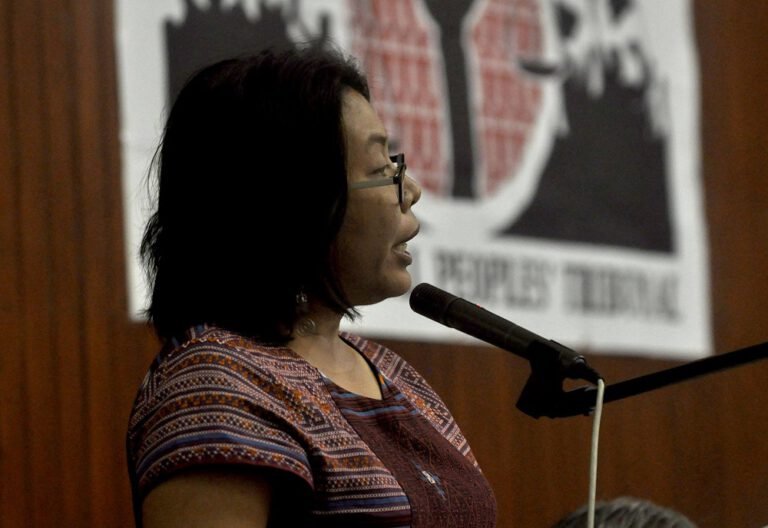
  • Sarojeni Rengam, Executive Director of Pesticide Action Network Asia Pacific (PANAP);
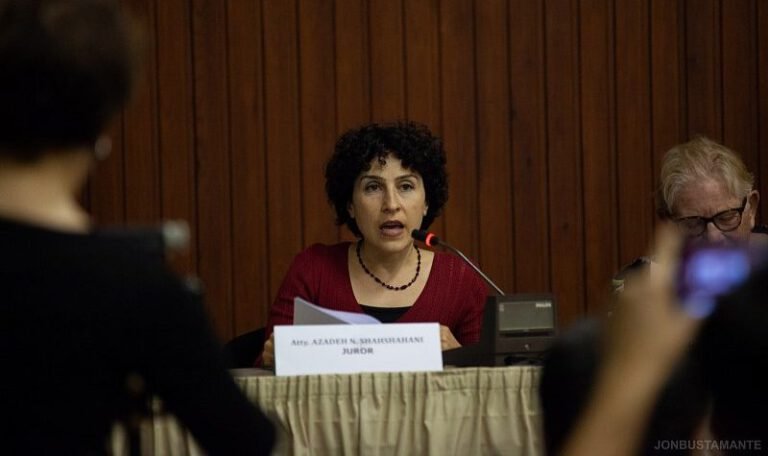
  • Atty. Azadeh N. Shahshahani, prominent human rights lawyer, former President of the National Lawyers Guild;
  • Dr. Gianni Tognoni, Secretary General of the Permanent People’s Tribunal (PPT);
  • Roland Weyl, founder and first Vice-President of the International Association of Democratic Lawyers, Dean of the Paris Bar; and
  • Rev. Michael Yoshii, pastor of the Buena Vista United Methodist Church (UMC) in California and Chairman of the Advocacy & Justice Committee for the California Nevada Annual Conference of the United Methodist Church.

Find out more about the Tribunal

Follow the proceedings of the Tribunal

Statement of Gill H. Boehringer

Statement of Gill H. Boehringer

Although I have had no formal notification from the Bureau of Immigration as to the basis for my exclusion from the Philippines, I wish to respond to the reports circulating in the media. It is alleged by the National Intelligence Coordinating Agency (NICA) that I am associated with “Communist Terror Groups”. That is preposterous. It seems that in the Philippines today almost anyone can be labelled a terrorist or in association with terrorists. I deny the accusation. I certainly am not a supporter of terrorism from whatever source.

It is further alleged that I attended a rally against an APEC meeting in November, 2015.Tthe legality, or not, of attending such a rally is a vexed question at the present time. I will not enter that debate at this point. What I will say is that I did not attend that rally. The charge is false.

A further allegation is that I attended a rally in February, 2018. This is also false. There was no rally or political activity. There was a trip to the forested mountains of the Caraga region, Mindanao to observe the educational activities at a primary school for indigenous (lumad) children run by the Triba lFilipino Program of Surigao del Sur (TRIFPSS). Amongst my special interests in teaching and research as an academic are the processes of educations, which I previously lectured in at the Open University, U.K., and the circumstances of indigenous people and their environmental custody of the land in my own country, in the Philippines and elsewhere. We did observe the interaction between the lumad students and the staff of the TRIFPSS school in and out of the classroom. We were able to exchange views with the school staff, the students and the community that supports the school.

I believe there is no basis for my exclusion from the Philippines in what was an educational experience for myself, the others who travelled with me into the mountain district, and also, I like to think, for those we met with there.

I have instructed my lawyers to contest all allegations against me, and to seek the lifting of the “blacklist{“, the “watchlist” and the exclusion order.

I would ask the government to recognize me as a person who has visited the country over many years with no subversive intent. I have sought in an intellectual way, through public dialogue, to aid in the maintenance of the rule of law and the structures and processes of democracy. It is true that as an individual-a Devil’s Advocate perhaps- I have been a critic of some of the policies and practices of three successive governments since coming to the Philippines as an International Election Observer in 2007 and 2010. Are those the activities of a terrorist? Surely not. Rather they might more appropriately be considered an attempt to make a rational contribution within the vibrant national discourse about how democracy can be strengthened, the rule of law protected and social justice ensured.

Finally, I would like to express my appreciation to all those who have responded to my plight around the globe. I am especially grateful for the support I have had from many individuals and organizations in the Philippines who have taken action to protect my legal rights, including my medical safety.

#HandsOffGill.

———————————————————————
PUBLIC INFORMATION DESK
publicinfo@karapatan.org
———————————————————————
Alliance for the Advancement of People’s Rights
2nd Flr. Erythrina Bldg., #1 Maaralin corner Matatag Sts., Central District
Diliman, Quezon City, PHILIPPINES 1101
Telefax: (+63 2) 4354146
Web: http://www.karapatan.org

KARAPATAN is an alliance of human rights organizations and programs, human rights desks and committees of people’s organizations, and individual advocates committed to the defense and promotion of people’s rights and civil liberties. It monitors and documents cases of human rights violations, assists and defends victims and conducts education, training and campaign.

_______________________________________________
PhilConcerns mailing list
PhilConcerns@humanrightsphilippines.net
http://humanrightsphilippines.net/mailman/listinfo/philconcerns_humanrightsphilippines.net

Australians and Filipino migrants protest Prof. Gill Boehringer deportation

Representatives of Action for Peace and Development in the Philippines (APDP), Philippine Australian Union Links (PAUL), Migrante Australia, International Coalition for Human Rights in the Philippines (ICHRP), Association to Defend Freedom & Human Rights in Iran – Australia, GABRIELA Australia, Lingap Migrante, Philippines-Australia Women’s Association (PAWA), Pax Christi Australia, Missionaries of the Sacred Heart Justice and Peace Centre (Australia) and Migrante Southwest Sydney went to the Philippine Consulate office in Sydney yesterday, August 10, 2018, to protest the imminent deportation of Australian Professor Gill Boehringer.

Letters addressed to President Duterte and statements condemning the immigration detention, the continuing threat of deportation and calling on President Duterte to intervene to cancel the blacklist order against Prof. Boehringer were presented to the Consulate representative. The representative stressed that it is up to the Bureau of Immigration in the Philippines to allow or deny a person entry to the Philippines even if they had been issued visa by the Consulate.

The letters signed by Peter Murphy, Chairperson of ICHRP’s Global Council and Secretary of the Philippines Australia Union Link pointed out that Duterte is “creating a pattern of deporting aged Australians who witness the harsh social and economic situation in the Philippines, even though the government itself recognised these problems and promised to address them. This does you no credit. This is damaging the relationship between our two countries.”

In its statement APDP stressed that “if President Duterte and his regime were upholding the dignity and rights of the Filipino people, they would welcome any interest in the human rights situation in the Philippines. Australian missionary Sr. Patricia Fox and Prof. Boehringer are true friends of the Filipino people who uphold the dignity and rights of Filipinos, amid overcoming poverty, injustice and violations of human rights.”

“The Philippine Bureau of Immigration’s decision to prevent Prof. Boehringer from entering the Philippines has instead brought massive media attention and internationalised further the issues that are close to Prof. Boehringer’s heart – the Lumad, extrajudicial killings, the continuing human right violations, the injustices and exploitation of Filipino people and its resources. The news is all over Australia,” Peter Brock of APDP told the Consulate representative.

Meanwhile, Migrante Australia said in its statement that “the heartless and gutless action to deny Prof. Boehringer to be with his Filipina wife as no different from President Duterte’s treatment of migrant workers who are forced to be separated their families in order to secure a brighter future for them. Blacklisting and deporting Prof. Boehringer also means that he will no longer have the facility to visit and spend quality time with his wife whenever he wants to. Duterte is tearing another family apart! How cruel is that!”

The group staged a snap action in front of the Consulate whilst bearing placards with the following calls:

  • Stop deportation of Prof Gill Boehringer! International solidarity is not a crime!
  • Stop persecuting human rights defenders in the Philippines!
  • Hands-off Prof Gill Boehringer! Hands-off human rights defenders!
  • Cut Australian military aid to Duterte government!
  • Cancel blacklist system for international human rights defenders!
  • Cancel deportation orders on Professor Gill Boehringer and Sister Patricia Fox!
  • President Duterte, how dare you break another family! Let Prof Boehringer stay with family in the Philippines!
  • President Duterte: human rights violator! Prof Boehringer and Sis Pat: human rights defenders! Stop human rights violations in the Philippines!

PUBLIC INFORMATION DESK
publicinfo@karapatan.org
Alliance for the Advancement of People’s Rights
2nd Flr. Erythrina Bldg., #1 Maaralin corner Matatag Sts., Central District
Diliman, Quezon City, PHILIPPINES 1101
Telefax: (+63 2) 4354146
Web: http://www.karapatan.org

KARAPATAN is an alliance of human rights organizations and programs, human rights desks and committees of people’s organizations, and individual advocates committed to the defense and promotion of people’s rights and civil liberties.  It monitors and documents cases of human rights violations, assists and defends victims and conducts education, training and campaign. 

Two Countries called “Philippines”

0
by Luis V. Teodoro


There are two countries that go by the name “Philippines.” The real, historical one is home to the Filipino millions, nearly half of whom are poor and powerless because they’re ruled by one of the most corrupt and most incompetent political classes on the planet. The other is an imaginary one — a creation of those very same rulers to convince the ruled that everything is fine, indeed nearly perfect, in this earthly paradise.

A March 31 statement by the Office of the Executive Secretary (OES), for example, kept referring to “the Philippines.” But it sounded as if it were describing an entirely different country outside of history.

The OES statement was in response to Victoria Tauli-Corpuz, the United Nations Special Rapporteur on the Rights of Indigenous Peoples, who aptly described the Duterte regime as authoritarian.

She was speaking at the Human Rights Festival in Milan, Italy last March 25, during which she also said that from the extrajudicial killing of alleged drug pushers and users, the regime is now targeting human rights defenders, critics, and political activists.

What is happening in the Philippines, she continued, is “fascism,” with which her audience was presumably familiar, that abomination having been the reality in Italy during the Benito Mussolini dictatorship.

Tauli-Corpuz is one of the more than 600 Filipino men and women listed in the Department of Justice’s (DOJ) court petition to declare the Communist Party of the Philippines (CPP) and the New People’s Army (NPA) terrorist organizations. Everyone in that list, including Tauli-Corpuz, is now in danger of either arbitrary arrest or even death, the rule of law having been replaced in much of these isles by the rule of force.

The list of allegedly ranking, “terrorist” members of the CPP and NPA also contains the names of community leaders and members of legal sectoral organizations such as urban poor, workers’ and farmers’ groups.

Presumably speaking for Executive Secretary Salvador Medialdea, the OES statement said “Democracy in the Philippines is vibrant and strong,” that “all branches of the government are functioning” — and that “the rule of law thrives.”

But if the rule of law “thrives,” why is Mindanao still under martial rule, the extension of which is premised on, among others, the incapacity of government agencies, including the courts, to function due to the supposedly continuing threat of terrorism?

That thought apparently escaped the drafters of the statement. But the next sentence in that paragraph should provoke even more questions, and not only because it is completely false. It is also because it sounds as if whoever drafted the statement was being sarcastic, as anyone who has been following developments in the executive, legislative and judicial branches of the government is likely to conclude.

Apparently, however, the writer of the statement wasn’t being literary, but literal. “The executive branch,” the sentence declares, “respects the separation of powers and the independence of the other co-equal branches and doesn’t meddle with their affairs.”

A strange, almost comic claim to make, it being at odds with the way the Duterte “supermajority” in the House of Representatives, in obedience to the wishes of its Malacanang patron, has forwarded a flawed impeachment complaint against Chief Justice Maria Lourdes Sereno to the Senate. The executive branch’s DOJ, in anticipation of Sereno’s exoneration in the upper house, is also trying to remove her through a quo warranto writ. Meanwhile, the Supreme Court appointees of President Rodrigo Duterte and his ally Gloria Macapagal-Arroyo, after some of them testified against Sereno, mobilized Supreme Court employees and some judges to demand her resignation.

What all these demonstrate is that not only is the executive branch in control of the “co-equal” lower house of Congress; it is also actively undermining what remains of the independence of the Supreme Court. But it is Tauli-Corpuz whom the OES statement accuses of being “detached from reality,” despite that description’s being more applicable to it.

If the OES statement sounds as if it were describing another country, the Easter message of Medialdea’s superior sounded as if it were from the head of state of that imaginary, near-perfect place.

Mr. Duterte has cursed Pope Francis, attacked the Catholic Church and its prelates, admitted, and in fact even bragged about, his having two wives, and at various times declared himself an unbeliever. But he nevertheless urged Filipinos to “thank the Lord for giving us His only son to save the world from sin.”

Himself far from being humble, and certainly unforgiving, Mr. Duterte also encouraged them to “nurture humility and forgiveness…as these will free us from the shackles of hatred and greed…” This, while Mr. Duterte’s online trolls and the state media system’s overpaid bureaucrats spread disinformation and incite others to rape, kill and commit other acts of violence against independent journalists and regime critics. In imitation of their role model, they use hate speech to debase democratic discourse.

But “let us make this occasion (Easter) more meaningful by offering aid to others, specially those in need,” Mr. Duterte continued. “Let us pray for the welfare and safety of our countrymen and for lasting peace in our nation so we can all work together in harmony towards real change.”

Because of their long experience with both domestic and foreign masters — with the Marcos kleptocracy and its bureaucrat capitalists, for example, and with the country’s colonizers and imperial overlords — Filipinos should by now be schooled in how to look beyond the words that have been and are still being used to mask the foulest deeds, and to convince the unwary that lies are truths and truths lies. Unfortunately, most of them are not, and are still susceptible to the blandishments of those who use words to deceive rather than enlighten.

Words are supposed to mean something, and for very sound reasons. Communication is meant to function in furtherance of the need to understand nature, society and human beings themselves, and from that understanding, to empower free men and women to change the world.

The particulars of the Filipino predicament — the poverty, injustice and misery that haunt millions, the corruption, the monopoly over political power by a handful of autocratic families, and yes, the fascism that has been the usual response to the centuries-old demands for justice and some measure of prosperity — all have to be understood by their victims, in whose hands is the potential to change them.

In fear of the possibility that out of that understanding may come the power of the poor to transform the world of injustice they live in, the country’s rulers have mastered the cynical use of words to hide, misrepresent, and prettify the ugly realities that define Filipino lives. They have created another universe as false as their glowing descriptions of their own dynastic rule. The “new society” was Marcos’ version. The “strong republic” was Gloria Macapagal-Arroyo’s — and the country where “change has come” that of Duterte’s.

The very real country of poverty, corruption, deceit, and state terrorism and violence that the Filipino millions inhabit, rather than the mythical one their rulers have been passing off as true, is what the human rights defenders; the social and political activists; the student, worker, farmer and indigenous peoples’ groups; and the reformers and revolutionaries have been describing to their countrymen. That is why they have been labeled “terrorists” by the very regimes, from that of Marcos’ to Duterte’s, that fear the changes of which they pretend to be the heralds.

First published in BusinessWorld. Photo from PCOO.

*Prof. Luis V. Teodoro is a former dean of the University of the Philippines College of Mass Communication, where he teaches journalism. He writes political commentary for BusinessWorld

Source: http://www.luisteodoro.com/two-countries-called-philippines/