
Home Blog Page 73

Global human rights group decries massacre of five Filipino farmers amid pandemic


Philippines still plagued by killings and arrests of food producers
 
“It alarms us that even Filipino farmers, who are food security front liners in a country barely winning the battle against the COVID-19, have become targets of the Philippine government’s more brutal crackdown,” says Peter Murphy, Chairperson of the International Coalition for Human Rights in the Philippines (ICHRP).


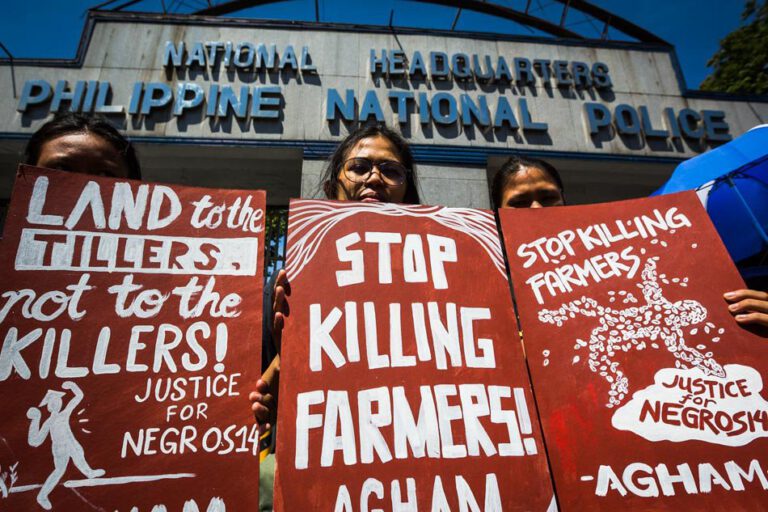
In a statement, ICHRP, a global network of human rights advocates, has strongly condemned the killing of farmers in this time of the pandemic. On top of the already slumped agriculture and distressed food producers, the relentless killings and attacks have wreaked fear in the country’s rural areas.


The farmers slain by state forces were identified as Jeric Vuno, Jerry Palanca, Robert Villafuerte, Raymundo Tañada, and Jaime Tañada residents of Dolos village in Bulan, Sorsogon province, 600 kilometres south of Manila. According to local reports, the victims were forcibly taken from their homes and executed at around 5 am on the morning of May 8.


The massacre was denied by the Philippine authorities, who instead claimed that the farmers were rebels. However, reports say that it was the Armed Forces of the Philippines (AFP) and the Philippine National Police (PNP) who arrived that day and summarily executed the residents including Robert Villafuerte, who according to locals, suffers from a mental health problem.


Neighboring residents were also harassed and beaten up by the armed authorities which resulted in physical injuries. The victims were Alvin Abuyog, Randy Golimlim, Marissa Estiller, and her two children.


Another, more recent case is the illegal arrest of farmers in Calaca, in the province of Batangas early morning of May 10 by a joint police and military operation. According to sugar workers and members of the Samahan ng mga Magsasaka sa Coral ni Lopez (Organisation of Farmers in Coral ni Lopez-SAMACOLO), the seized victims were Virgilio Vidal, Marcelo Vidal, July Julongbayan, Leovino Julongbayan, Doroteo Bautista and Roilan Tenorio. The farmers’ group said that they were illegally arrested and that the arresting team forcibly entered the houses and planted guns, ammunition, and explosives. Local residents said that some of those arrested are their village officials and had been facilitating the distribution of cash aid a day before the incident.


The global human rights group has condemned President Duterte for using the COVID-19 as an occasion if not an excuse to further his aims to implement de facto martial law throughout the country. ICHRP highlighted the comment of the UN High Commissioner for Human Rights, Michelle Bachelet that the Philippines’ “highly militarised response” to the pandemic had led to the arrest of more than 120,000 people including activists leading relief efforts.


“It is but heartbreaking and ironic that the killings and abuses continue at a time when we are trying to save lives from the lethal coronavirus,” says ICHRP. The government’s counterinsurgency operations in rural areas have been non-stop despite UN Secretary-General António Guterres’ reiteration for a global ceasefire. With the massacre in Sorsogon and the recent arrests in Batangas, food producers and rural folks have become the collateral damage. Since Duterte became president, there have been nearly 250 political killings of farmers.

“We call on our international colleagues to press for the accountability of state forces in the killings, arrests and other human rights violations in the Philippines,” ICHRP concluded.#
PH government urged to set political prisoners free amid the outbreak of coronavirus in jails

News Release

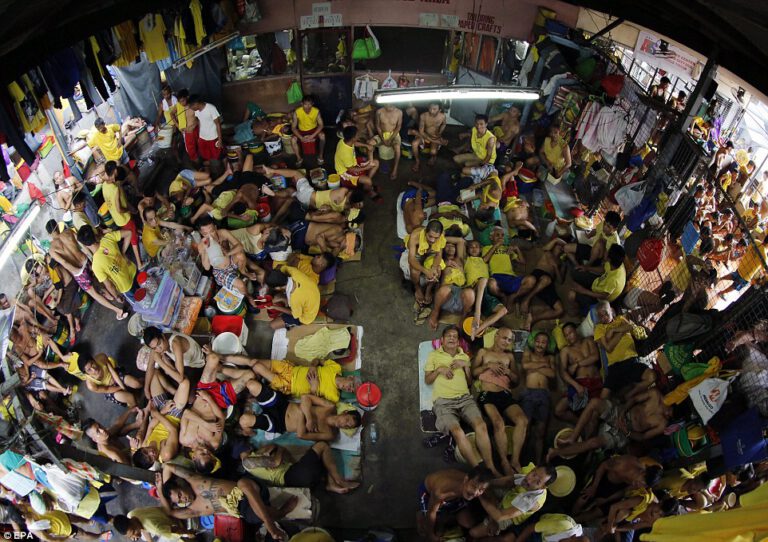
The International Coalition for Human Rights in the Philippines reiterates its call to release political prisoners as COVID-19 infects hundreds in crowded Philippine prisons. Coronavirus outbreaks have been reported in one of the most congested jail facilities in the world, infecting both inmates and corrections personnel.

“With the Covid-19 outbreak in prisons, the 609 political prisoners are already facing their death sentence. The Duterte government should act now and release them on humanitarian grounds,” says ICHRP chairperson Peter Murphy.

Earlier last week, ICHRP and other human rights group raised concerns of underreporting of COVID-19 cases in detention facilities together with prison deaths not fully reported. At least four prisoners have died of the virus while more than 300 detainees tested positive for the virus in Cebu City Jail, in Central Philippines. Fears of outbreaks in other prison facilities linger as mass testing of prisoners remains unprioritized.

Despite the directive of the Supreme Court to release 9,731 detainees unable to afford bail, no political prisoners were freed. Most of the political prisoners’ cases are non-bailable and have been stalled in courts for years. Dario Tomada, a 60-year-old political detainee with diabetes and suffering from two respiratory ailments has been behind bars for 10 years because of the slow judicial process.

ICHRP also notes that these political prisoners are Filipino farmers, union leaders, critics of the government, and human rights defenders jailed under trumped-up charges. Most of them are still to undergo trial which according to the Philippine Constitution and international law makes them innocent until proven guilty beyond reasonable doubt.

“The same compassion shown to the 9,731 released prisoners should be given to political prisoners. We are once again appealing to the leaders of the Philippine judiciary system to act now, to make the just, humane decision of freeing the elderly, sick, vulnerable and all political prisoners,” says Murphy, as the Supreme Court has yet to decide on a bid to release political prisoners.
Families and human rights lawyers of 23 political detainees filed their petition to the country’s highest Court last April 8, asserting that they are not flight risks because they are old, frail, and sickly.

The filed petition also includes the creation of a Prisoner Release Committee which is intended to “urgently study and implement the release of all other prisoners in various congested prisons throughout the country who are similarly vulnerable but cannot be included in this Petition due to the difficult circumstances.”

Releasing prisoners had been endorsed by the United Nations High Commissioner for Human Rights Ms. Michelle Bachelet. Other international groups such as the Prison Policy Initiative called for the release of low-risk detainees while Human Rights Watch warned about “catastrophic public health problems” if the government does not address the worsening situation of the Philippine prison system.

As of March 2020, the recorded congestion of Philippine prison facilities was 534%. Combined with unsanitary facilities, lack of water, nutritious food, and medical services, this situation has led to outbreaks of tuberculosis, other infectious diseases, and now the current threat of COVID-19.

Finally, ICHRP urges President Duterte and his government to heed the call of United Nations High Commissioner for Human Rights Ms. Michelle Bachelet: “governments should release every person detained without sufficient legal basis, including political prisoners and others detained simply for expressing critical or dissenting views.”#

Photo from : European Pressphoto Agency

Reference:
Peter Murphy, Chairperson
International Coalition for Human Rights in the Philippines
Email: peter_murphy1_au@bigpond.com

OPEN LETTER: Urging again the Supreme Court of the Philippines to send political prisoners home

May 5, 2020,

H. E. Mr Rodrigo Duterte,

President of the Republic of the Philippines

Malcanang Palace

E-mail: op@president.gov.ph or http://op-proper.gov.ph/

Urging again the Supreme Court of the Philippines to send political prisoners home

Dear Excellency,

Following the release of 9,731 prisoners between March 17 and April 29, 2020, due to directives aimed at decongesting jails during the COVID-19 pandemic, and your statement that 100 prisoners would be released each week, the International Coalition for Human Rights in the Philippines (ICHRP) is again urging the Supreme Court of the Philippines to delay no longer its decision on the release of political prisoners.

The Supreme Court has been considering this petition since April 17, when we wrote to you last, and may have delayed to await a move from you.

We are appealing to the leaders of the Philippine judiciary system to make the just, humane and compassionate decision of urgently freeing the elderly, sick and vulnerable political prisoners. There are 609 political prisoners detained in congested prisons and 47 of them are elderly while 63 are with pre-existing medical conditions and suffering from life-threatening illnesses.

Twenty-three of these detainees filed their petition to the Supreme Court last April 8, asserting that they are not flight risks because they are old, frail and sickly. Last March 29, Karapatan also made an urgent appeal for the release of political prisoners, especially those suffering from debilitating illnesses and the elderly.

We in ICHRP support the families, lawyers and human rights advocates in the Philippines working towards sending them home from these high-risk prisons.

ICHRP also notes that these political prisoners are Filipino farmers, union leaders, critics of the government and human rights defenders jailed under trumped-up charges. Most of them are still to undergo trial which according to the Philippine Constitution, and international law makes them innocent until proven guilty beyond reasonable doubt.

The filed petition also includes the creation of a Prisoner Release Committee which is intended to “urgently study and implement the release of all other prisoners in various congested prisons throughout the country who are similarly vulnerable but cannot be included in this Petition due to the difficult circumstances.”

Releasing prisoners had been endorsed by the United Nations High Commissioner for Human Rights Ms Michelle Bachelet. Other international groups such as the Prison Policy Initiative called for the release of low-risk detainees while Human Rights Watch warned about “catastrophic public health problems” if the government does not address the worsening situation of the Philippine prison system.

As of March 2020, the recorded congestion of Philippine prison facilities is 534%. Combined with unsanitary facilities, lack of water, nutritious food and medical services, this situation has led to outbreaks of tuberculosis, other infectious diseases and now the current threat of COVID-19.

Finally, ICHRP has urged the Court to heed the call of United Nations High Commissioner for Human Rights Ms Michelle Bachelet: “governments should release every person detained without sufficient legal basis, including political prisoners and others detained simply for expressing critical or dissenting views.”

As of this writing, countries that have released prisoners as part of their response to the pandemic include the USA, Canada, Germany, Iran, India, Indonesia, Ethiopia, Morocco, and Egypt.

Sincerely,

Peter Murphy, Chairperson, Global Council,

International Coalition for Human Rights in the Philippines

Cc: Mr. Diosdado M. Peralta, Chief Justice of the Supreme Court of the Philippines; Mr. Menardo Guevarra, Secretary of the Department of Justice; Mr. Jose Luis Martin Gascon, Chairperson of the Commission on Human Rights; Mr Antonio Guterres, United Nations; UN Special Rapporteur on EJK; DFAT Desk; Senator Marise Payne, Minister for Foreign Affairs; Senator Penny Wong; Senator Richard Di Natale, Andrew Wilkie MHR; Julia Dean.

LABOR DAY: Protests against Duterte’s “De Facto” Martial Law held around the world

News and Video Release

ICHRP condemns Labor Day arrests and murder of Filipino activist leading relief response to COVID-19

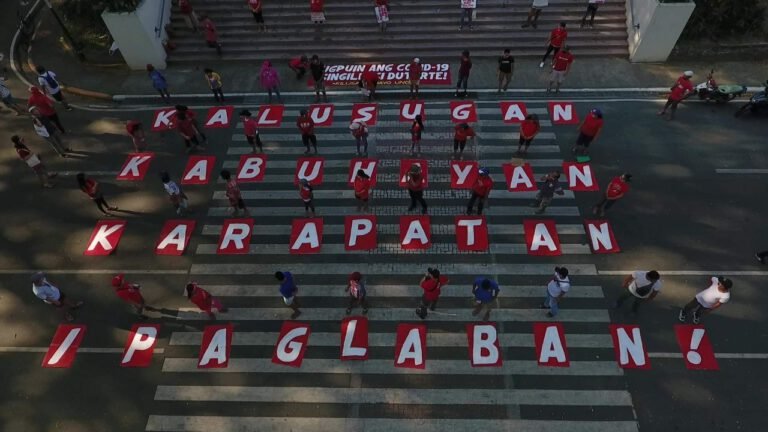
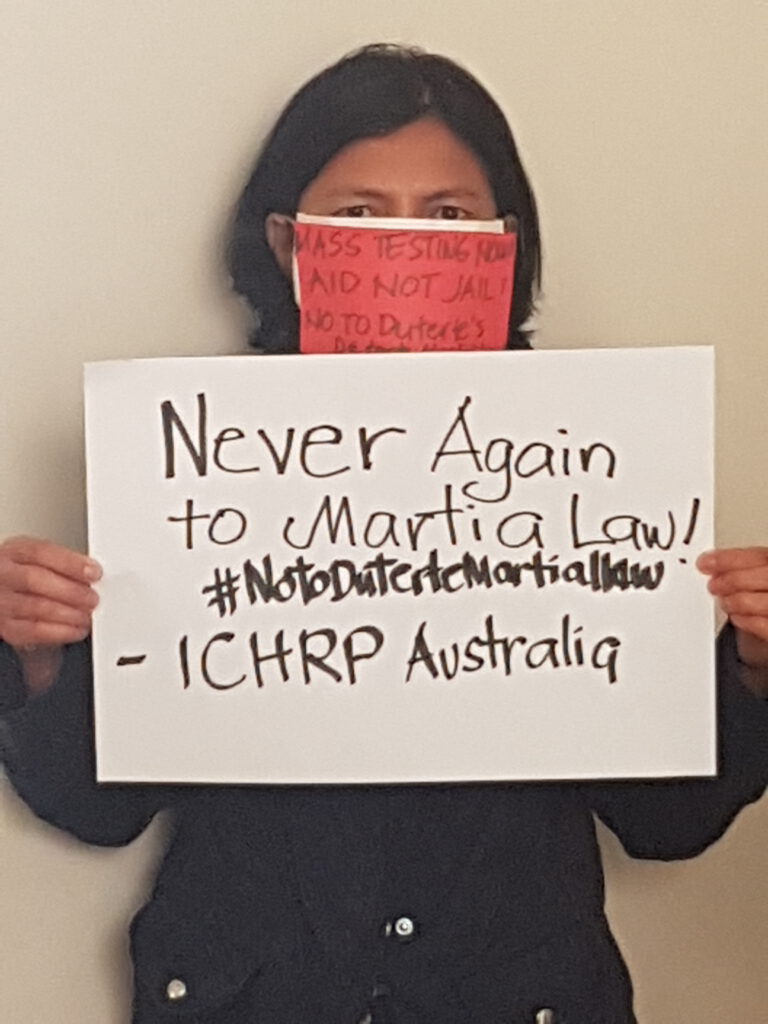
More than 20 cities launched physical and online protests in today’s International Workers Day to denounce President Duterte’s De Facto Martial Law. International Coalition for Human Rights in the Philippines (ICHRP) initiated the global day of action together with its chapters in Europe, North America, Asia, and Australia.

Protests were held in Vancouver, Toronto, Ottawa, Washington D.C., Portland, San Francisco, New York, Honolulu, New Jersey, London, Amsterdam, Spain, Sweden, Austria, Switzerland, France, Seoul, Hong Kong, Sydney, and Manila. 

Workers and youth launch a lightning rally with precaution and distancing in Manila, Philippines.

“We are supporting the workers and Filipinos’ fight against Duterte’s tyranny. We have strongly denounced his repressive policies and now, more than ever rejects his Martial Law agenda at the time of Covid-19 pandemic,” says ICHRP chairperson Peter Murphy who also joined protests in Sydney.

The global human rights group noted that on top of Duterte’s bloody human rights record, there is now a more brutal crackdown against civilians and critics. Recently, the Philippines earned the reprimand of the United Nations when it called out governments who used repressive measures to contain the spread of the coronavirus. UN High Commissioner for Human Rights, Michelle Bachelet cited how the Philippines’ “highly militarised response” to the pandemic had led to the arrest of 120,000 people for violating the curfew.

“We deplore that the Duterte Regime has been using Covid-19 as a means of furthering his aims to implement de facto martial law throughout the country,” says ICHRP’s Asia-Pacific spokesperson Sister Patricia Fox.

Migrant workers in Hong Kong join the Global Protest

Filipino organisations who have been extending relief to those affected by the lockdown are being targeted, arrested, and red-tagged by authorities. On the eve of Labor Day,  local community leader Jose Reynaldo Porquia was assassinated. He was leading relief efforts in poor communities in Iloilo City, Central Philippines. “We are denouncing the brutal killing of Porquia. We are one with families and friends in demanding justice. The utter disregard for life and attacks against civilians doing humanitarian work merits international condemnation. We say no more to Duterte’s de facto Martial Law!”, Murphy stressed.

The global human rights group also condemns the recent attacks against relief volunteers and activists during the International Labor Day. A spike in arrests and detention were documented in the country’s capital Manila, in parts of Luzon and Central Philippines:

·  Four youth volunteers of a feeding program and 14 residents of Barangay. Central in Quezon city

·  Ten volunteers distributing food packs in the city of Marikina

·  Four residents of “Protest From Home” in Valenzuela

·  Two unionists holding up placards in Rodriguez, Rizal province

·  16 workers of Coca-Cola factory were abducted and forced to surrender as rebels in Sta. Rosa, Laguna province

·  42 citizens conducting a caravan and candle lighting for the slain activist Porquia in Iloilo, Central Philippines

“The irony that they’ve been arresting workers and volunteers during Worker’s Day attests to the De facto Martial law being implemented across the archipelago. Relief volunteers should be allowed to serve the poor, more so, workers and activists exercising their right to peaceful protests should be left alone,” says ICHRP.

ICHRP US

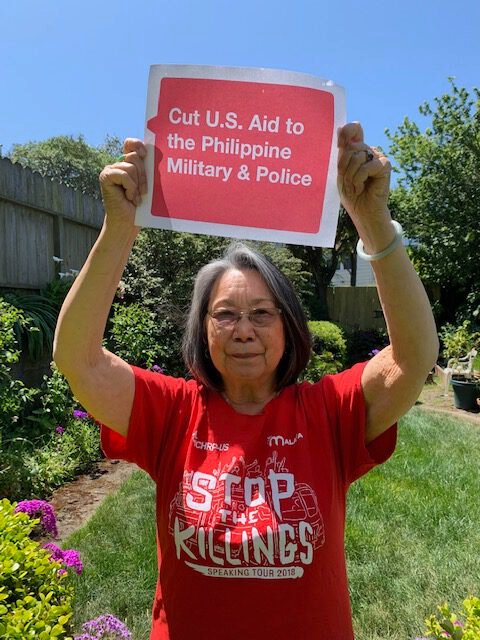
“While appalling, Duterte’s militarist response to COVID-19 is in character with his violent regime. Four years into his presidency, Duterte continues to shift from policy to policy that all manifest in de facto martial law in the country”, says ICHRP-US spokesperson Drew Elizarde-Miller in their online Labor Day protest. The ICHRP chapter in the US has been consistently campaigning for the end of US military aid that goes to Duterte’s drug war and repressive policies.

In the same series of protests, members of ICHRP Europe also called for the release of political prisoners on humanitarian grounds as the whole world battles the COVID-19 pandemic. As of March 2020, the recorded congestion of Philippine prison facilities is 534% with 133,316 deprived of liberty according to the country’s Bureau of Jail Management and Penology. There have been more than 100 confirmed cases of COVID-19 in these prisons and accounts of under-reporting have raised concerns from ICHRP, Human Rights Watch, and other international groups.

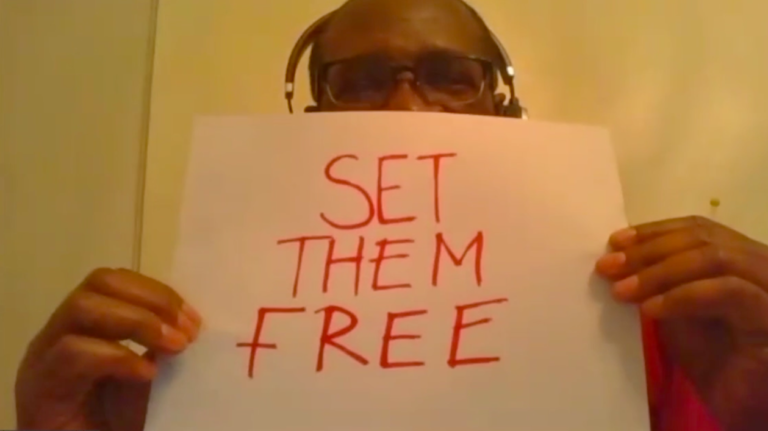
In a recorded video, the same calls to release political prisoners was echoed by ICHRP Canada board member Rev. Japhet Ndhlovy saying that: “Set them free. This is a health crisis and not a militarized situation. They also asserted that the government should address the health crisis by improving health facilities, conducting mass testing for all and providing all the necessary protective equipment for front line workers, instead of intensifying militarization and violence.  

“As the global pandemic and economic crisis worsens, we call on our international colleagues to press for the accountability of state forces in the killings and other human rights violations in the Philippines. We should turn our faces to the Philippines as workers, farmers, urban poor and a growing number of Filipinos struggle against a tyrant. The people of the world demand health care and livelihood, not martial law!” Murphy concluded.#

Reference: 

Peter Murphy, Chairperson

International Coalition for Human Rights in the Philippines

Email: peter_murphy1_au@bigpond.com

Duterte Regime is using COVID-19 as a prelude to de facto Martial Law

Asia Pacific Coalition for Human Rights in the Philippines

PRESS STATEMENT

Rather than expediting the distribution of relief goods and financial assistance to impoverished Filipinos, the regime of President Rodrigo Duterte has instead used the COVID-19 pandemic to creep closer towards authoritarian rule.

The Asia-Pacific Coalition for Human Rights in the Philippines (APCHRP) expresses strong concerns that the viral outbreak is being used as a disguise to usher in de facto martial law. This is evidenced by growing crackdown against dissenters and the preference of the Duterte Regime to use military/police action rather than a medical response to the pandemic.

One of the earliest moves of the current regime to respond to COVID-19 was to seek emergency powers from Congress. Despite having ample resources at his disposal to properly stymie the spread of the virus, President Duterte aimed to consolidate more power for his administration.

These extended powers were used to modify the 2020 national budget, repurposing hundreds of billions of pesos for the COVID-19 response instead. Despite the exorbitant amount of funds at their disposal, the Duterte Regime has failed to adequately ameliorate millions of impoverished Filipino households – many have suffered from the lockdown restrictions put in place.

Many of these destitute Filipinos are going hungry, but when they attempt to demand for food packs or financial assistance, they are violently dispersed. A good example is the brutal crackdown of residents of San Roque, Quezon City who were asking for relief assistance – 21 of them were detained by the Philippine National Police (PNP) instead.

Recently, volunteers from Tulong Anakpawis and Sagip Kanayunan who were on their way to distribute relief packages to needy families in Norzagay, Bulacan were unjustly apprehended at a police checkpoint. This group of 7 volunteers and former Anakapawis representative Ariel Casilao were later charged with sedition.

At a time when a multitude of Filipino families are going hungry due to an inept government response, the goodwill and charity of private organisations should be welcomed. Instead, because they have contrasting views with the Duterte Regime, they are being punished.

The present administration’s contempt for activist groups was made even clearer yesterday, when Bayan Muna Iloilo City leader Jory Porquia was senselessly murdered. In the early hours of Thursday 30th of April, Jory was attacked by assailants and suffered nine gunshot wounds – including to the head.

While the motives for his murder are still largely unknown, Jory was known to be an outspoken critic of the Duterte Regime and a tireless activist in the area. He vigorously worked to distribute relief assistance to impoverished families in Iloilo City during the COVID-19 pandemic; Jory devoted his life to serve the people and was repaid with a brutal fate for his beliefs.

The heightened use of military and police strength, the brutal crackdown of activists, and the consolidation of power by the Duterte Regime are akin to the martial law era under former President Ferdinand Marcos. While thousands of Filipinos are becoming sick due to COVID-19, Philippine democracy has also become ill with a virus called authoritarianism.

No less than the United Nations Commissioner for Human Rights, Michelle Bachelet, expressed concerns that some countries – the Philippines included – were “flouting the rule of law in the name of fighting the pandemic”.

Bachelet warned “emergency powers should not be a weapon governments can wield to quash dissent, control the population, and even perpetuate their time in power.”

APCHRP urges the Duterte administration to heed the call of Commissioner Bachelet and to restrain his military and police forces from inflicting human rights abuses during this health crisis. We also strong condemn the heightening violence in the Philippines during the pandemic and call on the government to uphold the rule of law.

The COVID-19 pandemic requires a medical response, not a militaristic one. Expediting the distribution of relief packs and the social amelioration program (SAP) payments should instead be the focus of the Duterte regime, not the imposition of de facto martial law.

For reference: Sister Patricia Fox

                       APCHRP Spokesperson