
Home Blog Page 194

Fighting for human rights and peace when it is already the Law

Keynote Speech at the International Conference on Human Rights and Peace in the Philippines

Quezon City, Philippines
July 19, 2013

By JEANNE MIRER
President, International Association of Democratic Lawyers

I want to thank the organizers of this important conference for the gracious invitation to address you today. I am the President of the International Association of Democratic Lawyers or IADL. IADL from its inception in 1946 has fought for the rights of peoples throughout the world to live in peace with human dignity. We were founded to promote the goals of the United Nations Charter and through the common action of lawyers, side by side with the peoples of the world we work to promote these important goals.

I have been a peoples’ lawyer for forty two years and the organization in the United States in which I work is the National Lawyers Guild or NLG. The NLG last year celebrated its 75th anniversary. The NLG was instrumental in the founding of the IADL and has always supported its work.

I have always felt especially close to our friends in the Philippines and the National Union of Peoples’ Lawyers since as a college student in the late 1960s I studied the American War against the Philippines. I was interested in studying the contending forces in the United States which lined up for and against the US effort to become a colonial power, replacing Spain as the overlords of the Filipino people after purchasing the Philippines from Spain for 20 million dollars. I studied the efforts of the Anti-Imperialist League to try to stop and end the war, and their efforts to expose US atrocities in the execution of the war. At the time I was searching for the roots in American history of the American war against Vietnam, and saw many parallels between the two wars and how the Anti-Imperialist League had not been able to hold back or defeat the forces of expansion. But as the internal logic of capitalism requires expansion and growing profits, the forces for expansion had the upper hand. Also, one cannot underestimate the role racism played in both the United States’ wars against the Philippines and Vietnam, but one thing is certain, ever since the American war against the Philippines there has been an ever growing military industrial complex which today is the largest in the world and which through the hundreds of military bases around the world is able to protect the economic interests of the United States and multinational corporations. This military industrial complex also increases the likelihood that throughout the world international, and intra national disputes will turn to military options as a first rather than last resort.

This year, 2013 is the fiftieth anniversary for two important events. Both of which I experienced. The first is Bob Dylan singing “Masters of War” which was published in 1963 and is his homage to the U.S. Military Industrial Complex. Some of the most relevant verses come to mind:

Come you masters of war
You that build the big guns
You that build the death planes
You that build all the bombs
You that hide behind walls
You that hide behind desks
I just want you to know
I can see through your masks

* *.

Let me ask you one question
Is your money that good
Will it buy you forgiveness
Do you think that it could
I think you will find
When your death takes its toll
All the money you made
Will never buy back your soul.

The second is the fiftieth anniversary of the historic 1963 march on Washington which attracted hundreds of thousands of marchers, which I attended as a teenager, and in which Martin Luther King delivered what has come to be known as his “I have a Dream” speech. This march occurred 100 years after the 1863 Emancipation Proclamation issued by President Lincoln which freed the slaves, only to see that charter of freedom, and the 13th Amendment which enshrined it become a hollow promise, with the advent of Jim Crow laws and de jure segregation. Before Martin Luther King turned to the hopeful and forward looking portions of his speech, in which he articulated a hope and dream for a non-racial and non-racist future, he discussed the reality of racism in the United States: He said:

“One hundred years later, the Negro lives on a lonely island of poverty in the midst of a vast ocean of material prosperity. One hundred years later, the Negro is still languishing in the corners of American society and finds himself an exile in his own land. So we’ve come here today to dramatize a shameful condition. In a sense, we’ve come to our nation’s capital to cash a check. When the architects of our republic wrote the magnificent words of the constitution and the Declaration of Independence, they were signing a promissory note to which every American was to fall heir.

This note was a promise that all men – yes, black men as well as white men – would be guaranteed the inalienable rights of life, liberty, and the pursuit of happiness. It is obvious today that America has defaulted on this promissory note in so far as her citizens of color are concerned. Instead of honoring this sacred obligation, America has given the Negro people a bad check, a check which has come back marked “insufficient funds”.

But we refuse to believe that the bank of justice is bankrupt. We refuse to believe that there are insufficient funds in the great vaults of opportunity of this nation. So we have come to cash this check, a check that will give us upon demand the riches of freedom and the security of justice.

We have also come to this hallowed spot to remind America of the fierce urgency of now. This is no time to engage in the luxury of cooling off or to take the tranquilizing drug of gradualism.

Now is the time to make real the promises of democracy.

I have been reflecting a lot lately on these two aspects of the 1960s struggles and what might be called anthems of the American anti-war and civil rights movements.

There is no question but the United States is the largest supplier of arms to the world and that all of the industries which profit from supporting a large military, and never saw a war they did not want to fight, are some of the first to criticize the peoples’ movements for economic justice where the demand is made for the government to provide basic economic human rights such as decent work, housing, health care and food and education. But, in Masters of War, we do not hear that as a matter of law both the threat of or the use of force in settling international disputes are actually illegal under the United Nations Charter, or that even taking up arms in self-defense is legally limited only to instances where it is necessary to repel an armed attack or in the absence of an armed attack, that the threat of armed attack is so “instant, overwhelming, and leaving no choice of means, and no moment for deliberation”. In “Masters of War” Dylan does not acknowledge that Article 26 of the UN Charter commits the world to work toward disarmament.

There are similar types of omissions from Martin Luther King’s “I Have a Dream” speech. That is, although by 1968 Martin Luther King, had denounced the American War against Vietnam, and had become a champion of the struggle for economic justice as well as civil rights, and was assassinated the night after marching with striking sanitation workers in Memphis Tennessee, in his 1963 “ I Have A Dream” speech, referenced only the Declaration of Independence. He did not acknowledge the existence of such important declarations as the 1944 Declaration of Philadelphia where the International Labor Organization had declared: (a) labour is not a commodity; (b) freedom of expression and of association are essential to sustained progress; (c) poverty anywhere constitutes a danger to prosperity everywhere; (d) the war against want is required to be carried on with unrelenting vigor within each nation, and by continuous and concerted international effort in which the representatives of workers and employers, enjoying equal status with those of Governments, join with them in free discussion and democratic decision with a view to the promotion of the common welfare and that all national and international policies and measures, in particular those of an economic and financial character, should be judged in this light and accepted only in so far as they may be held to promote and not to hinder the achievement of this fundamental objective;

We know the Declaration of Philadelphia was a source for inspiration of the 1948 Universal Declaration of Human Rights or UDHR. The UDHR declares both civil and political rights and economic social and cultural rights to be the basic rights everyone has a right to enjoy, and which declares the fundamental human rights all persons, have a right to expect. But there is no reference to the Philadelphia Declaration or the Universal Declaration of Human Rights in the “I have A Dream” speech.

Why did Bob Dylan in “Masters of War” omit any mention of the right to peace in the UN Charter, and why is there no mention of the UDHR in Martin Luther King’s “I have a Dream” speech? It is true that the United Nations at this time was somewhat paralyzed by the Cold War resulting in the general population not paying much attention to it, especially after the UN General Assembly initiated the “Police Action” on the Korean Peninsula in 1059. It is also true that in 1963 the United States was just emerging from the anti-communist hysteria of the McCarthy period, and Martin Luther King was always suspected of being a communist, and was spied on by the FBI for most of his life and that reference to economic human rights would have likely been considered subversive. And while I know songs or speeches do not cover everything, I am quite sure that a major reason why neither Dylan in “”Masters of War” did not mention the UN Charter nor did Martin Luther King in his “I have a Dream” speech reference the UDHR or other international human rights instruments, is that in the US and most likely all countries of the world, these documents and the rights and duties they spell out have been made to disappear so that the people do not know of their existence and/or that their governments have ratified these documents. Knowing that one’s government has committed through ratification of the UN Charter to respect international law to peacefully settle international disputes or to implement basic human rights can be a major and powerful boost to people in their day to day struggles for human rights and peace in world. It is precisely for this reason why I believe there is a conspiracy of silence about them. The rights and duties required under the UN Charter or in basic human rights documents are not even taught in law schools, which begs the question of how can peoples’ lawyers articulate these rights to the people or try to enforce them in the domestic courts or international agencies if we ourselves remain in the dark?

What can we do to change this state of affairs and lack of knowledge? In early 2011 the International Committee of the National Lawyers Guild put on a webinar entitled: “Human Rights 101 Using International Instruments to Work for Economic Social and Cultural Rights.” The audio recording and the power point are still available on the web at:

http://www.nlginternational.org/webinars/humanrights-mirer.mp3 and

http://www.nlginternational.org/webinars/humanrights-mirer.pdf

While this webinar and power point are more specific to the United States situation as the US has not ratified the International Covenant on Economic Social and Cultural Rights, I would like to go over some of the information from this webinar as part of this speech so as to familiarize you with topics which you will likely hear throughout this conference.

It is important therefore to consider the basic human rights treaties from the perspective of their role in promoting peace and also what has happened in the world order which has undermined the progressive realization of basic human rights.

The Universal Declaration although signed and executed in 1948 reflects the recognition in the 1945 United Nations Charter of the direct link between promoting and protecting human rights and ending the conditions that lead to war. The preamble to the UN Charter recognizes that the peoples of the world have the right to live in peace. It is important to quote the preamble:

WE THE PEOPLES (emphasis on the people not states) OF THE UNITED NATIONS DETERMINED

  • to save succeeding generations from the scourge of war, which twice in our lifetime has brought untold sorrow to mankind, and

  • to reaffirm faith in fundamental human rights, in the dignity and worth of the human person, in the equal rights of men and women and of nations large and small, and

  • to establish conditions under which justice and respect for the obligations arising from treaties and other sources of international law can be maintained, and

  • to promote social progress and better standards of life in larger freedom,

The Charter begins with these inspirational and aspirational words embracing human rights as fundamental to the promotion of social progress and better standards of life in larger freedom. One of the first actions of the UN was to identify these human rights and they did so through producing the Universal Declaration of Human Rights or UDHR. The Universal Declaration of Human Rights which was not a treaty but a relatively short, inspirational and energizing document usable by the people and designed to be the foundation and central document for an international bill of human rights. It was the first document to combine both civil and political rights and economic, social and cultural rights in one indivisible whole. The Universal Declaration connected the issue of realization of all human rights to the cause of peace and states that a common understanding of these rights is of great importance to their realization. This is evident in the Preamble to the UDHR which states.

Whereas recognition of the inherent dignity and of the equal and inalienable rights of all members of the human family is the foundation of freedom, justice and peace in the world,

Whereas disregard and contempt for human rights have resulted in barbarous acts which have outraged the conscience of mankind, and the advent of a world in which human beings shall enjoy freedom of speech and belief and freedom from fear and want has been proclaimed as the highest aspiration of the common people,

Whereas it is essential, if man is not to be compelled to have recourse, as a last resort, to rebellion against tyranny and oppression, that human rights should be protected by the rule of law,

Whereas it is essential to promote the development of friendly relations between nations,

Whereas the peoples of the United Nations have in the Charter reaffirmed their faith in fundamental human rights, in the dignity and worth of the human person and in the equal rights of men and women and have determined to promote social progress and better standards of life in larger freedom,

Whereas Member States have pledged themselves to achieve, in co-operation with the United Nations, the promotion of universal respect for and observance of human rights and fundamental freedoms,

Whereas a common understanding of these rights and freedoms is of the greatest importance for the full realization of this pledge,

The UDHR is set forth in 30 Articles as follows:

Article 1 reflects the inspirational nature of the project. It proclaims in ringing terms that:

“All human beings are born free and equal in dignity and rights. They are endowed with reason and conscience and should act towards one another in a spirit of brotherhood”.

Article 7 follows up this theme by saying that all are to be equal before the law and have a right to protection against any form of discrimination.

Articles 3 and 25 are probably the core of the substantive provisions in the Declaration. They give every human being the rights to life, to liberty, to security of person (Art 3); and to an adequate standard of living (Art 25). Articles 1, 3 and 7 constitute the UDHR’s core civil and political rights. Article 25 is the core of the economic and social rights. The right to an adequate standard of living is interesting in that it specifies as part of it the right to health and well-being not only of a person but of his or her family, but also the right to necessary food, clothing, housing and medical care, and the right to social security (also covered in Art 22). Article 23 also spells out the right to work under decent conditions of work, and for workers to form trade unions to protect their interests.

Article 28 is one of the most important Articles in that it states Everyone is entitled to a social and international order in with the rights and freedoms set forth in this Declaration can be fully realized.

The UDHR brought the world into the modern era of rights by introducing and/or reinforcing at least five key concepts:

  1. All human rights have both negative and positive components (i.e. they address both what government should and should not do);

  2. Human rights include the economic and social sphere, in particular issues of education, housing health, work, food and social security;

  3. Rights are universal, transcending national borders, and their legitimacy is no longer dependent on national recognition;

  4. Prohibitions on discrimination in the protection of human rights extend both to the purpose and the effect of government action and inaction; and

  5. Human rights are interdependent and cannot be viewed in isolation.

When the General Assembly passed the Universal Declaration the resolution included a provision that called upon all Member countries to publicize the text of the Declaration, and “to cause it to be displayed, read and expounded principally in schools and other educational institutions without distinction based on political status of countries or territories.”

As I have said, this obligation to publicize has been virtually ignored and at least in the United States, the rights contained in the UDHR and subsequent human rights instruments have remained largely invisible to the people. The same can be said for the two major human rights treaties which were written to implement the rights in the UDHR: the International Covenant on Civil and Political Rights, (ICCPR) and the International Covenant on Economic Social and Cultural Rights. (ICESCR).

The covenants were simultaneously adopted on December 16, 1966 and put forward for ratification by member states. Enough member states had ratified them as of January 3, 1976 that they went into effect. The overwhelming majority of countries in the world have ratified both the ICCPR and the ICESCR. This includes the Philippines, but does not include the United States which has only ratified the ICCPR. I want to focus primarily on the ICESCR as it is the deprivation of basic economic human rights which makes the day to day struggle for survival the primary focus of peoples’ lives making it difficult to exercise their civil and political rights.

The Covenant on Economic Social and Cultural Rights has five parts.

Part 1 (Article 1) recognizes the right of all peoples to self-determination including the right to “freely determine their political status” to pursue their economic, social and cultural goals, and manage and dispose of their own resources. It recognizes a negative right of a people not to be deprived of its means of subsistence and imposes an obligation on those parties still responsible for non-self-governing and trust territories (colonies) to encourage and respect their self-determination.

Part 2 (Articles 2 – 5) establishes the duty of State Parties to use and devote the maximum of its available resources to using progressively realize the rights contained in the Covenant. It also requires the rights be recognized “without discrimination of any kind as to race, color, sex, language, religion, political or other opinion, national or social origin, property, birth or other status. The rights can only be limited by law, in a manner compatible with the nature of the rights, and only for the purpose of “promoting the general welfare in a democratic society”.

Part 3 (Articles 6 – 15) lists the rights themselves. These include rights to

• work, under “just and favorable conditions”, with the right to form and join trade unions (Articles 6, 7, and 8);

• social security, including social insurance (Article 9);

• family life, including paid parental leave and the protection of children (Article 10);

• an adequate standard of living, including adequate food, clothing and housing, and the “continuous improvement of living conditions” (Article 11);

• health, specifically “the highest attainable standard of physical and mental health” (Article 12);

• education, including free universal primary education, generally available secondary education and equally accessible higher education. This should be directed to “the full development of the human personality and the sense of its dignity”, and enable all persons to participate effectively in society (Articles 13 and 14);

• participation in cultural life (Article 15).

Many of these provisions include specific actions which must be undertaken to realize them.

Part 4 (Articles 16 – 25) governs reporting and monitoring of the Covenant and the steps taken by the parties to implement it. It also allows the monitoring body – originally the United Nations Economic and Social Council – now the Committee on Economic, Social and Cultural Rights to make general recommendations to the UN General Assembly on appropriate measures to realize the rights (Article 21)

Part 5 (Articles 26 – 31) governs ratification, entry into force, and amendment of the Covenant.

The heart of the ICESCR appears in Principle of progressive realization. Paragraph one of Article 2 states: Each State Party to the present Covenant undertakes to take steps, individually and through international assistance and co-operation, especially economic and technical, to the maximum of its available resources, with a view to achieving progressively the full realization of the rights recognized in the present Covenant by all appropriate means, including particularly the adoption of legislative measures.

The duty to take steps to progressively realize the rights in the Covenant is not a hollow duty. It is a continuing affirmative obligation. It also rules out deliberately regressive measures which impede that goal.

The Treaty Body responsible for interpreting and enforcing the provisions of the ICESCR is the Committee on Economic Social and Cultural Rights. The Committee has issued in General comment 3 a full description of what taking steps to progressively realize the rights in the Covenant.

The principal obligation of result reflected in article 2 (1) is to take steps “with a view to achieving progressively the full realization of the rights recognized” in the Covenant. The term “progressive realization” is often used to describe the intent of this phrase. The concept of progressive realization constitutes recognition of the fact that full realization of all economic, social and cultural rights will generally not be able to be achieved in a short period of time. In this sense the obligation differs significantly from that contained in article 2 of the International Covenant on Civil and Political Rights which embodies an immediate obligation to respect and ensure all of the relevant rights. Nevertheless, the fact that realization over time, or in other words progressively, is foreseen under the Covenant should not be misinterpreted as depriving the obligation of all meaningful content. It is on the one hand a necessary flexibility device, reflecting the realities of the real world and the difficulties involved for any country in ensuring full realization of economic, social and cultural rights. On the other hand, the phrase must be read in the light of the overall objective, indeed the raison d’être, of the Covenant which is to establish clear obligations for States parties in respect of the full realization of the rights in question. It thus imposes an obligation to move as expeditiously and effectively as possible towards that goal. Moreover, any deliberately retrogressive measures in that regard would require the most careful consideration and would need to be fully justified by reference to the totality of the rights provided for in the Covenant and in the context of the full use of the maximum available resources.

This last sentence, regarding retrogressive measures comes from Article 5 which prohibits States, groups or persons from taking any action or activity aimed at the destruction of any of the rights or freedoms recognized in the present Covenant. That is, once a State has recognized a right contained in the Covenant, in law or practice, and has implemented it, it cannot legally be revoked, nor can a State which may have protected a right to a degree higher than called for in the Covenant, remove that right based on the fact that the Covenant provides lesser protection.

Furthermore, the principle of progressive realization has an affirmative obligation not to discriminate in the provision of these rights on the basis of race, color, sex, language, religion, political or other opinion, national or social origin, property, birth or other status.

The enacting of anti-discrimination provisions and the establishment of enforceable rights with judicial remedies within national legal systems are considered to be appropriate means.

Since 1966 there have been many more important international and regional human rights instruments debated and promulgated in addition to the ICCPR and the ICESCR. However, parallel to but on a completely different track was the rise of powerful multinational corporations and international financial institutions which arose out of the Bretton Woods agreements and were supposed to stabilize the world economy, but in fact have been doing the bidding of former colonial powers, large nations and multinational corporations. The International Labor Organizations’ 1944 Declaration of Philadelphia is still operative and still holds that fighting the war against want must be pursued with vigor and the world’s economic and financial character, should be judged in this light and accepted only in so far as they may be held to promote and not to hinder the achievement of this fundamental objective, and as Article 28 of the Universal Declaration of Human Rights still requires the development and maintenance of a social and economic order in which the rights and freedoms set forth in the Declaration can be fully realized, yet International Monetary Fund and the World Bank have been requiring States to distort their economies and the labor and human rights protections in these documents by conditioning loans and other financial resources on so-called liberalization policies which are part of the neo-liberal economic order which we are suffering with at this time.

This has resulted in a highly undemocratic international economic order. In May 2013 the IADL held a conference in Paris aimed at promoting a new democratic international economic order where we described the current undemocratic international neo-liberal economic order as being dominated by large multinational corporations which seek “liberalization” of laws protecting people in order to promote economies based on the market rather than human rights and needs of people, which includes the right to a healthy environment. We described the main pillars of the neo-liberal economic order to be: (1) deregulation of corporate activities including financial services, (2) privatization of public services such as education and prisons etc.; (3) de-unionization of the workforce, (4) casualization of the workforce with precarious workers i.e temporary, contingent or contract workers; and (5) free trade agreements aimed at protecting direct foreign investments by corporations to the detriment of indigenous rights. We pointed to the massive transfers of wealth upwards into to fewer and fewer wealthy hands both within countries and between countries with growing levels of inequality in both developed and developing countries. We noted the massive public debts owed to international financial institutions and private investors, especially by countries in the South. We also noted the unrest among the people suffering under these policies are dealt with by repression using, among other things, anti-terrorist laws that many countries passed or imposed after 9-11. They are also dealt with by surveillance and the type of national security state revealed by both Bradley Manning and now Edward Snowden.

We also emphasized the militarization which accompanies this economic order reflecting the powerful corporate military industrial complex and a foreign policy based on military intervention in countries which possess resources the United States and the western former colonial powers and their major corporations seek to exploit.

We pointed out that media corporations promote celebrity and spectacles as news and do not seek to educate the people about the nature of the current order and differences between people based on class, race, gender, religion, and citizenship status, and other characteristics are exploited in order to divert attention away from the fact that these divisions are a result of and exacerbated the economic order. Most importantly, we pointed to both an ignorance of and lack of respect for law and legal obligations, especially international law and international human rights (including labor) law and growing impunity for violating international law. We noted wars of aggression have been fought by superpowers without accountability. Corporations are engaging in illegal land grabbing and other illegal actions in developing countries without accountability.

What does all this mean for us at this conference and our friends throughout the Philippines? As understand it, the Philippine government has a policy designed to warm the neo-liberal heart, a policy which stems from the Presidential Decree under Marcos which has been accepted since known as the automatic appropriation for debt service which requires external debt to be paid before any other budgetary appropriation can be made. This provision was unsuccessfully challenged in 1991 when the Philippine Supreme Court said the policy did not contravene the Philippine Constitution which assigned the highest budgetary priority to education.

But, the Philippine constitution in Article II Section 2 has an inclusion clause whereby the Philippines adopts the generally accepted principles of international law as part of the law of the land… The inclusion of international law would mean the human rights treaties such as the ICESCR which the Philippines has signed and/or ratified as well as the UN Charter and the ILO Constitution which incorporates the Declaration of Philadelphia are part of the law of the land.

I understand that this automatic appropriation for debt service has impeded the Philippine government from living up to its obligations under the ICESCR specifically the obligations to devote the maximum available resources progressively realize the rights contained therein, or to realize the rights under Philippine laws which have been passed to ameliorate the suffering of the Filipino people. The Filipino people have been promised rights under their laws and their constitution as well as International Human Rights treaties they have ratified, but as long as the law which allocates a large portion of the Philippine treasury to pay debt service, that promise is illusory. They have been given the type of bad check, as Martin Luther King stated was given by the United States to African Americans which came back marked insufficient funds.

It is time we say that human rights trump property interests such as service on external debt. It is time that we learned to use human rights law to challenge policies like the automatic appropriation for debt service policy to ensure that the Filipinos can make the Philippine government actually devote maximum available resources to progressively realize basic economic human rights as articulated in the ICESCR and the UDHR. As Martin Luther King stated, we must reject gradualism as the answer. We must embrace the fierce urgency of now. It is time to judge policies which govern the Philippine government’s ability to fight the war on want by accepting laws only in so far as they may be held to promote and not to hinder achievement of this fundamental objective, and to accept laws only in so far as they comply with the command of Article 28 the UDHR to allow everyone to enjoy a social and economic order in which the rights and freedoms set forth in the Declaration can be fully realized.

These same arguments regarding the primacy of human rights law apply throughout the world, in all countries, including those which do not have a policy of automatic appropriation for debt service which siphons funds away from meeting human rights obligations. We must fight to make economic interests adhere to human rights principles. In so doing we can re-write the words to “Masters of War” and inscribe into the history books how the peoples’ fight for human rights allowed us to become the Masters of Peace.

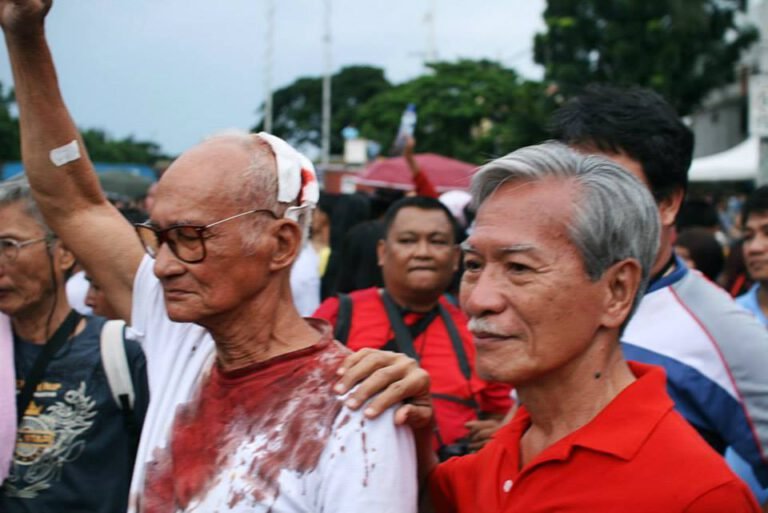
Mrs. Edita Burgos speaks about her son Jonas at the Human Rights Conference

At the opening of the International Conference for Human Rights and Peace in the Philippines on 19 July 2013, Mrs. Edita Burgos speaks of her ordeal as a mother searching for her missing son, Jonas, abducted by the Philippine military — a case akin to other enforced disappearances in the country.

US lawyer calls for peace through respect of people’s economic rights

A prominent American human rights lawyer is calling on Filipinos to use human rights laws and conventions to force the Aquino government into reversing economic policies that adversely affect ordinary citizens, especially the poor.

In her keynote speech before the International Conference on Human Rights and Peace (ICHRPP) at the Great Eastern Hotel in Quezon City, Jeanne Mirer, president of the International Association of Democratic Lawyers and a stalwart of the US National Lawyers’ Guild, said government economic policies should adhere to human rights principles.

Stressing the importance of satisfying the people’s economic rights to achieve peace, Mirer said: “It is time that we use human rights law to challenge policies to ensure that Filipinos can make the Philippine government actually devote maximum available resources to progressively realize basic economic human rights articulated in the International Convention on Economic and Socio-Cultural Rights (ICESCR) and the Universal Declaration on Human Rights (UDHR).”

Calling the current neo-liberal economic order “undemocratic” and dominated by large multinational corporation, Mirer said the people’s unrest resulting from the failure of such policies are dealt with by repression using, among others, anti-terrorist laws that many countries passed or imposed after the 9-11 bombings, and by surveillance and the type of national security state revealed by both Bradley Manning and most recently Edward Snowden.

Mirer said Filipinos should make the Philippine government accept laws that promote “economic democracy” and allow everyone to enjoy “a social and economic order in which the rights and freedoms set in the UDHR are fully realized.”

She said the fight for human rights has allowed its warriors to become “masters of peace”.

Sison warns of more human rights abuses

In his message to the ICHRPP, Jose Ma. Sison, chairperson of the International League of People’s Struggle (ILPS) and NDF chief political consultant, warned that with the Aquino government’s termination of the peace talks with the NDF, “we can anticipate the escalation of counterrevolutionary violence and human rights violations.”

He scored the Aquino government for enabling multinational banks and firms and local ruling elites “to exploit the broad masses of the people and violate their economic, social and cultural rights, and for using the “coercive apparatuses of the state to discourage and suppress  even lawful petitions and protests, especially those of the militant legal mass movement.”

Sison said that behind the Aquino regime’s all-out war policy against the revolutionary movement are orders from the US to carry out Oplan Bayanihan within the context of the US pivot or strategic shift to East Asia.

“The US wishes to tighten its control over the Philippines and use it to realize its strategic objective vis a vis China. It is hell-bent on further entrenching itself and making the Philippine reactionary government more than ever dependent on US military power. In connection with Oplan Bayanihan, it is goading the Aquino regime to engage in provocations and counter-provocations vis a vis China over the sea west of the Philippines. In this context, we can understand why the Aquino regime has terminated the peace negotiations,” Sison said.

Sison concluded his speech by calling on the conference participants to join the international network for promoting and supporting the cause of human rights and just peace in the Philippines.

The ICHRPP peace advocates from the US, Canada, Asia-Pacific, Latin America, Europe and the Middle East are committed to strengthen the international solidarity movement in defense of human rights and peace in the Philippines.

Conference participants are expected to join the people’s mass mobilization during the State of the Nation Address on July 22. ###

Advance our struggle for human rights and peace!

Message to the International Conference for Human Rights and Peace in the Philippines

Quezon City, Philippines
19-21 July 2013

By RENANTE M. GAMARA
EDUARDO O. SARMIENTO
EDUARDO R. SERRANO
Political prisoners
at Camp Crame, Quezon City

We, consultants of the National Democratic Front of the Philippines (NDFP) to the peace talks between the Government of the Republic of the Philippines (GPH)) and the NDFP join our fellow political prisoners, human rights defenders and advocates, friends and relatives of victims of human rights violations, and other personalities for the defense of human rights in expressing our militant support to the success of the International Conference for Human Rights and Peace in the Philippines which will be held on July 19-21 at the Great Eastern Hotel.

We extend our congratulations and thanks to the sponsors (International Coordinating Committee for Human Rights in the Philippines, KARAPATAN and the Ecumenical Voice for Human Rights) of this historical gathering that will uphold and defend the human rights of the Filipino people in particular and of mankind in general.

We salute our martyrs who have paid the supreme sacrifice with their lives in the defense of human rights.

We congratulate also the various human rights organizations and other advocates in launching this activity amidst the continuing impunity of the state agents in violating the basic human rights of the Filipino people and the brittle status of peace in this troubled land.

As political prisoners here in Camp Crame, we have witnessed so many human rights violations against political prisoners and other detainees here and other detention centers all over the archipelago. Women detainees are subjected to sexual molestations and other means of harassment in order for them to submit to the caprices of some jail officials.

Muslim detainees also experienced various unjust restrictions and discriminatory policies that are synonymous to penalties or punishments for so-called “terrorists” labeled by US and Philippine Authorities under their “war on terror” campaign. So many Muslim detainees are incarcerated due to mistaken identity fiasco of the government police and military operations. Many more detainees languished in jails and detention centers due to lack of financial resources and right connections that will assist them in defending themselves in courts or in facilitating their early release based on the absence of probable cause or insufficient evidences.

In our particular case as political prisoners, the National Union of Peoples’ Lawyer (NUPL) in its press statement last September 14, 2012 for the 5th year of its founding and on the occasion of the 40th year of Martial Law stated: “In concurrent jail visits across the country, NUPL highlighted the plight of political prisoners. In the conduct of its advocacy, NUPL has discovered that the alleged acts of prisoners are political in nature. Only a slim minority of political prisoners have been changed with rebellion. In most cases suspected political offenders are improperly charged with non-bailable ordinary crimes.” Furthermore, the same NUPL statement stressed that: “The NUPL has assessed that most of these (cases) are actually improper, false or fabricated charges that further persecute these detainees, degrade their stature, and mock the basic rules of evidence. This is a travesty of justice on top of the multifarious violations of their rights including torture and harassment.

On the other hand, the majority of the Filipino people especially those coming from the workers and peasants are suffering various human rights violations especially their socio-economic and cultural rights. They are being denied their right to health, housing and education. As expounded by Ex-Chief Justice Reynato Puno in his speech at the general assembly of the NUPL NCR last July 6, 2013, he said: “Filipinos must be able to demand from their government their right to housing, education and health or these socioeconomic rights would remain mere words on paper.” He further stressed: “We all know that a right that has no remedy is not a right at all.” He even cited the President Aquino’s veto of the Magna Carta of the Poor and the bill of the traditional view of socioeconomic rights not being demandable and because of a lack of funding to support the enforcement of these rights.

Against the backdrop of massive demolitions of urban poor communities especially in the metropolis to give way to the proposed Public-Private Partnership (PPP) projects of the government that will be established along esteros, ex-CJ Puno cited the experience of South Africa wherein a “South African housing activist who had sought relief before the high court and filed a case against the government after it failed to respond for applications for housing assistance and after it demolished the shacks that Irene Grootboom and her neighbors were occupying. In the end, “the Constitutional Court ruled that the issue raised was justifiable or could be entertained. Thus, “poor people could go to court and ask that their socio-economic rights in this case their right to housing be implemented by the appropriate government officials.

In our country, this will be a long shot target considering the political and economic bias of the justices of the Supreme Court and its lower courts. We can only rely on the militant actions and resistance of the people against these attacks on our democratic rights and freedoms. As stated by the CPP: “Oppression is a necessary concomitant of class exploitation. It is thus in the nature of the monopoly bourgeoisie to carry out attacks on the democratic rights and freedoms of the working class and the rest of the people In order to preserve the system of exploitation.”

We call on all human rights defenders and advocates to rise up the banner in upholding the human rights and raise the demand for “reforms to serve the immediate needs of the people for employment, decent income, better working and living conditions, and the availability of basic social services.”

We must collectively fight for the defense and advance of our human rights – civil, political, social, economic and cultural – for the benefit of the exploited and oppressed people. We must be able to act accordingly as the socio-economic crisis results in political crisis, and the forces and agents of monopoly capitalism malign and try to discredit democratic protest as unlawful rebellion or even as terrorism, and thus justify political repression. We must unite and fight for our human rights and strive to attain a just and lasting peace in our land!

Free all political prisoners!
Advance our struggle for human rights and peace!

Camp Crame, Quezon City
10 July 2013