
Home Blog Page 93

ICHRP on drug-related killings

0

The International Coalition for Human Rights in the Philippines views with grave concern the current drug-related killings which has claimed close to 4,000 lives in the past four months.

President Rodrigo Duterte’s “war on drugs” has identified local drug lords and “narco-politicans” together with their police protectors as promoters of illicit drugs. He has also started to forge agreements with Southeast Asian neighbors to crack down on cross-border drug-trafficking.

We recognize Duterte’s commitment to stamp out drugs in the country. Drug-crazed crimes have risen in the past years and drug abuse is ruining the lives of the working people and the youth. The illicit drug most widely manufactured and distributed is methamphetamine or shabu also known as “poor man’s cocaine”. High society and the rich use more exotic cocktails of drugs.

However, most of the victims are lowly addicts, gunned down under the pretext of having resisted arrest or being armed and dangerous. The rules of engagement during shootouts almost always favor the police version of incidents. It is not unreasonable to doubt that many of the killings are “rub-out operations” aimed at eliminating evidence of the involvement of military, police and government officials in the drug trade.

The ICHRP condemns police brutality in the arrests and killings. Arbitrary murder is a human rights abuse, and the Philippines government must take action to stop this aspect of the anti-drugs campaign.

We insist that the big-time drug lords, foreign and local financiers, and their protectors should be arrested, tried and punished to the fullest extent. Drug peddlers and lowly users should be rehabilitated to become productive members of society.

Illicit drug-use comes from the deepening poverty and suffering of the Filipino people. Its trade is exploited for quick profits by police-protected criminal syndicates. Politics and even international relations have been tainted by it, with the United States, the European Union and the United Nations joining the fray.

Addressing the social, economic and political ills of society is the only way to stamp out narcotics and the drug problem.  Summary killings would only add to the suffering of the people.

Reference:

Peter Murphy
Chairperson, Global Council, ICHRP
Mobile: +61 418312301

Just peace needs patience and resolve

The new global peace community JustPeacePH wants to maximise the prospects of peace in the Philippines despite the uneasy circumstances that have developed over the past week.

“We need patience and resolve to see through all the possibilities for the peace process”, said Peter Murphy, Chairperson of the International Coalition for Human Rights in the Philippines (ICHRP).

President Rodrigo Duterte declared a unilateral ceasefire during his State of the Nation Address (SONA) on Monday, July 25. Four days later, on July 29, he issued a 5:00 p.m. ultimatum for the other side to reciprocate.

Meanwhile, the national leadership of the Communist Party of the Philippines (CPP), New People’s Army (NPA) and the National Democratic Front (NDF) were preparing their own draft interim ceasefire declaration and was reportedly preparing to announce it by 8:00 p.m. on the same day. However, Pres. Duterte withdrew the government’s unilateral ceasefire at 7:30 p.m., before the CPP-NPA-NDF could even reciprocate.

A flurry of accusations and counter-accusations were exchanged between the two parties over the weekend. “We are greatly relieved that by the end of the day on Monday, August 1, both parties confirmed that the formal talks between the Government of the Republic of the Philippines (GRP) and the National Democratic Front of the Philippines (NDFP) in Oslo will definitely resume on August 20, 2016 as scheduled”, Murphy continued.

In response to President Duterte’s pronouncement of July 25, AFP Chief Gen. Ricardo Visaya issued “suspension of offensive military operations” (SOMO) but ordered AFP combat troops to continue “to perform its mandate of protecting the communities and its people from terrorist groups; secure and protect from attacks or sabotage vital government facilities, military camps, infrastructures, and projects”.

On July 26, Ka Oris, spokesperson of the National Operational Command of the New People’s Army (NPA-NOC) released a statement entitled “NPA to be on active defense as it awaits operational details of Duterte ceasefire declaration prior to reciprocal unilateral ceasefire declaration”.

In the same statement, he warned, “the NPA must remain ever alert to AFP offensive military operations, including reconnaissance, surveillance and intelligence operations, patrols and search-and-destroy operations, as well as psywar operations and suppression campaigns against civilians and communities in the guise of “peace and development” Oplan Bayanihan operations”.

The Philippine National Police (PNP) on July 27 declared suspension of offensive police operations (SOPO) against the Communist Party of the Philippines-New People’s Army (CPP-NPA).

Rigoberto F. Sanchez, New People’s Army Spokesperson, Regional Operations Command of Southern Mindanao Region, in a press statement issued July 30, however said “that there is no conspicuous and veritable unilateral ceasefire exercised by AFP, PNP and paramilitary troops in Southern Mindanao.”

On July 27, a unit of the NPA launched an ambush against operating troops and auxilliary forces of the 72nd Infantry Battalion in Kapalong, Davao del Norte. In its report, the NPA unit said they carried out the ambush as part of its active defense in the face of an imminent armed encounter with the operating armed troops and auxilliary forces of the 72nd IB of the AFP, and the notorious para-military group called Alamara as they “took off for combat operation from their detachment in Brgy. Patil”.

People’s rights alliance Karapatan has likewise received reports of continuing military combat operations in Davao del Norte, Davao del Sur, North Cotabato, Davao City, Isabela, Cagayan, Bulacan, Quezon, Batangas, Camarines Norte, Bohol, Catanduanes, Camarines Sur, Albay, Sorsogon, Samar, Surigao, and other provinces, even after Duterte’s declaration of the unilateral ceasefire.

Karapatan also reported that on July 30, a dozen members of the paramilitary group NIPAR led by Alde “Butsoy” Salusad fired at some eighty (80) Tigwahanon gathered for a wedding in Sitio Tibugawan, Brgy. Kawayan, San Fernando, Bukidnon. Makinit Gayoran, pregnant and carrying her months-old baby, was killed instantly while seven other individuals, including five minors, were wounded.

According to Karapatan, there were 97 victims of political killings perpetrated by paramilitary groups under the previous Aquino regime (data as of March 2016).  Thousands of Lumad were forced to evacuate from their homes because of the AFP’s and para-military operations in their communities.  These troops were not pulled out under the government ceasefire.

Understandably, these Lumad evacuees were very hesitant to go back home even with the President’s direct assurances to the community representatives of a safe return.

On July 31, the CPP said that it is “willing to issue a unilateral ceasefire declaration separately but simultaneously with the Duterte government” at the resumption of peace talks between the Government of the Republic of the Philippines (GRP) and the National Democratic Front of the Philippines (NDFP) on August 20-27 in Oslo, Norway.

JustPeacePH reiterates its call to the international community to support the Filipino people’s aspirations for just and lasting peace. The peace process between the GRP and the NDFP is very important and needs our support!

Communiqué of the International Conference on Peoples’ Rights in the Philippines

In July 2016, about  500 delegates, observers and supporters representing human rights organisations, faith-based and social movements from many places around the world gathered for the International Conference for Peoples’ Rights (ICPRP) in Brokenshire Convention Centre, Davao City, Mindanao, Philippines. The event was a festival marked with various workshops, forums, mass actions and cultural performances.

The conference was convened by the International Coalition for Human Rights in the Philippines (ICHRP), Initiatives for Peace in Mindanao (InPeace), KARAPATAN Alliance for the Advancement of People’s Rights in the Philippines, and Ecumenical Voice for Human Rights and Peace (EcuVoice). Co-organisers included the International League of People’s Struggles (ILPS), IBON International and BAYAN (New Patriotic Alliance).

The ICPRP coincided with the 40th year anniversary of the Algiers Universal Declaration of the Rights of Peoples that recognised the indivisible link between individual and collective rights; the interrelations between economic, cultural, and civil and political rights; and the right of the oppressed peoples of the world to fight for their liberation.

Davao City has been chosen as the venue for the ICPRP because Mindanao serves as a laboratory for the US-designed counter-insurgency program of the AFP’s Oplan Bayanihan. The Lumad Indigenous Peoples are particularly targeted for rights violations by paramilitary and military forces.  The Conference was held in the context of increasing human rights abuses against Lumad and other communities in Mindanao since July 2013.


Solidarity Missions

Prior to the conference, from 16 to 20 July, around 200 international and local delegates participated in solidarity missions (ISMs) in 11 areas: Zinundungan Valley; Cagayan, Patungan, Maragondon, Cavite; Jalaur, Iloilo; Tacloban, Leyte and Sta. Rita and Basey, Samar; Talaingod, Davao del Norte; Lebak, Sultan Kudarat; Tandag and Lianga, Surigao del Sur; Bayog, Zamboanga del Sur; Buffalo-Tamaraw-Limus communities in Maramag, Bukidnon; and Kidapawan, South Cotabato.

The identified ISM areas included communities struggling against land grabbing, development aggression, government neglect and disaster capitalism, environmental destruction, militarisation, political repression and harassment.

The solidarity missions aimed to give the delegates to the conference a concrete experience on the situation and violations of people’s rights in specific areas of our country and the socio-economic and political context of this situation. Reports of the ISMs and the recommendations drawn were presented at the conference proper in Davao.

For four days, delegates immersed with their local host community, participated in livelihood production, interviewed affected individuals, participated in mass actions, visited political prisoners and held dialogues with local government authorities and church leaders.

Delegates were impressed and inspired by Lumad schools continuing to serve children amidst threats from the paramilitary and soldiers.

“The delegates have seen how communities are resilient, how they turn their conditions into opportunities to fight. Our optimism is also raised with your solidarity,” said ICPRP spokesperson IFI Bishop Felixberto Calang.


International Coalition for Human Rights in the Philippines (ICHRP) 2nd General Assembly

On the evening of July 21, the 2nd General Assembly of the International Coalition for Human Rights in the Philippines (ICHRP) was formally opened. The ICHRP was launched at a major conference in Quezon City in July 2013. The 2nd General Assembly was held in Brokenshire Convention Centre in Davao City.

A rousing Mindanaoan music and dance performance from the cultural group Kathara set the mood for the opening of the assembly.

Founding ICHRP Chairperson Reverend Canon Barry Naylor, gave the keynote message via a pre-recorded video from Leicester, Unted Kingdom.

“We believe strongly in the power of international solidarity and the need for people from all over the world to stand united in the struggle for justice and in the affirmation of the dignity of each and every child, woman, and man on the face of the earth,” said Canon Naylor.

He expressed optimism under the new dispensation, but also urged for all to be ever vigilant and ready to challenge the powers that be if and when the basic human rights of any citizen or groups are violated.

Rev. Naylor was followed by IFI Bishop Calang. Bishop Calang urged the new administration of Rodrigo Duterte to heed the peoples’ demands for genuine social transformation and change by upholding human, civil, political, economic, social and cultural rights and their right to self-determination and liberation.

The second session of the General Assembly resumed the following morning. Peter Murphy, Secretary General of ICHRP gave welcome remarks and served as moderator.

Reverend Jeong Jin Woo facilitated the presentation and discussion of ICHRP reports from different regions: members from the Asia-Pacific (South Korea, Hong Kong, and Japan); Peter Murphy for Oceania; United States Team for US; Kelti Cameron  for Canada; and Ann Brusola for Europe. Dr. Angie Gonzales, Global Coordinator of ICHRP, capped off the segment with her Coordinator’s Report. Compared to the 59 which formed the ICHRP in 2013, there are now 71 member-organisations.

A short video on the Save our Schools campaign was shown during the break. The Save our schools campaign is an initiative of network of child rights advocates, organizations and various stakeholders working together to bring light and take action on the ongoing violation of children’s right to education, particularly those in the context of militarization and attacks on schools.

In the afternoon, ICHRP members conducted a review and assessment of the General Program of Action (2013-2016) to track progress on goals and targets set in the first general assembly.  This was followed by proposals to amend the coalition’s constitution and by-laws, presentation of new members, and approval of the General Program for 2016-2019. Elections of the Global Council was held and members for 2016-2019 are:

  1. Bern Jagunos (Canada)
  2. Michael Yoshii (US)
  3. Azadeh Shashahani (US)
  4. Ma Wan Ki (Hong Kong)
  5. Claude Mostowik (Australia)
  6. Shanthi Sivakumaran (UK)
  7. Jeong Jin Woo (S. Korea)
  8. Luciano Seller (Italy)
  9. Peter Murphy (Australia)
  10. Archbishop Joris Vercammen (the Netherlands)
  11. Douglas Booker (Canada)

Side-events were also held for non-ICHRP members. The Asia-Pacific People’s Research Network , in partnership with IBON International and the International League of Peoples’ Struggles, conducted a workshop on the mega-regional free trade agreements Transpacific Partnership Agreement (TPP) and the Regional Comprehensive Economic Partnership (RCEP). Community integration at the Community Technical College of Southeastern Mindanao was also organised for delegates wanting to know more about grassroots initiatives to train youth from low-income families and provide them complete and integrated education.

As the sun set, the General Assembly created placards and streamers and moved outside to form a torch parade to march to the United Church of Christ Haran compound nearby, where over 700 Lumad indigenous peoples have been sheltering for over a year. The Lumad were forced to evacuate their communities, particularly the Talaingod by military action against their schools and homes. In this way, ICHRP joined in the many “Human Chain” activities in Manila and elsewhere calling on President Duterte to take action for justice and peace.

Following dinner, a book launching was held for Prof. Jose Ma. Sison’s publication Building People’s Power. The book is a comprehensive and concrete guide on organising and mobilizing the broad masses of the people against US imperialism and local reaction in the Philippines and in many other countries.

A concert/benefit dinner for Lumad alternative learning schools was organised at a nearby grill restaurant.


International Conference for Peoples’ Rights in the Philippines (ICPRP)

The International Conference for Peoples’ Rights in the Philippines was an initiative that sought to build on the gains of the 2013 International Conference for Human Rights and Peace in the Philippines (ICHRPP) which raised the discourse on peoples’ rights and strengthened efforts for international solidarity for the Filipino and all struggling peoples of the world.

Kathara cultural group opened the event with a stirring indigenous Mindanao song and dance performance. Lumad leader Matanem Monico Cayog, Sr. Annie Oser, MSM, Bishop Jonathan Casimina, and Ustadz Ishak Azarie led the interfaith opening invocation.

Davao City Councilor Antoinette “Petite” Principe read the welcome remarks in behalf of Davao Mayor “Inday” Sara Duterte and the city resolution in support of the Conference.

Bishop Felixberto Calang, Chairperson for Initiative for Peace in Mindanao, delivered brief welcome remarks on behalf of the ICPRP convening organizations.

ILPS Chairperson Jose Ma. Sison sent his message of solidarity via a pre-recorded video.  He was followed by Rev. Malcolm Damon, Economic Justice Network Executive Director, who discussed Peoples’ Rights in the context of the crisis of moribund imperialism.

Owing to unforeseen circumstances, Azadeh Shahshahani of Project South could not personally attend the Conference. Her speech on the 40th Year of the Algiers Declaration was read by Gill Boehringer, Former Head of Law School, Macquarie University.  This was followed by the speech of Luis Jalandoni, Head of the National Democratic Front of the Philippines’ (NDFP) Negotiating Panel, on “the Peoples’ Struggles for Just and Lasting Peace in the Philippines.”  It was delivered by Rev. Rex RB Reyes, Executive Committee member of the World Council of Churches.

Leaders and speakers of the conference met with the local media to help convey to the wider public the Conference’s positions on burning local and global issues.

The first afternoon panel was dedicated to in-depth discussions on the state of peoples’ rights around the world. The session was preceded by a video message from renowned Belgian Catholic theologian and Marxist sociologist Francois Houtart.

Antonio Tujan Jr. provided the general international situationer, while Demba Moussa Dembele, director of the African Forum for Alternatives; Prof. Camilo Perez-Bustillo, executive director Human Rights Centre at the University of Dayton; and Sarojeni Renggam of Pesticide Action Network – Asia Pacific discussed peoples’ rights in Africa, Latin America, and Asia Pacific respectively.

The second afternoon panel focused on the current threats and prospects for peoples’ rights in the Philippines. Hon. Neri Colmenares of Makabayan shed light on the topic of imperialism and the Filipino peoples’ right to development. Hon. Carlos Zarate, Bayan Muna partylist representative, shared insights on climate change and its impacts on peoples’ rights in the Philippines. Finally, Cristina Palabay, KARAPATAN secretary general, discussed imperialist aggression, militarisation, and their impacts on the collective rights of the Filipino people.

The first session of the ICPRP closed with international and regional delegates’ reports on the International Solidarity Missions held in 11 areas across Luzon, Visayas, and Mindanao. They proposed important recommendations and plans of action for their respective ISM-areas. The results of the ISM were presented in the plenary through creative and rousing presentations by the respective ISM teams.  These were all enthusiastically received by the audience.

The second day of the ICPRP began with simultaneous workshops of different participating organisations on relevant themes and topics, combining theoretical discussions and sharing practical experience in peoples’ struggles. They were:

  1. US, Militarisation and State Terrorism in the Philippines and the Asia-Pacific by BAYAN, IBON International and ILPS
  2. On Self-Determination and Liberation by International Indigenous Peoples’ Movement for Self-Determination and Liberation (IPMSDL), Asia Indigenous Peoples’ Pact (AIPP), KATRIBU National Alliance of Indigenous Peoples’ Organisations in the Philippines, KALUMARAN (Mindanao-wide Lumad Alliance), and Cordillera Peoples’ Alliance (CPA)
  3. Encouraging Interfaith Peoples’ Solidarity in Confronting War on Terror Policies and Islamophobia by Suara Bangsamoro
  4. The Free Our Sisters! Free Ourselves! Campaign and women’s collective rights and struggles by Gabriela and International Women’s Alliance (IWA)
  5. The Role of Rule of Law: The Mary Jane Veloso Case and the Rights and Freedoms of Migrants and Refugees by National Union of Peoples’ Lawyers and Migrante
  6. The Rocky Road to a Just and Lasting Peace in the Philippines by EcuVoice and InPeace Mindanao
  7. Defending the Filipino Peasants’ Collective Rights by Kilusang Magbubukid ng Pilipinas (KMP), Asian Peasant Coalition, and ILPS Peasant Commission
  8. Let Freedom Ring! A Workshop on Political Prisoners by Karapatan, SELDA and Hustisya
  9. Amid Attacks and forced displacements: People call for peace, struggle for justice, defend the right to education by KASALO: Kahugpongan sa Lumadnong Organisasyon – Caraga Regional Lumad Organisation, ALCADEV; Alternative Learning Centre for Agricultural and Livelihood Development; and TRIFPSS: Tribal Filipino Program of Surigao del Sur, Friends of the Lumad in Caraga Alliance
  10. Climate Change and Human Rights by Kalikasan and 350.org Pilipinas
  11. Violations on Collective Rights: Stories of Resistance by Barug Katungod Mindanao (Consortium of Human Rights Defender Organizations in Mindanao)

Participants to the workshops reported on the results of their discussion during the afternoon plenary session.

The ICPRP Declaration Fight for Peoples’ Rights! was read and reviewed for plenary discussion and amendments. It also incorporated the recommendations drawn from the 4-day International Solidarity Missions and workshops.

Part of the statement reads as follows:

We will continue to organise and mobilise to promote solidarity for the Filipino and the world’s peoples to advance their democratic rights and welfare.  We shall continue to support the struggles of communities and organizations in the Philippines by:

  • conducting more research on current problems and threats to peoples’ rights;
  • leveraging sectoral-based organising that focuses on terminating the VFA and EDCA; continuing to highlight gender-based violence that comes with US military occupation; and focusing on military recruitment in both US and the Philippines
  • contributing to relief efforts, health and education, psychosocial services, production inputs, paralegal support and human rights education;
  • raising public awareness about the Filipino peoples struggles in our own countries;
  • encouraging others to join solidarity missions and community exposure in the Philippines; and
  • connecting local struggles in the Philippines to international campaigns and struggles of other oppressed and exploited peoples in other countries.

We shall continue to fight for peoples’ rights here in the Philippines and beyond. As oppression and exploitation grows across borders, so too shall our resistance. Dare to struggle, dare to win!

The delegation closed the conference by trooping to the convention open grounds to participate in and witness a Lumad Indigenous Peoples’ prayer and ritual. Peter Murphy, the newly elected Chairperson of ICHRP gave the closing remarks, exhorting everyone to continue to support the struggles for peoples’ rights in the Philippines and the world through greater and broader solidarity actions.

A solidarity night of song and dance brought together all the participants together to share in the joy of struggle and prepare for greater challenges ahead.

The new international platform for a just and lasting peace in the Philippines called JustPeacePH was launched during the conference. Its goal is to reach out to individuals, organisations and institutions which have advocacies on peace and issue-based people’s concerns in various capacities outside of the country. In particular, JustPeacePH seeks support from individuals and organisations in multilateral organisations, people’s organisations, civil society organisations, academe, development institutions as well as governments across the globe.


Mass Actions

The ICPRP was also an opportunity for the international delegates to participate in militant mass actions in the Philippines.

Before the Conference proper, ICPRP delegates joined local people’s organizations in a demonstration in front of the Commission on Human Rights Region 11 Office last July 21 to demand the dropping of trumped-up charges against the “Haran 15”.  These are 15 leaders and activists who have been slapped with charges of kidnapping and serious illegal detention for helping 700 Lumad evacuees seek refuge in the Haran Compound of the UCCP in Davao last August 2015.

The ISM team in Zamboanga also returned to Pagadian City IFI Church, where over 200 people had gathered to set off from Mindanao to Manila to take part in the People’s Rally for the new President Duterte’s State of the Nation Address. The shared concern was to ensure that peace talks begin between the government and the NDFP, that political prisoners are released, and that land grabbing by mining companies, logging companies and agri-business stop.

The presence of international observers and delegates did not deter fascist elements from carrying out new attacks against the Lumad. On July 15, Herman Alegre and his companion Danny Diarog were shot by unidentified persons on their way home from a meeting called by the National Commission on Indigenous Peoples in Barangay Tagakan. Alegre died while Danny Diarog survived the attack but is still in critical condition. On July 24, Some of the ICPRP delegates attended the tribute program for the slain Lumad leader and reiterated their support for the call for the end in the attacks against the Lumad who are defending their ancestral lands.

Another four ICPRP delegates joined the rescue of Ronnie Garcia who was holed up in a hospital trying to evade suspected security forces who had been harassing and tailing him for several weeks already because of his work with Salugpongan Lumad schools.

Finally, around 100 international delegates joined the 40-thousand strong mobilisation in Batasan Complex, Quezon City, and 15 delegates in Rizal Park in Davao City for the first State of the Nation’s Address of President Duterte. They were one with the Filipino masses in urging President Duterte to resume the peace negotiations between the Government of the Philippines and the NDFP, the release of all political prisoners, and to challenge the new government to take on progressive actions for a just and lasting solution to the roots of the armed conflict in the country. ###

Fight for Peoples’ Rights: Declaration of the International Conference for Peoples’ Rights in the Philippines

We, delegates of people’s and social movements, faith-based organisations, the academe, and human rights organisations from different parts of the globe gathered for the International Conference for Peoples’ Rights in the Philippines (ICPRP) held on July 23-24, 2016 in Davao City, Philippines to reassert our commitment to support and defend people’s rights,justice and peace in the Philippines, and strengthen ties of solidarity and resistance between the Filipino people and peoples all over the world.

We commemorate the 40th anniversary of the Universal Declaration on the Rights of the People adopted in Algiers and uphold its progressive principles and aspirations. We draw inspiration from the struggles of peoples and their movements to translate into reality and further enrich the message of Algiers.

We reaffirm the comprehensive and indivisible character of peoples’ rights. They go beyond individual liberties and encompass rights held by the people in common, including civil, political, economic, social, and cultural rights.

Peoples’ rights are predicated on the all-round transformation of the material conditions and social relations to prevent one group from enjoying greater rights while dispossessing the vast majority. The oppressed and exploited classes, sectors, and marginalised communities have the right to a society that enables them to enjoy the fruits of their labour and collectively control and manage social wealth and resources, meaningfully participate in decision-making and governance, hold institutions accountable, and lead dignified lives.

Finally, peoples’ rights cannot be realised as long as oppressed nations remain captive under imperialist or colonial subjugation. Peoples of colonial and semi-colonial nations have the right to independently chart their own future, assert their sovereignty and liberate themselves against foreign economic and political intervention and military occupation.

Today, peoples’ rights are gravely threatened.  The multiple crises besetting the world capitalist system did not lead to its demise but has opened opportunities for it to take on new and more violent forms.

Workers across the global labour divide face increasing competition and wage repression. A number of free trade agreements are geared to squeeze superprofits from underdeveloped countries’ cheap and docile labour force, while slashing the gains and advances made by the workers through wage cuts, outsourcing, and austerity measures. Mass poverty force people to leave their homeland and families to find employment abroad. Poor farmers and indigenous peoples are dispossessed and displaced as farmlands and ancestral territories are cleared for subdivisions, mining sites, industrial zones, and farmlands for cash crops.

Women are at a particularly disadvantaged situation with the worsening peoples and human rights violations in the country. In a context where workers receive mere pittance for their labour, the wage gap between men and women has become even more pronounced. Due to their domestic responsibilities, women take on ever lengthening work hours resulting in their poorer health situation. The rise of militarism and renewed US basing in the country intensifies various forms of violence against women and LGBTQ individuals.

To preserve its global dominance in the face of the reemergence of powers such as Russia and China, the US has proceeded to engage in military intervention, war provocation, destabilization and wars of aggression in nearly all regions of the world. Thus the US stands as the most bellicose power, the number 1 purveyor of militarism and war, and the biggest threat to peoples’ rights in the world today.

In this context, the Aquino regime played a crucial role in promoting US imperialist ambition in Asia-Pacific and the world. Aquino shamelessly parroted US’ neoliberal and militarist agenda even as that entailed the surrender of the country’s independence and sovereignty and the trampling of the Filipino peoples’ rights.


  1. The State of Filipino Peoples’ Rights under Aquino’s Neo-colonial and Fascist Rule

Aquino’s 6-year rule reinforced the pro-foreign and backward nature of the country’s economy, widened the gap between the ruling elite and the poor majority, perpetuated patronage politics, intensified violations of civil and political rights, and tightened US imperialist stranglehold over Philippine sovereignty.

Wages of millions of workers across industries remain low, while the net incomes of the top richest families and their corporations increased manifold times. Contractual work and other flexible labour arrangements have become rampant. The government’s bogus agrarian reform program of the government has re-concentrated land ownership to the landlords through various manoeuverings such as land reclassification and stock distribution options.

The largely discredited neoliberal policy of privatisation has been repackaged through Aquino’s centrepiece program of public-private partnerships (PPPs). PPPs have enabled corporations to pass on to the government and taxpayers financial burdens and risks in the form of penalty payments and sovereign guarantees.

Climate change caused by imperialist plunder of natural resources and pollution is affecting the Philippines through droughts, increased typhoons, rising tides and other impacts. The US is most responsible for climate change, yet refuses to stop polluting, causing further harm to the people. The Philippine government’s corruption, negligence and incompetence put even more lives at risk.

Typhoon Yolanda (Haiyan) exposed Aquino’s incompetency and insensitivity to the plight of the poor. Almost three years after the tragedy, tons of relief goods have gone undelivered and cash donations unaccounted for even as thousands of victims cried for aid.  Rehabilitation of communities has not only remained incomplete; it has been transformed into a profit-making scheme for big business.

In compliance with Pres. Obama’s “Pivot to Asia” strategy, he signed the Enhanced Defence Cooperation Agreement (EDCA) in 2014 to allow US military basingin the Philippines for unlimited periods of time.

Extrajudicial killings and enforced disappearances were unabated under Aquino’s Oplan Bayanihan. Harassment, intimidation and illegal detention of activists were blatant. Almost half of the current number of political prisoners were arrested and detained under Aquino’s term.

The Indigenous Peoples in the Philippines have been subjected to militarisation of their communities and schools, harassment, and killings by military elements and security forces of foreign extractive companies. Thousands of Lumad and other Indigenous Peoples have become internal refugees.

The Aquino Regime sabotaged the peace negotiations with the National Democratic Front of the Philippines (NDFP). It refused to recognise and honour previous agreements signed between the NDFP and the Government of the Republic of the Philippines (GRP) with the illegal arrest and detention of NDFP peace consultants based on trumped-up charges and subversion cases filed by the military.

Meanwhile, the peace pact between the GRP and the Moro Islamic Liberation Front (MILF) similarly faced an impasse, with the failure of the Congress to pass the Bangsamoro Basic Law (BBL). BBL is expected to create the political entity for the Moro peoples’ autonomous rule.


III. Defend and Uphold Peoples’ Rights in the Philippines!

We are one with the Filipino people in their continuing struggle to defend and uphold their rights.

  1. We affirm the Filipino peoples’ inviolable right to exist, with their own sovereignty, territory, economy, social cohesion and culture. We also recognize their right to independence and their right to wage revolutionary struggles against colonial or neocolonial subjugation by US and other imperialist powers.
  2. We affirm the Filipino peoples’ right to political self-determination. We join the Filipino peoples’ struggle to abrogate all unequal treaties and international agreements with other nations particularly the RP-US Mutual Defense Pact, Mutual Logistic and Services Agreement, Visiting Forces Agreement, Enhanced Defense Cooperation Agreement and the Agricultural Commodities Agreement.
  3. We affirm the economic rights of the Filipino people to be free from exploitation by foreign monopoly capitalism and by such local exploiting classes as the big compradors and landlords. We support the peoples’ determination to develop their economy through national industrialization and land reform, and to ensure that everyone enjoys the right to secure means of livelihood, adequate incomes and ever expanding and improving social services.
  4. We affirm the Filipino peoples’ right to a national, scientific and pro-people system of culture and education. We support the immediate demand of all to enjoy ever expanding and ever improving free public education at all levels.
  5. We affirm the Filipino peoples’ right to their environment and the natural resources within their sovereign territory and their maritime rights as defined by the United Nations Convention on the Law of the Sea (UNCLOS), and to use said resources for economic and social development. We support the peoples’ struggles to conserve their natural resources and prevent plunder by the imperialists and the local exploiters.
  6. We recognize that Indigenous Peoples, national minorities, and the Bangsa Moro have the right to self-determination and to struggle against any national discrimination, oppression and exploitation by the state or any instrumentality of vested political and economic interests of the ruling elites and foreign private corporations.

We call on the new administration of President Rodrigo Duterte to step up to the challenge of effecting reforms for justice, peace and development. We welcome his openness to hold meaningful conversation with peoples’ movements and organisations towards achieving real change.  In particular we call on the new Duterte administration to immediately:

  1. Resume the GPH peace negotiations on the basis of upholding and respecting previously signed agreements with the NDFP and complete the peace process with the Moro Islamic Islamic Liberation Front and Moro National Liberation Front.
  2. Release all political prisoners, drop trumped-up charges and end such policy against activists and community leaders to harass, intimidate and detain them.
  3. Stop the militarisation of rural communities, including forced displacement of residents. Immediately pullout troops from militarised communities and dismantle all paramilitary groups. Allow the immediate and safe return of forced evacuees to their homes.
  4. End extra-judicial killings, enforced disappearance, rape, torture, and other violations of human rights, including that of alleged drug and other criminal offenders, by police, military and other state or state-sponsored forces. Investigate, prosecute and arrest perpetrators of HRVs.
  5. Ensure and protect peoples’ economic and social rights by implementing genuine land reform to liberate the landless tillers, promote food sovereignty and rural development, and spur national industrialisation. Respect workers’ right to unionise. Stop contractualisation and all other forms of labour flexibilisation. Expand and improve social services and social protection measures. Repudiate privatisation and commercialisation of public services and institutions. Stop the demolition of urban poor communities and forced relocation to remote areas.
  6. Suspend large-scale mining operations including a moratorium on the issuance of mine permits. Rescind the Mining Act of 1995. Review all development projects including mega dams and reforestation programs that affect indigenous and other communities. Impose a moratorium on the construction and expansion of coal-fired power plants, especially those in Indigenous Peoples’ communities and cancel previously approved coal power projects in the pipeline.
  7. Defend Philippine sovereignty, national patrimony, and independence by rescinding the Enhanced Defense Cooperation Agreement and prohibiting the US Military from accessing and using the Antonio Bautista air base in Palawan, Basa air base in Pampanga, Fort Magsaysay in Nueva Ecija, Lumbia airport in Cagayan de Oro, Mactan-Benito Ebuen air base in Mactan, and other facilities in the country.
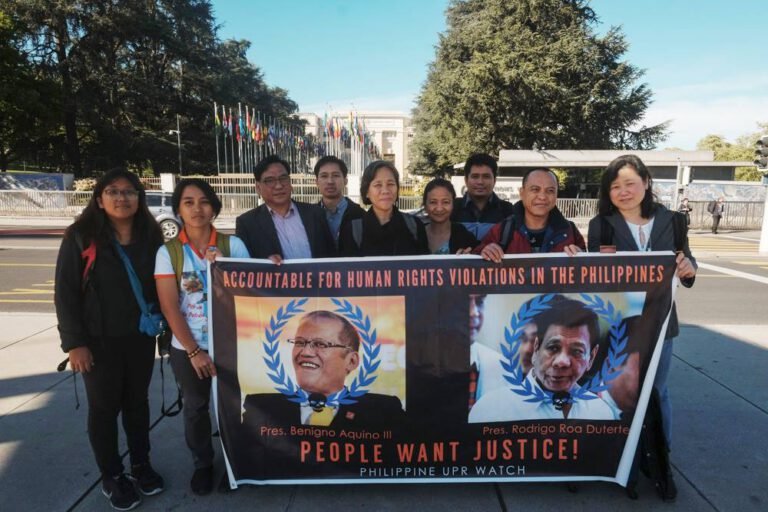
  8. Prosecute Benigno S. Aquino III and cohorts as well as Gloria Macapagal Arroyo for criminal liabilities and gross human rights violations:

We will continue to organise and mobilise to promote solidarity for the Filipino and the world’s peoples to advance their democratic rights and welfare.  We shall continue to support the struggles of communities and organizations in the Philippines by:

  • conducting more research on current problems and threats to peoples’ rights;
  • contributing to relief efforts, health and education, psychosocial services, production inputs, paralegal support and human rights education;
  • raising public awareness about the Filipino peoples struggles in our own countries;
  • encouraging others to join solidarity missions and community exposure in the Philippines; and
  • connecting local struggles in the Philippines to international campaigns and struggles of other oppressed and exploited peoples in other countries.

We shall continue to fight for peoples’ rights here in the Philippines and beyond. As oppression and exploitation grow across borders, so too shall our resistance.

Dare to struggle, dare to win!


Global rights group denounce Gloria Arroyo acquittal, injustice

DAVAO – International delegates coming from several international solidarity missions in the Philippines today decry the Supreme Court’s dismissal of plunder charges filed against former president Gloria Macapagal-Arroyo and the elation of the current presidential peace adviser Jesus Dureza on the ruling.

Dureza, a former Cabinet and press secretary of the Arroyo administration, said he was elated by the high court’s ruling.

“This is a grave injustice to the Filipino people.  Former Pres. Aquino filed weak cases against GMA in the first place.  What is surprising is that current peace adviser Jesus Dureza is overjoyed about the injustice and virtually slurs the thousands of victims of rights violations under Arroyo,” spokesperson for the International Conference for People’s Rights in the Philippines (ICPRP), Rev. Rex R.B. Reyes, Jr., said.

Former Pres. Arroyo has been criticized by international groups not only for plunder but also for grave people’s rights violations during her nine-year rule with Oplan Bantay Laya I & II. She is accountable for the extra-judicial killings, forced disappearances, illegal detention, torture, militarization and displacement of entire communities, and wholesale plunder of the country’s economy and resources.

“Is Dureza happy that her former boss can go away scot-free for crimes against the people? That is no way to pursue a just and lasting peace in the country as violations continue unabated.  It’s a shame to the world,” Rev. Reyes added.

Over 200 people’s rights advocates from 25 countries are meeting in Davao City over the coming weekend for the ICPRP. They are supportive of the resumption of peace negotiations between the government and the National Democratic Front of the Philippines (NDFP) to address the roots of the armed conflict in the country.

Rev. Reyes is a member of the Central Committee of the World Council of Churches and Chair of the Ecumenical Voice for Peace and Human Rights in the Philippines (Ecumenical Voice), a co-convenor of the ICPRP.

Reference:
Rev. Rex R.B. Reyes Jr.
Mobile number: 0917-475-6217
www.humanrightsphilippines.net
https://www.facebook.com/ICHRPhilippines/