
The government of Rodrigo Duterte welcomed 2019 with a bang, continuing its violations of Filipinos’ human rights into its mid-term.
The killing spree continues both under the so-called “war on drugs” and the counter-insurgency program Oplan Kapayapaan.
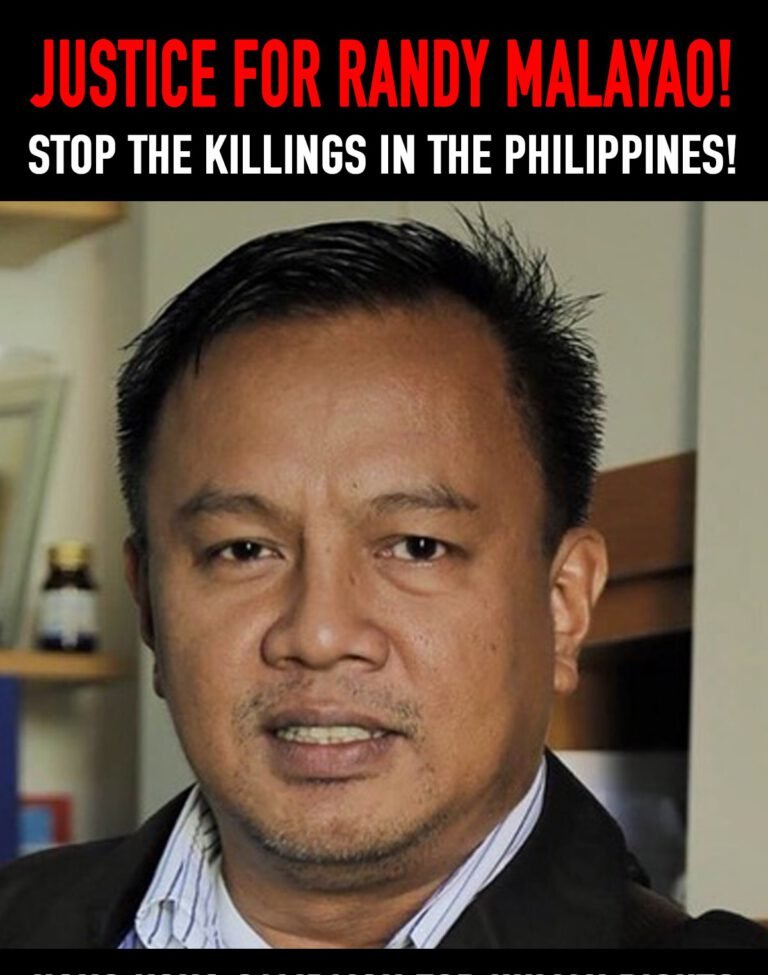
The most high-profile victim of extra-judicial killing at the beginning of the year is Randy Felix Malayao, a consultant of the National Democratic Front of the Philippines in the peace talks with the government. Malayao was shot and killed by a still-unknown assailant while sleeping inside a bus at a stopover in Aritao, Nueva Vizcaya on January 30.
The government tried to besmirch his name, but there was an outpouring of tributes from his friends and comrades in the activist and revolutionary movements.
The following farmers were also victims of extra-judicial killings:
>> Albert Espenas, 39, in San Francisco, Quezon, on January 8. He was manning his store and was shot by unidentified men who feigned buying from him. His death was used as a pretext to militarize his village.
>> Remeglo
>> Nicasio Ebo, 37, in Bacon, Sorsogon on January 11. While standing near the barangay hall, he was shot dead by four motorcycle-riding men. He is a member of progressive
>> Sergio Atay, 35, in Rizal, Zamboanga del Norte on January 29. He was stopped at a military checkpoint on his way home, went missing and was found dead the following day. He is a member of local farmers group Magbabaul, which is affiliated with the Kilusang Magbubukid ng Pilipinas or the Peasant Movement of the Philippines.
>> Emel Tejero, 36, and Randel Gallego, 21, whose bodies were discovered in Lianga, Surigao del Sur on January 30. After hauling abaca, they were fired upon by the military, went missing, and were found dead the following day. They are members of Lumad organization Mapasu.
The arrest and imprisonment of Maria Ressa, one of the Philippines’ top journalists and editor of news website Rappler.com, on February 13 was international news. It highlights how the Duterte government is using laws and trumped-up charges to imprison, harass and try to intimidate into silence its critics and those accused of supporting them.
>> Regional Lumad leader Datu Jomorito Goaynon and regional peasant leader Ireneo Udarbe were reported missing on January 28. On the following day, the military announced that it has captured two high-ranking leaders of armed rebel group New People’s Army — who turned out to be Goaynon and Udarbe. They remain imprisoned to date on the basis of planted evidence and trumped-up charges.
>> On January 30, the office of the Misamis Oriental Farmers’ Association was raided by the military. The following were arrested: MOFA chairperson Gerry Basahon, peasant leader Gerald Basahon
>> Regional peasant leader Norly Bernabe, who was arrested on February 7 in Taytay, Palawan. Before this, Bernabe had survived an assassination attempt and was forced by the military to present himself as an NPA surrenderee but declined. He is in prison on the basis of trumped-up charges over the killing of a policeman.
>> Jennifer David, 28, a leader of progressive
>> Racquel Quintano, 42, a spokesperson of an organization of relatives of political prisoners, as her husband is detained in Davao City, was abducted on January 16 in Tagum City, Davao del Norte. On the following day, the military admitted that she is in its custody, having surrendered supposedly as a “tax collector” of the NPA. She remains in prison in Compostela Valley.
>> In San Mariano, Isabela, six Kalinga farmers were illegally arrested by the military on January 14, after being strafed. The military accused them of hiding grenades in their baskets and nets. After the immediate response of the community, the farmers were released after two days.
As of December 2018, there were already 225 political prisoners who were arrested under Duterte, bringing the total number of political prisoners in the country to 548.
Ressa’s arrest came hand-in-hand with the cyber-attacks, or the Distributed Denial-of-Service, against progressive news websites Bulatlat.com, PinoyWeekly.org, Kodao.org
The Duterte government has also continued to threaten, harass and intimidate activists and other groups critical of it.
>> The military released flyers accusing church workers, lawyers, activists and a journalist in the Northern Mindanao region of being members of the NPA and the Communist Party of the Philippines. Among those included in the flyer
>> The police filed a case of obstruction of justice, grave threats and coercion against
>> The following church workers and local church leaders also faced harassment in January-February: Fr. Marco Sulayao of the IFI in Bacolod, Negros Occidental; Rev. Christopher Ablon, Rev. Marciano Carabio, Rev. Jerome Lito, and Rev. Arnold Abuel, all from the IFI, in Metro Manila; Fr. Randy
>> The members of the following activist organizations in Eastern Visayas have also experienced harassment and intimidation: Bayan, People Surge, Anakbayan, and Sinirangan Bisayas.
>> Just after classes resumed on the first week of January, a Philippine National Police memorandum was exposed as ordering the profiling of teachers who are members of progressive
>> Fake news
>> Other victims of harassment in this period are: Ralph Justine Baguinon, a student activist and chairperson of the College of Engineering Student Council in
>> Suspected military men in plain clothes went to the national office of the Kalipunan ng Damayang Mahihirap or Kadamay on January 16 and asked about the whereabouts of the militant urban poor group’s leaders and staff.
>> On February 1, a judge of the Manila Regional Trial Court reduced the names in the Department of Justice’s terrorist list from more than 600 to two. A threat still hangs over the heads of the more than 600 activists because Malayao was included in the list, was included among those removed, and was still assassinated.
The Duterte government seems intent on intensifying repression and human-rights violations. It is pushing for the lowering of the age of criminal responsibility from 12 to nine. It is using the January bombings in Jolo, Sulu to try to justify the continued imposition of Martial Law in Mindanao. It is proposing more draconian amendments to the country’s anti-terrorism law.
In February, it undertook a black propaganda drive in Europe in which it demonized progressive organizations and institutions in the Philippines as Communist fronts, in order to attempt to deodorize its stinking human-rights record. It continues to appoint retired police and military generals to positions in the civilian bureaucracy. It continues to revive age-old cases against NDFP peace consultants including Vicente Ladlad, who is now a political detainee. It has asked a UN working group on enforced disappearances to remove 625 cases within the period 1975-2012 in order to whitewash these cases.
Despite all this, condemnation and protests against
Here are some recent articles that provide context to the Duterte government’s wanton violations of human rights.
___
The data presented in this roundup comes from Karapatan, an alliance of individuals, groups
Starting 2019 with a bang
Tribunal Declares Trump and Duterte Guilty of Crimes Against Humanity

BY Marjorie Cohn
Source: https://truthout.org/articles/tribunal-declares-trump-and-duterte-guilty-of-crimes-against-humanity/
Philippine President Rodrigo Duterte and his government committed war crimes and crimes against humanity, aided and abetted by U.S. President Donald Trump and his administration, according to a recent ruling from the International Peoples’ Tribunal on the Philippines.
The tribunal, which was held in Brussels, Belgium, on September 18 and 19, 2018, rendered its 84-page decision on these crimes on March 8. Conveners of the tribunal included the International Association of Democratic Lawyers, European Association of Lawyers for Democracy and World Human Rights, Haldane Society of Socialist Lawyers, IBON International, and the International Coalition for Human Rights in the Philippines. A panel of eight jurors from Egypt, France, Italy, Malaysia, the Netherlands and the United States heard testimony from 31 witnesses, including me.
These jurors ordered the defendants to make reparations; to provide compensation or indemnification, restitution and rehabilitation; and to be subjected to possible prosecution and sanctions for their crimes. Although the tribunal does not have the power to enforce those measures, its findings of facts and conclusions of law could be used to bolster the preliminary examination of crimes by the Duterte regime currently pending in the International Criminal Court (ICC).
“The Tribunal has finally rendered its historical and comprehensive decision,” Edre Olalia, president of the National Union of Peoples’ Lawyers (NUPL) in the Philippines, who also served as clerk of the tribunal, told Truthout in an email. “It is extensive in its presentation of the facts and evidence” and contains “an incisive elaboration of the nexus between the acts and omissions of Defendants and their accountability under a plethora of international instruments.”
Olalia added that the decision “sends out a message loud and clear: a people continually victimized by authoritarian and repressive governments and exploitative entities will seek justice wherever they can before those who are willing to give them a fighting chance.” Finally, Olalia said, “the decision remains ever more relevant to this day and time when the Filipinos are still struggling to ride out the storm of tyranny, brutality, corruption, misogyny and repression.”
Much of this tyranny, brutality and corruption has been endorsed, whether implicitly or explicitly, by the United States. The unholy alliance between the Philippine and U.S. governments is long-standing. For the past 18 years, under Presidents Bush, Obama and Trump, the United States has continued to provide assistance to the Philippine government, which enables it to commit war crimes and crimes against humanity against its own people and deny them their legal right to self-determination.
After the 9/11 attacks, Bush declared the Philippines a second front in the war on terror, calling it “Operation Enduring Freedom-Philippines.” The Philippine government used Bush’s campaign as an opportunity to escalate its vicious counterinsurgency program against Muslims and individuals and organizations that oppose its policies.
The Philippine government labels specific people and groups as “terrorists,” which makes them targets of the regime. The government also engages in “red tagging” — political vilification. These labels can lead to harassment, assault, detention, torture and even murder. Targets are frequently human rights activists and advocates, political opponents, community organizers or groups struggling for national liberation.
Indeed, attorney Benjamin Ramos, secretary general of the National Union of Peoples’ Lawyers, was assassinated on November 6, 2018, two months after the tribunal proceedings. “Atty. Ramos was a leading human rights lawyer in Negros, who passionately advocated for genuine agrarian reform and peasant rights,” the NUPL said in a statement. Ramos was the 34th lawyer killed by the Duterte regime. Two more have been killed since.
The tribunal found Defendants Rodrigo Duterte and his regime, and Donald Trump and his administration guilty of gross and systematic violations of civil, political, economic, social and cultural rights; and the rights of the people to national self-determination and development.
Duterte is responsible for the crimes of his administration under the doctrine of Command Responsibility. Commanders are criminally liable for murders and other crimes committed by their subordinates if they knew or should have known they would be committed and they did nothing to stop or prevent it.
Liability for the Trump administration was based on its role as accomplice to Duterte’s crimes. The Rome Statute of the ICC includes aiding and abetting liability for war crimes. An individual can be convicted of a war crime in the ICC if he or she “aids, abets or otherwise assists” in the commission or attempted commission of the crime. This includes “providing the means for its commission.” The U.S. government supplied the Duterte regime with $175 million in foreign military financing in 2017 and 2018, and $111 million in 2019.
Violations of Civil and Political Rights
The tribunal found the Duterte regime responsible for “mass murder, gross violations of the right to due process, unabated killings, attacks, terrorist-tagging and criminalisation of human rights defenders and political dissenters, muzzling of the right to free expression, impunity to the hilt, general situation of unpeace, and the utter contempt for human rights.”
Duterte is perpetrating a ruthless “war on drugs,” which has taken the form of a violent war on suspected drug users. Most victims of the drug war are poor people from the slums. A police memo ordered that suspected drug users be “neutralized” or killed. The government admits to killing at least 4,410 people suspected of drug use as of July 31, 2018. Independent sources put the number at 23,000. The police claim that they acted in self-defense.
But, tribunal prosecutor Neri Colmenares, the chairperson of the National Union of Peoples’ Lawyers, argued, “direct evidence including eyewitness’s accounts, CCTV and others show that the police, themselves, killed the victims [who were] not fighting back. They have been killing the victims while the victims were kneeling and pleading for their lives.”
Colmenares noted the brazenness of these killings, saying, “They were committed in broad daylight, in public places, in front of many witnesses … even near police stations showing that the perpetrators were never afraid at all at being accosted by the authorities.”
There is a culture of impunity for officials in the Philippines. Police officers who carry out illegal killings are not brought to justice. They are promoted to higher posts.
Many lawyers are afraid to defend drug suspects for fear they might be killed. Since Duterte took office on July 1, 2016, the regime has illegally killed 10 prosecutors, 21 lawyers, three judges, and 13 journalists.
“The extra-judicial killings have also intensified against human rights defenders and the progressive sections of Philippine civil society who have criticized the current undemocratic and anti-people policies and systems,” the tribunal wrote. “As of June 2018, 169 leaders of the progressive movement have been victims of extrajudicial-killings (EJKs) and an additional 509 political prisoners are illegally jailed, subjected to trumped-up criminal charges and planted evidence.”
Duterte is unapologetic. On September 27, 2018, he publicly admitted, “My only sin is the extrajudicial killings.” Extrajudicial means outside the law.
Fatou Bensouda, chief prosecutor of the International Criminal Court wrote in an October 2016 statement about the situation in the Philippines that extra-judicial killings may fall under the jurisdiction of the ICC “if they are committed as part of a widespread or systematic attack against a civilian population pursuant to a State policy to commit such an attack.” That is the definition of a crime against humanity.
Witnesses testified at the tribunal that suspects and prisoners endure physical and psychological torture. Janry Mensis, a miner in Mindanao, testified via video. He described how he and his brother were arrested, detained and tortured. They were tied and detained inside an ambulance for nine days. Then they were hogtied and their mouths covered with packing tape. The soldiers then strangled them. When the brothers pretended to be unconscious, they were thrown into a pit with wood and oil and set afire. They dragged themselves out of the pit after the soldiers left them for dead. They both suffered third-degree burns and other injuries from the torture.
Duterte declared Martial Law in Mindanao on May 23, 2017, purportedly in response to an invasion in one city by an alleged ISIS-inspired group (ISIS is also known as Daesh). His government has used the Martial Law to conduct illegal arrests and detentions, enforced disappearances, forced displacement and arbitrary deprivation of property, destruction of mosques and schools, and arbitrary denial of humanitarian aid to civilians caught in the crossfire.
After considering this evidence, the tribunal found violations of the International Covenant on Civil and Political Rights; Universal Declaration of Human Rights; Geneva Conventions; Nuremberg Tribunal; International Convention on the Elimination of All Forms of Racial Discrimination; Convention against Torture and Other Cruel, Inhuman or Degrading Treatment or Punishment; and UN Declaration on Human Rights Defenders.
Murder, torture and cruel treatment constitute war crimes under the Rome Statute and the Geneva Conventions.
Murder or torture committed as part of a widespread or systematic attack directed against any civilian population, with knowledge of the attack, constitute crimes against humanity under the Rome Statute.
Violations of Economic, Social and Cultural Rights
The Philippine and U.S. governments were not the only entities on trial at the tribunal. Other defendants included the International Monetary Fund (IMF), the World Bank, the World Trade Organization (WTO), and transnational corporations and foreign banks doing business in the Philippines.
“Duterte’s economic policies result in the deprivation of genuine government service as they divert public funds to corruption and big ticket projects demanded by Defendants World Bank, IMF, WTO and transnational corporations,” the tribunal wrote.
The tribunal determined that Duterte “has perpetrated anti-democratic and exclusionary economics and governance as he dramatically perpetuates neoliberal policies imposed or influenced by Defendant actors and transnational entities doing business in the Philippines by the systematic violation of fundamental human rights as exemplified in the mining exploitation.” Moreover, the tribunal concluded, “This aggravates even more systemic violations of the people’s social, economic and cultural rights.”
Witnesses testified to “the impact of an exploitative system that has deprived millions of Filipinos of their livelihood, demolished the shanties of the marginalized poor, grabbed lands of the peasants and condemned workers to eternal poverty through perpetual contractualization and the exportation of labor, many of whom are victimized abroad,” Colmenares summarized.
The evidence revealed the imposition of “an exploitative system which has reduced the Philippines into a producer of raw material for industries; reduced the Philippines into a mere source of cheap labor and a lucrative and pliant market for their goods.” This is called neoliberalism.
The tribunal concluded that the Duterte regime “has consistently failed to provide the basic rights to work; to living wages and regular employment; to land; to an adequate standard of living; and to health, housing and education.” The tribunal also faulted the regime for imposing “new taxes that hit primarily the poor; and forced displacement of poor families to install tourism projects on their lands.”
“Farmers are deprived of the lands they have tilled for ages and are attacked; workers are exploited and their strikes violently dispersed; the urban poor remain homeless and threatened when they assert their rights; education is commercialized and inaccessible to the great majority,” the tribunal noted. In addition, “thousands are forced to migrate daily, including nurses, under a labor export policy; the right to livelihood is curtailed; and distressed overseas workers are neglected and abandoned.”
The tribunal found violations of the International Covenant on Economic, Social and Cultural Rights; Universal Declaration of Human Rights; Convention Concerning Freedom of Association and Protection of the Right to Organize; Convention on the Right to Organize and Bargain Collectively; Algiers Declaration; Convention on the Elimination of All Forms of Discrimination Against Women; and International Convention on Protections of Rights of All Migrant Workers and their Families.
Violations of the Rights to National Self-Determination and Development
“Duterte has essentially demonstrated his allegiance to US imperialist goals in Asia-Pacific region,” the tribunal concluded. His government “also overturned anew the victory of the people in removing US military bases.”
The tribunal explained how the U.S. bases in the Philippines facilitate Duterte’s counterinsurgency program: “US presence and the permanent and expanded basing of US troops are further emboldening the Defendant Duterte government in implementing the counterinsurgency program Oplan Kapayapaan patterned after the 2009 US Counterinsurgency Guide and financed by Defendant US government.”
U.S. government assistance to the Duterte government includes the provision of “intelligence, funding, orientation, training and arms to promote and pursue its economic and geopolitical interests in the region.”
The tribunal adopted my testimony as follows: “US military aid to the Philippine government facilitates its commission of war crimes and crimes against humanity against its own people. Like Philippine leaders, US political and military leaders could be liable in the International Criminal Court as aiders and abettors of war crimes and crimes against humanity.”
The Filipino people have the right to self-determination, which includes the right to development. As stated in the Declaration on the Right to Development, it is “by virtue of” self-determination that peoples “have the right freely to determine their political status and to pursue their economic, social and cultural development.” The people have the “inalienable right to full sovereignty over all their national wealth and resources.”
Witnesses documented widespread and systematic attacks on indigenous peoples and national minorities, and the use of white phosphorous gas and enforced disappearances, which amount to crimes against humanity.
“Philippine and US political and military leaders do not enjoy impunity for their crimes. Achieving justice for the Filipino people is not just a matter for people in the Philippines. Americans and other people throughout the world have a responsibility to bring the criminals to justice,” the tribunal wrote, adopting my testimony. “The Filipino people continue their valiant struggle for national liberation and self-determination. Providing legal accountability for the crimes of Philippine and US officials will help to deter them from committing additional crimes.”
In February 2018, Bensouda opened a preliminary examination into possible crimes committed since at least 1 July, 2016, in the context of the “war on drugs” campaign launched by the Philippine government. A preliminary examination is an initial step to determine whether there is a reasonable basis to proceed with a full investigation.
The following month, in March 2018, the Philippine government submitted a withdrawal from the Rome Statute. It takes effect one year later. Bensouda responded, “A withdrawal has no impact on on-going proceedings or any matter which was already under consideration by the Court prior to the date on which the withdrawal became effective.”
Even if the ICC does not ultimately investigate and prosecute war crimes and crimes against humanity committed by military and police officials of the Philippine government, other countries could bring the offenders to justice under the well-established principle of universal jurisdiction.
Any country can try a foreign national for war crimes and crimes against humanity when the suspect’s home country is unable or unwilling to prosecute, and Duterte has proved unwilling to prosecute those responsible for the heinous crimes against the Filipino people.
Copyright © Truthout. Reprinted with permission
Marjorie Cohn is professor emerita at Thomas Jefferson School of Law, former president of the National Lawyers Guild, deputy secretary general of the International Association of Democratic Lawyers and a member of the advisory board of Veterans for Peace. Her most recent book is Drones and Targeted Killing: Legal, Moral, and Geopolitical Issues.
Free Maoj! Free all Political Prisoners in the Philippines

February 22, 2019
Atty. Menardo Guevarra
Secretary, Department of Justice
Padre Faura St., Manila
Email: communications@doj.gov.ph
Dear Secretary Guevarra,
Philippines Australia Union Link has been working since 1984 to strengthen the solidarity between the union movements of our two countries.
We utterly condemn the Duterte government for the operation in which Maoj Maga was detained on February 22, 2018. Maoj is an organiser of the Kilusang Mayo Uno Labor Center. He was accosted on a basketball court by at least a dozen men, blindfolded and forced into a vehicle without knowing why or where he was being taken. At the police headquarters, he was subjected to hours of interrogation and not given the chance to contact his lawyers and family. The arresting officers added to the outrage with the absurd charge or a murder in far away Mindanao, and planted a .45 caliber pistol on him. Maoj was put through misery in several congested prisons as well as a quarantine-isolation cell.
On this first anniversary of his unlawful detention, we call for his immediate release from the Metro Manila District Jail-Annex 4 in Camp Bagong Diwa, Bicutan, Taguig City, along with the release of the other thirty-five political prisoners there.
In fact, we call loudly for the release of all detained trade unionists in the Philippines and all 500 plus political prisoners held in jails across the country, an end to the repression and for genuine peace negotiations to resolve the deep crisis in Philippines society.
In solidarity,
Peter Murphy
Secretary
Cc Hon Chito Gascon, Commission on Human Rights; Senator Marise Payne, Minister for Foreign Affairs; Senator Penny Wong; Senator Richard Di Natale; Ms Michelle Bachelet OHCHR; KMU; Karapatan
3 farmers killed, 6 illegally arrested as 2019 rolls out – Karapatan
Press Release
January 17, 2019
Reference: Cristina Palabay,
Karapatan Public Information Desk, +63918-9790580
Reposted from:
3 farmers killed, 6 illegally arrested as 2019 rolls out – Karapatan
“
Meanwhile in Bicol, a member of Anakpawis was also shot dead by four motorcycle-riding gunmen while standing near the village hall in Brgy. Bato, Bacon, Sorsogon. The victim, Nicasio Ebio, was 37 years old and an active member of Anakpawis.
“
“
———————————————————————
PUBLIC INFORMATION DESK
publicinfo@karapatan.org
———————————————————————
Alliance for the Advancement of People’s Rights2nd Flr. Erythrina Bldg., #1 Maaralin corner Matatag Sts., Central DistrictDiliman, Quezon City, PHILIPPINES 1101Telefax: (+63 2) 4354146Web: http://www.karapatan.org
KARAPATAN is an alliance of human rights organizations and programs, human
Justice for Atty. Ben Ramos! Stop the Killings in the Philippines

The Europe Network for Justice and Peace in the Philippines and the International Coalition for Human Rights in the Philippines (ICHRP) condemn in the strongest possible terms the ruthless killing of Atty. Benjamin Tarug Ramos, Jr. on November 6 in Kabankalan, Negros Occidental. He was gunned down in a cowardly attack by motorcyclists riding in tandem after completing some legal work on behalf of one of his pro-bono clients.
As a people’s lawyer, Ben dedicated his life to the fight for justice, defending the rights of the poor and landless peasants in Negros, taking up cases of political prisoners, enforced disappearances and killings of activists and putting his profound legal knowledge at the disposal of all who needed his help.
At the time of his murder, he had been providing legal assistance to the survivors of the Sagay massacre in which nine sugarcane workers were brutally killed in their sleep in Sagay, Negros, on 20 October 2018. The workers had occupied idle lands and lands covered by agrarian reform but not yet distributed in order to grow crops to feed their families in the period between planting and harvesting sugar cane, a time when families suffer massive hunger.
For many years Ben had been well aware that he was a target for liquidation by the Philippine authorities. In fact, he had already survived a previous attack on his life in 2007. In April of this year the Philippine National Police in Negros placed his name and picture on a poster together with 60 other human rights defenders, branding them as members of the Communist Party of the Philippines. This is tantamount to labeling them as “terrorists” and therefore a free target for killing under the present Duterte Administration.
Despite these perpetual threats to his life and well being, Ben chose to continue to serve the poor and the fight for justice.
His death comes at a moment when extrajudicial killings are dramatically increasing in the Philippines and the culture of impunity is ever worsening. Following the Sagay massacre earlier in the month, just last week on 31 October a banana plantation worker at Sumifru Philippines Corporation and an active member of Nagkahiusang Mamumuo sa Suyapa Farm (NAMASUFA), an affiliate of labor union Kilusang Mayo Uno (KMU), was shot dead at the Compostela public market in Compostela Valley.
As we struggle to come to terms with the immensity of this loss and grieve with Ben´s family and loved ones, our grief is transforming into outrage and a strong determination to do everything in our power to ensure that those responsible for his killing and the slaughter of many others and are finally brought to justice.
Our tribute to Ben will be to continue to support what he believed in: a Philippines where justice, fairness and genuine peace prevail, where the rich and powerful no longer live at the expense of the weakest members of society. Ben’s vision, strength and courage will always be an example to us as we continue that fight.
We stand with Ben’s family, with Paghida-et sa Kauswagan Development Group, Inc. (PDG), the organization that he founded and led up to the time of his death and all those who have given their lives in the pursuit of justice and human rights in the Philippines.
We call on the international community to condemn this barbaric act and the continuing reign of impunity under the Duterte administration, even as we vow to strengthen our solidarity and support for the defenders of the poor and exploited in the Philippines.
References:
Julie Smit, Convenor, Europe Network for Justice and Peace in the Philippines
Email address: julie.smit1@gmail.com
Angie Gonzales, Global Coordinator, International Coalition for Human Rights in the Philippines (ICHRP)
Email address: ichrp2013@gmail.com
Peter Murphy, Chairperson, Global Council of the ICHRP
Email address: peter_murphy1_au@bigpond.com