Home Blog Page 79

Greatly expand our solidarity with the Filipino people! Discredit and isolate the tyrannical US-Duterte dictatorship!

0

Hong Kong, June 27-29, 2019

Conference Declaration

Stand United
in solidarity with the Filipino People for
Justice Freedom and Democracy

The Duterte Presidency at the start of its third year is a tyrannical dictatorship provoking widespread anger, disgust and revulsion at the combination of tens of thousands of dead Filipinos arbitrarily murdered by police and hired guns in the phoney ‘war on drugs’, the hundreds of people’s leaders and defenders shot down by the military death squads, the ruthless suppression of the Lumad schools and the communities which built them, the vicious and hateful attacks on the dignity of women, the deadly vilification and smearing against legitimate people’s organizations, the neoliberal economic measures which impoverish the people even more, the massive displacement of people and destruction of Marawi City, and the Martial Law which is spreading to the whole country. And all this wrapped in abusive and misogynist language, blatant broken promises and praise of fascism and the dictator Marcos.

Duterte’s broken promises on releasing political prisoners and on proceeding with the peace talks with the National Democratic Front of the Philippines can only result in greater violence and repression.

This Duterte presidency is trying to crush the individual and collective human rights and people’s rights enshrined in the Constitution and international covenants to which the Philippines is a signatory.

This 3rd General Assembly of the International Coalition for Human Rights in the Philippines is full of admiration for and inspired by the huge numbers of Filipinos who defy this vile regime by continuing to assert their rights and freedoms and by protesting the great abuses taking place, by continuing to fight for genuine land reform, for national industrialisation, and for peace, for workers’ rights to a living wage and secure jobs, and for democratic rights across society.

The Duterte Regime is a scandal to the international community. Iceland has condemned this regime. But not enough governments have raised their voices to support the Filipino people and to call Duterte to account. This in itself is a scandal and demonstrates a threat to the individual and collective rights of people everywhere. A major reason for this failure in the international community is the US Trump administration’s use of Duterte in its competition with China, and the US support for the suppression of the national democratic people’s movement. The Trump administration and other governments, particularly Australia, Canada and Israel, directly arm and train the military and police of this murderous regime.

Following the May 2019 national elections, marked by blatant cheating, President Duterte is poised to change the Constitution to extend his rule and allow even greater imperialist plunder of the nation’s people and resources. This is a prospect for far sharper social conflict and nation-wide martial law, in which people’s rights will be threatened even more.

Faced with this prospect, the International Coalition for Human Rights in the Philippines is expanding its organisation and campaign capacity to provide strong and visible solidarity to the Filipino people in their struggle against this tyranny. ICHRP will greatly expand its public education campaigns to rouse international public opinion to demand action, and at the same time undertake an exhaustive campaign to the diplomatic community to hasten the international isolation of this dangerous dictatorship. ICHRP will focus on ever more pressure for the indictment of President Duterte in the International Criminal Court, building on the work of the International People’s Tribunal of September 2018.

In making this commitment to the Filipino people, ICHRP calls on all social organisations which uphold democratic values and human rights to respond to our calls and to join our Coalition so that the Filipino people can win the Justice, Freedom, Democracy and Peace for which they have been fighting for so long.

Let us STAND UNITED in this cause!

Stop the killings in the Philippines! Stop the attacks now!

0

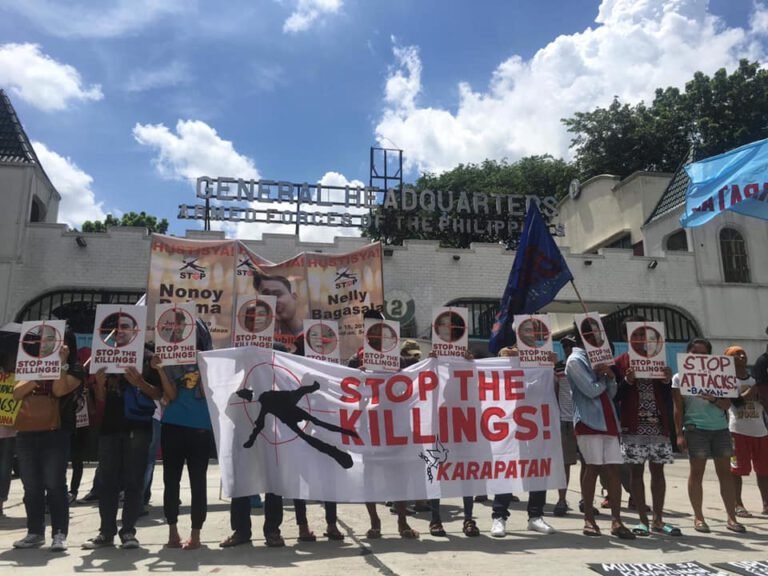
The International Coalition for Human Rights in the Philippines (ICHRP) strongly condemns the recent spate of killings of human rights defenders as we support the indignation rally today in front of the headquarters of the Armed Forces of the Philippines.

Killed in Sorsogon City last June 15 by motorcycle-riding assailants were Ryan Hubila, 22, and Nelly Bagasala, 69.  Both were staffers of the human rights group Karapatan and were previously threatened and harassed by elements of the 31st IB of the Philippine Army.

Two days later, on June 17 in Naga City, Neptali Morada, 45, former campaign committee head of Bagong Alyansang Makabayan (BAYAN)-Bicol, regional Bayan Muna head and a member of the Students Christian Movement of the Philippines (SCMP), was also gunned down.

The Bicol region is among the poorest regions in the country and included in President Duterte’s Memo Order No. 32 extending martial law from Mindanao. These regions, along with Negros and Samar, were hit hard by military attacks.

In Mindanao, KASAMA-Bukidnon member, farmer Leogildo ‘Nonoy’ Palma was gunned down outside his residence by three assailants on board a motorcycle on the 16th of June. One of the gunmen was recognized as a local militiaman. He was shot in front of his wife and child. Before the incident, Palma endured surveillance and harassment from soldiers of the 81st IBPA and Alamara paramilitary group.

Attacks on human rights defenders has already caught the attention of 11 United Nations rapporteurs and human rights experts who issued a rare joint statement on June 7 calling on the UN to conduct an independent investigation of a “staggering” number of summary killings and attacks on human rights workers committed with impunity.

We call on all human rights defenders and advocates to denounce the killings under President Duterte and support the Filipino people’s struggle for justice. #


Reference:

Peter Murphy, Chairperson

International Coalition for Human Rights in the Philippines

peter_murphy1_au@bigpond.com

Stop vilification of Human Rights Defenders in the Philippines

May 25, 2019

H E Mr. Rodrigo Duterte

President of the Republic

Malacañang Palace,

JP Laurel St., San Miguel,

Manila, Philippines 1005

E-mail: op@president.gov.ph

Stop Vilification of Human Rights Defenders in the Philippines

Dear Excellency,

We call on your government to put a halt to the series of vilification and smear campaigns against Karapatan, Rural Missionaries of the Philippines, Ibon Foundation, alternative learning centers for indigenous children in Mindanao, and other people’s organizations, under its counterinsurgency program Oplan Kapayapaan (Operational Plan Peace).

These campaigns are instigated under your Executive Order No. 70 issued last December 4, 2018, which created a “National Task Force (NTF) to end local communist armed conflict.”

Karapatan is a non-stock, non-profit, non-governmental organization that has conducted human rights advocacy, monitoring and documentation in the Philippines since 1995. It is a member of the Civicus World Alliance for Citizen Participation, the SOS-Torture Network of the World Organization Against Torture, and, recently, of FORUM-ASIA. Its officers are involved in various feminist platforms such as the Asia Pacific Forum on Women, Law and Development.

IBON Foundation is a non-stock, non-profit development organization that has conducted research and education since 1978. The Rural Missionaries of the Philippines is a non-profit, non-governmental organization, inter-diocesan and inter-congregational in character of men and women religious, priests and lay, founded in 1969. It acts as the mission partners of the Association of the Major Religious Superiors in the Philippines (AMRSP). The Mindanao Interfaith Service Foundation is a non-stock, non-profit, religious institution serving the marginalized Lumad, Muslim and Christians in Mindanao, founded in 1983.

We strongly condemn the NTF’s reported conduct starting in February 2019 in Europe, where military and intelligence officials wrongfully labelled and vilified these Philippine human rights organizations as terrorists and communist fronts. These dangerous slanders are a clear reprisal to their human rights work, specifically on their advocacies and reports regarding the dismal human rights situation under your administration. Your government’s repeated denials instead of initiating investigations and addressing the rampant human rights abuses have reinforced the actions of human rights violators and enabled gross impunity in the country.

The attacks on the credibility of these Filipino human rights organisations in Europe aims to dissuade international actors from providing resources to human rights work, research and humanitarian support for these organizations and their communities. This situation imperils the many efforts of human rights defenders and various organizations to access and inform the international community on cases of rights violations and the over-all human rights situation in the Philippines and their initiatives to provide services for marginalized indigenous, peasant and urban poor communities.

More so, these forms of terrorist-labelling and red-tagging have resulted in the murder of human rights defenders, criminalization of their work and beliefs, illegal arrests and detention, torture and other violations of the people’s right to uphold and defend rights, to form organizations and to conduct human rights work.  In his 2008 Report to the UN Human Rights Council, UN Special Rapporteur on Extrajudicial, Summary or Arbitrary Killings Prof. Philip Alston recommended that the Philippine government should stop such vilification as it has resulted to such grave violations.

But because Prof. Alston’s recommendations have been largely unheeded by succeeding administrations, these forms of attacks continue, despite the UN Declaration on the Rights of Human Rights Defenders and the European Union Guidelines on Human Rights Defenders.

These attacks are in the context of the extrajudicial killings spawned by your government’s drug war and counter-insurgency campaigns, the political persecution of vocal critics of your government such as Sen. Leila de Lima and former Supreme Court Justice Marilou Sereno, the attacks on press freedom as shown by the arrest and detention of Rapplers Maria Ressa and cyber-attacks against online news sites, the martial law declaration in Mindanao, the state of emergency declared in three other regions enabling more military presence in communities, attempts to legislate to undermine human rights, militarization of the civilian bureaucracy and more recently, the issuance of Securities and Exchange Commission Memorandum 15 arbitrarily classifying and regulating the operations of non-profit organizations. These smear and vilification campaigns contribute to the over-all trend of shrinking civil society space and the worsening climate of impunity in the Philippines.

We wholeheartedly support the work of Karapatan, Rural Missionaries of the Philippines, Ibon Foundation, Mindanao Interfaith Service Foundation, and the alternative learning centres for indigenous children in Mindanao. We call on your government to stop such attacks and vilification campaigns using false, baseless, and malicious allegations against staunch advocates of human rights. Finally, we urge your government to instead allow initiatives of civil society, governments and intergovernmental bodies to independently investigate the human rights situation in the Philippines.

Accounts of the incidents:

On December 4, 2019, you signed Executive Order No. 70, creating a national task force (NTF) to end local communist armed conflict and institutionalizing the so-called whole of nation approach. In February 2019, the NTF and other government officials went on a trip in Europe.

On February 14, 2019, this Philippine government delegation went to Sarajevo, Bosnia and Herzegovina, to meet with the United Nations Working Group on Enforced and Involuntary Disappearance. In the sidelines of this meeting, Brig. Gen. Antonio Parlade, Jr., assistant Deputy Chief of Staff for Operations of the Armed Forces of the Philippines, said: “Yung pinanggalingan ng data eh may ibang interes, may ibang agenda. It’s really to destroy the government. And we believe, talagang ganun kasi, ah kasi nakita na natin yang trend na yan, information coming from Ibon, from Karapatan – these are all organizations of the Communist Party of the Philippines.” (The sources of data have other interests and agenda, that is to really destroy government. We believe that it is so because we already saw the trend where information is coming from, from Ibon, from Karapatan, these are all organizations of the Communist Party of the Philippines.)

On February 18, 2019, the delegation reportedly went to Brussels, Belgium, to meet with Belgian government officials, members of the European Union Parliament and Gilles de Kerchove, EU Counter-Terrorism Coordinator of the European Council. In this meeting, government officials referred to Ibon, Karapatan and the Rural Missionaries of the Philippines as front organizations of the CPP. They called on the EU and other member states to stop releasing funds to these groups.

In an article in the Philippine News Agency (PNA), Parlade was quoted to have said: “Many of this money was channelled by these NGOs to other organizations whose only objective is to portray President (Rodrigo) Duterte as a tyrant and his administration as oppressive.” He said, “What we wanted the EU and UN (United Nations) to also know is that the CPP and its front organizations, like Karapatan, are consistent and persistent in providing UN and European governments with all these false data.”

The NTF also met with the Belgian Ministry of Foreign Affairs. In this meeting, Parlade again claimed that some of the funds provided by the Belgian government finances CPP front organizations including Karapatan, Ibon Foundation, Mindanao Interfaith Service Foundation, and RMP. Gunnar Weigand, Managing Director of European External Action Service and European Commission South East Division of Development and Cooperation, said that they will monitor donors to the country and help with the audit of these funds. In a news report, Alex Paul Monteagudo, Director General of the National Intelligence Coordinating Agency, further alleged that “these front organizations have mastered the art of sourcing and diverting funds to buy weapons and train children to become warriors in their alleged schools.”

Under Proclamation No. 374, signed in December 2017, under Section 3 and 15 of the Republic Act 10168 or the Terrorism Financing Prevention and Suppression Act of 2012, you designated the CPP-NPA and all other designated persons/organizations as terrorist organizations. This proclamation allows authorities to freeze and forfeit property and funds of members of front organizations of CPP-NPA and those that may be funding or providing financial assistance to these organizations. The circumstance may lead to warrantless arrests of said persons.

On February 21, 2019, the Philippine government through National Security Council Deputy Director General Vicente Agdamag handed over to Ambassador Evan P. Garcia, Philippine Permanent Representative to the United Nations (UN) and other International Organizations in Geneva, documents of alleged complaints of several indigenous people’s groups, represented by Mindanao Indigenous Peoples Council for Peace and Development, against the Communist Party of the Philippines-New Peoples’ Army-National Democratic Front (CPP-NPA-NDF).

They again cited IBON Foundation, Rural Missionaries of the Philippines, Mindanao Interfaith Service Foundation, and KARAPATAN as alleged front organizations of the CPP-NPA-NDF in their complaints. The Philippine government delegation said these organizations are the source of accounts of human rights violations in the Philippines, which they called false narratives.

The Philippine delegation also maligned United Nations Special Rapporteur on the rights of indigenous peoples Victoria Tauli-Corpuz in their so-called letter-complaint to the Office of the UN High Commissioner on Human Rights. The delegation’s letter was quoted in a news report: “It must be noted that the current UN Rapporteur Victoria Tauli-Corpuz seems to have never lifted a finger to intervene in these communist terrorist groups’ (CTGs) violations and has rather trained her attention to government forces who have been trying to defend the human rights of the IPs.”

In an opinion post, Tauli-Corpuz said she has not received any communications regarding the NPA. “We also address non-state actors, such as corporations and non-state armed groups when we receive communications about them and if we have addresses,” she added. The UN expert also said that “the main actors we monitor are States. The duty-bearers of human rights are States. Thus, the main mandate of Special Rapporteurs is to monitor the duty bearers. So far, I received no communications regarding the NPA.”

Tauli-Corpuz was included among 600 in the proscription filed by Department of Justice in February 2018 at a Manila Regional Trial Court declaring CPP-NPA as a terrorist organization. On January 2019, the Manila RTC Branch 19 trimmed down the list to just eight, excluding that of Tauli-Corpuz.

On February 22, 2019, the Philippine delegation conducted a briefing at the Concordia Room at the Palais des Nations in Geneva, Switzerland. According to government reports, representatives of at least 20 countries including Italy, Pakistan, Egypt, Thailand, Brazil, France, US, Croatia, Canada, Uruguay, Mexico, Switzerland, Nigeria were briefed by Senior Supt. Omega Jireh Fidel of the Philippine National Police (PNP) Directorate for Investigation and Detective Management; Brig. Gen. Antonio Parlade, Jr, assistant Deputy Chief of Staff for Operations of the Armed Forces of the Philippines; and Undersecretary Joel M. Sy Egco, Executive Director of the Presidential Task Force on Media Security. The panelists and Garcia pressed that correct information on human rights in the Philippines could only come from the government itself and tried to persuade senior officials of UN representatives that the Philippines has legal mechanisms to address human rights violations.

At the same time as the UN trip, Presidential Communications Operations Office (PCOO) officials went on a tour to Brussels and Geneva in a “Press Freedom Caravan” to defend President Duterte’s stand on issues such as the cases of enforced disappearances and counterinsurgency programs.

However, in the Philippine government’s October 2018 risk assessment report on non-profit organizations (NPOs), the Anti-Money Laundering Council (AMLC), Securities and Exchange Commission and the Department of Social Welfare and Development stated that there is no evidence proving that non-profit organizations (NPOs) are being used for “terrorist funding.” The report noted that previous accusations are based on hearsay. The government’s own agencies stated that NPOs are not the preferred “mode of raising funds” for so-called threat groups. The same report says that the abuse of NPOs were actually from politicians, as in the case of NPOs being used “as conduit for money laundering in the PDAF scam”.

In a statement released on February 19, 2019, Karapatan said: “Our attention has been called regarding the conduct of military and intelligence officers who make rounds in diplomatic missions to red-tag specific organizations and dissuade them from providing resources that go into the campaigns and initiatives of said groups. This situation puts into peril the many efforts of human rights defenders and various organizations to provide services for the many that are marginalized and neglected by past and present governments. Years of hard work and concrete actions to respond to these specific needs are being maligned and in danger of being overturned. Their operation is gradual and surreptitious, but altogether perilous to the movement, capacity, and spaces being maximized by civil society.

“Victims are instead branded as terrorists and mechanism to safeguard people’s rights pushed forward mainly by the efforts of civil society are being co-opted and twisted in this government’s desperate PR stunt,” they further argued.

In a statement released on February 24, 2019, Karapatan said that through “a national task force composed of militarists and mercenary hacks, it is promoting a most unbelievable lie – that government is correct and everyone else is wrong. What is however apparent is its elaborate effort to hide the injustices apparent in the country.”

Karapatan further said: “Together with other human rights and civil society organizations, and even international human rights experts and UN officials, we have been repeatedly maligned in the government’s vicious terrorist-labelling campaign and have faced reprisals due to our work exposing State-perpetrated human rights violations and demanding for justice and accountability. We highly urge government to stop whining and acting like the government is the aggrieved party and start addressing these issues. We remind the Duterte government that the State is the primary duty-bearer in the promotion, protection and advancement of human rights. We are certain you might have already forgotten. Efforts to falsely accuse groups and journalists raising these issues will not erase the atrocious crimes already committed and are continuously being committed by State security forces. However, these forms of terrorist-labelling and red-tagging have also resulted in the killings of human rights defenders, criminalization of their work and beliefs and illegal detention, torture and other violations of the people’s right to uphold and defend rights, to form organizations and to conduct human rights work.”

In our April 1, 2019 statement, Karapatan expressed openness to the impartial and participative audit of the European Union, including the Belgian government. To wit: “We, as rights-holders and human rights defenders, are receptive to such queries, in the spirit of meaningful dialogue, transparency and accountability. We are confident with what we are, and we are ready to face any question on our work, that is in accordance to international and local human rights standards.

“Our human rights workers, all doing voluntary work, toil through day and night, even at great risk to their lives and security, to assist victims of rights violations and their families, including victims of extrajudicial killings, enforced disappearances, arrests, torture, forced evacuation, among others. We are not terrorists. We do not support terrorist activities through our projects and work — all of which are well-documented, accounted for and independently audited.” 

Also in a statement, the Rural Missionaries of the Philippines said: “We condemn in the highest terms this slander of our organization. We reiterate that our commitment to serve the rural poor drives us to provide programs for them including literacy and numeracy for Lumad children, livelihood programs, relief and rehabilitation, training and education for rural communities. This is definitely alarming as it can be used as justification to go after rural missionaries, priests, sisters and lay workers, and so we urge our fellow Christians to condemn these preposterous accusations and echo the call to end the attack against rural poor and peace advocates.”

Karapatan and RMP have filed complaints before the Commission on Human Rights regarding these attacks and vilification by State forces. Unfortunately, the AFP and Parlade have continued their smear campaign against Karapatan and many other human rights defenders.

We urge you and your government

The International Coalition for Human Rights in the Philippines therefore urges you and your government to stop the vilification and smear campaigns, through red-tagging and terrorist-labelling, against human rights defenders, their organizations and communities.

We urge you and your government to recall Executive Order No. 70 and its so-called whole of nation approach and stop all activities emanating from this order, including the smear campaigns against human rights activists.

We urge you to withdraw the counterinsurgency program Oplan Kapayapaan, which victimizes innocent and unarmed civilians, and criminalizes the work of human rights defenders.

We urge instead that your government prioritize the enactment and full implementation of a Human Rights Defenders Protection Bill that will give legal recognition and safeguard rights defenders in the conduct of their work, in accordance with the UN Declaration on the Rights of Human Rights Defenders.

Finally, we urge you and your government to adhere to and respect the Universal Declaration of Human Rights, the International Convention on Civil and Political Rights, and all major Human Rights instruments that it is a party and signatory.

Yours sincerely,


Peter Murphy

Chairperson, Global Council,

International Coalition for Human Rights in the Philippines


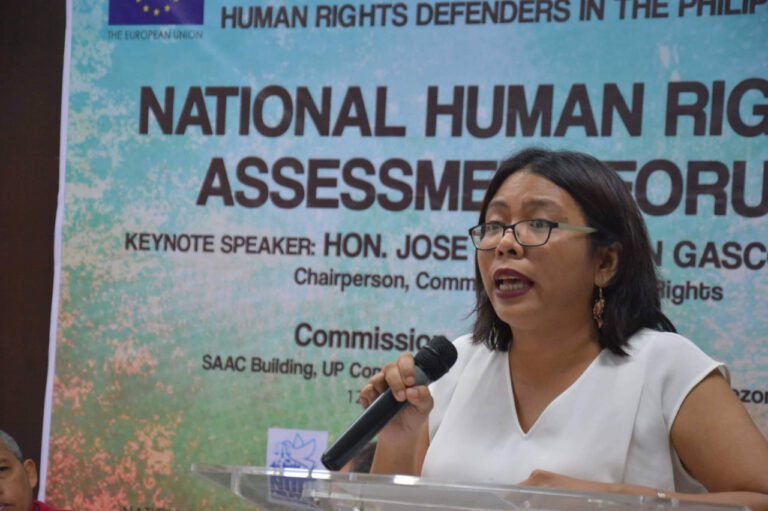
Cc:          Cc Mr Antonio Guterres, Secretary-General, United Nations; UN Special Rapporteur on EJK; DFAT Desk; Senator Marise Payne, Minister for Foreign Affairs; Senator Penny Wong; Senator Richard Di Natale, Andrew Wilkie MHR; Julia Dean; Ret Gen Carlito G Galvez Jr, Presidential Adviser on the Peace Process; Ret Maj Gen Delfin Lorenzana, Secretary, Dept of Defence; Mr Menardo Guevarra, Secretary, Department of Justice; Mr. Jose Luis Martin Gascon, Chairperson, Commission on Human Rights.
ICHRP Canada launches in Ottawa

0

OTTAWA — Over 100 community leaders from cities across Canada came together at the Public Service Alliance of Canada (PSAC) headquarters in Ottawa on May 11 and 12 to launch a cross-country campaign against a backdrop of “troubled times for human rights in the Philippines” and form the Canadian chapter of the International Coalition for Human Rights in the Philippines (ICHRP-Canada).

The group has vowed to “strengthen our solidarity with counterparts on the ground in the Philippines” and to “exert more effective pressure on both the Canadian and Philippine governments to respect human rights in the Philippines.”

ICHRP-Canada has elected a 6-person national coordinating committee composed of human rights and peace advocates, church leaders, academics and community leaders, namely Andy Tran, Regional Coordinator for Ontario; Dani Gay, Regional Coordinator for Quebec; Whitney Haynes, Member at Large; Rev. Ndhlovu Japhet, Member at Large; Doug Booker, Secretary-General/Treasurer; and Rev. Patricia Lisson, Chairperson.

The formation of ICHRP-Canada was the result of several years of campaigning by Canada-based solidarity groups calling for freedom for political prisoners, calling to stop the killings and enforced disappearances, and raising concerns on the implications of Canadian foreign aid and investment in the Philippines.

Prior to the launch a conference was held with prominent speakers. Dr. Angie Gonzales, Global Coordinator of ICRHP, shared how the international coalition began with the “Stop the Killings” platform.

Meanwhile, people’s lawyer Edre Olalia provided a general overview of the current human rights situation in the Philippines. He discussed the so-called conspiracy “matrix” from alleged coup plotters against the government resorting to state red-tagging and what’s left of the rights of people under Duterte.

Rev. Marma Urbano, who participated in forming the US Chapter of the ICHRP, shared her personal story depicting the violence faced by community leaders and human rights defenders. Filipina fair trade activist Ruth Fe Salditos, whose own life is at risk, recounted the fight against unscrupulous landlords in Panay island, central Philippines. Both also conveyed a message of hope through the peace process in the midst of the civil war between the Government of the Philippines and the National Democratic Front of the Philippines (NDFP).

Coni Ledesma spoke about the relation of peace talks to the call to defend human rights further explaining that only by addressing the roots of the armed conflict would real change happen.

Renowned international muralist Bert Monterona also provided the backdrop for the occasion.

Canada-based members are expected to participate at the ICHRP 3rd General Assembly on June 27-29, 2019 at the HKFYG Jockey Club Sai Kung Outdoor Training Camp, New Territories, Hong Kong.

###

Quotes

“The war on drugs is a distraction from the social and economic problems plaguing the country. It’s really a war on the poor. It’s taking drug addiction as a disease, as the fundamental problem and not as a symptom of an even bigger problem.”

– Dani Gay, Quebec regional representative for ICHRP Canada from the Jeunes Socialistes pour le Pouvoir Populaire (JSPP)

“In the Philippines, if you’re not a Duterte supporter, you’re either a protector of drugs or a communist. If you criticize, if you resist, if you stand in their way, they will get you out of the way…We have to stand together amidst all the misery, amidst all the oppression, amidst all the tyranny. We have the truth! We have the people!”

– Edre Olalia, president of National Union of People’s Lawyers

“For the National Democratic Front of the Philippines, our vision is clear. We want and will continue to struggle for just and lasting peace. It is only when the deepest aspirations of the people are met: land for the landless, jobs, food, education and healthcare. That is, when national and social liberation is achieved would there be peace.“

– Coni Ledesma, member of the negotiating panel with the National Democratic Front of the Philippines (NDFP)

Quick facts

ICHRP-Canada has filed an access to information request to find out how much military aid the Canadian government gives to the Philippine government. It pushed Canadian officials in 2018 to reconsider the sales of helicopters, citing deal will abet humans rights violations by Duterte government

The International People’s Tribunal (IPT) 2018 found President Rodrigo Duterte guilty for his crimes against the Filipino people, citing witness testimonies on alleged incidents.

In a November 2018 report, the Standing Committee on Foreign Affairs and International Trade of the Canadian House of Commons recommended that Canada needs to reimagine its relationship with the Philippines in the context of growing authoritarianism.

In March 2019, the Philippines became the second country in the world to withdraw from the International Criminal Court

Lancement de ICHRP- Canada Coalition internationale pour les droits humains aux Philippines
Jeudi, 23 mai 2019

OTTAWA – Plus d’une centaine de dirigeants communautaires de toutes les régions du Canada se sont réunis aux locaux de l’Alliance de la Fonction publique du Canada (AFPC) à Ottawa les 11 et 12 mai pour lancer une campagne pancanadienne dans cette

” période difficile pour les droits de la personne aux Philippines ” et former la section canadienne de la Coalition internationale pour les droits humains aux Philippines (ICHRP-Canada).

Le groupe s’est engagé à ” renforcer notre solidarité avec nos homologues sur le terrain aux Philippines ” et à ” exercer une pression plus efficace sur les gouvernements canadien et philippin pour qu’ils respectent les droits humains aux Philippines “.

ICHRP-Canada a élu un comité national de coordination composé de six personnes, défenseurs des droits humains, leaders religieux, universitaires et communautaires. Ce sont Andy Tran, coordonnateur régional pour l’Ontario, Dani Gay, coordonnateur régional pour le Québec, Whitney Haynes, membre sans portefeuille, Ndhlovu Japhet, membre sans portefeuille, Doug Booker, secrétaire-trésorier et Patricia Lisson, présidente.

La création de l’ICHRP-Canada est le résultat de plusieurs années de campagne menée par des groupes de solidarité au Canada qui réclament la libération des prisonniers politiques, la fin aux meurtres et aux disparitions forcées, et qui soulèvent des préoccupations concernant l’aide et des investissements étrangers du Canada aux Philippines.

Avant le lancement, une conférence a été organisée avec des conférencier-ières éminent-es. Angie Gonzales, Coordinatrice mondiale de l’ICRHP, a expliqué comment la coalition internationale a commencé avec la plate-forme “Stop the Killings” (Arrêtez les meurtres).

Entre-temps, l’avocat du peuple Edre Olalia a donné un aperçu général de la situation actuelle des droits humains aux Philippines. Il a discuté de la soi-disante “matrice” de conspiration d’un présumé coup d’Etat contre le gouvernement, et que le gouvernement utilise comme prétexte pour étiqueter comme « rouge » tous les opposants qui défendent ce qui reste des droits du peuple sous le président Duterte

La Révérende Marma Urbano, qui a participé à la création de la section américaine de l’ICHRP, a raconté son histoire personnelle décrivant la violence à laquelle sont confrontés les dirigeants communautaires et les défenseur-es des droits humains. La militante philippine du commerce équitable Ruth Fe Salditos, dont la vie est en danger, a raconté la lutte contre des propriétaires sans scrupules sur l’île de Panay. Toutes deux ont également transmis un message d’espoir en parlant du processus de paix en pleine guerre civile entre le gouvernement des Philippines et le Front démocratique national des Philippines (NDFP).

Coni Ledesma a parlé de la relation entre les pourparlers de paix et l’appel à défendre les droits humains en expliquant que ce n’est qu’en s’attaquant aux racines du conflit armé que le changement réel se produira.Le muraliste de renommée internationale Bert Monterona a créé le décor de fond pour cette occasion.

Les membres du Canada se préparent à participer à la 3e assemblée générale de l’ICHRP du 27 au 29 juin 2019 au camp d’entraînement extérieur du HKFYG Jockey Club Sai Kung, New Territories, Hong Kong.

###
Citations

“La guerre contre la drogue est une distraction par rapport aux problèmes sociaux et économiques qui affligent le pays. En réalité, c’est une guerre contre les pauvres. On prend la toxicomanie comme la maladie, comme le problème fondamental et non comme un symptôme d’un problème encore plus grave.”

– Dani Gay, représentant régional du Québec pour ICHRP Canada des Jeunes Socialistes pour le Pouvoir Populaire (JSPP)

“Aux Philippines, si vous n’êtes pas un partisan de Duterte, vous êtes soit un protecteur du narcotrafic, soit un communiste. Si vous critiquez, si vous résistez, si vous vous mettez en travers de leur chemin, ils vous mettront à l’écart… Nous devons rester unis devant la misère, l’oppression, la tyrannie. Nous avons la vérité ! Nous avons le peuple !”

– Edre Olalia, président de l’Union nationale des avocats du peuple

“Pour le Front démocratique national des Philippines, notre vision est claire. Nous voulons et continuerons de lutter pour une paix juste et durable. Ce n’est que lorsque les aspirations les plus profondes de la population sont satisfaites : terre pour les sans-terre, emplois, nourriture, éducation et soins de santé. C’est-à-dire, une fois la libération nationale et sociale réalisée, qu’i y aurait la paix”

– Coni Ledesma, membre du groupe de négociation du Front démocratique national des Philippines (NDFP)

Quelques faits

ICHRP-Canada a déposé une demande d’accès à l’information pour connaître le montant de l’aide militaire que le gouvernement canadien accorde au gouvernement philippin. En 2018, il a poussé les autorités canadiennes à reconsidérer les ventes d’hélicoptères en invoquant le fait que l’accord favorisera les violations des droits de la personne par le gouvernement Duterte.

Le Tribunal international du peuple (TPI) 2018 a déclaré le Président Rodrigo Duterte coupable de ses crimes contre le peuple philippin, citant des témoignages des actes allégués.

Dans un rapport publié en novembre 2018, le Comité permanent des affaires étrangères et du commerce international de la Chambre des communes du Canada a recommandé que le Canada réévalue ses relations avec les Philippines dans le cadre d’un autoritarisme croissant.

En mars 2019, les Philippines est devenue le deuxième État à se retirer du Tribunal Pénal International.


Reposted from: https://www.facebook.com/notes/ichrp-canada-international-coalition-for-human-rights-in-the-philippines/ichrp-canada-launches-in-ottawa-see-french-below/1346635605493317/

Human rights in the Philippines roundup

March-April 2019

The biggest human-rights news in March-April 2019 is the killing of 14 farmers in three towns of Negros Oriental province in the wee hours of March 30. The military and police launched “drug war”-style operations in the area, claiming that they were serving arrest warrants to members of armed group New People’s Army (NPA) and that the latter “fought back (nanlaban).”

Condemning the killings, the families of the victims claim that the victims were sleeping when the police and military knocked on their doors, that they did not know any court case against them, that they are definitely not NPAs, and that most of them are not even peasant activists. Please read the final report of the National Fact-finding and Solidarity Mission in Negros Oriental held on April 4-8.

The killings became a focal point in the struggle against the repressive and outright fascist policies of the government of Rodrigo Duterte. Progressive organizations called for a Global Day of Action on April 10 to condemn the killings, and many individuals and organizations from around the world responded with solidarity for the Filipino people and condemnation of the killings.

The following members and leaders of people’s organizations were victims of extra-judicial killing in the two months:

>> March 12 — James Vinas, 72, former partylist group Bayan Muna’s coordinator in Borongan, Eastern Samar. He was shot dead by two motorcycle-riding men.

>> March 15 — Jerome Pangadas, 15-year old member of Ata-Manobo indigenous peoples and student in a community-run school in Talaingod, Davao del Norte. He was killed when a member of the military’s auxiliary unit opened fire on the house where he was watching television.

>> March 18 — Larry Suganob, 42, member of Pinagbuklod, an affiliate of peasant organization Kilusang Magbubukid ng Pilipinas in San Jose del Monte, Bulacan. He was about to take a bath outside his house when he was gunned by two men riding a motorcycle. This happened at a time when the military was actively making rounds in his area.

>> April 26 — Pining Lebico, barangay captain in Las Navas, Northern Samar, was shot dead a few meters away from a military camp. Karapatan’s Eastern Visayas chapter claims that the military has been active in the area days before Lebico’s killing and was responsible for the death of a 10-year old child. Lebico is a relative of the child, and was soliciting support in the town proper for the child’s burial. Before this, he has submitted to the provincial capitol petitions of his constituents calling for the military’s pull-put from their area.

Datu Kaylo Bontulan, a leader of many Lumad organizations and national leader of Sandugo, an alliance of national minorities, died on April 7 during an aerial bombardment in Kitaokitao, Bukidnon. The military claimed that he was killed in a clash with the NPA, but Bontulan was a civilian and was consulting Lumad leaders in the province when he was killed. He is well-known to many students and activists in Metro Manila, having discussed the situation and struggles of the Lumad and acted as the translator of Lumad leader and icon Bai Bibyaon Ligkayan Bigkay.

On April 22, Bernardino Patigas, 72, a city council member in Escalante City in Negros Occidental who is running for reelection, was shot dead by two motorcycle-riding men. He was riding his motorcycle, was hailed by the men, stopped, and was shot. He is a founder of the regional affiliate of human-rights organization Karapatan. He is a long-time activist, a survivor of the Escalante Massacre in 1986 in which killed between 20 to 30 farmers, and a legendary activist figure in the region. After his assassination, a leader of umbrella organization Bagong Alyansang Makabayan in the province received text messages naming the leaders of progressive organizations there and saying that they are next to be killed.

Meanwhile, Cindy Tirado, 28, a woman combatant of the NPA, was killed in a reported encounter between the armed group and the military in Tagum City, Davao del Norte in April 15. Tirado’s mother, however, claims that her daughter did not engage the military in a firefight, was alive when she was arrested, was tortured under military custody, and was found dead with her vagina “shattered with a bullet.” It bears remembering that Duterte had earlier called on the military to do precisely that — shoot NPA women in the vagina.

Deodicto Minosa, 60, member of partylist group Anakpawis was reported missing by his family on March 24. He was last seen on March 20, after saying he will go to his farm in San Luis, Aurora. His family was told to look for him in the nearest military camp. His family claims that before being disappeared, intelligence agents went to Minosa’s house and looked for him and his son.

A political detainee, Franco “Pangkoy” Romeroso, 38, died because of an illness on April 19. Romeroso is one of the “Morong 43” health workers who were arrested in February 2010 and released in December 2010. He was arrested again on March 27 in Ternate, Cavite on the basis of trumped-up charges. He is the fourth political prisoner to die under the Duterte government.

Meanwhile, on March 31, 28 Lumad families composed of 168 persons, were forced to leave their homes in Lianga, Surigao del Sur because of aerial bombings made by military helicopters, the firing of canon artillery, and strafing by the military in their area.

The Duterte regime’s Synchronized Enhanced Managing of Police Operations (SEMPO) or “Oplan Sauron” is in full effect in the Negros region. This has caused the revival of Negros Oriental province’s ordinance which states that “written permission from the office of the governor is required before conducting medical or fact-finding missions.”

Karapatan called for the scrapping of the said provision which it describes as “repressive and patently unconstitutional. Such ordinances and acts deny much-needed aid for civilians, and it violates basic freedoms including the right to privacy and the right to defend people’s rights.”

Two consultants of the National Democratic Front of the Philippines in its peace talks with the government were arrested in this period. Their arrest puts the number of NDFP consultants imprisoned by the Duterte government to six.

First was Renante Gamara, 61, a unionist and trade-union organizer, on the evening of March 20 in Imus City, Cavite. He was arrested with his companion, former priest Arturo Balagat, 72. Both were arrested and imprisoned on the basis of trumped-up charges of illegal possession of firearms and explosives

Second was Franciso “Frank” Fernandez, 71, a well-known priest-turned-rebel in the Negros region, on March 24 in Liliw, Laguna. He was arrested with his wife, Cleofe Lagtapon, 66, while seeking medical treatment. Police claimed the two had pending arrest warrants for cases of murder, robbery, and illegal possession of firearms.

The Duterte government again arrested well-known journalist and editor of online newsmagazine Rappler.com Maria Ressa at the Ninoy Aquino International Airport in Manila on March 28 using a new set of fabricated charges. She was immediately released after paying a US$ 1,700 bail. Her arrest came in the midst of continued Distributed Denial of Service attacks on websites of organizations and media organizations critical of the government.

Even grassroots activist leaders in Metro Manila and nearby regions are not spared from illegal arrests based on fake charges. On March 20, Eugene Garcia, president of the workers’ union in the Chinese-owned Pioneer Float Glass Manufacturing Inc. was arrested in his home in Pasig City in Metro Manila. The police claimed it was serving an arrest warrant, but witnesses claim that policemen planted a gun that was used as the basis for arresting Garcia.

Reynaldo Remias, Jr. and John Griefen Arlegui, members of urban poor group Kalipunan ng Damayang Mahihirap in Pandi, Bulacan, went missing on April 14. The following day, they were found in Malolos, Bulacan, imprisoned over illegal possession of firearms.

The Duterte government stepped up its red-tagging campaign in March and April. Various organizations accused by Brig. Gen. Antonio Parlade, starting from his press conference on March 13, of being fronts of the Communist Party of the Philippines condemned his statements. Karapatan issued strongly-worded statements criticizing Parlade’s tirades.

Karapatan, together with one or some of the organizations accused, filed a case before the Commission on Human Rights, the Joint Monitoring Committee of the NDFP-GRP peace talks and United Nations rapporteurs. The International Coalition for Human Rights in the Philippines in the US, relatives of victims of human-rights violations, political detainees, and Karapatan’s chapter in Southern Mindanao Region all released statements condemning the red-tagging.

On March 17, the Duterte governments’ withdrawal from the International Criminal Court took effect. The withdrawal is widely seen as an attempt to avoid accountability before the court for the government’s numerous violations of the Filipino people’s human rights. Karapatan takes special care to note that even if the Duterte government has withdrawn from the ICC, it can still be tried by the latter for crimes committed while it was still a member.

Facing mounting criticisms and opposition for his various policies — “glaring failures in his flagship fascist policies, allegations on the complicity of the government in the illegal drug trade, exposed onerous deals with China and embarrassing handling of the West Philippine Sea issue, and escalating human rights violations,” in Karapatan’s words — Duterte threatened to suspend the writ of habeas corpus on April 4. This threat was met with widespread criticism from various political groups in the country.

Karapatan issued its 2018 year-end report on the human-rights situation in the Philippines; please read it here. The Supreme Court on April 2 allowed the release of documents pertinent to the Duterte government’s “drug war,” which has supposedly killed more than 20,000 suspected drug addicts and users, most of whom come from the poorest section of the population. This is seen as a victory in the fight for human rights in the country, which must be utilized and defended.

Global condemnation of the Duterte regime’s human-rights record continues to spread and grow stronger, notably in the US, where organizations are calling on the US government to stop supporting the repressive Duterte regime.


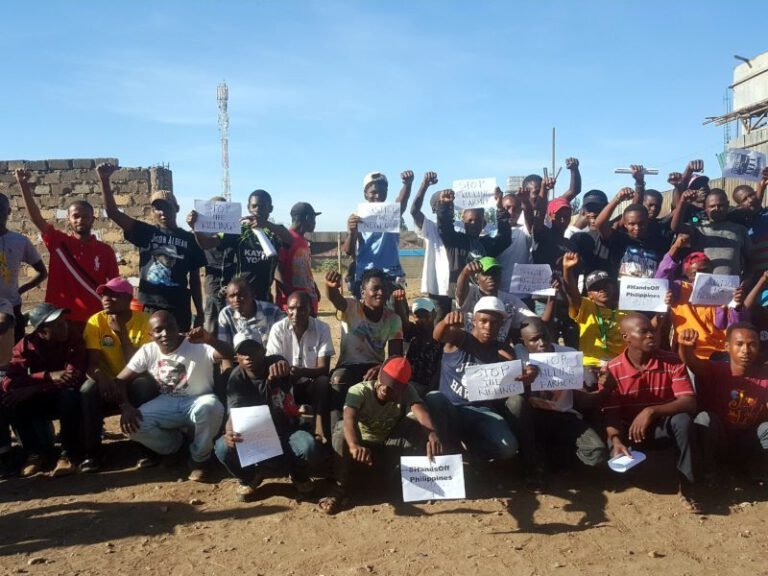
Most of the data presented in this roundup comes from Karapatan, an alliance of individuals, groups and organizations working for the promotion and protection of human rights in the Philippines. Collated and contributed by ICHRP-Africa