Home Blog Page 36

How does the Philippine state violate International Humanitarian Law?

0

International Humanitarian Law (IHL) is a set of rules which seek to limit the effects of armed conflict and to reduce the human suffering caused by it. It protects civilians, service providers, and soldiers who have ceased fighting. In the Philippines, the state regularly commits violations of IHL, known as war crimes.

For decades, the Government of the Republic of the Philippines (GRP) has claimed that it is carrying out a counter-insurgency strategy to fight the armed communist movement in the country. In reality, the “counter-insurgency” campaigns under various presidents have targeted any and all forms of dissent against the GRP, including the campaigning of civilian activists and organizations.

These IHL violations are carried out by the various state and state-aligned machineries, as they implement the GRP’s war on dissent. These war crimes are carried out by soldiers of the Armed Forces of the Philippines (AFP), the Citizen Armed Force Geographical Units (CAFGUs), the Philippine National Police (PNP), and various other militia and vigilante groups.

The AFP indiscriminately drops bombs on peasant communities where they believe NPA units are operating. This violates Customary IHL Rule 13 on bombardment of areas containing civilians. A recent example is the AFP bombing of communities on the border of Abra and Ilocos Norte on April 2nd. Indiscriminate bombings force civilians to evacuate and put their lives at risk.

The AFP and PNP torture and murder captured NPA members. This violates Customary IHL Rule 47 on attacks against persons hors de combat, and various rules on humane treatment. On February 23, members of the AFP and PNP in Bohol abused and murdered five NPA members in front of local residents. The Bilar 5 had been captured earlier that day.

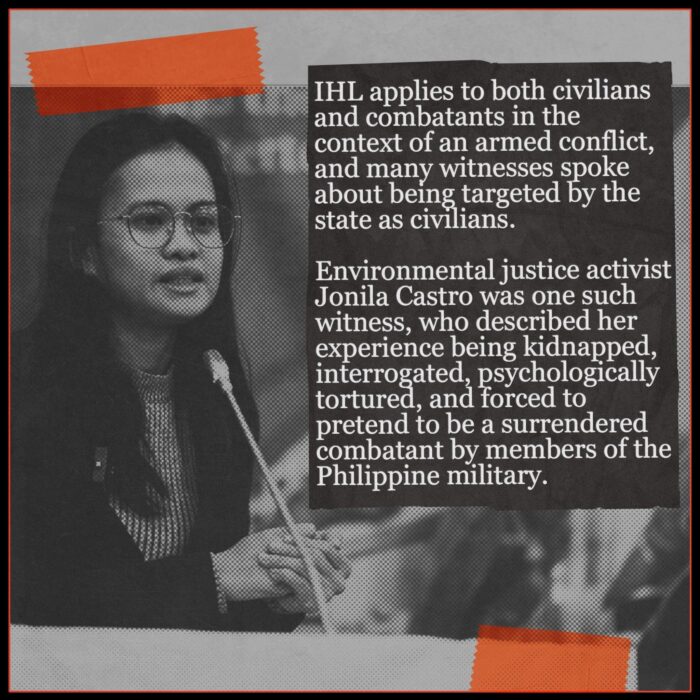
The Philippine state also disappears civilians and combatants against their will. This is a violation of Customary IHL Rule 98 on enforced disappearance or military kidnapping. Environmental activists Jonila Castro and Jhed Tamano were disappeared by the military last year and interrogated for 8 days, before bravely revealing their abduction at a press conference organized by the government in October.

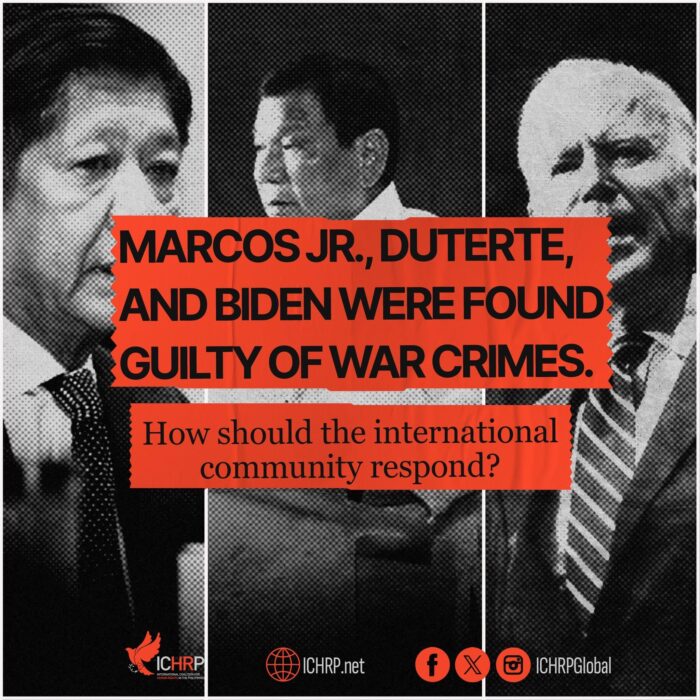
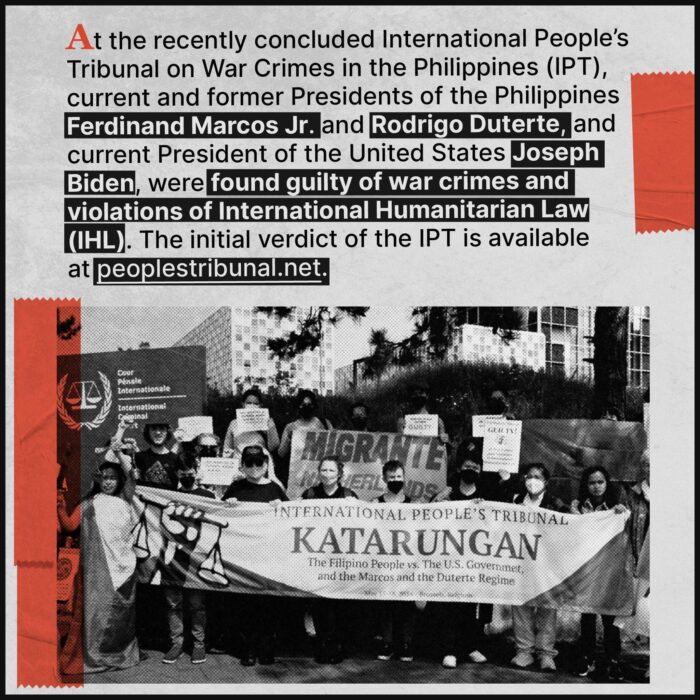
These are just some of the rules of IHL that are violated by the Philippine state, in addition to many others. These war crimes are the subject of the upcoming International People’s Tribunal which will put the Marcos and Duterte regimes on trial for war crimes. For more information about the International People’s Tribunal, visit www.peoplestribunal.net

Solidarity Message to the 40th Anniversary of Cordillera Day

From Peter Murphy, ICHRP Global Council Chairperson
April 23, 2024

The International Coalition for Human Rights in the Philippines (ICHRP) sends its warmest greetings of solidarity to delegates attending the 40th Anniversary of Cordillera Day on April 23 – 24, 2024. 

ICHRP joins with you to remember and celebrate the life of Macli-ing Dulag and the people’s victory against the Chico Dam project. We stand alongside you in your fight for self-determination, land and life. We salute the Cordillera Peoples Alliance and recommit to the Save Cordillera Campaign against repression by the US-Marcos Jr. regime.

On April 24, 1980, soldiers of the Philippine military under the Marcos Sr. regime assassinated Macli-ing Dulag, a tribal chieftain from the province of Kalinga renowned for his staunch opposition to the World Bank-funded Chico Dam Project. The project threatened to displace hundreds of thousands of indigenous peoples from their ancestral land in the mountainous region of northern Philippines.

The murder of Macli-ing Dulag was a watershed moment in the Cordillera peoples’ struggle for self-determination. As the mass movement against both the Chico Dam construction and Marcos Sr. dictatorship grew, the Macli-ing Memorial was held to commemorate the death of the slain tribal leader from 1981 to 1984. 

Following the founding of the Cordillera Peoples Alliance (CPA) in June 1984, the commemoration’s name was changed to Cordillera Day in 1985. The mass movement broadened as it aimed to unite the struggle of indigenous peoples across different provinces in the Cordillera, while building solidarity with national and international advocates and supporters.

Since its inception, Cordillera Day has been a political solidarity event gathering thousands of indigenous peoples, advocates, supporters, and solidarity activists every year to discuss burning issues which plague not only indigenous communities but also the Filipino people at large.

The Cordillera Peoples Alliance’s international solidarity work led to a conference of indigenous leaders and advocates from different countries across the globe in November 2010, which subsequently founded the Indigenous Peoples Movement for Self-Determination and Liberation (IPMSDL), a global network committed to advancing the rights of indigenous peoples to self-determination, land and life.

As a solidarity organization committed to campaign for a just and lasting peace in the Philippines, ICHRP draws boundless inspiration from the Cordillera peoples’ valiant and historic struggle for self-determination amidst decades of attacks, discrimination, militarization, and oppression. 

We wish you every success in the two-day celebration of the 40th anniversary of Cordillera Day.

Agbiag ti Kordilyera!
Long live the Cordilleran people’s struggle for self-determination!
Long live the martyrs and heroes of Cordillera!
Long live international solidarity!

Human Rights Coalition Condemns Red-Tagging of Peasant Advocate in Dasmariñas, Cavite

Press Statement
April 17, 2024

This past week, peasant organization KASAMA – TK announced that its Deputy General Secretary, Jeverlyn Seguin, is wanted by Task Force Ugnay under the 2nd Infantry Division of the Armed Forces of the Philippines (AFP). Since March, members of the armed unit have visited residents in Dasmariñas, Cavite, showing photos of Jeverlyn and claiming that she is a member of the New People’s Army (NPA).

“The International Coalition for Human Rights in the Philippines (ICHRP) strongly condemns the red-tagging and intimidation of Jeverlyn by members of the Philippine military,” said Peter Murphy, ICHRP Chairperson. “The harassment and terror-tagging of legal-democratic activists has become a standard tactic of the Marcos Jr. regime, as well as past regimes, in its all-out war of suppression against dissent in the Philippines.”

Katipunan ng mga Samahang Magbubukid sa TK (KASAMA – TK), or Union of Peasants’ Associations in Southern Tagalog, is a peasant group that organizes and mobilizes farmers in their struggle for land, rights, and basic services. Before her red-tagging, Jeverlyn had been participating in the launch of a campaign to document the effects of the El Niño weather system on farmers in the area.

The threat to Ms. Seguin is related to the recent Facebook post released by the Office of the President regarding the data of the National Task Force to End Local Communist Armed Conflict (NTF-ELCAC), that red-tags the Kilusang Magbubukid ng Pilipinas and its members as a front of the “Communist Terrorist Group”.

“The red-tagging of peasant advocates like Ms. Seguin goes hand-in-hand with the ongoing violations of International Humanitarian Law (IHL) by the AFP against peasants across the country,” Murphy continued. “Arbitrary red-tagging of activists blurs the line between the ongoing civil war between two belligerent sides—the AFP and the NPA—and the legal-democratic movement of non-combatants.”

“In the course of its US-designed ‘counter-insurgency’ war, the AFP indiscriminately targets civilian peasants through bombings, strafing, enforced disappearance, killing, and more,” said Murphy. “ICHRP condemns all forms of violations of IHL and attacks against peasant activists by the AFP. We reiterate our call to the Marcos Jr. administration to end the policy of red-tagging, and to re-commence formal peace talks with the National Democratic Front of the Philippines to resolve the armed conflict by addressing the socioeconomic roots of the conflict, rather than pursue indiscriminate military action that kills, inures and displaces civilians.”

Further comment: Peter Murphy, ICHRP Chairperson. WhatsApp: +61 418312301. Email: media@ichrp.net.

US-Japan-Philippines Trilateral Summit makes the Philippines a battlefield for US-China conflict

Press Statement
April 12, 2024

At a time of heightened violations of human rights and International Humanitarian Law (IHL) by the US-backed Armed Forces of the Philippines, and rapid US military build-up in the Philippines and throughout Southeast Asia, President Ferdinand Marcos Jr. met yesterday with US President Joe Biden and Japanese Prime Minister Fumio Kishida at the three nations’ first trilateral summit at the White House. The main objective of the summit is to strengthen military ties between the countries, particularly in the context of the US drive to war against China.

“The International Coalition for Human Rights in the Philippines (ICHRP) condemns the ongoing military buildup by the US and its allies in Southeast Asia,” said Peter Murphy, ICHRP Chairperson, today. “We condemn the intrusion of Chinese naval and fishing vessels into the Exclusive Economic Zone of the Philippines, but ICHRP is deeply concerned by the collaboration between the Marcos Jr administration and the US, Japan, and their allies in openly preparing for war against China. The deployment of more troops, the military exercises, and the placing of medium-range missiles along the so-called First Island Chain are all preparations for war.”

Murphy added: “This military and economic collaboration between Marcos Jr, Biden, and Kishida is especially reprehensible given the history of violent invasion, mass murder, and colonization of the Philippines by both the United States and Japan within the last century, and Japan’s invasion of China and occupation of Korea.” 

The US invaded and occupied the Philippines in 1899–1913, when the US army rounded up peasants into concentration camps and declared entire areas of the country as battle zones, in which no distinction was made between combatants and civilians. Over 16,000 Filipino soldiers were killed in the fighting, with estimates of civilian deaths of up to 1 million. US colonial control was interrupted only by the brutal Imperial Japanese invasion from 1942–45.  

The “Independence” of the Philippines in the immediate postwar period institutionalized US military, economic and political control through unequal treaties and trade agreements. 

The Philippines has since served as a constant outpost of US militarism, especially with the relentless bombing of Vietnam from 1965–73. The Enhanced Defense Cooperation Agreement (EDCA) bases, the Reciprocal Access Agreement (RAA) and the 25-year-long RP-US Visiting Forces Agreement give the US military access to all of the Philippines.

The US Counterinsurgency Doctrine has produced a series of brutal US-backed regimes—Marcos Sr., Ramos, Estrada, Gloria Macapagal Arroyo, Duterte, and Marcos Jr.—all too willing to wage war on their populations in a never-ending campaign to suppress dissent. 

The millions of Filipinos who are forced to seek work overseas as a result of the dire economic situation are evidence that this ongoing subservience to the US offers little for the average citizen in terms of social and economic stability. The trilateral summit is a back-to-the future event where the Philippines will be the United States’ frontline vassal in its looming confrontation with China. 

ICHRP denounces the trilateral summit’s objective to bolster security ties through joint military exercises by the US, Japan, and the Philippines. Washington’s anti-China war propaganda ignores the reality that these exercises primarily occur in the Philippines and further consolidate the Marcos Jr regime’s subjugation to the US and repression of its own people. 

Every diplomatic effort must be made to avoid war in Southeast Asia and to uphold the sovereign rights of all nations in the region, including the Philippines. The South China Sea should be a focus for negotiated demilitarisation, and events like the trilateral summit should be shunned by all parties.

Oppose violations of International Humanitarian Law!
Uphold Philippine sovereignty!
Oppose China’s aggression!
Oppose US militarism and its drumbeat for war on China!
Oppose the trilateral summit!

Further comment: Peter Murphy, ICHRP Chairperson. WhatsApp: +61 418312301. Email: media@ichrp.net.

What is International Humanitarian Law and why is it relevant in the Philippines?

0

International Humanitarian Law, or IHL, is a set of rules which seek to limit the effects of armed conflict and to reduce the human suffering caused by it. In the context of war, IHL calls for the protection of civilians, service providers like medical personnel, and persons who were previously involved in the armed conflict but have ceased fighting. This includes soldiers who are wounded, sick, shipwrecked, or otherwise unable to fight (known as hors de combat); surrenderees; and prisoners of war.

All persons protected under IHL are entitled to humane treatment, medical care, and other legal guarantees. IHL also places restrictions on certain means and methods of warfare that fail to discriminate between civilians and combatants that cause superfluous injury, or cause severe damage to the environment. Violations of international humanitarian law are known as war crimes.

IHL was developed over hundreds of years of human history, as people witnessed the potential for excess suffering in armed conflicts. Such excesses include murder of wounded soldiers, torture, use of chemical weapons, and more. The codification of universal IHL began in the late nineteenth century, but it was primarily laid out following World War II. The Geneva Conventions of 1949, and their Additional Protocols of 1977, define the major parts of IHL used today. Many other agreements and conventions have developed the rules of IHL since.

In the Philippines, IHL applies to the active armed conflict in the country between the revolutionary movement represented by the National Democratic Front of the Philippines (NDFP) and the Government of the Republic of the Philippines (GRP), which has been ongoing since 1969. Both the NDFP and GRP have explicitly expressed their willingness to abide by IHL, mainly through the signing of the Comprehensive Agreement on Respect for Human Rights and International Humanitarian Law (CARHRIHL) over the course of peace negotiations.

Since the signing of CARHRIHL in 1998, however, IHL violations continue to mount under the GRP’s US-designed counter-insurgency strategy. The Philippine national army, police, and militias have carried out bombings of civilian communities, kidnapping and torture of civilians, murder and desecration of hors de combat, among countless other violations. These violations are the subject of the upcoming International People’s Tribunal, from May 17-18, which will put the US government and Marcos and Duterte regimes on trial for war crimes.

For more information about the International People’s Tribunal, visit www.peoplestribunal.net