
Home Blog Page 247

Desaparecidos: Prosecution on Burgos case should go up to Gloria Macapagal Arroyo

0

Reference: Mary Guy Portajada, Secretary General
09175415133/4342837

“We hope that through this, justice will come swiftly,” Pamilya ng Desaparecidos para sa Katarungan (Families of Desaparecidos for Justice) or Desaparecidos  say as they welcomed the Commission on Human Rights’ investigative report and recommendations on the case of Jonas Burgos.

Jonas Burgos is an agriculturist who taught organic farming among peasants in Bulacan. He was abducted allegedly by the Philippine Army on April 28, 2007 in a mall along Commonwealth Ave. in Quezon City. Jonas is the son of a prominent Martial Late press freedom fighter Joe Burgos.

At the same time the organization of families of victims of enforced disappearances reminds the public that there are still a number of similar cases petitioned for Writ of Amparo pending before the Supreme Court. Portajada cited the cases of Sherlyn Cadapan and Karen Empeño – the two missing University of the Philippines students, Romulo Robiños and Leo Velasco among others. “We are hoping that the respective courts and government agencies follow suit and come out with favourable responses on the said cases.”

Moreover, Portajada criticized AFP Chief of Staff Lt. Gen. Eduardo Oban Jr.’s order of creating a technical panel to study the CHR report. “The AFP should immediately comply with the CHR recommendations, instead of creating a technical panel to study the findings. It took four long years for a government agency to come out with favourable findings on the Burgos case, we don’t want to add more and lengthen the process by undue processes that would only delay the serving of justice to victims.”

Portajada also warns the public, that even if the prosecution of 1st Lt. Harry Baliaga of the Army’s 56th Infantry Battalion will proceed, without the Philippine Congress’ passage of the Anti-Enforced Disappearance Bill, all will be in vain.

Baliaga was identified by witnesses in their testimonies as the “principal by direct participation” on the abduction of Jonas Burgos.

According to the Desaparecidos, Baliaga can only be liable for Kidnapping and NOT for the crime of enforced disappearance.

Portajada explains the difference between the two crimes, “Kidnapping is illegally seizing a person by force and against his will; it also involves the use of ransom for the surfacing of the illegally detained person. This eliminates the political motive of the state forces to disappear a person. While with enforced disappearance, a person is disappeared for political reasons by state security forces; thus both state security forces and the commander in chief will be held responsible. This would mean that, even former president Gloria Macapagal Arroyo can be held liable for Jonas’ disappearance and even that of other victims.”

“The CHR report might be a welcoming development. Yet, until victims remain to be missing, and masterminds of enforced disappearances are still free, we will continue to be vigilant and our cry for justice will remain.”#

KARAPATAN Alliance for the Advancement of People’s Rights
Philippine Human-Rights Group Honors Former UN Envoy Philip Alston

0

by Ronalyn V. Olea On January 25, 2011

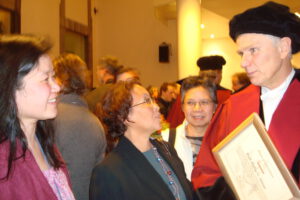
Prof. Philip Alston in a light moment with Ms. Marie Hilao of Karapatan and Dr. Angie Gonzales of ICCHRP

MANILA — Human-rights group Karapatan conferred a plaque of appreciation to former United Nations special rapporteur on extrajudicial executions Philip Alston on Jan. 20 in Maastricht, the Netherlands.

Karapatan and the International Coordinating Committee for Human Rights in the Philippines (ICCHRP) awarded the plaque to Alston “for his resolute fight for human rights amidst adversity, particularly his valuable role in bringing to the attention of the United Nations and the international community his objective and fearless findings on the role of state security forces in grave human rights violations under the counter-insurgency program in the Philippines, the marked reduction of extrajudicial killings following his report, and the institutional recognition of non-government organizations like Karapatan in monitoring government compliance with UN conventions and treaties on human rights.”

Alston visited the Philippines [2]in February 2007 to investigate the spate of extrajudicial killings in the country. In his report [3], Alston blamed the counter-insurgency program of the then Arroyo government for the killings and other rights violations. He also dismissed the “purging theory” within the Communist Party of the Philippines peddled by the Philippine military as a means to dispense responsibility.

Alston presented recommendations to the Philippine government to address the extrajudicial killings, including the outright denunciation of killings in the counterinsurgency program, abolition of the Inter-Agency Legal Action Group tasked to build up legal charges against activists and dissenters, among others.

Alston of the New York University School of Law also received an honorary doctorate degree from the Maastricht University in the Netherlands, along with five other honorees for their outstanding contributions to their fields of specialization.

The conferment rites were held on the same day at the Vrijhtof Theater in Maastricht, The Netherlands, and was attended by more than 500 academics and guests. It was presided by Prof. Gerard Mols, rector magnificus of the Maastricht University.

“Philip Alston is one of the world’s most authoritative academics in the field of human rights, and author of a wide-ranging and substantial oeuvre. His work is characterized by a high degree of erudition and originality. He has a sharp tongue and enjoys knocking down sacred cows. He’s also done a great deal of practical work for the United Nations, as member of supervisory committees and as Special Rapporteur on extrajudicial executions”, stated Prof. Menno Kamminga of the MA Faculty of Law, in his testimonial to Alston. (http://bulatlat.com) [4]

P-Noy breaking ‘militia vow’

0

(Philippine Daily Inquirer)

OUR AMNESTY group 1190 in Germany has written letters on human rights concerns to Israel, Cambodia, China, Burundi, Turkey, Ukraine, Uzbekistan, Nepal, Honduras, Equatorial Guinea, Guatemala and Chad.

May I call attention to human rights abuses by militias, paramilitary groups and private armies. Everyone would agree with me that the authorities have the power to revoke an executive order that has had grave consequences for human rights in the Philippines? So far, however, former President Gloria Macapagal-Arroyo’s Executive Order No. 546 has not been rescinded. This 2006 presidential order directs the Philippine National Police to provide active support to the military in counterinsurgency operations, including deputizing militias and civilian volunteer organizations (CVOs) as “force multipliers.”

The full impact of the government’s tacit support for the private armed groups of local politicians became starkly clear on Nov. 23, 2009, when 57 people traveling in an election convoy were massacred in Maguindanao. Since then, former Maguindanao Gov. Andal Ampatuan Sr., members of his family and their private army have been arrested and charged in connection with the killings. Many members of his private army were part of CVOs, which the government had established and armed.

The system of authorization for armed groups which are then used as private armies remains intact.

After the Maguindanao massacre, then Senators Benigno Aquino III and Mar Roxas issued a statement demanding the “immediate revocation of Executive Order No. 546.” On April 22, near the end of his presidential campaign, Mr. Aquino said, “Our security forces must be directed to dismantle all private armies.” Although now commander in chief of the Armed Forces of the Philippines, President Aquino has yet to translate his words into action by disbanding and disarming these groups. Before the President’s election, his party announced as part of its platform: “The immediate task is to establish the conditions for a genuine human rights regime in the country.” In his first 100 days, however, the President failed to make human rights an immediate priority.

In losing his father, President Aquino has personal experience of a grave human rights violation and is now in a position where he can help protect the human rights of all Filipinos.

—FRIEDHELM KUHL,
Group 1190, Amnesty International

Leonard Co family files murder raps vs 38 Army soldiers

0

The family of slain botanist Leonard Co on Tuesday filed a complaint accusing 38 members of the Philippine Army’s 19th Infantry Battalion of murdering Co and his two other companions in Leyte last year.

Those who filed the complaint were Co’s wife, Glenda, and parents Lian Sing and Emelina Co.

Co’s family had earlier protested a DOJ fact-finding panel’s report that cleared the military of any liability for the the killing of Co, forest guard Sofronio Cortez, and guide Julius Borromeo at the Energy Development Corp. (EDC) premises in Kananga, Leyte.

The military had claimed that the three were killed in a crossfire between the 19th IB and New People’s Army (NPA) rebels.

But Co’s family said they do not believe the military because the Army’s shooting was supposedly “specifically directed only at Co, Borromeo, Cortez and their companions.”

“We have basis to believe that no encounter occurred between the 19th Infatnry Battalion and the communist terrorists when Co, Borromeo, Cortez were killed and that they were in fact murdered by elements of the 19th Infantry Battalion of the Philippine Army,” they said in their complaint.

Those named on the charge sheet were:

# 1Lt. Ronald Odchimar,
# 2Lt. Cameron Perez,
# Corporal Marlon Mores,
# Private First Class Albert Belonte,
# PFC Michael Babon,
# PFC Elemer Forteza,
# PFC Roger Fabillar,
# PFC Gil Guimerey,
# PFC Alex Apostol,
# PFC WIlliam Bulic, and
# 28 other John Does.

Lt. Gen. Ralph Villanueva, commander of the Armed Forces Central Command, said they have yet to get a copy of the complaint but vowed to make available the soldiers involved in any investigation.

“We are fully cooperating with all investigative bodies… our soldiers will be there so they can give their side and explain what happened. We are ready to [face] any of these [investigating] bodies,” said Villanueva, whose command has supervision over the battalion involved.

Complaint

In their complaint, Co’s family asked the DOJ to conduct a preliminary investigation to determine whether the respondents should be charged with murder for the killing of Co and his two other companions.

Lawyer Evalyn Ursua, counsel for the family, said a review of the DOJ panel’s report would show that “the findings and the conclusions of the report are flawed and contrary to evidence.”

Speaking to reporters, Ursua said that a scrutiny of the soldiers’ affidavits would show that they did not have personal knowledge of the supposed presence of communist rebels.

“We examined their affidavits and we saw their statements. Some were hearsay and unreliable regarding the presence of armed communist terrorists, and the shooting was directed especially at the team of Doctor Co,” Ursua said.

Co’s wife and parents added in their complaint: “It is understanding that these hearsay and unreliable statements about the supposed presence of three armed communist terrorists cannot give credence to the claim that Co, Borromeo, and Cortez were killed in the crossfire between government soldiers and communist terrorists.”

They likewise said that the fact that treachery, an element of murder, was present because Co, Borromeo, and Cortez were killed defenselessly.

“Under the law, the sudden and unexpected attack against Co, Borromeo, and Cortez when they were unarmed and completely defenseless constitutes treachery and makes their killing murder,” they said.

Which has more weight?

In a separate interview with reporters, Justice Secretary Leila de Lima said she will assign a panel of prosecutors that will hande the Co family’s complaint.

She added that the filing of the complaint paves the way for a preliminary investigation, which is a more formal inquiry compared with the earlier fact-finding probe done by a DOJ panel of prosecutors.

The DOJ panel’s report blamed the deaths on the communist rebels, saying the trajectory of the bullets that killed Co and his companions came from lower grounds, where the NPA rebels were allegedly located.

She added that the imminent preliminary investigation on the murder charges “effectively” has more weight than the fact-finding probe done by the panel.

“In the preliminary investigation, the evidentiary rules will apply. The ultimate goal is to determine probable cause whether the respondents can be indicted. This is a different proceeding, it’s more formal and it will be done by a different panel,” she said.

De Lima likewise vowed the DOJ’s impartiality in the upcoming preliminary investigation.

“The panel that will be created will be presumed to be regular and diligent and efficient in the discharge of its mandate,” she said. — RSJ, GMANews.TV (SOPHIA M. DEDACE, GMANews.TV)

NY-based group dissatisfied with govt campaign vs rights abuses

0

A New York-based human rights group on Tuesday criticized President Benigno Aquino III for allegedly not doing enough to provide justice for human rights abuses, eradicate private armies and address the culture of impunity by the police and military organizations.

In its 2011 report, the Human Rights Watch (HRW) said that after seven months into his presidency, Aquino “has taken insufficient steps to make perpetrators of killings and other abuses accountable.”

“President Aquino came to office promising that human rights would be a top priority,” said HRW deputy Asia director Elaine Pearson. “But talk is cheap, so long as security forces remain unaccountable for violent abuses.”

In its World Report 2011, HRW described the Philippines as a multiparty democracy with a thriving civil society and vibrant media, but observed that law enforcement agencies and the justice system remain weak, and the military and police commit human rights violations with impunity.

It also noted that “no significant progress has been made in hundreds of political killings that have occurred over the past decade.”

However, it took exception on the trial of Andal Ampatuan, Jr., a former mayor in Maguindanao province, and several others linked Nov. 23, 2009 massacre of 57 people, including 32 media workers in Ampatuan town, Maguindanao.

The HRW said that since Aquino took office, more than 20 leftist activists have been killed, and that even the international community led by the United Nations, European Union, and the United States, had scored the Philippines’ dismal human rights record.

A local rights group Karapatan claimed that 1,118 extrajudicial killings and more than 200 enforced disappearances were documented in the Philippines between 2001 and October 2009.

“Aquino has not fulfilled his campaign promise to take action against other ruling families who use militias and police as their private armies,” the HRW said.

Task forces were created to examine two private armies elsewhere in the country, but this has not resulted in any further action, the HRW said.

HRW’s Pearson, meanwhile, hailed Aquino’s December order to drop charges against the so-called “Morong 43,” saying it “sends a proper message to the military and police that mistreatment of suspected rebels undermines counterinsurgency efforts.”

In February 2010, the army and police arrested 43 men and women in Morong, Rizal province, and for 36 hours kept them blindfolded and refused them legal counsel. Following Aquino’s order, 35 were released in December.

Three men who face separate criminal charges remain in jail while two men and three women who have admitted to being communist rebels and chosen to enroll in the government’s integration program are still in military custody.

But rather than investigating the allegations of abuse, Pearson lamented that the military granted awards to two officers who led the arrests.

Pearson also cited the two new laws on torture and war crimes that were enacted in late 2009, which will assist prosecutions of government officials implicated in criminal acts.

“New laws on torture and war crimes provide valuable tools for combating abuses. But real progress in professionalizing the army and police will only happen if these laws are put to use,” Pearson said. — LBG/KBK, GMANews.TV