


Home Blog Page 183

Families of desaparecidos hit Aquino on continuing disapperances, decry tokenism of Anti-Disapperance Law

On the International Day of the Victims of Enforced Disappearances

Desaparecidos (Families of the Desaparecidos for Justice)

“Until when will we keep looking for the disappeared?” Lorena “Aya” Santos, a daughter of a desaparecido and Secretary General of the Families of the Desaparecidos for Justice asked.

“For years, we keep commemorating the International Day of the Disappeared to remember all the desaparecidos in the world, and to call to stop enforced disappearances. Regimes had passed, but enforced disappearances still exist while our missing loved ones have yet to be found,” Santos said.

“It is obvious that the elimination of the practice of enforced disappearance will not end under the Noynoy Aquino regime,” Santos lamented.

“All the indicators are here. Enforced disappearances continue, the government does not own up to its accountability, no perpetrator has been prosecuted or jailed, and human rights violators are promoted to higher posts. Maj. Gen. Jovito Palparan remains free from prosecution and jail,” Santos said.

Palparan is responsible for the abduction, torture and disappearance of UP students Karen Empeño and Sherlyn Cadapan. In December 2011, a warrant of arrest was issued against him and his cohorts. With a 2-million peso bounty on his arrest, Palparan remains at large to this date.

Under the Aquino regime, 17 persons have fallen victim to enforced disappearance. The latest case of disappearance is that of Bryan Epa of Nueva Vizcaya, an anti-mining activist, who was abducted by Vizcaya police on the night of 21 August.

It is the first time that the Philippines is commemorating the International Day of the Disappeared with a law that criminalizes enforced disappearance. “But we, families of desaparecidos, have nothing to celebrate about,” Santos said.

“The law alone cannot put a stop on enforced disappearances as proven by the recent cases of disappearances; more so to surface the disappeared,” Santos pointed out.

“This law has so far served only as a mere token to appease our outrage; but nothing has really changed since its enactment,” Santos said.

“While Pres. Aquino desperately saves his administration on the issue of corruption and the pork barrel system through the Napoles ‘surrender’, he can not do the same to hide the evils of human rights violations in the Philippines,” Santos said.

The members of Families of Desaparecidos for Justice today held a program-teach in at the lobby of Palma Hall at the  University of the Philippines, Diliman, where disappeared Karen Empeño, Sherlyn Cadapan, and Leo Velasco were among its alumni. Poems were read, songs, dances, and other cultural numbers were performed in remembrance of the disappeared. At the steps of Palma Hall, rights defenders and families of desaparecidos mounted huge letters made of old clothes to form the word “SURFACE”.

Meanwhile, in Guatemala, a demonstration and a gathering of relatives were held as a tribute to the disappeared. The solidarity activities between the Families of Desaparecidos for Justice in the Philippines and the Fundacion Amancio Samuel Villatoro in Guatemala were agreed upon by both organizations during the International Conference for Human Rights and Peace in the Philippines in July 2013.

Both organizations jointly paid tribute to the desaparecidos and issued a joint statement where they scored the United States’ role in the use of enforced disappearance and other forms of human rights violations by various States to keep the US’s economic and political interests in both countries, and in other neo-colonial states in Asia, Africa, and Latin America.

“Until when does a person stop searching for a disappeared loved one? The search for the actual missing body may eventually stop after years of not getting any clue. But the fire in the hearts of each yearning mother, daughter or son, wife or husband for justice will never die. The search for justice will not stop, until enforced disappearance is ended,” Santos concluded.

Reference:
Lorena “Aya” Santos
Secretary General, Desaparecidos
+639222962260
———————————————————————
PUBLIC INFORMATION DESK
publicinfo@karapatan.org
———————————————————————
Alliance for the Advancement of People’s Rights
2nd Flr. Erythrina Bldg., #1 Maaralin corner Matatag Sts., Central District
Diliman, Quezon City, PHILIPPINES 1101
Telefax: (+63 2) 4354146
Web: http://www.karapatan.org

KARAPATAN is an alliance of human rights organizations and programs, human rights desks and committees of people’s organizations, and individual advocates committed to the defense and promotion of people’s rights and civil liberties.  It monitors and documents cases of human rights violations, assists and defends victims and conducts education, training and campaign.
Court of Appeals orders release of security guard tagged as “rebel leader”

A vindication of sorts but a travesty of justice nonetheless

National Union of Peoples’ Lawyers

The National Union of Peoples’ Lawyers (NUPL), counsel for security guard Rolly Panesa who who was tagged by the military as a supposed top-ranking rebel leader, welcomed with sigh of relief the 27 August 2013 decision of the Court of Appeals finally granting after several months the petition for the issuance of the privilege of the writ of habeas corpus. Even as it comes belatedly, we commend the Decision for finally seeing through all the deliberate lies and clumsy fabrications of the military to justify the violation of his rights.

Rolly Panesa, an ordinary security guard for the longest time, was illegally arrested way back 5 October 2012 at a busy intersection in Quezon City, and detained by joint elements of the 2nd Infantry Division of the Philippine Army, led by Southern Luzon Commander Maj. General Alan Luga, and the Philippine National Police. He was severely tortured while the military cynically misidentified him for a certain “Benjamin Mendoza”, supposedly the secretary of the Communist Party of the Philippines (CPP) in Southern Luzon, with a reward of PhP 5.6 million.

At the same time, the NUPL laments the long drawn-out and tedious legal proceedings that Panesa had to undergo just to simply prove that he is not what the military says he was and despite overwhelming evidence to establish his identity. This includes multiple official identification cards and records issued by government agencies themselves, on top of incotrovertible testimonial evidence, in stark contrast to the self-serving, contrived, and ludicrous accounts of spurious witnesses for the military a.k.a. roving rebel retrunees. It does not give comfort that the Office of the Solicitor General was, wittingly or unwittingly, a party all throughout to the perpetuation of this gross injustice.

The NUPL pointed out that the poor fellow had to endure almost 11 months in detention while awating his deserved vindication. If there is any classic example of justice delayed and justice denied, this no doubt fits the bill.  Nothing indeed will bring him back all those times lost and the damage wrought on his reputation, not to mention the agony and ordeal he and his family went through.

The NUPL condemns the money-making scheme of the Department of National Defense and the Department of Interior and Local Government’s secret hit list as it is now again proven to be dubious.  Previously, a certain Olegario Sebas of Negros Oriental who was similarly arrested for purportedly being another rebel leader, was also ordered released by virtue of a habeas corpus petition.

The payment by the Armed Forces of the Philippines of handsome reward money to supposed informers for the capture of what it refers to as “terrorist personalities and communist leaders” is farcical, withal dangerous. Thus, the DND-DILG’s secret hit list must be scrapped totally and immediately as it has become the basis to arrest, detain, and torture people on false charges; or worse, disappeared or killed. In addition, those who concocted this not so bright idea should also be held accountable for misusing the people’s money to violate people rights.

We shall suppport our client’s longstanding plan to file countercharges against those who have practically destroyed his life beyond `repair as impunity shall simply continue if there is no accountability.

Reference:

Atty. Ephraim Cortez
Deputy Secretary General for Legal Services
+639175465798

Atty. Edre U. Olalia
Secretary General
+639175113373

National Secretariat
National Union of Peoples’ Lawyers (NUPL)
3F Erythrina Bldg., Maaralin corner Matatag Sts. Central District,Quezon City, Philippines
Telefax no.920-6660
Email addresses: nupl2007@gmail.com and nuplphilippines@yahoo.com
Follow us on twitter @nuplphilippines
and facebook @https://www.facebook.com/nuplphilippines
Visit the NUPL website at http://www.nupl.net/

Nixing mining the only way to end Tampakan horrors — KAMP

By Kalipunan ng mga Katutubong Mamamayan ng Pilipinas (KAMP)

An indigenous people’s organization condemned the brutal slay of two Blaan tribe members in Kiblawan, Davao del Sur village by alleged members of the Philippine Army on 23 August. The Blaan communities in Kiblawan and adjacent villages are affected by the explorations of Glencore-Xstrata Tampakan Gold-Copper Project.

According to the National Alliance of Indigenous Peoples Organizations in the Philippines (KAMP), the pangayaw (tribal war) will persist as long as the Blaan are threatened with displacement.

“Gruesome massacres and killings will not end until Xstrata is sent packing,” Piya Macliing Malayao, spokesperson of the indigenous peoples’ group said. “The killing of the Freay family members is a horrible development in the long-wrought and arduous struggle of the Blaan people to protect their lands.”

The Blaan tribe has been waging a seven-year pangayaw against Xstrata (fully acquired by Glencore early this year), and its local affiliate, Sagittarius Mines Inc (SMI), in defense of their lands against open-pit and large-scale mining.

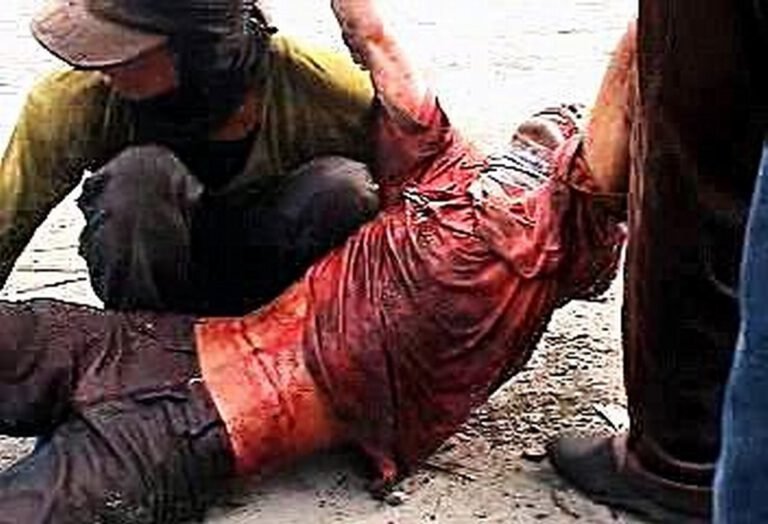
Datu Anting Freay, 60, and his son Victor Freay, 16, were killed allegedly by members of the 39th Infantry Battalion of the Philippine Army and Task Force Kitaco in their home in Sitio Bulol Kalon, Bongmal, Kimlawis, Kiblawan, Davao del Sur. Anting sustained three gunshot wounds in the face, neck, and leg, while Victor sustained eighteen gunshots to the body, disemboweling him.

“The Blaan communities affected by the Tampakan mining project is resolute in fighting for their rights to land, even if it has been costing the lives of many Blaan men, women, and children. They know that this struggle to defend their lands is for the next generations and the patrimony of our country,” Malayao shared.

“It is the Aquino government and its mercenaries that need to stand down and finally acknowledge the rights long fought for by the indigenous peoples.”

The Tampakan Gold-Copper Project straddles the towns of Tampakan in South Cotabato, Columbio in Sultan Kudarat, Kiblawan in Davao del Sur, and Malungon in Sarangani. Xstrata, taken over by commodities giant Glencore International last April, is now in the reigns of the US$5.9-billion mining project. It is considered the country’s biggest foreign investment.

Protracted violence, rights violations

In October 2012, a Blaan family was murdered also in the affected areas of the Tampakan Project. Juvy Capion, and her children John and Pop aged 8 and 13, were slain by strafing by members of the 27th Infantry Battalion. Nine members of the 27th IB were relieved from duty following the Capion massacre. The 39th IB is now deployed in the area, in conjunction with Task Force Kitaco, an armed organization of paramilitary and regular military troops sanctioned by the Armed Forces of the Philippines to quell opposition to the Xstrata mining project.

The 39th Infantry Battalion of the Philippine Army also has a smirched human rights record, says Malayao. “The 39th IBPA’s hands are tainted with the blood of two other Blaan people, that of Rudy and his son, Rudyrick Dejos. Like the Capions and the Freays, the Dejoses were part of the struggle to defend Blaan lands from mining.”

In 2011, the 39th IBPA were allegedly responsible for the brutal slay of Rudy Yalon-Dejos and his son Rudyrick. They sustained multiple gunshot and stab wounds, their hands smashed, their bodies covered with bruises.

“The case of the Blaan people’s struggle against this mining corporation is a splatter of blood stains in the “peace and development” of Aquino’s Oplan Bayanihan. There is no peace resulting in the development agenda of the government, but a string of human rights violations committed against the indigenous peoples,” Malayao said.

“We want Xstrata out of the Philippines, and its mercenaries and protectors, namely the Armed Forces of the Philippines, to stay out of Blaan lands. Because surely, the indigenous peoples will relentlessly defend their lands from plunder and destruction.”

Reference:
Piya Macliing Malayao
+63917-3631576
Kalipunan ng mga Katutubong Mamamayan ng Pilipinas (KAMP)

National Alliance of Indigenous Peoples Organizations in the Philippines
Room 304 NCCP Building
876 Epifanio De Los Santos Avenue
West Triangle, Quezon City
Philippines

Rights groups score Aquino government on disappearance of anti-mining activist

By KARAPATAN

“As the world commemorates the International Day of the Disappeared on August 30, another person is victimized. We strongly condemn the enforced disappearance of anti-mining activist Bryan Epa and we hold the Aquino administration accountable for this heinous act,” said Lorena ‘Aya’ Santos, secretary general of Families of Desaparecidos for Justice.

Epa is a Katribu Partylist organizer in Nueva Vizcaya and has led campaigns against destructive mining in the province. In communities where there are barricades against the mining exploration of the Royalco Mining Exploration, residents experienced military harassment and intimidation, red tagging, surveillance, and sexual harassment.

On August 19, prior to Epa’s disappearance, 40 members of the Civilian Auxiliary Forces Geographical Unit (CAFGU) went to an anti-mining barricade at Binuangan village. They pretended to be members of the New People’s Army looking for their “comrades” who, they say, were supposed to be in the barricade. The protesters asserted there are no NPA members with them, and that guns are not allowed in the barricade. The men were asked to leave but insisted to stay until the following day.

On the day of Epa’s disappearance on August 21, 2013, around 9 o’clock p.m., Bgy. Councilor Alfonso Shog-oy dropped off Epa at a friend’s house in Brgy. Salvacion, Dumlao Blvd. to get his bag. Both Epa and Shog-oy, noticed three policemen at a street corner nearby.

On his way back to pick up Epa, Shog-oy saw six policemen inside a patrol car; three of them got off the car and approached Epa and tried to take away his bag. According to Shog-oy, Epa asked the police why they were taking his bag. Later, Shog-oy saw Epa being pushed by the policemen inside the patrol car, as they said they are taking him for questioning because he is “suspicious looking”. The police tried to handcuff Epa, punched him in the stomach and hit him with bats, when he tried to resist.

The following day, Shog-oy and Atty. Fidel Santos went to the Philippine National Police Bayombong station but policemen claimed Epa was already released and that his name is Felix Bacsa Jr. There was no record or police blotter, however, on Bryan Epa’s arrest.

Desaparecidos said that prior to Epa’s disappearance, they have monitored 14 victims of enforced disappearances under the Aquino administration.

Human rights group Karapatan called on Aquino and his “henchmen” in the Armed Forces of the Philippines and the Philippine National Police to surface Epa and all victims of enforced disappearances.

“Epa’s disappearance proves that the Anti-Enforced Disappearance Law of the Noynoy government is merely an embellishment under Oplan Bayanihan as disappearances continue. The law is a fictitious detail in the overall picture of repression under Oplan Bayanihan,” Cristina Palabay, secretary general of Karapatan said.

Bryan Epa, Nueva Vizcaya anti-mining activist missing

Kalipunan ng mga Katutubong Mamamayan ng Pilipinas (KAMP)

As Typhoon Maring battered many parts of the country with its hard rains, an anti-mining activist has gone missing.

Bryan Epa, 34 years old, was reported missing after police arrested him last August 21, but has not been seen since. According to Karapatan-Cagayan Valley, village official Alfonso Shog-oy saw six policemen take Epa aboard their patrol vehicle in Barangay Salvacion Dumlao Boulevard, Bayombong, Nueva Vizcaya. The witness then related how he heard the policemen say that Epa will be taken into custody because he looked ‘suspicious’. Epa resisted arrest, he was punched in the stomach by two of the policemen, and then hit in the hand by the baton. The police managed to cart him away despite his protestations.

The following day, Shog-oy and Atty. Fidel Santos sought Epa at the police station, but they did not find him there. The police claimed that they have released a detained person on the same night that Epa was arrested, but according to records, it was a person named Felix Bacsa Jr. Epa’s whereabouts remain unknown.

Epa is an anti-mining activist and among the residents of Nueva Vizcaya opposing the entry of Australian mining company Royalco Philippines Inc. Epa is among the locals manning the barricades, set up since 2007 to prevent mining equipment from entering their lands.

Kalipunan ng mga Katutubong Mamamayan ng Pilipinas (KAMP, National Alliance of Indigenous Peoples’ Organizations in the Philippines) expressed its concern over the disappearance of Epa, citing other cases of enforced disappearances among activists. “The climate of impunity in the Aquino administration is a breeding ground for grave human rights violations especially of those perceived as ‘enemies of the state,’ including those resisting mining operations,” Piya Macliing Malayao, KAMP spokesperson said. “We fear for the safety of Bryan Epa.”

According to KAMP, there had been 35 extra-judicial killings of indigenous peoples in the three-year administration of President Aquino, and most of these killings were in the context of community resistance against mines, plantations, or dams. Leaders and members of local people’s organizations and their family are the usual targets of liquidation by state forces and paramilitary groups.

KAMP says the police are liable for the disappearance of the anti-mining activist, because he was last seen under their custody. “Given the human rights situation in the Philippines, and the brutality shown by the arresting police, it all bodes ill for his fate,” Malayao said.