Home Blog Page 181

Bryan Epa, Nueva Vizcaya anti-mining activist missing

Kalipunan ng mga Katutubong Mamamayan ng Pilipinas (KAMP)

As Typhoon Maring battered many parts of the country with its hard rains, an anti-mining activist has gone missing.

Bryan Epa, 34 years old, was reported missing after police arrested him last August 21, but has not been seen since. According to Karapatan-Cagayan Valley, village official Alfonso Shog-oy saw six policemen take Epa aboard their patrol vehicle in Barangay Salvacion Dumlao Boulevard, Bayombong, Nueva Vizcaya. The witness then related how he heard the policemen say that Epa will be taken into custody because he looked ‘suspicious’. Epa resisted arrest, he was punched in the stomach by two of the policemen, and then hit in the hand by the baton. The police managed to cart him away despite his protestations.

The following day, Shog-oy and Atty. Fidel Santos sought Epa at the police station, but they did not find him there. The police claimed that they have released a detained person on the same night that Epa was arrested, but according to records, it was a person named Felix Bacsa Jr. Epa’s whereabouts remain unknown.

Epa is an anti-mining activist and among the residents of Nueva Vizcaya opposing the entry of Australian mining company Royalco Philippines Inc. Epa is among the locals manning the barricades, set up since 2007 to prevent mining equipment from entering their lands.

Kalipunan ng mga Katutubong Mamamayan ng Pilipinas (KAMP, National Alliance of Indigenous Peoples’ Organizations in the Philippines) expressed its concern over the disappearance of Epa, citing other cases of enforced disappearances among activists. “The climate of impunity in the Aquino administration is a breeding ground for grave human rights violations especially of those perceived as ‘enemies of the state,’ including those resisting mining operations,” Piya Macliing Malayao, KAMP spokesperson said. “We fear for the safety of Bryan Epa.”

According to KAMP, there had been 35 extra-judicial killings of indigenous peoples in the three-year administration of President Aquino, and most of these killings were in the context of community resistance against mines, plantations, or dams. Leaders and members of local people’s organizations and their family are the usual targets of liquidation by state forces and paramilitary groups.

KAMP says the police are liable for the disappearance of the anti-mining activist, because he was last seen under their custody. “Given the human rights situation in the Philippines, and the brutality shown by the arresting police, it all bodes ill for his fate,” Malayao said.

COMMUNIQUÉ: International Conference for Human Rights and Peace in the Philippines

Quezon City, Philippines
19 – 21 July 2013

Guided by the theme: “Uphold People’s Rights! Work for Peace! Fight for Justice! Build Solidarity and Resistance with the People of the Philippines and the World!”, 280 representatives of people’s organizations, the academe, faith-based institutions, human rights advocates, defenders and victims, people’s lawyers, and peace promoters from 26 countries in five global regions gathered for the International Conference for Human Rights and Peace in the Philippines (ICHRPP) held at the Great Eastern Hotel in Quezon City, Philippines from 19 to 21 July 2013.

The objectives of the ICHRPP were:

  1. Identify, examine and analyze the social, economic, political, and the geopolitical context of the worsening violations of collective and individual rights in the Philippines.

  2. Identify the Filipino people’s commonalities with progressive forces in various countries confronting people’s and human rights issues, and on these bases seek to develop, expand and consolidate the Philippine movement of international solidarity to defend, uphold and advance human rights and people’s rights.

  3. Assess the significance of the combined domestic and international human rights solidarity campaigns concerning the Philippines since the fall of the Marcos dictatorship, and draw up a plan for an international solidarity campaign for peace, human rights and people’s rights in the Philippines culminating in the next international conference in 2016, the 30th anniversary of the fall of the Marcos dictatorship.

The ICHRPP was organized by the ICCHRP (International Coordinating Committee for Human Rights in the Philippines) with Karapatan (Alliance for the Advancement of People’s Rights), EcuVoice (Ecumenical Voice for Peace and Human Rights in the Philippines), Peace for Life Network, and the ILPS (International League of Peoples’ Struggle).

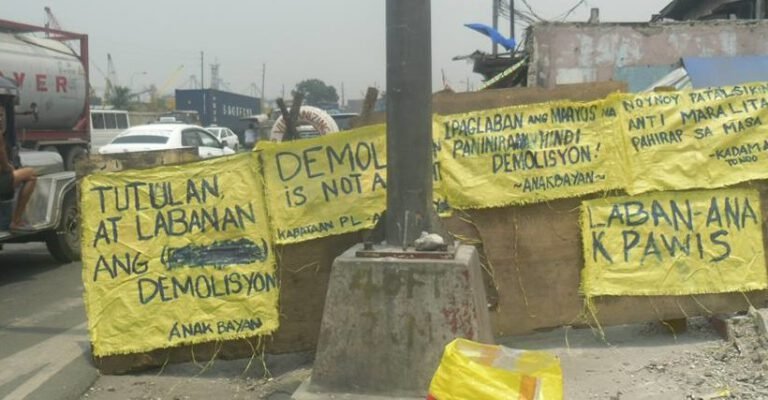
Prior to the holding of the ICHRPP, international solidarity missions were conducted in several areas, including Central Luzon, Southern Tagalog, three regions in Mindanao, Cordillera, and the National Capital Region. The missions looked into large-scale mining, landgrabbing, forced evacuation and the plight of internal refugees due to militarization in the countryside, targeted areas of extensive political repression by Oplan Bayanihan, forced eviction and demolitions in the urban areas, trade union struggles, and the situation of political prisoners in detention centers.

Among the prominent guests of the International Conference were: Jeanne Mirer, President of the 700-strong International Association of Democratic Lawyers (IADL); Azadeh Shahshahani, President, National Lawyers Guild (NLG) in the US; Anna Claire Morris, Vice-Chairperson, Haldane Society of Socialist Lawyers; Jan Fermon, Co-Head of the Progress Lawyers Network, and Bureau member of the IADL; Prof. Gill Boehringer of the International Association of People’s Lawyers (IAPL) and former Dean of Macquarie University Law School, Australia; Marta Benavidez of Siglo XXIII, El Salvador; David Wildman of the General Board of Global Ministries, United Methodist Church; and Antonio Tujan, Co-Chair, CSO Partnership for Development Effectiveness.

Three days of in-depth discussion of people’s issues

The first day session of the Conference was opened by the People’s Chorale with the rendition of the song Batingaw (Bells). It was followed by the welcome address of Rep. Teddy Casiño, who was also ICHRPP spokesperson.

The keynote addresses were delivered by: 1) Edita Burgos, mother of missing Jonas Burgos. She inspired the delegates with her strong determination to find her missing son. 2) Jeanne Mirer, who spoke about economic rights as human rights. And 3) Prof. Jose Ma Sison, Chairperson of the International League of Peoples’ Struggle (ILPS), who, in his video message, assailed the impact on human rights and peace of neoliberalism and the imperialist crisis.

Panel 1 (Economic, political and social crisis globally and in the Philippines, and implications on peace and human rights in the Philippines) had the following speakers: Dr. Kathryn Poethig (Associate Professor of Global Studies, California State University, Monterey Bay) tackled the deterioration of economic and social conditions in different parts of the world; David Wildman spoke about the crisis in Afghanistan and the Middle East; Rev. Christopher Ferguson shared about the conditions in Latin America, with special focus on Colombia; and Antonio Tujan, as final speaker, comprehensively discussed the global situation and implications on the Philippines.

A video entitled “No Child’s Play” by EJ Mijares, was shown after Panel 1.

Panel 2 (US geo-political and military strategies in the Asia-Pacific and the Aquino government’s Oplan Bayanihan) had the following discussants: Rep. Satur Ocampo (President, Makabayan People’s Coalition and, as Bayan Muna representative, was Deputy Minority Leader of the 14th Philippine Congress) on Aquino’s Oplan Bayanihan, US Counterinsurgency Guide and US pivot to Asia; Prof. Gill Boehringer explained why Australia is a “deputy sheriff, an imperialist subaltern”; Len Cooper (Divisional President, Communications Electrical and Plumbing Union, CEPU) discussed the implications on Oceania and the Philippines; and Kao Wei-kai (Councilor, Hinchu County and member, Taiwan Labor Party) discussed the peaceful development and reunification between the strait, and US intervention.

In the morning session of the second day, Marie Hilao-Enriquez, Chairperson of both Karapatan and Selda (organization of former political detainees), delivered a keynote speech on the human rights situation in the Philippines.

Speakers for Panel 3 (Struggle for just and lasting peace) included: Anna Claire Morris on the South African experience; Azadeh Shahshahani on the experience in the Middle East; and Jose Enrique “Sonny” Africa (Executive Director, Ibon Foundation – Philippines) on the struggles for economic and social rights in the Philippines.

Panel 4 speakers (Best practices in international solidarity campaigns) included: Fr. Rex Reyes

(General Secretary, National Council of Churches in the Philippines – NCCP) on Ecumenical Voice’s international lobbying; Kelti Cameron (International Solidarity Officer, Canadian Union of Public Employees – CUPE) on Canada’s Stop the Killings (STK) campaign; Dr. Julie Caguiat (Executive Director, Community Medicine Foundation, and co-spokesperson of the Free the Morong 43 Alliance) on the Free the Morong 43 national and international campaigns; and Jan Fermon on winning Jose Ma. Sison’s legal battle in Europe.

The last session, Panel 5 (Struggle for national and social liberation) had for its speakers: Ann-Kristin Kowarsch (Kurdish Women’s Office for Peace, CENI); Alberto Ruiz (Civil Rights Committee, Peru); and Luis Jalandoni (Chairperson of the Peace Negotiating Panel, National Democratic Front of the Philippines), whose paper was read by Fidel Agcaoili (NDFP Peace Negotiating Panel member. Sharing their countries’ situation were Marta Benavidez about El Salvador; Dr. Malem Ningthouja (Campaign for Peace & Democracy) from Manipur, India; and Samuel Villatoro (Museo de los Martires del Movimiento Sindical Estudiantil y Popular de Guatemala).

A summary highlighting discussions and points of agreement for the five panel discussions was given by Dr. Carol Araullo (Chairperson, Bagong Alyansang Makabayan – Bayan or New Patriotic Alliance) after a dance interpretation of an original song, “Palayain ang Bilanggong Pulitikal” or Free Political Prisoners by a community youth cultural group, KMM.

On the third day of the Conference, delegates had the chance to join any of the ten workshops on different topics such as: people’s resistance to large-scale mining; peasants fight global landgrabbing; workers’ struggle against monopoly capital attacks; women and children fight neoliberal policies and state violence; church’s role in the struggle for human rights and peace; challenging the legal system as tool of repression and impunity; urban poor resist forced eviction, demolitions and massive displacement; defending migrants’ rights; indigenous peoples’ defense of land, life and rights; and cultural imperialism as a violation of people’s rights.

A plenary session was convened afterward for workshop report-back and the adoption of a number of workshop resolutions.

Asserting people’s rights

The Conference approved the Conference Declaration which asserts that people’s rights encompass the economic, social, cultural, civil and political dimensions, and involve the people collectively and as individuals. It upholds, respects, promotes, and calls for the defense of people’s rights as embodied in various international instruments and agreements and further developed as fruits of the collective experiences and struggles of the people against discrimination, exploitation and oppression.

The Conference Declaration further states:

“We salute the determination of the Filipino people in their struggle for genuine sovereignty and democracy.

“We agree to further develop international cooperation to put a stop to state repression that breeds a culture of impunity in the Philippines and elsewhere; to pursue justice for the countless victims of human right violations in the country and elsewhere, and to build a strong solidarity network for human rights, peace and justice in the Philippines that supports similar struggles in other countries.”

Several resolutions covering different issues were also submitted for the approval of the Conference. Among these were resolutions on: withdrawal of the 10 million euro grant by the EU to the EU-Philippine Justice Support Programme; release of all political prisoners, specifically Abimael Guzman of Peru and Ocalan of Kurdistan; surfacing of and justice for victims of enforced disappearances; against the terrorist listing of Prof. Jose Maria Sison; against the privatization of health care; and condemnation of Canadian mining operations, to mention a few.

The results of the First General Assembly of the newly-formalized International Coalition for Human Rights in the Philippines (ICHRP) were shared with the Conference delegates. The human rights coalition elected an11-person Global Council and chose the Rev. Barry Naylor of the Anglican Church of the United Kingdom as Chairperson, and Peter Murphy of the SEARCH Foundation (Australia) as General Secretary.

To close the International Conference, a short message of appreciation addressed to all the delegates from Rev. Barry Naylor was read.

The conference closed with the People’s Chorale singing two songs of struggle, with a solo from its choral director in between. The solidarity night cultural program which followed was enthusiastically participated in by almost all delegations.

Rehashing lies that Morong 43 are NPAs: When is torture ever justified?

By National Union of Peoples’ Lawyers

Like a ghoulish ritual for the carcass of the dead, the military once again would resuscitate its long discredited claim that our clients, the Morong 43 health workers, are members of the underground New People’s Army.

Jumping on another opportunity to peddle this storyline — quite inherently contradictory most of the time — they now claim that one of those killed in an encounter weeks ago was in fact a former member of the Morong 43 who were illegally arrested, searched, detained and tortured more than 3 years ago.

It now claims that most of our clients “have returned to the hills” even as it concedes that a number of them have “continued” to be members of “progressive organizations”. It confirms that our clients — especially those who are visible in rallies and public places or events, or who chose to file cases against them and whom they stalk to this very day — continue to engage in health services.

As for all the rest that are less visible or who chose to keep a low profile, if not a “quiet” life after their horrific ordeal for 10 months, the military automatically claims are again NPAs.  Except of course a select few of them that they have spoiled and are living it up as their glorified slaves.

If the military cannot keep its facts straight, at least — if it has time — it should review its math. Even their convoluted figures do not literally add up.

As for Ramon dela Cruz who was reportedly killed in an alleged encounter, the belated claim that he is an NPA and the same person as the namesake of a former member of the Morong 43 is grounded on questionable bases and circumstances.

The comparison with his supposed mugshots and the similarity of the names of his supposed parents that he allegedly disclosed while under extreme and hostile interrogation in isolated detention is at best self-serving and at worse contrived if not malicious. And it does not help one bit that those who purportedly corroborated his identity as an NPA were most probably the usual roving mad dogs and itinerant professional “rebel returnees.”

And what if he was? On the supposition which cannot be independently established that he became an NPA after he was released, as far as his basic human rights were concerned, so what?

While we as lawyers are absolutely positive that our clients were not members of the NPA at the time the incident of illegal arrest happened, we are not privy into the minds and daily lives of each and every single client of ours after our legal engagement. We are incompetent and would be pretentious to judge them in whatever choices or options they subsequently take.

Yet we would be the least surprised as counsels who have known their torment up close that they are simply frustrated or have just had enough of a system that has betrayed them, with their pending cases they had filed personally and in constructive representation of others to seek justice in the Supreme Court, the Ombudsman, the Regional Trial Court and the Commission on Human Rights still in outstanding limbo after all these years.

We have to remember these people who just wanted to help the poor and those in need went through horrendous psychological and even physical torture, not to mention illegal arrest, search, detention, and denial of counsel. The arguable supposition that one of them became an NPA more than 3 years afterwards does not make those violations right, much less make those liable for such violations immaculate.

Otherwise, we would accept the strained fallacy as follows:

  1. the military claims the Morong 43 are NPAs,
  2. there were violations of their rights including torture,
  3. the Morong 43 deny that they are NPAs but are community health workers,
  4. the killing of one of them supposedly confirmed he was an NPA,
  5. all of the Morong 43 were therefore NPAs all along, and
  6. Ergo, the torture and rights violations are proven justified and it is alright to have tortured them after all.

While checking on its arithmetic, it would also do well for the military and those who want to get away with impunity – again if they have time – to review their logic if not their sense of right and wrong.

Indeed, when was torture by anybody on anyone at anytime and in any place and under any circumstance ever justified?

Reference:
Edre U. Olalia
Secretary General
+639175113373

New Zealanders demand surfacing of missing activists, release of all political prisoners

Paper cranes, desaparecidos, and political prisoners in the Philippines

30th of August is International Day of the Disappeared. Tomorrow, 21st of August, Ninoy Aquino Day will again be observed, commemorating the life and death of Senator Benigno “Ninoy” Aquino Jr.

On this occasion, the Philippines Solidarity Network together with faith-based justice and peace advocates in New Zealand reiterate their appeal for President Benigno Aquino III to end human rights abuses.

“Since Aquino came to power in 2010, we have joined the international community in challenging him to honour his father by heeding the appeals to stop the extra-judicial killings, free political prisoners and surface victims of involuntary disappearances,” Murray Horton, Secretary of Philippines Solidarity Network of Aotearoa, said in a statement sent to the Mindanao Examiner.

Last July, New Zealand-based Korean Pastor Kyoung Gyun Han represented the Presbyterian Church of Aotearoa New Zealand at the International Conference for Human Rights and Peace in the Philippines.

“It was a big conference of over 200 people from around the globe. It is such an honour to be part of a global network including churches actively supporting the Filipino people’s quest for justice and peace.”

“Coming back to New Zealand, I am committed to watch out Philippine situation, engage in solidarity action and strengthen migrants’ ministry particularly in Auckland and Christ church where there are now around 1,000 Filipinos working to help rebuild the quake-devastated city,” Rev. Han, who is the PCANZ Asian Ministries Coordinator, noted during his report-back meeting with Auckland Philippines Solidarity

psn_newzealand01Rev. Han also met recently with APS members and representatives of the Presbyterian Church of Aotearoa New Zealand and The Methodist Church about action plans to support justice and peace quest in the Philippines.

They lamented the fact that far from Aquino’s 2010 election promise to deliver justice for human rights victims of past regimes, his three-year administration now holds a record of 142 extra-judicial killings, 540 illegal arrests, 76 cases of torture, 30,678 forced evacuations and 31,417 cases of threats, harassment and intimidation, among others.

In solidarity with victims’ families, they made paper cranes — Japanese origami — in support of the campaign to Surface James Balao and all victims of enforced disappearances.

Based on the ancient Japanese legend that anyone who folds a thousand origami cranes will be granted a wish by a crane, they sought the help of Japanese friends to demonstrate how to make paper cranes so they can express support for all the families awaiting the return of their loved ones who have been abducted by state agents.

US troops in the Philippines violate sovereignty, perpetuate impunity — KARAPATAN

“The permanent presence of US troops in the country, the unlimited access to Philippine facilities, including storage of arms, and the use of drones, are direct attacks against Philippine sovereignty and the people’s rights,” said Cristina Palabay, Karapatan secretary general, on the talks between the US and Philippine governments which start today on the increase of rotational presence of American forces in the country.

As the Philippine government and US military officials gear to “formalize” the deployment of more US troops in the country, hundreds of residents of Loreto, Agusan del Sur, left their homes and sources of livelihood, and opted to stay in an evacuation center to evade threats, harassment and intimidation by elements of the 26th Infantry Battalion-Philippine Army (IBPA) and paramilitary groups attached to it.

Prior to the evacuation, two children, Jay-Ar S. Basilisco, 17 years old, and Arnel B. Tolentino, 16, were detained on 22 July, after they were accosted and tortured by elements of the 26th IBPA and the Bagani Force, a paramilitary group. Their hands were tied, they were punched in the stomach, neck, and head. They were told to run at gunpoint but they refused, knowing the possibility that they will be shot at.

Basilisco’s lips were burned with cigarettes; bullets were inserted between his fingers. Tolentino’s face was beaten; a calibre .357 handgun was inserted in his mouth. Both Basilisco and Tolentino’s heads were wrapped in plastic until they were unconscious. Later, they were charged with attempted murder for the death of Ramon Dioganon, a Barangay (village) Captain of Brgy. Kauswagan.

“This scenario has become familiar, and will be multiplied all over the country as the US government props up the Armed Forces of the Philippines with more troops, war materiel and training for the final push of Oplan Bayanihan’s last year of its Phase1,” said Palabay.

Karapatan said Noynoy Aquino’s Oplan Bayanihan is patterned after the US Counterinsurgency Guide and is implemented by the Armed Forces of the Philippines under the guidance of the US.

“Even as the AFP already admitted Oplan Bayanihan’s failure, the Aquino government is dead set on meeting its deadline to render the Communist Party of the Philippine ‘irrelevant’ and to turn over internal security matters to the Philippine National Police so it can shift its focus on external security. The so-called shift is timed with the US’s so-called Asian pivot,” added Palabay.

Karapatan maintains Oplan Bayanihan’s deadline and the presence of more US troops and military aid in the country will bring about more human rights violations and perpetuate impunity.

“The ‘negotiations’ between the Aquino government and the US government, the so-called rotational deployment, the drones for humanitarian purposes are blatant assaults to the nation’s sovereignty, violate the interest of the country and the Filipino people who already said NO TO U.S. BASES. It is a clear manifestation of the Aquino government’s puppetry to the interests of the US government and its treachery against the Filipino people,” Palabay ended.

REFERENCE:
Cristina “Tinay” Palabay
Secretary General
+63917-3162831

Angge Santos
Media Liaison
+63918-9790580


PUBLIC INFORMATION DESK
publicinfo@karapatan.org


Alliance for the Advancement of People’s Rights
2nd Flr. Erythrina Bldg., #1 Maaralin corner Matatag Sts., Central District
Diliman, Quezon City, PHILIPPINES 1101
Telefax: (+63 2) 4354146
Web: http://www.karapatan.org

KARAPATAN is an alliance of human rights organizations and programs, human rights desks and committees of people’s organizations, and individual advocates committed to the defense and promotion of people’s rights and civil liberties. It monitors and documents cases of human rights violations, assists and defends victims and conducts education, training and campaign.