
Home Blog Page 159

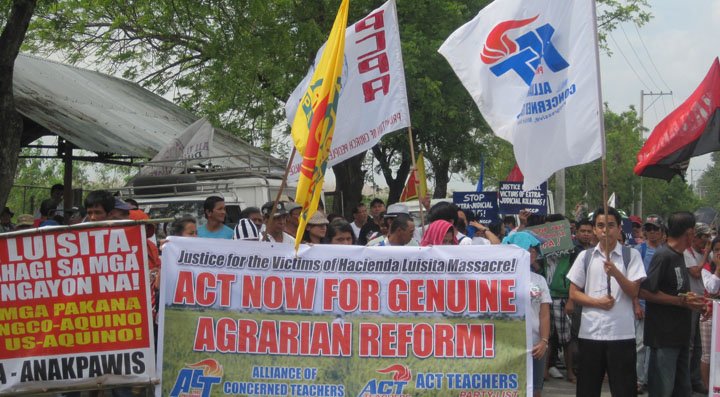
Tensions in Hacienda Luisita to continue unless genuine land distribution is implemented — UMA

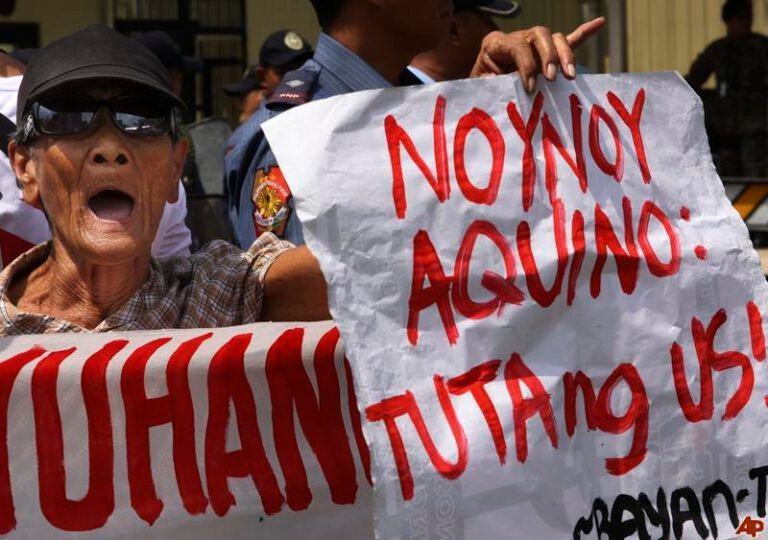
Malacañang spokesperson Abigail Valte recently announced that President Aquino is hoping that tension in Hacienda Luisita does not escalate. The announcement, as expected, failed to mention that the continuing agrarian unrest in the said Tarlac estate has generally been engendered by the bogus land distribution efforts of the Department of Agrarian Reform (DAR), which has once again proven the bogus nature of the CARPER.

Malacañang likewise has consistently kept mum as regards the aggressive and oftentimes violent means by which the powerful Cojuangco-Aquino family, to which the President himself belongs, has been employing against Luisita farmworkers in staking claim over at least 1000 hectares of agricultural land in the area.

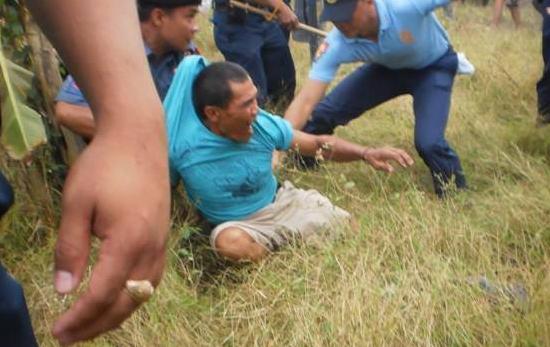
Just this 7 and 8 March, the Cojuangco-Aquino owned Tarlac Development Corp. (TADECO) tried to bulldoze 214 hectares of land in barangays (villages) Mapalacsiao and Central with the aid of Philippine National Police personnel.

The Mapalacsiao and Central lands are apart from the 358 hectares that have been issued a Notice of Coverage (NOC) by the DAR in barangays Balete and Cutcut on 17 December 2013. Despite the DAR’s NOC, the Balete lands have already been completely bulldozed and fenced off by TADECO, leaving scores of farm workers without any means of livelihood. The same farm workers are now also facing various trumped-up charges lodged against them by both the police and TADECO.

Aside from these lands, it is estimated that TADECO has still at least 700 hectares of agricultural lands under its control which the DAR has failed to include for land distribution.

At present, the Presidential uncle, Peping Cojuangco himself, is vigorously conducting a petition in the ten barrios of Hacienda Luisita, openly opposing any effort to cover the said lands for land distribution. Cojuangco is also trying to deceptively bribe the farm workers with the prospect of being compensated from the P1.33 billion standing debt of Hacienda Luisita Inc. in exchange for surrendering their call for land distribution.

There is no sign meanwhile that the DAR will seriously implement land distribution in the said areas notwithstanding the NOC that it has earlier issued for the lands in barangays Balete and Cutcut. The DAR also has no intention of recognizing that 216 farm workers have already been tilling the lands there since 2005. This was also the attitude of DAR when it implemented the Lot Application Certificate (LAC) through raffle starting July last year. In essence, DAR is purposely creating friction among those who are already tilling the lands since 2005 by designating other beneficiaries to these lands.

Tension in the Hacienda will not cease unless genuine land distribution is implemented. Lands should be distributed for free to those who have been tilling in the area since 2005. All the security guards and military personnel inside the Hacienda should also be pulled out, and all those who ordered and carried out the violent eviction of farm workers on 21 December 2013, and various other suceeding incidents should be prosecuted and punished.

Source Verification:
Gi Estrada

UMA Media Officer:
+639166114181

—————————————————–
Unyon ng mga Manggagawa sa Agrikultura
(Agricultural Workers Union)
Philippines

Follow UMA Pilipinas on Twitter

The Filipina and the Continuing Struggle for Human Rights in the Philippines

By the International Coalition for Human Rights in the Philippines
On the occasion of International Women’s Day
8 March 2014

Women have always been integral in the Philippine people’s centuries-long struggle against foreign domination and for social emancipation. They have been ever present in the people’s fight against the control of the country’s economy and resources by a tiny fraction of Philippine society. With the majority of women being part of the classes whose conditions and livelihood are for the most part dictated by the foreign and local elite, women have historically played active, even leading roles, in the struggle for genuine freedom and democracy in the Philippines. But in addition to the exploitation and oppression that women share with their brothers in the Philippines, they are subjected to further oppression.

This International Women’s Day, the International Coalition for Human Rights in the Philippines (ICHRP) salutes and commemorates the brave efforts made by women in the struggle and calls for solidarity with them in their continuing struggle against the violations of their human rights.

The devastating Typhoon Haiyan (local name: Yolanda) which recently swept through the poorest regions of the country has exposed the lack of political will and ability of the Benigno S. Aquino III administration to deliver relief, implement effective and efficient measures to rebuild the lives of the affected peoples and communities, put in place policies and programs to reduce the vulnerability of communities to calamities, and protect the victims in desperate need.

Among the most vulnerable of the victims have been women and girls. There are reports of rape incidents in Tacloban City, Leyte, in the aftermath of the typhoon. The slow pace of rehabilitation and failure to create jobs and livelihood in affected areas have pushed women to prostitute themselves in exchange for food. Girls have been trafficked to other parts of the Philippines for sex work.

The criminal negligence exhibited by the Administration not only confirms President BS Aquino’s incompetence when it comes to protecting the well-being of the Philippine people, it also exposes the current system’s bankruptcy in bringing about genuine development to its people. Where disaster has tread, the landless peasants are now also homeless, the poor now even poorer.

Just under a year before Typhoon Haiyan hit the Philippines, Typhoon Bopha (local name: Pablo) battered the southernmost island of Mindanao. Victims of Typhoon Bopha experienced the same neglect as victims of Typhoon Haiyan. This prompted Cristina Jose, a city councilor and head of Barug Katawhan, an organization of Bopha survivors, to act. Cristina exposed the food blockade and militarization of relief operations conducted by the 67th Infantry Battalion of the Philippine Army. In response to the slow delivery of food relief by the Department of Social Welfare and Development (DWSD) to the desperately hungry Bopha victims, she initiated the action of the victims in accessing the sacks of rice and relief goods hoarded in the DSWD warehouse.

Shamefully, these actions of the victims simply demanding food and justice were met with state violence. Cristina Jose and those who participated in the action at the DSWD were harassed by the 67th Infantry Battalion of Philippine Army. On 4 March 2013, just days before International Women’s Day, Cristina was on her way to Davao City to report the harassment experienced by Bopha survivors when she was brutally gunned down by suspected security forces. To this day, no one has been prosecuted or convicted for the murder of Cristina Jose.

Vicious attacks like this one have become all too common in the Philippines. Although involvement in these attacks has been denied by the Philippine Army and security forces, the motive behind the attack, the method of the attack, and the impunity with which these political assassinations are committed all point to government forces. Well over one thousand extrajudicial killings committed since 2001 were driven by the counterinsurgency policies of the current Administration and those before it.

Counterinsurgency policies like Pres. Aquino’s Oplan Bayanihan have caused women to suffer as victims of extrajudicial killings, enforced disappearances, forced evacuation, and as political prisoners. Oplan Bayanihan labels as “enemies of the state” those who criticize corrupt, unjust, and inhumane government programs and policies. In reality, Oplan Bayanihan amounts to a war on the poor, targeting workers, peasants, church people, indigenous peoples, journalists, and others who organize for the attainment of the people’s legitimate rights.Under the BS Aquino administration alone, Karapatan has documented 18 women victims of extrajudicial killing, three cases of rape of girls, and 33 women political prisoners who were also victims of illegal arrests and fabricated charges.

Instead of addressing the roots of widespread poverty, the Administration has consistently worsened the situation of women and the poor by pursuing policies that only advance the economic interests of the ruling elite and foreign corporations. On the other hand, when some representatives and supporters of People Surge, an alliance of typhoon Haiyan survivors demanded for financial support consisting of 40,000 pesos (US$ 900.00) per family to kick off their livelihood last January, they were flatly refused by Social Welfare Secretary Corazon Soliman.

Meanwhile, on 20 February 2014, “Rehabilitation Czar” General Panfilo Lacson alarmingly branded the protesting Haiyan victims as “communist pawns”. Cristina has also been tagged by the 67th IB-PA commander Lt. Col. Krishnamurti Mortela as “councilor of the (communist-led) New People’s Army” before she was murdered.

The ICHRP will continue to uphold the Philippine struggles and issues that women are involved in. We demand the perpetrators of Cristina Jose’s murder be prosecuted and jailed. We demand that the Aquino government fast track rehabilitation efforts in the areas affected by Typhoons Haiyan and Bopha. We will continue to use all means at our disposal to monitor and hold the Administration accountable for these.

ICHRP will continue to uphold the Filipino people’s collective right to fully participate in and enjoy economic, social, cultural, and political development. We give our unending support to the women and men in the Philippines who have tirelessly battled the roots of underdevelopment, transform the existing system to establish a society based on justice and lasting peace. ICHRP remembers their sacrifice on days like International Women’s Day and will continue to call on the international community to engage in solidarity for this continuing struggle.

References:

Canon Barry Naylor (UK)
Chairperson, ICHRP Global Council
Office: +44 (0) 116 261 5371
Mobile: +44 (0) 775 785 3621

Peter Murphy (Australia)
General Secretary, ICHRP Global Council
Mobile: +61 418312301

Bern Jagunos (Canada)
Deputy Secretary ICHRP Global Council
Email: ichrpcanada@yahoo.com

Katrina Abarcar (USA)
Member, ICHRP Global Council
Email: info@katarungan-dc.org

BS Aquino, a bane to poor Filipinas, rights groups declare

“The BS Aquino regime is a bane to poor Filipino women. His presidency has made lives harder and more dangerous for women, especially those who speak out against rights violations and his anti-poor policies,” said Cristina Palabay, Karapatan secretary general and Tanggol Bayi convenor, on the commemoration of International Women’s Day.

Palabay said that “despite the Aquino government’s much-ballyhooed declarations on economic growth under his presidency and on the promotion of equality by his administration, the joblessness rate among women remains high at 35.9% of the labor force, according to the December 2013 survey of the Social Weather Station.” These figures, she said, may be higher because many of the unpaid and family workers are women.

“The Public-Private Partnership program has resulted to forced evictions of poor women and their families from the urban poor communities where such projects were implemented. Poor women also bear the brunt of poverty, as the number of families experiencing hunger in the past years under Aquino has risen,” she added.

Kiri Dalena, co-convenor of Tanggol Bayi said, “as more women are faced with escalating problems, they are also the first to rise to defend their rights, their families’ and their communities’ interests. The Aquino regime seems to be threatened by the poor Filipinas’ defense of their rights, that it has made women human rights defenders targets of state repression.”

Dalena said “18 women activists, most of them human rights defenders, have been killed under the Aquino administration. The loss of these women who have valiantly struggled for genuine pro-people change is unforgiveable.”

Among those killed by state security forces were Cristina Jose, a village councilor and leader of typhoon survivors in Davao Oriental, on 4 March 2013; and Juvy Capion, an anti-mining activist who was massacred in October 2013 together with her two children.

Palabay and Dalena also scored the Aquino administration for its recent appointment of police general Lina Sarmiento as the chairperson of the Martial law victims claims board.

“The appointment of Sarmiento to a top government post is NOT an achievement for Filipino women. It is a grave insult that is tantamount to a slap on the faces of thousands of Filipino women who suffered during the Marcos dictatorship. Aquino successfully proves how he overwhelmingly underestimates our capacity to see through this cheap and superficial shot at women empowerment,” they concluded.

References:
Cristina Palabay
Karapatan secretary general
and Tanggol Bayi convenor
+639173162831

Kiri Dalena
Tanggol Bayi convenor
+63920-9755575

———————————————————————
PUBLIC INFORMATION DESK
publicinfo@karapatan.org
———————————————————————
Alliance for the Advancement of People’s Rights
2nd Floor Erythrina Building
#1 Maaralin corner Matatag Streets
Central District, Diliman
Quezon City, PHILIPPINES 1101
Telefax: (+63 2) 4354146
Web: http://www.karapatan.org

KARAPATAN is an alliance of human rights organizations and programs, human rights desks and committees of people’s organizations, and individual advocates committed to the defense and promotion of people’s rights and civil liberties.  It monitors and documents cases of human rights violations, assists and defends victims and conducts education, training and campaign. 

Aquino government bid to the UN Human Rights Council shameless — Karapatan

http://www.karapatan.org/GPH%E2%80%99s+bid+to+the+UN+Human+Rights+Council+shameless%E2%80%94Karapatan

“Nakakakilabot ang kapal ng mukha ng gobyernong ito,” (The callousness of this government is ghastly.) is how Karapatan secretary general Cristina Palabay described the BS Aquino government’s bid for a seat to the United Nations Human Rights Council (UNHRC) for 2016-2018 as announced by Foreign Affairs Undersecretary for Policy Evan Garcia.

“The government has no right to be in any mechanism that deals with human rights. It has not done anything substantial to improve the country’s human rights situation,” she added. The UNHRC monitors how UN-member States comply with its obligations on international treaties and agreements on human rights.

“We call on the international community not to heed the government’s call to support its bid to the UNHRC. It will be an injustice to the victims of human rights violations and their relatives,” said Palabay.

Karapatan believes the government has nothing to be proud of its ‘superbody’ tasked to investigate extrajudicial killings, enforced disappearances, and other rights violations. “The creation of the ‘superbody’ did not deter human rights violations by State security forces. When the superbody was created in the last quarter of 2012, there were 114 documented victims of extrajudicial killing. Now, there are 169 documented cases of extrajudicial killing and 179 frustrated killings. For the first six weeks of 2014, there are already seven victims of extrajudicial killing. And, not one perpetrator was punished for these crimes.”

Garcia, in a news report, cited the “creation of a high-level inter-agency committee to solve verified cases of extra-legal killings” known as ‘superbody’ as among the actions taken by the Aquino government after the UN Universal Periodic Review (UPR) in 2012. The UPR is a UN process of reviewing the human rights record of member States every four years.

“We would also like to emphasize that during the UPR, the government refused to accept the recommendation of Spain and The Netherlands to repeal E.O. 546 that mandated the creation of paramilitary groups. These groups continue to commit gross human rights violations as force multiplier of the Armed Forces of the Philippines in its implementation of Oplan Bayanihan,” said Palabay.

The Philippine government accepted 66 of the 88 recommendations by member States during the 2012 UPR.  Palabay noted that the government failed to end extrajudicial killings and to prosecute perpetrators, disband private armies, and end the use of torture—recommendations the government accepted.

On March 9 to 20, the Ecumenical Voice for Human Rights and Peace in the Philippines (EcuVoice), a network of human rights and faith-based organizations, is participating in the 25th session of the UNHRC in Geneva, Switzerland. The group is represented by Pastor Jerome Baris, national coordinator of the justice, peace and human rights program of the United Church of Christ in the Philippines, and Atty. Ephraim Cortez, deputy secretary general of the National Union of People’s Lawyers.

EcuVoice’s delegation is set to raise the issue of unabated extrajudicial killing of political activists, the AFP’s use of schools and other civilian facility in its counterinsurgency operation, and other rights violations, including the Aquino government’s incompetence to address the needs of the victims of typhoon Yolanda. The delegation is a follow-up engagement to the 2012 UPR.

Reference:
Cristina “Tinay” Palabay
Secretary General
+63917-3162831

Angge Santos
Media Liaison
+63918-9790580
———————————————————————
PUBLIC INFORMATION DESK
publicinfo@karapatan.org
———————————————————————
Alliance for the Advancement of People’s Rights
2nd Floor Erythrina Building
#1 Maaralin corner Matatag Streets
Central District, Diliman
Quezon City, PHILIPPINES 1101
Telefax: (+63 2) 4354146
Web: http://www.karapatan.org

KARAPATAN is an alliance of human rights organizations and programs, human rights desks and committees of people’s organizations, and individual advocates committed to the defense and promotion of people’s rights and civil liberties.  It monitors and documents cases of human rights violations, assists and defends victims and conducts education, training and campaign. 

The International Conference for Human Rights and Peace in the Philippines

http://vimeo.com/86634417

From 19-21 July 2013, 280 delegates from 26 countries gathered for the International Conference for Human Right and Peace in the Philippines (ICHRPP). They are victims of human rights violations, advocates for human rights and peace, members of people’s organizations, academe, faith-based institutions, people’s lawyers.

Together, they articulated the progressive framework of human rights and the underlying sense of violations as a systemic problem rooted in monopoly capitalism and elite domination of economic, social, cultural and political life. The conference universally affirmed the primacy of people’s struggles for the attainment and protection of human rights and just and lasting peace.

Prior to the holding of the international conference, more than 100 delegates participated in solidarity missions conducted in several areas in the country, including Central Luzon, Southern Tagalog, three regions in Mindanao, Cordillera, and the National Capital Region. The missions looked into large-scale mining, landgrabbing, forced evacuation and the plight of internal refugees due to militarization in the countryside, targeted areas of extensive political repression by Oplan Bayanihan, forced eviction and demolitions in the urban areas, trade union struggles, and the situation of political prisoners in detention centers.

The ICHRPP was organized by Karapatan (Alliance for the Advancement of People’s Rights), the Ecumenical Voice for Justice and Peace (EcuVoice) and the International Coordinating Committee for Human Rights in the Philippines (founded and launched during the conference as the International Coalition for Human Rights in the Philippines), in cooperation with the Peace for Life network and the International League of Peoples’ Struggles.

Video coverage of the conference is a project of Kodao Productions (Philippines and Europe) and the International Coalition for Human Rights in the Philippines in cooperation with Taiwan Foundation for Democracy.