
Home Blog Page 134

US Congress continues to be concerned about human rights violations by Philippine Army

0

Ecumenical Advocacy Network on the Philippines

In an appropriations bill signed by president Obama on December 15, the US Congress expressed serious concern about the lack of progress on human rights by the Philippine Army. The bill appropriates $50 million in credits for the Armed Forces of the Philppines to buy arms from the US, but bill contains provisions that prevent funding of the Army unless the US Secretary of State certifies the Army meets three human rights restrictions.

In order for the Philippine Army to be given access to the funding the Government of the Philippines must be:

  1. investigating and prosecuting army personnel who are credibly alleged to have committed, or aided or abetted, extra-judicial executions, forced disappearances, and other gross violations of human rights, and strengthening government institutions working to eliminate such crimes;
  2. implementing a policy of promoting army personnel who demonstrate professionalism and respect for human rights; and
  3. taking steps to ensure that the Philippine army and paramilitary groups under its control are not engaging in acts of intimidation or violence against journalists or human rights defenders.

The Ecumenical Advocacy Network on the Philippines (EANP), a US based human rights group that has advocated for the human rights restrictions since its founding in 2007, recently sent a letter to the US Congress and the State Department documenting the lack of progress on human rights. EANP stated that the Army has a very poor record of prosecuting human rights violators. Since President Benigno Aquino was inaugurated, 152 political and environmental activists have been killed and 18 disappeared.

There have been very few arrests, and only a handful of convictions and not one mastermind has been convicted. The Army continues to promote human rights violators. In 2013 the Army promoted Brigadier General Eduardo Año, Brigadier General Aurelio Baladad, Lieutenant General Jorge Segovia, and Brigadier General Ricardo Visaya, all Army officers with credible accusations of involvement in human rights violations. Killings and abductions continue. Human rights groups in the Philippines have documented over 40 killings so far in 2014, a very significant increase compared to the previous year.

In addition to the killings, detentions, torture, disappearances, enforced dislocations of indigenous people, harassment and intimidation of human rights advocates, and suppression of labor rights are on the rise.

Since 2008 the AFP has lost over $13M in funding because the US Secretary of State concluded that the AFP has not sufficiently improved its human rights record.

Ecumenical Advocacy Network on the Philippines
Durham, North Carolina
P.O. Box 51844
Durham, NC 27717
email: eanp2007@email.com
http://www.eanp.org
phone number +1-651-646-1985

Luisita Farmworkers to Pope Francis: “Fight with us!”

0

In a Christmas party held today in Hacienda Luisita, farmworkers said that they are looking forward to Pope Francis’ visit in January next year. Fr. Jess Dumawal, MSC who led the celebration said that the Pope is a champion of the poor and in particular to the Catholic Church’s teaching that “agrarian reform is, moreover, a political necessity, a moral obligation”.

The Pope’s address to Popular Movements made in the Vatican City on October 29, 2014 resonates in Hacienda Luisita.  Violent incidents against farmworkers have been ongoing since since 2013, coinciding with the commencement of government’s “land distribution” activities in Luisita. Victims point to President Aquino’s kin, their goons and minions in the police and the military as the perpetrators. Luisita farmers are not alien to the Pope’s own words, “Cruel are the images of forced displacements, of bulldozers pulling down small houses, images so like those of war.”

The party held in Barangay Balete was organized for the children of farmworkers and members of the Alyansa ng Manggagawang Bukid sa Asyenda Luisita (AMBALA), an affiliate of the national federation, Unyon ng mga Manggagawa sa Agrikultura (UMA).

Church people have been assisting Luisita farmers in providing seeds and teaching non-conventional but scientific farming techniques such as organic farming and production of organic fertilizers and pest control.  They have been witnesses to the effects of the sham land reform in Hacienda Luisita.  Crops in AMBALA’s model farm in Barangay Mapalacsiao were destroyed on orders of officials from the Department of Agrarian Reform (DAR), the local government and police last June. With the continued support from church people, farmers were able to recover from the losses and star over.

The Department of Agrarian Reform Adjudication Board (DARAB) in Tarlac recently sent summons to at least 8 farmers in Mapalacsiao for allegedly unlawfully occupying and possessing the landholdings. The tillers have been cultivating the said farmlots since 2005 but the DAR awarded these to other farmers via a lottery drum (tambiolo) raffle last year, thus causing conflict among the “farmworker-beneficiaries.”

AMBALA Chairperson Florida Sibayan, a survivor of the 2004 Hacienda Luisita massacre,  said that they no longer trust the DAR, the courts or the police in Tarlac  — they no longer expect these authorities to help them seek justice.

Farmworkers has now found strength in Pope Francis’ words: “I accompany you with my heart on this journey. Let us say together from our heart: no family without a dwelling, no rural workers without land, no worker without rights, no person without the dignity that work gives.”

“We have been fighting for land and justice for decades. Fight with us, Pope of the Poor!” Sibayan urged Pope Francis.

Unyon ng mga Manggagawa sa Agrikultura
(Agricultural Workers Union)
Philippines

Call for Support: International Tribunal on US-Aquino Crimes against Filipino people

On the occasion of the International Human Rights Day, the International Coalition for Human Rights in the Philippines (ICHRP) reiterates its solidarity and commitment to accompany the Filipino people in their journey to achieve just and lasting peace in the land.

We take this opportunity to call on all freedom loving peoples of the world to listen and support the victims of various violations of human rights and international humanitarian law in the Philippines as they present their cases to the International People’s Tribunal (IPT) on the Crimes of the US-Aquino Government Against the Filipino People come July 2015.

The ICHRP, in cooperation with other concerned international organizations, has taken the task of organizing the International Peoples Tribunal at the behest of the victims, their kin and supporters — belonging to a wide spectrum of social classes and sectors in Philippine society – as represented by the Ecumenical Voice for Human Rights and Peace in the Philippines (EcuVoice), KARAPATAN (Alliance for the Advancement of the People’s Rights), Hustisya! (Victims United for Justice), DESAPARECIDOS (Families of the Disappeared for Justice), SELDA (Society of Ex-Detainees Against Detention and Arrest), among others.

We enjoin you to stand in solidarity with them.

Reference:
Rev. Canon Barry Naylor
Chairperson, Global Council
International Coalition for Human Rights in the Philippines


Statements & Reports:

  1. Karapatan (Alliance for the Advancement of People’s Rights in the Philippines): People’s verdict on US-Aquino regime’s human rights violations: Panagutin, Palayasin!
  2. Karapatan 2014 Year-End Monitor
  3. Luisita Watch: Hacienda Luisita is the face of every known form of human rights violation in the country
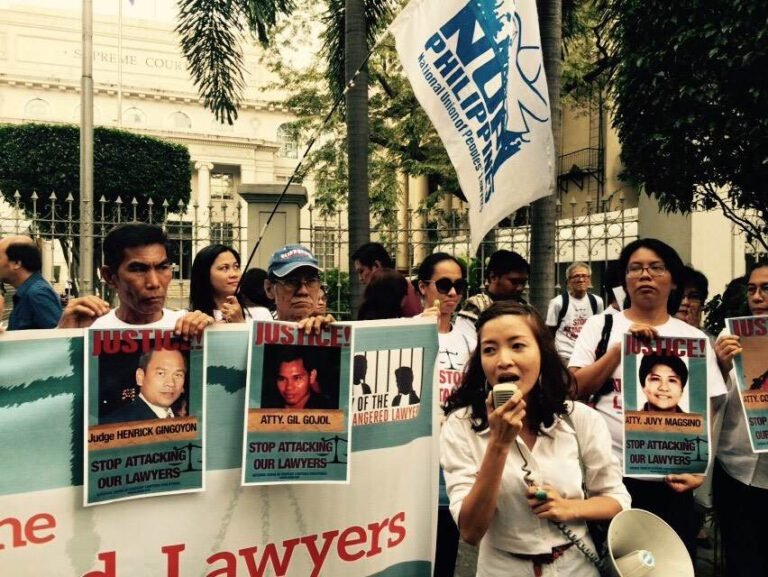
  4. National Union of Peoples’ Lawyers: On Human Rights Day: How many more laws before violations stop?
  5. BAYAN Canada: Economic plunder and human rights violations: US-Aquino’s double-barreled attack against Mindanao
  6. Asia Pacific Coordinating Committee on Human Rights in the Philippines:  Underdevelopment Is A Human Rights Violation

People’s verdict on US-Aquino regime’s human rights violations: Panagutin, Palayasin!

The US-backed Aquino regime stands trial for crimes against the Filipino people as organizations led by Karapatan, Manilakbayan, Bayan, and Defend-Southern Tagalog gather to commemorate the International Human Rights Day.

“The witnesses are the victims of human rights violations or their kin. Their testimonies are their own harrowing experiences under the US-Aquino regime. Today, they will declare the verdict on the US-Aquino regime’s crime against the Filipino people, its violations of human rights and international humanitarian law. For these crimes, we say, the US-Aquino regime is guilty,” said Karapatan Secretary General Cristina Palabay.

Karapatan enumerated a number of these crimes:

  • BS Aquino paid no heed to the demands of the Manilakbayan contingent, mostly peasants and indigenous peoples, to pull out the 55 battalions of AFP combat troops in Mindanao that implement Oplan Bayanihan and protect big foreign mining corporations and plantations, which plunder the country’s resources.
  • The 226 victims of extrajudicial killings—84 of them are from Mindanao; 136 are peasants, and 54 are indigenous peoples. There are also 225 victims of frustrated killings. What is more alarming is the manner by which a number of victims were killed. To date, there are 15 victims of extrajudicial killing who were brutally slain, involving individuals who were tortured to death, beheaded, hogtied and dumped in a shallow grave.
  • There are more than 145,000 victims of the AFP’s use of, and encampment in, schools, medical, religious and other public places for military purpose. Most of the documented cases are in Mindanao.
  • BS Aquino regime used trumped-up criminal charges against activists and community leaders to silence them and quell protests against government policies and projects that attack their communities. There are 491 political prisoners, most of them falsely charged with criminal offenses.
  • Millions of people’s money were used by Voltaire Gazmin’s Department of National Defense and Mar Roxas’s Department of Interior and Local Governments as bounty for “communist leaders” in their Order of Battle (OB). The practice has victimized civilians who are jailed by insisting they are the persons whose names appeared in their OB list. For 2014 alone, Gazmin and Roxas’s departments gave away Php 51.2 million to “informers” as reward money.
  • While mouthing slogans of peace, BS Aquino continues to stand in the way of peace. It refuses to seriously face the National Democratic Front of the Philippines at the negotiating table, disregards previously signed agreements and  reneges on its commitment to release “all, if not most” of political prisoners. It has not ceased to arrest and detain NDFP peace consultants. There are currently 14 NDFP detained consultants who are protected by the Joint Agreement on Safety and Immunity Guarantees (JASIG).
  • The violation of rules of engagement and international humanitarian law against the civilians and the seven members of the New People’s Army in a Northern Luzon Command-led military operation in Lacub, Abra on September 3-6. Recca Noelle Monte was killed without any gunshot, and Arnold Jaramillo’s body was riddled with bullets. The two, with five other NPA members Brandon Magranga, Ricardo Reyes, Pedring Banggao, Robert Beyao and Roberto Perez were tortured, willfully killed and their remains desecrated.
  • The BS Aquino regime is guilty of treason for the US re-occupation of the Philippines and the sell-out of the country’s sovereignty through the signing of the Enhanced Defense Cooperation Agreement.The BS Aquino regime isguilty for the systematic human rights violations perpetrated under the Oplan Bayanihan, and directed by the US through its Counterinsurgency Guide of 2009.

Palabay said, “The victims of typhoons Yolanda and Ruby taught us not to depend on the government that is unreliable and useless; that our safety and well-being rest in our own hands and in our collective power. We can apply this lesson in dealing with our miserable situation under the US-Aquino regime.”

In its more than four years in power, Palabay said, the “BS Aquino regime has done nothing but exaggerate the actions it has taken supposedly to address human rights violations; or ignore as baseless or propaganda the complaints of violations against his regime. He calls the people’s protests against human rights violations as heckling, hooliganism or vandalism.”

These cases will also be brought before the international community through the International People’s Tribunal (IPT) on the Crimes of the US-Aquino Government Against the Filipino People being organized by the International Coalition for Human Rights in the Philippines (ICHRP) and other international groups, in July 2015. “We call on the international community to support the Filipino people’s voices at the IPT,” said Palabay.

“In the end, because the US-Aquino regime does not uphold and protect our individual and collective rights, it is also our right as a people to kick out a president that has only served well the corrupt bureaucracy, his own landlord class and his master, the US imperialism. Thus, we say: US-Aquino regime, papanagutin, palayasin,” ended Palabay.

Reference:
Cristina “Tinay” Palabay
Secretary General
+63917-3162831

Angge Santos
Media Liaison
+63918-9790580


On Human Rights Day: How many more laws before violations stop?

On human rights day, we pause again to ask: how many continue to be killed with impunity by the State though the death penalty has been long repealed? How many still get disappeared & remain missing though we now have an anti-disappearance law? How many are still tortured routinely, viciously, though we now have an anti-torture law?

How many political prisoners remain detained & falsely charged, even as we hypocritically gloat on a tricky and belated human rights victims compensation and recognition law? How many still inordinately languish in jail though we have a plethora of rules on speedy trial?

How many peaceful rallies are violently dispersed, though we have a public assembly law recognizing the right?

How many farmers remain landless and live in penury, though we have a slew of agrarian reform laws? How many workers are laid off perfunctorily before six months, let alone have decent jobs to start with, though we have laws on security of tenure?

How many “informal settlers” are left homeless via inhumane demolitions, though we have an urban development and housing law? How many indigenous peoples are involuntarily displaced by “development” though we have a law on the need for free, informed and prior consent?

Ad infinitum.

One too many victims. Way too many violations. Yet so much elegant and fancy laws that have a disconnect with reality on the ground.

Reference:
Edre U. Olalia
Secretary General
National Union of Peoples’ Lawyers

+639175113373


Economic plunder and human rights violations: US-Aquino’s double-barreled attack against Mindanao

We vehemently demand that the BS Aquino government, notorious in its collusion with the US and its foreign policies on economy and politics in the Philippines, stop its reign of terror in the island of Mindanao. We are in solidarity with the struggle of the people of Mindanao to reclaim their rights to their land and environment. We are in solidarity with their ongoing campaign to protect their lives and their due rights as Filipino citizens to economic, political and personal safety. We,Filipinos who reside and work in Canada and have worked  in other foreign countries for the sake of our families, deplore this violent situation and demand a stop to the shameless, relentless and deliberate attack of the Philippine government against its own people.

The BS Aquino government brazenly lies, as many previous governments have lied throughout these dark years, about the rationality of such an attack. As though there could be any acceptable reason for the plunder, the torture and the killings, it presents a “defender of democracy” face.  It ingloriously grinds its propaganda machine to hide its ulterior motive of profit behind such words as “democratic way of life” as versus “rebellion” and “terrorism”.

The island of Mindanao, a veritable symbol of the whole country, is rich with natural resources and had been previously productive under the stewardship of its residents. Today however, the state powers have violated land and resources, and have allowed their distortion into agribusiness plantations, private energy development or high-scale mining projects run on labour paid at pitiable wages by foreign usurpers. The reward of government must be immeasurably immense, for it to demean itself by taking (on) the double roles of broker and security guard for these usurpers.

Just as we struggle for our rights and welfare abroad, our families and friends in the Philippines have to fight against the injustice, deprivations and dangers that now rule their lives. The irony of their birthright to a wealthy land is glaring and painful, particularly in places like Mindanao. Outrageous, most of all, is the usurpation of indigenous people from ancestral lands and the ruin of their ancient way of life.

After 2012, the year of the first mass protest march from Mindanao to Manila, the government, instead of listening to its people, stepped up its militarization of Mindanao.  According to reports from Food and Peace in Minda Now, a network of organizations composed of spearheading groups Panalipdan Mindanao and KALUMARAN, there are now some 55 combat battalions, approximately over 5,000 Philippine military troops in Mindanao, as well as American troops in a camp in Zamboanga.

The result of militarization and repression, as reported by advocate groups:

  • Thousands of innocent civilians, mostly peasants and the indigenous, have been displaced, and thousands of them killed, by the Armed Forced of the Philippines’ aerial bombings, artillery bombardments and strafing of homes and farms
  • Children and adults are no longer safe in community schools,where parents, teachers and students are vilified and harassed by the military.Military troops have also set up camp In several school grounds.
  • In 2014 alone, there were more than twelve incidents of forcible evacuation of 39 indigenous communities in Mindanao,affecting more than 1,112 families with over 4,735 women, men and children.
  • To this date there are more than 500 mass leaders and members of progressive people’s organizations and community members now facing trumped up criminal charges

We salute the courage and determination of the people of Mindanao to seek justice! We will stand and act with the people of Mindanao in bringing their urgent message to the world.  We are in firm accord with them as they demand that the government stop its massive human rights violations in Mindanao and the wholesale disastrous economic plunder of Mindanao by foreign and local business tycoons.

Reference:
Dr. Chandu Claver
Chairperson, Bagong Alyansang Makabayan – Canada


Underdevelopment is a Human Rights Violation

Landless peasants and indigenous peoples marching for miles to stage protests in the capital; victims of natural calamities trooping to government centers demanding for relief and rehabilitation; hundreds of thousands rallying and signing up for a people’s initiative to fight against pork barrel and widespread corruption; and hundreds of cases of human rights violations against activists, lawyers and media practitioners remaining unresolved in courts.

These are the current events that have come upon everyone commemorating International Human Rights Day in the Philippines this year, and bring to sharp focus the Aquino government’s fundamental violations of the Right to Development enshrined in the UN’s Rio Declaration on Environment and Development in 1992, as well as its Vienna Declaration and Program of Action at the World Conference on Human Rights in 1993. In the Vienna declaration, it was affirmed that “the human person is the central subject of development”, and that “States should cooperate with each other in ensuring development and eliminating obstacles to development.”

And yet the Philippines remains a prime example of underdevelopment in the region, with no genuine land reform for tillers of the soil, no national industrialization program, no gainful employment for most of its workers, and no significant participation of majority of its population in the country’s governance infrastructure. Systemic corruption, patronage politics, grave social inequalities, servility to lopsided foreign agreements are deeply entrenched and historic, and have gone unaddressed for decades in exchange for cosmetic socio-economic policies that include, labor export, promotion of peripheral service industries and poverty alleviation programs that merely line the pockets of multinational corporations and corrupt local officials.

Such formidable problems serve as barriers to the realization of justice and human rights in the Philippines, and are fetters to full human development in the country. There is a need to highlight the economic woes of majority of Filipinos for human rights advocates to acquire a full grasp of what needs to be done. Nothing less than development justice, which approaches the question of collective ownership of resources head on, can make our advocacy for human rights meaningful and substantive.

This Human Rights Day, the Asia Pacific Coordinating Committee on Human Rights in the Philippines (APCCHRP), a regional committee that supports human rights concerns in the Philippines, calls on the Aquino government to decisively address the country’s development issues as a way of promoting genuine peace and justice among the Filipino people.

In relation to this, we also call for the immediate resumption of the stalled peace talks to pave the way for discussion on the draft of the Comprehensive Agreement on Social and Economic Rights (CASER), which provides for a people-oriented approach to development justice in the Philippines.

Uphold the Filipino people’s right to development!
Resume the GRP-NDFP peace talks, NOW!

UN Special Rapporteur heeds Philippines human rights defenders’ pleas

http://www.karapatan.org/UN+Special+Rapporteur+on+HR+Defenders+heeds+Manilakbayan%2C+HR+defenders%E2%80%99+situation

United Nations Special Rapporteur on the Situation of Human Rights Defenders (UNSR-HRD) Michel Forst expressed interest to renew his mandate’s request to the Philippine government for an official visit in the country to investigate reports of rights violations against human rights defenders. Forst is in the country as keynote speaker in a gathering of human rights defenders in the Asia-Pacific region.

In a two-hour meeting with rights defenders led by Karapatan, Forst listened to the testimonies of some members of the Manilakbayan contingent and representatives of Karapatan chapters in Mindanao and Southern Tagalog. The meeting took place on December 3 in Quezon City.

“We enjoin the international community and human rights advocates to press the Philippine government to accede to the request of the UNSR-HRD to look into the numerous reports of attacks against rights defenders in the country.  The Aquino administration has repeatedly deceived the international community and evaded scrutiny on the real score on the human rights situation in the Philippines,” said Cristina Palabay, secretary general of Karapatan.

Previous UN special rapporteurs on the situation of the rights of HRDs Hina Jilani and Margaret Sekaggya both submitted several requests to conduct an official investigation in the Philippines, but they were not able to obtain official invitations from the Philippine government.

“Human rights defenders in the Philippines have increasingly become a vulnerable target of BS Aquino regime’s counter-insurgency program Oplan Bayanihan,” she added. Under the Aquino regime, Karapatan documented 226 victims of extrajudicial killings, 105 of them are human rights defenders. The group also monitored 26 enforced disappearances, 104 victims of torture, and more than 900 illegal arrests.

Manilakbayan spokesperson Datu Jomorito Guaynon discussed with Forst the serious impact of combat operations by the Armed Forces of the Philippines on the farmers and indigenous peoples in Mindanao, where 55 combat battalions are currently deployed. “Indigenous people’s leaders Genasque Enriquez and Jalandoni Campos are among the 213 individuals slapped with trumped up charges by the military because they continue to defend their ancestral lands. They are both vocal in their opposition against large-scale and destructive mining operations, and the role of the AFP in protecting the interests of these big companies,” Guaynon said.

Rights defenders Sr. Famita Somogod of the Rural Missionaries of Philippines-Northern Mindanao and Hanimay Suazo of Karapatan-Southern Mindanao reported the various threats to their lives and security by state security agents, who have tagged and labeled them as “enemies of the State.”

“Our lives are on the line. In Mindanao, there are 83 victims of extrajudicial killings; most of them are rights defenders. We are very concerned that such trend will continue with the Aquino administration’s disregard for human rights,” Suazo commented.

Eleven-year old Bertoldo Garay, a student in an alternative learning school for Lumad in Surigao del Sur, described to Forst how the AFP turned their school into barracks, at the same time, tagging it as “NPA school.” “Even children like me are called NPAs,” Garay said.

Rights defenders from Karapatan and Gabriela Southern Tagalog highlighted the illegal arrest and detention of women activists Andrea Rosal and Miradel Torres, who were both pregnant when they were arrested.

“We appeal to the international community to support the call to immediately release Rosal, Torres and all political prisoners,” said Leona Entena of Gabriela Southern Tagalog.

Palabay said that on July 2012, Sekaggya and the UN expert on extrajudicial killings Christof Heyns released a statement highlighting the killings and attacks against human rights defenders like Italian missionary Fr. Fausto Tentorio. They called on the Government of the Philippines to “adopt urgent measures to protect the life of rights defenders and to ensure they are able to carry out their important work.” They likewise urged the authorities to implement immediately the recommendations of UN Special Rapporteur Philip Alston in his 2007 report on the killings and rights violations in the Philippines.

———————————————————————
PUBLIC INFORMATION DESK
publicinfo@karapatan.org
———————————————————————


Alliance for the Advancement of People’s Rights
2nd Flr. Erythrina Bldg., #1 Maaralin corner Matatag Sts., Central District
Diliman, Quezon City, PHILIPPINES 1101
Telefax: (+63 2) 4354146
Web: http://www.karapatan.org

KARAPATAN is an alliance of human rights organizations and programs, human rights desks and committees of people’s organizations, and individual advocates committed to the defense and promotion of people’s rights and civil liberties.  It monitors and documents cases of human rights violations, assists and defends victims and conducts education, training and campaign. 

Lumad school in Davao del Norte struggles against militarization

The Lumad school on Pantaron Range

The Salugpungan Ta’tanu Igkanugon Learning Center Inc. (STTILCI) in Davao del Norte – a school borne out of the Lumad’s unity to defend their ancestral land – continues to struggle against militarization.

BY DEE AYROSO
Bulatlat.com

MANILA – Teacher Mabel Historia, 22, has a diminutive frame with a slightly hunched back. She has had scoliosis since birth, but her physical condition doesn’t bother nor limit her. The military allegations about her were, however, a bit too much.

“They said I am an NPA (New People’s Army) leader,” Historia smiles, slightly amused. “With my small frame, I can’t even carry heavy loads,” she said.

Historia, a teacher of Salugpungan Ta’tanu Igkanugon Learning Center Inc. (STTILC) is among the target of red-tagging and harassment by the military, that has been calling it “an NPA school.”

The STTILC is located in the hinterland village of Palma Gil, in Talaingod, Davao del Norte. The area is home to the indigenous tribe of the Manobos, one of the Lumad tribes whose ancestral territories are in primary forests of the Pantaron Mountain Range.

On March 3, the combined forces of soldiers of the 68th and 60th infantry battalions of the 1003rd brigade of the Philippine Army and the 4th Special Forces of the Armed Forces of the Philippines began to scour the area, entering the communities and conducting aerial bombings.“They disrupted our school graduation,” recalled Melvin Loyod, 18, and currently in grade 8. He said the program was halted as soldiers began streaming in. On March 20, bombs fell in Palm Gil.

From March to April, the massive military operations forced the Talaingod Manobos to evacuate to Davao City, the second time in 20 years, where they stayed for a month. The soldiers left in late April, but returned in July in sitio Nasilaban. They remain encamped as of this writing.

Historia, Loyod and the 12 other students of the grade 8 class joined the Manilakbayan ng Mindanao to call for the pull-out of the military in the communities. They have been performing and speaking in forums in Manila since mid-November as part of the Save Our Schools (SOS) campaign to gather support to protect schools from militarization.

“Every day, soldiers go to the school. They try to turn the community against the school, to make the people drive the school out,” said Kerlan Fanagel, secretary general of the Confederation of Lumad Organizations in Southern Mindanao (Pasaka), and the STTILC research and curriculum development staff.

‘Salugpungan’

For the Manobos to turn against the school would be to turn against the fruit of their own blood, sweat and tears, for the STTILC is actually borne out of the Lumads’ struggle for their right to self-determination and their territories in Talaingod.

It was built by, and named after the indigenous group Salugpungan Ta’tanu Igkanugon, which means “Unity of People to Defend the Ancestral Land” in Manobo. The group was formed on Nov. 30, 1994, uniting 83 Manobo tribes of Talaingod to defend the ancestral domain against encroachment of the logging company Alcantara and Sons (Alsons).

The group, led by Datu Guibang Apoga, engaged in negotiations with the pro-logging Talaingod local government and the military. But as the militarization and the encroachment by logging and dam companies continued, the datus decided to launch a “pangayaw,” a tribal war to defend the ancestral land.

Apoga and other tribal leaders were forced to go into hiding after government ordered their arrest in 1997, but the Salugpungan continued to unite the Lumad communities, gathering support for their calls.

In 2003, Salugpungan sought the assistance of indigenous peoples’ advocates and the Rural Missionaries of the Philippines to set up STTILC, starting as a literacy-numeracy school for adult Lumads in Palma Gil village.

In 2007, it was accredited by the Department of Education (DepEd) as an alternative learning school, and started teaching preschool to elementary. Its main school is in sitio Dulyan.

Two years ago, it opened a boarding school that is the equivalent of a high school, and follows the K to 12 curriculum. The high school has two branches, one in sitio Nasilaban, Palma Gil, and in sitio Tibucag, Dagohoy village.

Scientific

Historia is the adviser to the Grade 8 class, which was the first batch of STTILC elementary graduates. She describes the school curriculum as “nationalist, mass-oriented and scientific.”

“Our discussions take off from what we see around us,” she said. To start a science lesson on matter, for example, Historia would ask students to each bring an object from the surroundings, and describe the object’s features.

Lessons in Music, Arts, Physical Education and Health (MAPEH) include Lumad culture and tradition.

“The students themselves research about the traditional way of life, customs, and the history of their tribe,” Historia said. She added that the teachers, specially the non-Lumads, learn along with the students.

Historia takes no credit for the polished performance of her 13 students during protests and forums. She said that they hold a cultural presentation every Friday, and students are divided into groups that prepare and present traditional songs and dances. This practice has honed the natural talents of the students, who are encouraged by the tribe to dance even as small children.

Historia said the students also make the scripts and dialogue themselves.

“In Social Studies, we discuss the national situation and issues,” she said. Their textbooks are those published by the thinktank Ibon Foundation.

Before a history lesson, Historia asks the student to prepare a skit based on something they have experienced in the community. It helps them better understand the past by linking it to the present, and vice versa.

Historia said the school would be offering training in agriculture, midwifery and education when students reach grade 12.

The teacher lamented that the school direly lack supplementary educational materials. There is no computer class, nor access to the internet. Although there is one computer in the school, it is rarely used. There is no electricity in the village, and school generator is also scarcely used. The school also has only one microscope.

Dreams and fears

Students Yanyan Salimdim, 17, Divina Pogkot, 16 and Melvin Loyod, 18 – all grade 8 students – all want to be a teacher someday.

“I want to help my tribal brothers and sisters,” said Salimdim, in an interview with Bulatlat.com.

Loyod said very few teachers are willing to work in an interior village like theirs. Pogkot, whose favourite subject is Math, said she wants to continue her studies and take up education in college.

They said their parents cannot read nor write, and had wanted their children to finish school.

The three students consider their boarding school special because they produce their own food. Mondays to Fridays are devoted to regular class work, but Fridays and Saturdays are field work, when they tend to their vegetable gardens. The students grow string beans, eggplants, squash and other vegetables. They also have a nursery where they raise fruit trees like marang and durian.

The produce is enough to feed the total of 40 grade 7 and 8 students in sitio Nasilaban. When it comes to learning the Lumad culture, the three said: “We do what the elders do.”

They observe, and follow the movements of the elders in rituals, such as in giving thanks to the good spirits at the start of the planting season or the harvest festival.

The three students said the presence of soldiers stirs fear among children and students. Pogkot said she worried for her parents and other adults. In 2011, her father Minggoy was accosted and detained by soldiers on his way to the farm.

“They tied him up. They scattered the camote in his sack,” she said. Minggoy was held up by the soldiers from morning until 3 p.m., when he escaped. Pogkot said her family was so worried because he was missing for a whole day, and had not eaten anything.

Loyod said soldiers harassed some grade 7 students.

“The soldiers told them not to study there because it is an NPA school,” said Loyod. Some of the students were so scared they weren’t able to go to class.

Destroyed

Fanagel said when the community returned in May after a month in evacuation, they found the schools ransacked and damaged.

“Everything was destroyed,” he said.

Plates, pots and kitchen utilities were thrown outside the windows. Books and notebooks were scattered. The electrical wirings in the high school in sitio Tibucag, Dagohoy village were all cut. The cables were newly-installed and were supposed to be powered by generator. The sacks of seeds for the students’ garden were hacked, and the spilled seeds were unusable. The ceilings of classrooms were also hacked.

Camote plots and abaca crops were cut down and destroyed to clear a landing pad for helicopters.

Houses were also looted, the residents’ bolos and other items missing.

“When the classes started, we had a hard time,” Fanagel said.

The community had barely recovered when the soldiers returned in July in sitio Nasilaban. The soldiers encamped in the DepEd school, positioned on a hill and just opposite the hill where the STTILC sits. The DepEd school had stopped classes because the teachers had left, said Loyod.

Loyod said the soldiers get themselves drunk then fires in the direction of the boarding school.

The Salugpungan went to Davao city to seek help from the DepEd, which facilitated a dialogue with the military on Nov.6. The soldiers agreed to move out of the DepEd school, but then, the next day, they moved into the community, which is on the vale between the two hills and even closer to the school.

Red tag

“We believe that aside from the school, the real target of the militarization is Pantaron Range,” said Fanagel.

The Pantaron range straddles the Davao region up to North Cotabato and Bukidnon, and is the location of the headwaters of major Mindanao river systems. Its rich biodiversity of flora and fauna, remain well-preserved because of the active defense by the indigenous peoples of their ancestral territories.

Fanagel said his group learned that the national government plans to build a P9 billion ($200 million) mining hi-way that leads up to Pantaron Range. He said that it means that the government is seriously aiming to get its hands on the resources of Pantaron range, thus, the persistent attack on the communities.

Most recently, Loyod said soldiers are going around the community asking people to sign a document belying the statement of Salugpungan spokesperson Datu Duluman Dausay, who said that on Oct. 16, drunken soldiers encamped at the DepEd school fired in the direction of STTILC.

“Those who refuse to sign will be considered an NPA supporter,” said Loyod. Also in October, state security forces arrested Dominiciano Muya, RMP staff and husband of STTILC executive director Lolit Muya, on criminal charges. He is still in detention in Bukidnon.

Fanagel said the military-organized paramilitary group Alamara is also recruiting among Lumads, to divide their ranks. The indigenous peoples mandatory representatives (IPMR) in the local government bodies are being pitted against the progressive indigenous leaders. He cited the October 2014 issue of Raptor, the publication of the 103rd Brigade, which posted a “unified statement” of the IPMR which listed “communists,” including himself, school director Muya, North Cotabato indigenous woman leader Norma Capuyan, a bishop and several Talaingod leaders.

20 years

As the Salugpungan commemorates its 20th founding year on Nov. 30, it declared the renewal of its commitment “to steadfastly defend our culture, our people and our ancestral domain.”

The group also called for the immediate pull-out of military troops in Talaingod communities.

“The militarization of our communities and the attacks on our services, specially our schools bring us closer to the spectre of Talaingod-Manobos being driven from their communities, fragmented and hopeless, more hungry than ever and Talaingod being opened to large-scale mining, the Pantaron being ravaged and the Alcantaras back in power,” said the group in its statement.

“Amidst all the challenges we have proven over two decades that we can rely only on our own strength, to our unity as organization and as people. There is no reason now to stop our fight in seeking our rights and continuing the defense of ancestral domain,” said the Salugpungan statement.