The continued disappearance of Jonas Burgos, who was abducted and disappeared eight years ago, is now the accountability of Pres. BS Aquino, said rights group Desaparecidos (Families of the Disappeared for Justice).
Other relatives of desaparecidos joined the Burgos family and handed over a letter today at the Aquino residence along Times Street, with a statement telling Pres. Aquino to “order your subordinates, the AFP-PA to follow the SC order and return Jonas to the family, at whatever state he is in.”
Almost 50 members of the Philippine National Police blocked some 15 members of the Burgos family and supporters. “Which is not allowed, handing over a letter and airing our demands, or abducting and disappearing people? Tell us which is not allowed?” said Lorena Santos, Desaparecidos secretary general.
In the letter signed by Edita Burgos, mother of Jonas, she said “We have won the battle and yet we are losing the war… Jonas has not been returned to his family and nobody has been held responsible for this noncompliance of the Supreme Court order dated February 2, 2014. Even the National Bureau of Investigation whom Your Excellency has ordered to investigate and to file the necessary cases as expeditiously as they can as warranted from the investigation, has not done anything after more than a year after your order was received.”
Santos said they have witnessed all the efforts of the Burgos family to seek justice for Jonas. According to Santos, “Together, we searched camps and elsewhere. We filed cases, appeals and demands before various agencies and bodies. The families of the disappeared have looked for justice, and their loved ones, since day one. Where is Jonas?”
“Like what happened to our kababayan Mary Jane Veloso, we hold the Aquino government accountable in the continued disappearance of Jonas. We are enraged of the negligence that Pres. Aquino has shown in the past five years on the lives of our people, while perpetuating a culture of impunity and implementing the same policy of repression including abductions and enforced disappearances,” said Santos.
Desaparecidos has documented 24 cases of enforced disappearances under Aquino.
Burgos, an agriculturist and activist, was abducted inside a mall in Quezon City on April 28, 2007, under the Pres. Gloria Macapagal-Arroyo.
Reference: Lorena Santos Desaparecidos secretary general +63908-8121982
Agrarian unrest and impunity linger in Hacienda Luisita, three years after the landmark Supreme Court (SC) ruling for total land distribution.
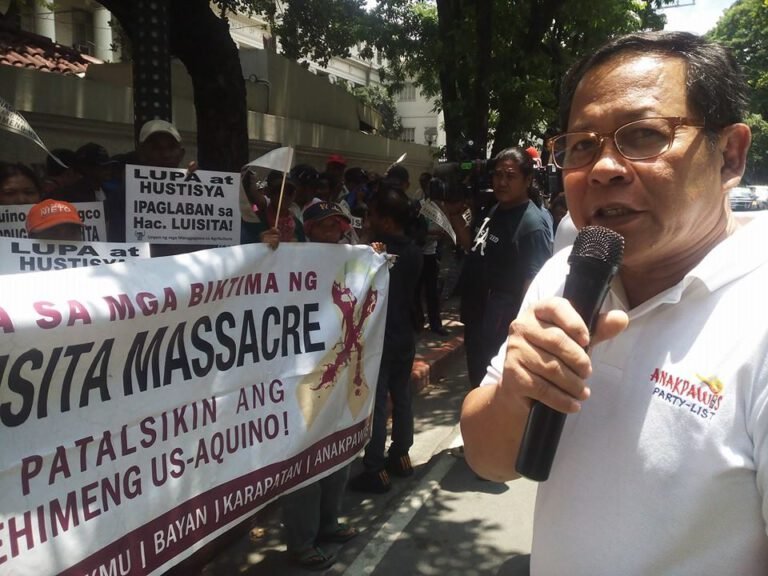
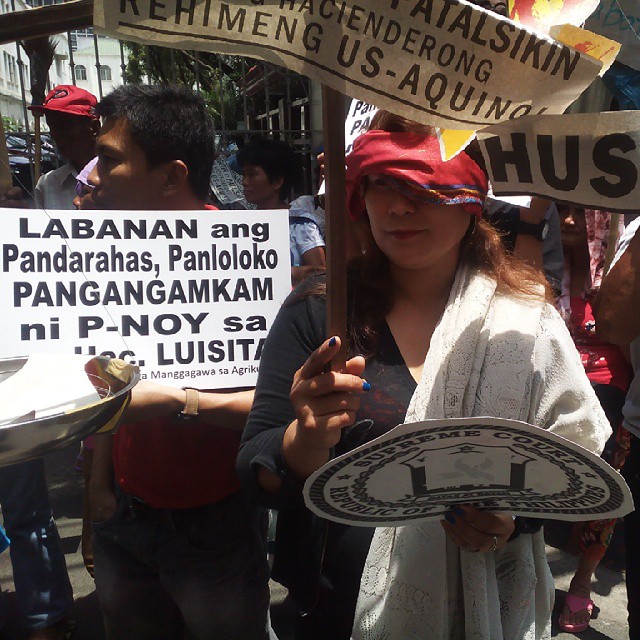
Farm workers led by the Alyansa ng Manggagawang Bukid sa Asyenda Luisita (AMBALA) and the national federation Unyon ng mga Manggagawa sa Agrikultura (UMA) once again trooped to the Department of Justice (DOJ) office in Padre Faura, Manila, today to demand land and justice for Hacienda Luisita farmers.
Even before the clamor grew with the DAP and the Mamasapano fiascos, Luisita farmers were among the first to call for Aquino’s resignation over sham land reform, human rights violations and violence unleashed by the state against supposed agrarian reform beneficiaries in the controversial sugar estate controlled by the Presidential kin for decades.
“It seems that it was not only in Mamasapano that Aquino gave a stand down order. It appears that even DOJ Secretary Leila de Lima was ordered not to act on the complaints we filed against the Aquino-Cojuangcos,” laments Florida Sibayan, AMBALA Chairperson.
During the past year, farmers have trooped thrice to the DOJ to seek justice for a string of atrocities committed by Aquino’s kin including his sister, Ma. Elena “Ballsy” Aquino-Cruz of the Tarlac Development Corporation (TADECO), their employees and goons, police officials, local government and Department of Agrarian Reform (DAR) officials.
Complaints were filed by farmers on January 16, March 20, and October 10, 2014 for more than a hundred counts of various criminal offenses which involved the bulldozing and destruction of millions worth of crops, burning of homes, fencing of farm lots, theft of farm tools and animals, arbitrary arrests and illegal detention including that of a minor, assault, mauling and attempted murders over several incidents from September 2013 up to August of 2014.
After the last filing of complaints at the DOJ in October, Malacanang was quick to denounce AMBALA and even dared the beleaguered farmers to present evidence to the public to back their complaints. “We believe this is a strong signal from Aquino himself for the DOJ to ignore the cases we filed against his kin,” said Sibayan.
Despite several follow-up letters, the DOJ has yet to act on any of the complaints. Meanwhile, several farmers still face fabricated charges filed by the Aquino-Cojuangcos in local courts in their bailiwick Tarlac. Harassment of Luisita farmers and leaders continue to this day.
Even the DAR, the government agency mandated to carry out land distribution, weighed down thirteen (13) AMBALA members with absurd charges of violation of the Comprehensive Agrarian Reform Program (CARP) which farmers see as a ploy to evict them from parcels of land they have been cultivating for years. Other pending cases against farmers and their advocates include a direct assault charge filed by police against nine (9) persons whom police violently nabbed whilst on a fact finding mission on September 17, 2013; a trespassing charge against Tarlac City Councilor Emily Ladera-Facunla, who was acting in her capacity as a public official to intervene in a bulldozing incident involving police and goons of the Aquino-Cojuangcos in December 2013; and physical injuries complaints against farmworkers Ofelia Hernandez, Marcelino Lugay and Romeo Corpuz, who ironically suffered near fatal injuries after a violent assault by Aquino-Cojuangco goons in March 2014.
Other fabricated cases against farmers have been dismissed by local courts or reverted to the DAR due to their agrarian nature, but not without tedious processes taking its toll on the victims.
On April 24, 2012, the Supreme Court issued a final and executory decision for total land distribution and the revocation of the Stock Distribution Option (SDO) land reform scheme in Hacienda Luisita. Three years after, farmers complain of the chaotic distribution process carried out by DAR. The SC also ruled for the Hacienda Luisita, Inc. to audit and return Php 1.33 billion to farmworkers for the sale of Luisita landholdings.
Without any clear development in the auditing process, the Aquino-Cojuangcos have been continuously maneuvering to hide and maximize land and company assets without the knowledge of the thousands of farmworkers who were once practically co-owners of the HLI under the SDO, and even the thousands of others who remain shareholders of the company per the 2012 SC ruling. The fencing of agricultural land, commercial development of certain areas within the estate, and the reported sale of the Central Azucarera de Tarlac sugar mill are examples of recent maneuvers of the Aquino-Cojuangcos.
AMBALA also filed motions to cite the DAR with contempt and indirect contempt of court in January last year, which includes a prayer to order the DAR to put a stop to TADECO’s illegal bulldozing and destruction of farmers’ livelihood. The SC has yet to act on the farmers’ appeals.
Today, farmers say that the Aquino-Cojuangcos have maintained control of thousands of hectares of land, while majority of beneficiaries awarded CLOAs or certificates of land ownership have fallen prey to illicit lease or buy-back agreements with dummies representing the Aquino-Cojuangcos. President Aquino’s kin maintain control of sugarcane production in the estate while plans are underway for ambitious land conversion and development projects within the estate.
Fight for land and Justice in Hacienda Luisita
The illicit contracts peddled to beneficiaries are similar to agribusiness venture agreements or AVAs now being institutionalized by the Aquino government.
“AVAs are modified clones of the SDO designed to legitimize land monopoly, landgrabbing and slave wages for agricultural workers,” said Ranmil Echanis, UMA deputy secretary general. Luisita farmworkers received wages as low as P 9.50 per payday during the SDO period, prompting thousands of farmers to strike in 2004.
The SDO scheme, however, is still in effect in more than a dozen haciendas in Negros and elsewhere, affecting thousands of farmworkers up to this day. Meanwhile, at least 1.2 million hectares of “CARP-awarded” land across the country are under various AVAs.
“Bogus land reform and government’s failure to provide crucial support services to farmers are further highlighted by unabated bureaucratic corruption typical of multi-billion anomalies and scams in the state’s agriculture and land reform departments hogging today’s headlines,” said Echanis referring to recent Commission on Audit (COA) reports implicating Aquino’s alter-egos in the DAR and Department of Agriculture.
“We have had enough of Aquino’s corruption, incompetence and lies. Even without mentioning the monstrosities we now know as Yolanda, Mamasapano or DAP – Hacienda Luisita is more than enough reason to kick Aquino out of office,” said Echanis.
Aquino and AFP Chief Gen. Gregorio Pio Catapang are also implicated in the Hacienda Luisita massacre case where at least 7 farmworkers were killed in a violent strike dispersal. A motion by survivors and kin of victims to reopen the case was immediately junked by the Ombudsman several weeks after it was filed in August 2014.
Without any hope of justice from different levels of government and its institutions, farmers are now looking into filing their complaints through the National Democratic Front of the Philippines (NDFP) and its counterpart within the Joint Monitoring Committee (JMC) on the peace talks, and even international tribunals.
The NDFP incidentally celebrates its 42nd founding anniversary today.
DAVAO CITY – Japanese fruit exporter Sumifru (Philippines) has agreed to stop the implementation of its piece-rate pay scheme in all its packing plants in Compostela Valley province in Mindanao following a protest by its banana workers.
Banana workers said it scored a “historic win over a powerful capitalist’s attempt to implement an exploitative wage scheme.”
“In a compromise agreement signed April 22 by SUMIFRU and the workers’ unions, the piece rate pay scheme is effectively stopped and the previous hourly rate scheme restored. Furthermore, the salary differentials of the workers will be paid in full.”
“The unpopular piece rate scheme has been the cause of unrest among the workers in the Compostela banana industry because it sliced already meager wages by nearly 50 percent,” leaders of the workers’ union said in a statement sent to the regional newspaper Mindanao Examiner.
It said some 5,000 workers within the SUMIFRU’s 2,700-hectare area in Compostela were affected by the piece rate scheme since the company declared its full implementation on March 23.
Because of this scheme, workers from 11 packing plants resisted the piece rate system and organized themselves into Banana Industry Growers and Workers Against SUMIFRU (Bigwas) and launched protests to force the company to revoke the piece rate scheme.
Joel Cuyos, spokesperson of Bigwas, and union president of packing plant 95’s Nagkahiusang Mamumuo sa San Jose, said their victory is a victory of the working class.
“This victory is a lesson to SUMIFRU and all capitalists that you cannot impose exploitative and unjust policies on your workers without facing resistance. Moreover, this victory was made possible only because we stood united against a blatantly anti-worker policy like the piece rate system,” he said.
Kilusang Mayo Uno also lauded the “strength and unbending unity of the workers which secured this important victory.”
It said this is the second successive victory of workers in the banana industry following the conclusion of the 2-day strike of Davao del Norte banana workers on April 10.
“This victory is a concrete of expression of working class power in defeating capitalist exploitation. It is a strong warning to capitalists not to treat workers as slaves or underestimate their power when they stand united,” said Joel Maglunsod, a spokesperson for Kilusang Mayo Uno in Mindanao.
“We hope that this working class victory will challenge the workers of the banana industry in other regions in Mindanao to organize, form unions and to struggle relentlessly for fair treatment and just working conditions,” he added.
There was no statement from the SUMIFRU about this latest development in the company’s operation.
SUMIFRU started its operation in the southern Philippines in 1970 growing bananas and in 1990 it introduced Gracio brand of bananas. It now engages in the sourcing, production, shipment and marketing of various fresh fruits, primarily the bananas, pineapple and papaya and exports them to Japan, China, Korea, the Middle East, New Zealand and Russia. (Mindanao Examiner)
“Attorney, please bring back my mother back home already, ok? ” — 6-year old youngest son Darren, whispered coyly to Atty. Olalia
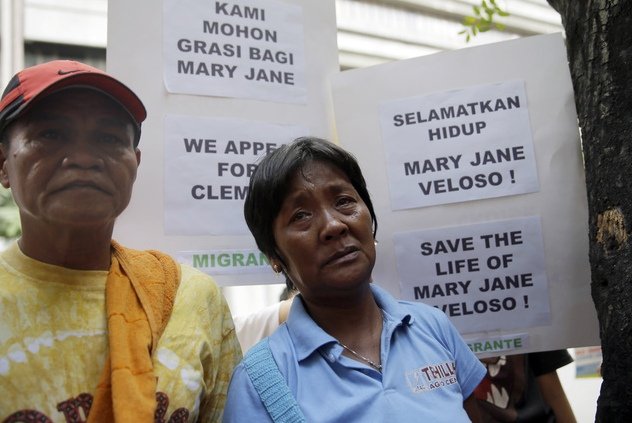
Mary Jane’s Indonesian private lawyers’ new ground for the second judicial review to be filed on Monday in Yogyakarta is that she is a victim of DRUG trafficking.
Upon proposal of her Philippine private lawyers finally relayed to their Indonesian counterparts in their meeting yesterday in a posh Jakarta law office, and based on advise of foreign legal experts the former are in constant consultations with, and on running research and study by the NUPL legal team, an additional ground which should be highlighted is that she is PRIMARILY a HUMAN trafficking victim in the first place and, therefore, must be protected.
In accordance with international and parallel local laws, she must not be penalized for any alleged crime which was integral and in connection with such human trafficking scheme, and must instead be repatriated back to the Philippines.
By Ranmil Echanis Deputy Secretary General Unyon ng mga Manggagawa sa Agrikultura
This is in reaction to Billy dela Rosa’s article in the Philippine Daily Inquirer titled “CARP: Key to national development” (Talk of the Town, 3/29/15).
Dela Rosa said that a more radical faction is demanding an end to the Comprehensive Agrarian Reform Program or CARP and is pushing for the passage of the genuine agrarian reform bill or GARB. However, he did not give GARB’s features any space in his arguments.
His piece dwelt on the history of the government land distribution programs from the Quirino presidency up to CARP (which ran for almost three decades—with two extensions—from 1988). The author refused to call CARP the dismal failure that it is as he batted for another extension.
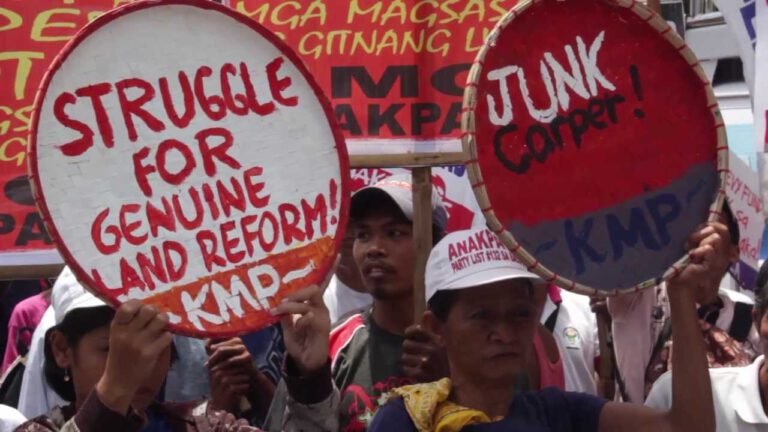
CARP’s numerous loopholes, which Dela Rosa himself presented, led however to this: A bogus land reform program, CARP can only go so far as to create illusions of reform while actually maintaining land monopoly and foolishly attempting to suppress peasant unrest. The Kilusang Magbubukid ng Pilipinas accurately describes CARP as the longest-running, most expensive and bloodiest bogus land reform program in the world, even before it finally expired in June 2014.
Dela Rosa himself says, the rampant cancellation of certificates of land ownership award (Cloas) to farmers now covers over a million hectares of land. He did not mention though that CARP required beneficiaries to pay land amortization; the failure to do so in three cumulative years would result in foreclosures. In Senate hearings, Land Bank officials admitted that only 10 percent of farmers have been able to pay these amortizations in full.
Free land distribution is one of the main features of GARB as this is the essence of social justice. Dela Rosa even decries CARP’s meager budget without mentioning that billions of pesos in public funds have actually been used to compensate despotic land-grabbers or lost to bureaucratic corruption and “support service” scams.
Support packages have supposedly resulted in improvements in beneficiaries’ incomes, the Department of Agrarian Reform reports. But just a look at the situation of farmworkers in the Aquino-Cojuangco’s Hacienda Luisita Inc. (HLI) would reveal how completely bogus CARP is.
Cory Aquino’s CARP provided for a non-land transfer scheme, the stock distribution option (SDO), which turned farmworkers into “stockholders” with slave wages—P9.50 per payday in HLI. In 2012, the Supreme Court revoked HLI’s oppressive SDO. The scheme, however, is still in effect in a dozen haciendas in Negros and elsewhere, affecting thousands of farmworkers up to this day.
Almost three years past the high court’s landmark decision for total land distribution in Luisita, only 4,099 hectares out of the 6,453-hectare estate have been allocated for distribution. The issuance by DAR of belated notices of coverage proved useless as the Aquino-Cojuangcos employed brute force to evict farmers in areas supposedly “not covered by the Supreme Court ruling.”
Majority of Luisita beneficiaries who have meanwhile been awarded Cloas have now fallen prey to illicit leaseback contracts or aryendo brokered by dummies to maintain the Aquino-Cojuangcos’ control over sugarcane production. These contracts are akin to agribusiness venture agreements (Avas) or corporative schemes then promoted alongside the SDO and now being institutionalized by the current Aquino administration.
Avas legitimized land-grabbing and the exploitation of farmworkers by landlords and agribusiness. Private sector “assistance”—– i.e., monopoly control—is promoted to substitute for the state’s obligation to provide support services. The SDO and Avas make a complete mockery of agrarian reform’s aim to transfer ownership and control of agricultural lands to the tillers. As “beneficiaries” of CARP, farmworkers continue to endure landlessness and slave wages as the poorest of the rural poor.
CARP must now be completely junked along with destructive neoliberal schemes such as the SDO and Avas. Agrarian reform advocates must rethink their support for the pestilence called CARP.
GARB, with its aim to break up the monopoly of a few landowners and foreign control of agricultural lands, must now be enacted to put an end to feudal and semi-feudal exploitation in the Philippine countryside. Genuine land redistribution must be attended with a holistic program of support services that empower the peasantry politically, nurture their productive strength and carry out the spirit of true cooperativism. Agrarian reform must also be integrated with a program of national industrialization as key to genuine national development.
—————————————————————————— Unyon ng mga Manggagawa sa Agrikultura (Agricultural Workers Union) Philippines Follow UMA Pilipinas on Twitter