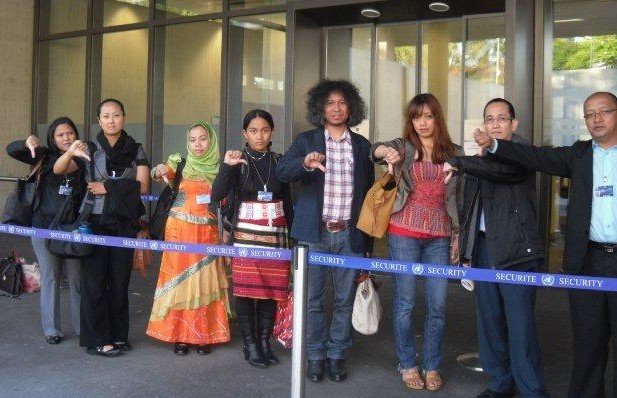
Joint Written Submission to the UN Human Rights Council by the Asian Legal Resource Centre and KARAPATAN Alliance for the Advancement of People’s Rights – Philippines
The Asian Legal Resource Centre (ALRC) and KARAPATAN Alliance for the Advancement of People’s Rights – Philippines (Karapatan ) welcome the General Assembly’s Resolution (A/HRC/RES/26/12) reaffirming the “need for effective action to combat and eliminate the abhorrent practice of extrajudicial” killings. The failure, if not inability, to hold the perpetrators accountable,” as the Resolution rightly pointed, “remains the main cause of the continued occurrence” of extrajudicial killings.
Welcoming the extension of the mandate of the Special Rapporteur on extrajudicial, summary or arbitrary executions, the ALRC and Karapatan wish to draw the Rapporteur’s attention, and urged her/him, to focus on these grave concerns with respect to the ongoing and targeted attacks on human rights and political activists. As noted in ALRC’s Oral Intervention during the 21st Session of the Council, “we have serious doubts” the Philippine government would enforce the recommendation.
Nearly three years after the Universal Periodic Review (UPR) and despite the Government’s assurances that it would take “firm measures to address the problem of extrajudicial killings and enforced disappearances,” extrajudicial killings, enforced disappearances, and targeted attacks against human rights and political activists have continued without relent under the administration of President Benigno Simeon “Noynoy” Aquino III.
From June 2010 to present, 238 persons have been victims of extrajudicial killings; of these, 106 are human rights defenders. As documented by the ALRC and Karapatan, the situation on the ground has continued to deteriorate rather than improve, notably as the Government has implemented its counterinsurgency program, Oplan Bayanihan. This program has been identified as the cause for continued violations of the right to life, committed most notably by the state security forces—the police, military, paramilitary, and those under their oversight.
As noted in the Resolution, while “human rights law provide an important framework of accountability,” there are policies and practices of the Government that defeat what this framework of accountability aims to achieve: first, on counter insurgency programs; second, military listings of human rights and political activists as “target persons”; third, targeted prosecutions of activists based on ready-to-testify witnesses under military custody and evidence of questionable merit.
On counter-insurgency program, Oplan Bantay Laya
At the conclusion of his country visit on March 2007, former Special Rapporteur Philip Alston identified the causes that constitute the killings: first, the “vilification,” “labelling”, or guilt by association; second, the extent to which aspects of the Government’s counter-insurgency has impacted on the political and civil rights of persons (A/HRC/4/20/Add.3, para 8). His observation was confirmed by the admission of Gen. Avelino Razon, former Chief of the Philippine National Police, during the inquiry conducted by the Melo Commission, on which he “agrees with the statement of Gen. Palparan that organizations such as Karapatan and Bayan Muna are ‘fronts’” of the communist party and its armed group. (Melo Commission Report, 2007, p8)
This ideology—which does not distinguish legitimate activities and advocacies of the unarmed human rights and political activists with the activities of armed rebels—remains entrenched in the police and military establishment. The causes have been identified, but there is no concrete and substantial progress to prevent and stop the killings, and to ensure accountability. Rather, the phenomenon continues.
In 15 March 2014, Romeo Capalla, 65, a member of the Board of Directors of the Panay Fair Trade Center (PFTC) was shot dead in Iloilo. His group is a member organization of the International Federation of Alternative Trade that exports certified organic muscovado sugar and banana chips. Earlier, on 5 July 2010, Capalla’s colleague, Fernando Baldomero, was murdered. Baldomero was the provincial Chairperson of Bayan Muna Partylist. He was the first victim of extrajudicial killings under the current Aquino government. Capalla and Baldomero were also included in the “Order of Battle” list of the 8th Infantry Division of the Philippines Army.
The local police filed a deliberately weakened charge against Baldomero’s perpetrators. To date, none of those charged for his murder have been arrested to face trial, despite the issuance of a warrant of arrest. In Capalla’s case, the prosecutors dismissed the complaint against the perpetrators.
On 24 March 2014, human rights defender William Bugatti was shot dead in Kiangan, Ifugao Province. He was on his way home when the perpetrators, believed to have links with the Armed Forces of the Philippines (AFP), shot him dead. At the time of his death, Bugatti worked for Cordillera Human Rights Alliance (CHRA), one of the member organizations of Karapatan. His name was listed and posted by the 5th Infantry Division of the Philippine Armed and 86th Infantry Battalion, in Tinoc, Ifugao, as “brains of the NPA.” The list also included Jude Baggo, Secretary General of Karapatan for Cordillera region.
Similar cases of extrajudicial killings of human rights and political activists, whom the military claim have links with communist rebels, have occurred. The documentation by Karapatan and the AHRC reveals these activists were killed due to their advocacy and work on the protection of rights, notably those of the oppressed and the indigenous minority.
Take the case of Cristina Jose, one of the villagers who became victim to internal displacement due to typhoon Pablo. After Jose protested at the Government’s outright neglect, inefficiency, and corruption in providing assistance to victims, she was shot dead. On 4 March 2013, Jose was murdered in front of her niece and daughter, as they were riding on a motorcycle. At the time of her death, Jose was a village councilor in Baganga, Davao Oriental. She also questioned the authority of the military to control the distribution of relief goods in her town on pretext this would ensure the village would not end up under the control of the communist rebels.
On 7 October 2011, Italian missionary Fr. Fausto “Pops” Tentorio was shot dead in the compound of his church in Arakan, North Cotabato. For decades Fr. Tentorio was a parish priest and member of the Pontifical Institute for Foreign Mission (PIME). He campaigned against the operation of large-scale mining companies. The perpetrators belong to a paramilitary group, Bagani, under the oversight of the 57th Infantry Battalion of the Philippine Army (IBPA). The perpetrators are yet to be prosecuted.
On human rights and political activists as “target persons”
On June 2, 2009, the ALRC’s sister organisation, the Asian Human Rights Commission (AHRC), has reported that in Davao City 105 human rights defenders—which includes, lawyers, journalists, human rights and political activists, physicians, union leaders and religious leaders—have been listed as targets by the military. Their names are listed in the 67-page power-point presentation, which is reported to have been prepared by the 10th Infantry Division (ID), AFP.
In a letter to the AHRC, dated 9 June 2009, P/Sr. Supt Franklin Jesus Bucayu, Chief of the PNP Human Rights Affairs Office, has given assurance “he will conduct meetings with concerned office of the AFP, specifically the AFP Human Rights Office and Task Force Usig, to talk and inquire on this leaked document. (His) office will inform you of the progress of the actions taken soon as we have developments.” To date, the AHRC has not receive any information from him on the progress of his inquiry. Therefore, in line with the GA’s Resolution, we have urged the Special Rapporteur to “react appropriately and expeditiously”, as this is a clear example whereby the Government “have not yet responded to communications submitted to them” in substance.
The ALRC and Karapatan are of the opinion that the PNP fails to take prompt, effective, and impartial investigation that can hold the military establishment accountable. Their failure means that Alston’s recommendation in 2007, wherein the Government was tasked to “immediately direct all military officers to cease making public statements linking political or other civil society groups to those engaged in armed insurgencies”(A/HRC/4/20/Add.3, para 15(a)) is yet to be implemented.
As a result, Capalla and Baldomero have been targeted by the paramilitary Revolutionary Proletarian Army – Alex Boncayao Brigade (RPP-ABB), under the orders of the 8th Infantry Division of the Philippine Army (IDPA). Prior to Jose’s murder, the military harassed and labelled her as “councilor of the New People’s Army.” Bugatti was killed after his name appeared in the list of ‘targets persons’ by the military.
On 18 October 2012, anti-mining activist Juvy Capion, and her sons, Jordan and John Mark, were killed by soldiers attached to the 27th IBPA in Kiblawan, Davao del Sur. The perpetrators claimed the victims were engaged in an encounter with them; however, investigations revealed otherwise. Juvy was two months pregnant at that time. Two months later, Juvy’s brother-in-law, Kitari, was also killed during a military operation. The Capions were members of the B’laan tribe opposing the incursion of the Xstrata-SMI Mining Corporation of their ancestral land. After Kitari’s murder, the B’laan community were forced to evacuate their homes. Similarly, Datu Anting Freay and his son, Victor, were also murdered in 23 August 2013.
Targeted prosecution of human rights and political activists
ALRC, in its submission during the 28th session of the Council, welcomed the Government’s “abolition of Inter-Agency Legal Action Group (IALAG)” (A/HRC/28/NGO/84, para. 13). However, we also noted the “increasing trend of the filing of fabricated charges against persons (defenders) perceived as ‘enemies of the state’ and ‘purported front groups’ of the Communist Party”.
In fact, some of those who had been murdered were falsely charged, arrested, detained, and prosecuted on questionable evidence. In August 2005, prior to the murders of Capalla and Baldomero, they were arrested on fabricated charges of arson. Capalla and Baldemero were former political prisoners.
In 2011, Ericson Acosta, a poet and cultural worker, was arrested without warrant by members of the AFP on the island of Samar. He was doing his research on human rights and the situation of peasants. He was interrogated and tortured for three days. To justify the arrest, he was falsely charged with the illegal possession of explosives. It was only in January 2013 that Acosta was released from detention after the Department of Justice (DoJ) dismissed the charges against him for lack of basis and ordered the Samar provincial prosecutor to file a motion to withdraw the information filed against the 40-year-old Acosta..
On 1 October 2013, Kim Gargar, an environmental scientist, was arrested. Gargar was conducting his research on reforestation and the rehabilitation of forest areas devastated by typhoon Pablo/Bopha in Cateel, Davao Oriental Province. The army, however, claim Gargar to be a member of the New People’s Army and took him into custody. His belongings were confiscated. At the police station where he was taken, he was interrogated in absence of legal counsel, and his request for immediate medical assistance was ignored. The police and army took him to the hospital after they finished interrogating him. Gargar was charged with murder, with illegal possession of firearms and explosives, and for violating the election gun ban.
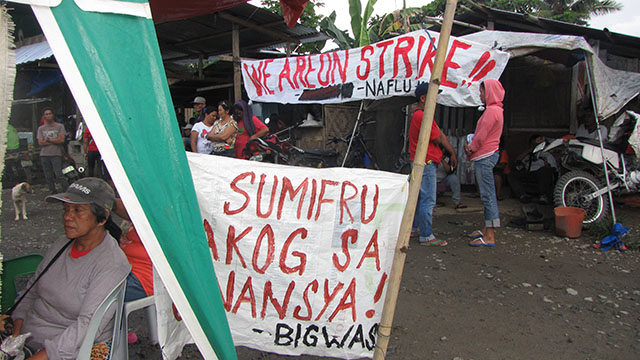
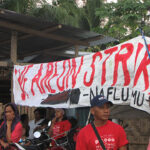
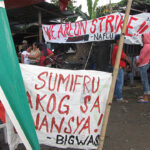
In January 2015, during the visit of Pope Francis to the Philippines, political prisoners all over the Philippines staged a coordinated hunger strike to express their urgent plea for freedom, justice, and human rights. The detainees at the Special Intensive Care Area 1 (SICA) of the Metro Manila District Jail at Camp Bagong Diwa, Taguig City, initiated the hunger strike. However, the jail authorities confronted them with repressive measures inside the jail. On succeeding days, doctors, lawyers and paralegals, and other rights advocates and supporters, and some of their family members, were prevented from entering the jail.
Recommendations
The ALRC and Karapatan urge the Council to draw the attention of the Philippine government so that it considers:
Withdrawing its counter-insurgency program, Oplan Bayanihan. As noted in this submission, the program has been identified as one of the causes of continuing extrajudicial killings, notably that of innocent unarmed civilians;
Implementing the recommendation of Prof. Alstion that the Government must direct the military to cease labelling and targeting human rights defenders as “front organizations of the communists” and “enemies of the state”;
Ensuring that investigation into cases of extrajudicial killings, disappearance, torture, and fabrication of charges of human rights and political activists are effective, impartial, and prompt. Only through prosecution and punishment of perpetrators can the framework of accountability have meaning in practice.
About the ALRC: The Asian Legal Resource Centre is an independent regional non-governmental organisation holding general consultative status with the Economic and Social Council of the United Nations. It is the sister organisation of the Asian Human Rights Commission. The Hong Kong-based group seeks to strengthen and encourage positive action on legal and human rights issues at the local and national levels throughout Asia.
About the KARAPATAN: KARAPATAN is an alliance of individuals, groups and organizations working for the promotion and protection of human rights in the Philippines. Its founders and members have been at the forefront of the human rights struggle in the Philippines since the time of Marcos’ martial law regime. KARAPATAN was founded by its member organisations in 1995
—————————–
Asian Human Rights Commission
G/F 52 Princess Margaret Road
Ho Man Tin, Kowloon
Hongkong S.A.R.
Tel: +(852) 2698-6339
Fax: +(852) 2698-6367
Web: www.humanrights.asia