
Home Blog Page 110

Who are the military-backed “Datu”?

0

“The attempts of the Armed Forces of the Philippines to deny their links to the Magahat-Bagani paramilitary groups involved in the massacre of three Lumad leaders and to discredit the communities they victimized backfired when they presented before the media the so-called datu of Mindanao who turned out to be known leaders of paramilitary groups,” said Marie Hilao-Eriquez, Karapatan chairperson.

The AFP has been doing the rounds and presenting before the media three ‘datu’ who are members of paramilitary groups, namely: Marcial Belandres, Nestor Apas, and Lumansad Sibogan.

“The AFP just gave us proof of their links to the paramilitary groups.” Hilao-Enriquez also scorned the shots of Winnie Monsod, a  self-confessed member of Oplan Bayanihan’s “multisectoral advisory group”, who echoed the same lies peddled by the AFP, resorting to victim blaming, and fueling AFP’s Lumad versus Lumad storyline.

Below are some of the documented involvement of the AFP-backed ‘datu’ in human rights violations among Lumad:

  1. Marcial Belandres was identified by witnesses as one of the killers of  Lumad leader Henry Alameda on October 24, 2014.  Alameda was dragged from his house towards the forest in Sitio Cabalawan, San Isidro, Lianga, Surigao del Sur. He was shot in the chest when held on to a post and resisted the attempt to bring him out of the community. The killing happened when units under the 24th Infantry Division were conducting combat operations in Lianga, Surigao del Sur and in San Lorenzo, Agusan del Sur. Specific units involved in the combat operations were the 2nd Scout Ranger Battalion based in St. Christine, Lianga under Col. Jesus Durante, 36th Infantry Battalion of the Philippine Army, and the 3rd Special Forces under the 401st Brigade PA, members of the Citizens Armed Forces Geographical Unit (CAFGU) and members of  Calpit Egua paramilitary group were also seen with the AFP units.Marcial Belandres’ younger brother Waway Belandres is married to the sister of Calpet Egua, a known leader of a paramilitary group in Agusan del Sur. Waway was involved in the disappearance of Jojo Tejero and Elde Martinez on October 22, 2014 in Sitio Kapatagan, San Roque, San Miguel, Surigao del Sur. The same Army units mentioned above were also with them when Tejero and Martinez were last seen. On October 24, 2014, Waway and the Egua paramilitary group also indiscriminately fired at Brgy. Captain Alejandro Dumaguit and his children Elejen and Aldren Dumaguit; and neighbors Alfredo Undayon, Victor Undayon and minors “Enggoy” and “Lynlyn” in Prosperidad, Agusan del Sur.
  1. Nestor Apas is a known leader of Alamara, a paramilitary group in Davao del Norte. He is a self- declared tribal leader of Langilan Manobo tribe in Kapalong, Davao del Norte. On February 6, 2015, Apas was seen with soldiers from the 60thIB-PA, led by 1Lt. Roldan and 2Lt. Carino, who encamped at the Mindanao Interfaith Services Foundation, a Lumad school in Kapalong, Davao del Norte. He was involved in harassing teachers and students. He also instigated and facilitated the filing of trumped-up criminal charges against leaders and supporters of the Manabo evacuees who are seeking temporary shelter at UCCP Haran, Davao City. Apas was with the Alamara paramilitary group and Congresswoman Nancy Catamco during the raid at the UCCP on  July 23, 2015.
  1. Lumansad Sibogan is a leader of Alamara and a member of the Tribal Council of Talaingod of the National Commission of Indigenous People. He was among those seen with the 38thIB-PA who encamped in schools in Talaingod, Davao del Norte and forcibly recruiting Lumad into Alamara. ###

http://www.karapatan.org/Who+are+the+AFP-backed+%E2%80%9CDatu%E2%80%9D%3F

Reference:
Marie Hilao-Enriquez
Chairperson
+639175616800

Angge Santos
Media Liaison
+63918-9790580

———————————————————————
PUBLIC INFORMATION DESK
publicinfo@karapatan.org
———————————————————————

Alliance for the Advancement of People’s Rights
2nd Flr. Erythrina Building
#1 Maaralin corner Matatag Streets
Central District, Diliman
Quezon City, PHILIPPINES 1101
Telefax: (+63 2) 4354146
Web: http://www.karapatan.org

KARAPATAN is an alliance of human rights organizations and programs, human rights desks and committees of people’s organizations, and individual advocates committed to the defense and promotion of people’s rights and civil liberties.  It monitors and documents cases of human rights violations, assists and defends victims and conducts education, training and campaign.

A brutal assassination, but the government turns a blind eye

0

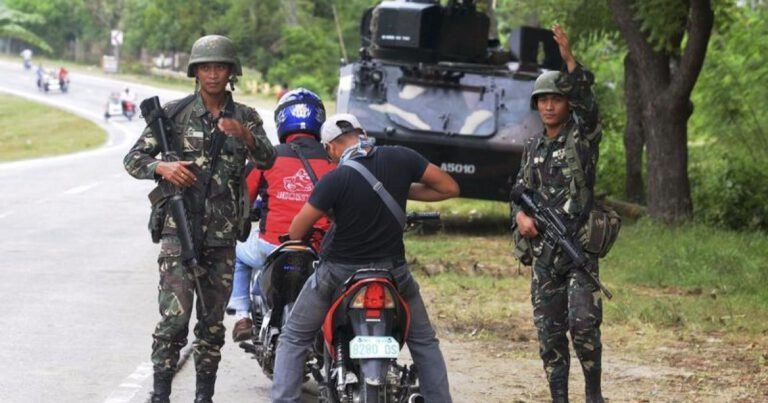
On 1 September 2015, 40 soldiers and a paramilitary group occupied the local school and threatened to massacre the entire community unless they left within 48 hours. This was when Emerito and two local leaders were killed in broad day light, as the community looked on.

By Graciela Romero Vasquez
International Programmes Director, War on Want
http://www.waronwant.org/media/brutal-assassination-government-turns-blind-eye

Mining routinely disrupts and destroys people’s lives and livelihoods – it forces people from their land and devastates the natural environment on which they depend.  And more often than not, the expansion of mining and resource extraction by large corporations brings with it violence and intimidation.

Militarised conflict is one of the chief causes of poverty. When fuelled by greed for resources, it is civilians and local communities who suffer, and big business that profits.

For human rights defenders across the world, the fight for justice is frequently met with brutal repression and all too often the tragic and needless loss of life.

In July 2015, human fights defenders met in Philippines for the annual International People’s Conference on Mining. Less than a month later, one of them was dead – brutally assassinated in Mindanao, Philippines.

Since 2005, Emerito Samarca, Executive Director of the Alternative Learning Centre for Agricultural and Livelihood Development (ALCADEV) had been fighting for the rights of the Lumad, a group of indigenous people defending themselves and their ancestral homelands against the threat of mining.

On 1 September 2015, 40 soldiers and a paramilitary group occupied the local school and threatened to massacre the entire community unless they left within 48 hours. This was when Emerito and two local leaders were killed in broad day light, as the community looked on. Fearing for their lives, some 2,000 indigenous people fled. Forced from their homes, this was the latest in a long history of violence and intimidation.

Illegal arrests, detention and torture

For a decade now, community members have been the victims of trumped-up criminal charges, illegal arrests and detention, and torture. Shamefully, to date, the local government has turned a blind eye to these recent atrocities, failing also to provide any humanitarian assistance for the people bullied from their land and forced from their homes.

KARAPATAN, an alliance of individuals, groups and organizations working for the promotion and protection of human rights in the Philippines, has since stated that the collusion between the state armed forces and paramilitary groups had been reported in previous cases where community leaders had been killed.

While innocent people are being murdered in the Philippines, on the other side of the Atlantic, 16 community leaders in Peru are facing up to 35 years in prison for publically expressing their opposition to the World Bank and US owned Newmont Mining’s “Conga Project” (a gold and copper mining venture in the northern highlands of Peru). Some of these leaders have also been physically attacked by Peru’s state forces during public protests, and five people were killed during public demonstrations against the project. Yet the Peruvian government has yet to bring anyone to justice.

In both the Philippines and Peru, human rights defenders have raised grave concerns over allegations of collusion between state armed forces and corporations such as Glencore in the Philippines and Newmont Mining Corporation in Peru. Moreover, in Peru, the involvement of both the Catholic Church and the World Bank shows the extent to which international and national bodies are complicit in human rights violations. Both of these institutions have a stake in the Conga Project and both have refused to condemn the killings and repression of communities and their leaders. The Archbishop of Lima has even publicly acknowledged the Church will be a direct beneficiary of the Conga Project.

Criminalisation of protest

Human rights defenders and community leaders have long been accused of terrorism, incitement to violence and public intimidation by governments determined to silence dissenting voices. Trumped up criminal charges and other onerous judicial processes, lasting for years, not only nullify the work of human rights defenders but serve to deter others from speaking out. Ultimately, the legitimate right to protest is criminalized by the state – the impact of which can be severely distressing.

In both Peru and the Philippines human rights defenders suffer long term psychological pressure as a result of having to endure endless judicial processes, where hearings are frequently postponed and further financial costs are incurred. In many cases, people are detained for long periods without being charged. In the Philippines, a female community leader recently explained how she had to attend a hearing every month, paying fees for each session over a period of two years. To this day she doesn’t know what the charges against her are for.

Forcing people from their homes and silencing anyone who opposes the plundering of resources appears to be the norm for extractive industries. And with help from the state, it seems their unofficial handbook reads: militarise territories with the army and paramilitary forces, use the judicial system to criminalise human rights defenders, create conditions which divide communities and buy up community leaders. And if these tactics don’t work? Massacre and displace local people.

While it is clear that the recent killings in Mindanao and those of others fighting injustice around the world cannot go unpunished, it’s testament to the remarkable courage and determination of human rights defenders, and those communities facing off against extractive industries, that the struggle to hold companies and governments to account for their crimes goes on. The people are resolute; they’re fighting back. And War on Want stands with them.

Judge Jude Alaba murdered: Keystone cops perpetuating impunity. Again.

0

By National Union of Peoples’ Lawyers (NUPL)

The National Union of People’s Lawyers (NUPL) has condemned the snail-paced investigation of the Philippine National Police in the recent killing of a Baler RTC judge.

“It took the police several days to find out what the news outlets had reported on the day of the murder: that Judge Alaba acquitted an alleged NPA leader last year,” said NUPL secretary-general Edre Olalia.

Baler RTC Branch 91 Judge Jude Erwin Alaba, 45, was shot dead last Sept. 1 as he arrived at the regional trial court compound in Baler, Aurora. His wife Margarita, who was with him when he was ambushed, sustained a gunshot wound on her left arm.

The police had recently said they were dropping the New People’s Army (NPA) from their list of suspects. According to news reports, the police had earlier considered the NPA among the suspects because Judge Alaba had tried a case involving Delfin Pimentel, an alleged NPA leader. In that case, however, Alaba acquitted Pimentel, allegedly one of the regional leaders of the New People’s Army (NPA), of charges of multiple murder and frustrated murder, filed in connection with an ambush on the military 15 years ago. This year, Alaba also dismissed the charges of illegal possession of firearms against Pimentel and his wife Imelda.

The police has released a sketch of the suspected killer, and said they have witnesses who have heard alleged gang members discussing a plot to kill Alaba.

Olalia said the ambush – at the parking lot of the Hall of Justice in Baler, at 2 o’clock in the afternoon – highlights the ineptness of the Aquino government in protecting its citizens, much less its hardworking public servants.

“The judiciary is supposed to be one of the partners of government in seeing to it that justice is done. The ineptness with which the police is investigating this case is a clear message to the killers that they can literally get away with murder,” Olalia said.

“Unlike the bogus cases that are often filed against the political prisoners, which are eventually dismissed, we call on the police to prove us wrong by catching for once the real culprits and filing a case that will stand in court.”

Aldaba, a graduate of the UP College of Law, was one of the college’s awardees in public service. The Supreme Court had earlier condemned the killing and asked the authorities to “take all necessary steps with all deliberate speed to do justice for Judge Alaba and his wife by fully investigating the crimes.”

For its part, the NUPL shall do whatever is within its mandate and resources, including bringing this to the attention of international lawyers groups and institutions that are keenly concerned with attacks on lawyers and judges and their adverse effect on the independence of the judiciary and ultimately the so-called rule of law.

Reference:
Edre U. Olalia
Secretary General
+639175113373

Alnie Foja
Asst. SecGen for Protection and Welfare of Lawyers
+639479761197

National Secretariat
National Union of Peoples’ Lawyers (NUPL)
3F Erythrina Bldg., Maaralin corner Matatag Sts. Central District,Quezon City, Philippines
Telefax no.920-6660
Email addresses: nupl2007@gmail.com and nuplphilippines@yahoo.com

Follow us on twitter @nuplphilippines and facebook @https://www.facebook.com/nuplphilippines
Visit the NUPL website at http://www.nupl.net/

Karapatan raises issue of Lumads to UN, calls for probe

0

“We want international bodies to know what is happening in Mindanao—that the Lumad, in defense of their land, are being killed and forced to leave their communities,” Karapatan secretary general Cristina Palabay said.

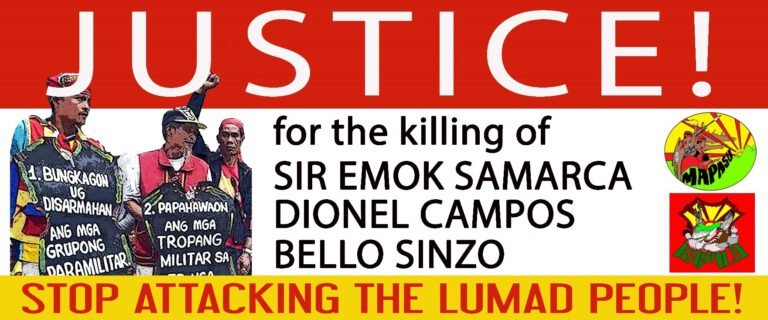
Karapatan brought to the attention of the United Nations Human Rights Council the killing of Lumad leaders Dionel Campos and Datu Juvello Sinzo, and ALCADEV school director Emerito Samarca. Karapatan asked for an investigation on the killings and the evacuation of almost 3,000 Lumad in Surigao del Sur through letters* sent to Dr. Chaloka Beyani, SR on the Promotion of the Human Rights of Internally Displaced Persons; Christof Heyns, Special Rapporteur (SR) on extrajudicial, summary or arbitrary executions; Michel Forst, SR on Situation of Human Rights Defenders; and Victoria Lucia Tauli-Corpuz, SR on Rights of the Indigenous People’s. “We are asking the UN HRC to investigate and recommend actions to the Philippine Government on these issues,” Palabay added.

It was the morning of September 1, 2015, when the Magahat/Bagani paramilitary forces under the 36th and 75th Infantry Battalion-Philippine Army gunned down Campos in front of the whole community in Km. 16, Diatago, Lianga, Surigao del Sur. Sinzo, who was separated from the crowd, was tortured by hitting his arms and legs with wooden stick before he was shot. Samarca, on the other hand, was found dead inside the classroom of ALCADEV with an ear-to-ear slit on the throat and gunshot wounds in the chest. “The 36th Infantry Battalion (IB), 74th IB and the Special Forces were at the periphery,” Palabay recounted the accounts of the witnesses.

“While the AFP can lie through their teeth about their involvement on the killings and all other atrocities of its paramilitary groups, the motives are crystal clear: eliminate those who are perceived as enemies of the state, including those who fight for their land and their rights. There is no way the government can deny this as long as it implements counter-insurgency programs like Oplan Bayanihan. The paramilitary groups is one way of tackling this dirty war against the Filipino people. It is no wonder why the AFP has not disbanded these groups—because they work together,” Palabay said.

The killing of Fr. Fausto Tentorio, the massacre of the Capion family, the murder of Datu Jimmy Liguyon, the Tabugol brothers, among others was done through the use of paramilitary forces who are known in many names—the Civilian Auxiliary Forces Geographical Unit (CAFGU), the Special Civilian Armed Auxilliary, the Investment Defense Force, Bagani Forces, Magahat-Bagani, Alde Salusad’s group, and the De la Mance group, to name a few.

Back in 2012, Heyns and then UN SR on human rights defenders Margaret Sekaggya have already sounded the alarm bells on the role of the paramilitary groups in the killings. Their statement can be viewed through this link: http://www.ohchr.org/en/NewsEvents/Pages/DisplayNews.aspx?NewsID=12333&LangID=E

In the same year, during the UN’s Universal Periodic Review (UPR) on the Philippines there were already recommendations from member Nations to disband paramilitary groups that perpetuate serious abuses. “The BS Aquino government has rejected this and even continued to multiply and allowed the proliferation of these groups as force multipliers. We reiterate our position that the political killings happening right now is part of the government’s policy and not simply an internal conflict among indigenous people’s as the government wants the public to believe,” Palabay ended.

** Copies of the complaints are available upon request.

http://www.karapatan.org/Karapatan+raised+issue+of+Lumad+to+UN%2C+calls+for+probe

Reference:
Cristina “Tinay” Palabay
Secretary General
+63917-3162831

Angge Santos
Media Liaison
+63918-9790580

———————————————————————
PUBLIC INFORMATION DESK
publicinfo@karapatan.org
———————————————————————

Alliance for the Advancement of People’s Rights
2nd Flr. Erythrina Building
#1 Maaralin corner Matatag Streets
Central District, Diliman
Quezon City, PHILIPPINES 1101
Telefax: (+63 2) 4354146
Web: http://www.karapatan.org

KARAPATAN is an alliance of human rights organizations and programs, human rights desks and committees of people’s organizations, and individual advocates committed to the defense and promotion of people’s rights and civil liberties.  It monitors and documents cases of human rights violations, assists and defends victims and conducts education, training and campaign. 


ICHRP Address at the Barug Katungod Mindanao Conference

Keynote Address of ICHRP Global Council Chairperson Reverend Canon Barry Naylor, at the opening of the Barug Katungod Mindanao Conference 11 September 2015 in Cagayan de Oro City, with the theme “Strengthening and Broadening the People’s Movement for Human Rights against the Intensifying State of Impunity in Mindanao.”