Home Blog Page 101

AFP-backed paramilitaries kill 94 civilians under the BS Aquino regime

Int’l Human Rights Day countdown: “Tuwid na Daan” wakasan!

“We call on the Aquino regime to enforce the warrant of arrest against the members of the Magahat-Bagani paramilitary groups involved in the September 1 massacre of Alcadev executive director Emerito Samarca and Lumad leaders Dionel Campos and Juvello Sinzo. It has been three months since the massacre yet, these AFP-backed paramilitary members and the AFP units responsible for the massacre remain scot-free and continue to sow terror in the Lumad communities,” Karapatan Secretary General Cristina Palabay said.

Those with standing warrants of arrest are brothers Bobby and Loloy Tejero and Margarito Layno, all members of the Magahat-Bagani group attached to the 36th Infantry Battalion/4th Infantry Division of the Philippine Army.

The Magahat-Bagani group is one of the 24 documented paramilitary groups in the country. The Civilian Auxiliary Force Geographical Unit (CAFGU) is spread throughout the country while groups such as the Special Civilian Armed Auxiliary (SCAA), ITDF (Inter-Territorial Defense Force), Alamara, Bagani-Magahat, Dela Mance, Sanmatrida, and New Indigenous People’s Army Reform (NIPAR) groups are found in Mindanao. They come in so many different names, but are essentially AFP surrogates in their terror attacks against communities.

As of November 30, 2015, the AFP-trained and supported paramilitary groups were involved in the killing of 94 out of the 304 documented victims of extrajudicial killings under the BS Aquino regime. They were also involved in five out of 15 incidents of massacre.

The latest victim killed by the paramilitary group, particularly the De la Mance group, was Lumad activist Mankombite Mariano, who was shot then hacked last October 27. Mariano, 48, of the Talaandig tribe in the town of Cabanglasan, Bukidnon, was on his way to pick some durian fruit along with 16 others, 12 of them are children. Mariano was hit in the left chest and left hip when the Dela Mance group fired at them. Mariano’s grandson Ryan Olimbayan, 10, was hit in the left leg but was able to run away and hide. However, he saw how Manlumakad Bocalas of the Dela Mance group approached and hacked his grandfather in the head, left shoulder, and left thigh. Ryan survived the attack.

“The regime’s monstrosity, that even children are not spared, speaks of the evil tactics of the counterinsurgency program of BS Aquino, Oplan Bayanihan. The attempt to pit the people in the community against each other ‘through winning the hearts and minds’ is simply sugar-coating its ‘divide and rule’ tactic. In truth, the AFP provides arms to those who can be used against its perceived enemies,” Palabay said.

“By providing guns and some cash, the AFP attempts to control civilians, even if they have to kill their own kind. Such is the case of Loreto Mayor Dario Otaza,” Palabay said. Mayor Otaza, whose death was owned up by the New People’s Army, “Our documentation showed Otaza’s Bagani Lubog Force was responsible for the killing of three persons in his area,” said Palabay. The group, which is attached to the 2th IB, was involved in the killing of peasants Manhiloy Mantog, 35, Benjamin Planos, 28, and Gabriel Alindao, 60, in 2013.

Palabay explained there are a number of reports of human rights violations committed by Otaza and the Bagani Lubog Force, but human rights workers could not come close to the areas of incident in Loreto, Agusan del Sur due to heavy military and paramilitary presence.

Karapatan reiterates its call to disband all paramilitary groups and punish the perpetrators of human rights violations among its rank. “There’s no use for the government to keep denying that the paramilitary groups are its creation because these groups obviously perform tasks along the regime’s counterinsurgency program.”

http://www.karapatan.org/AFP-backed+paramilitaries+killed+94+civilians+under+the+BS+Aquino+regime

———————————————————————
PUBLIC INFORMATION DESK
publicinfo@karapatan.org
———————————————————————

Alliance for the Advancement of People’s Rights
2nd Flr. Erythrina Building
#1 Maaralin corner Matatag Streets
Central District, Diliman,
Quezon City, PHILIPPINES 1101
Telefax: (+63 2) 4354146
Web: http://www.karapatan.org

KARAPATAN is an alliance of human rights organizations and programs, human rights desks and committees of people’s organizations, and individual advocates committed to the defense and promotion of people’s rights and civil liberties.  It monitors and documents cases of human rights violations, assists and defends victims and conducts education, training and campaign.

BS Aquino’s Paris Climate Change speech is height of hypocrisy

Coal mining violates indigenous peoples’ rights in Surigao del Sur

Amidst the spate of killings and forcible evacuation of Lumad and peasant communities because of intense military operations in Surigao del Sur over areas sold through Coal Operating Contracts (COC) by the Department of Energy, Noynoy Aquino’s 3-minute speech in Paris on the occasion of the 2015 Conference of Parties (COP) 21 on Climate Change is a big insult to the Lumad people, to genuine human rights and gender activists.

Abacus Coal Exploration and Mining Corporation has already brought their machinery to begin coal production operations in the Andap Valley Complex while the communities resisting it are in evacuation.  Benguet Corporation is also raring to operate, as are Great Wall Mining and Power Corporation, PNOC Exploration and ASK Mining and Exploration Corporation. By the simple tactic of displacing communities through counter-insurgency operations, the Aquino Administration through the military, whether by coincidence or design, is paving the way for the unhampered operation of these companies who have long waited for this chance to make use of their “expensive” COC.

Noynoy Aquino as the PH poster boy of COP 21 is his spin doctors’ take on this administration’s superficial regard for the environment and seeming concern for indigenous peoples’ so-called climate vulnerability.  It conceals the fact that it is the very policy of his government of promoting and protecting large-scale mining investments through the military as  “investment defense forces” that destroys the ecological balance in  ancestral lands that have been protected and defended by generations of these indigenous peoples that is making them increasingly vulnerable.  They are made doubly vulnerable to natural and manmade calamities, as illustrated by the Lumad forcible evacuation crisis in Surigao del Sur today as a result of massive military deployment and operations in the province.

His bedrock principle lies on a foundation of imperialist greed, not on the human rights of the Filipino people, as his alternate reality designers proclaim.  His administration is among the most brutal violators of human rights of indigenous peoples, just ask Michelle Campos and Karlgen Samarca  whose fathers, Dionel Campos and Emerito Samarca, were killed by the paramilitary forces that this administration is using in its war for imperialist plunder disguised as counter-insurgency operations.  Just ask the 3,000 Manobo victims of forcible evacuation from 23 communities that are still suffering amidst the intensified military operations in their mountain communities to pave the way for coal mining operations.  Just ask more than 25 women who have given birth in the evacuation centers because of these military operations, who are nourishing and nurturing their children the best they can in the only sanctuary available to them to ensure their families’ safety from attacks.  Just ask the family of farmer Orlando Rabuca who was killed as he continued to lead his community’s peasant organization in its campaign against mining despite threats to his life. That military and paramilitary units continue to commit  grave violations against the right to life with impunity as they protect the biggest destroyers of the environment renders Aquno’s bedrock principles as insubstantial as air.

For human rights and environment activists in the Caraga region, Noynoy Aquino certainly does not represent our interests and our advocacies.  The rapid degradation of the mountains of Claver, Surigao del Norte that is irreversibly affecting the marine, coastal, mangrove, riparian and forest ecosystems because of large-scale open-pit nickel mining is evidence of his hypocrisy.  How can he talk of protecting us from climate vulnerability when his regime allows the wholesale destruction of natural shelters against climate disasters?  After typhoons Sendong, Pablo and Yolanda that have spared Caraga from utter devastation, it is only a matter of time before we are hit by another catastrophic weather phenomenon.

By a hail of bullets or precipitation, the Aquino Administration is exacting the people’s blood by its total indifference to the concrete demands of the Lumad in Surigao del Sur for justice for their martyrs Emerito Samarca, Dionel Campos and Datu Juvello Sinzo; justice that remains elusive as the perpetrators of their killings remain at large.  The communities can only be peaceful if the armed paramilitary men, including the private security forces in the payroll of mining corporations, that are committing these crimes, are disarmed and disbanded.  Erring commanding officers and units of the Armed Forces of the Philippines, especially the 75th IBatt and 402nd IBde must be held accountable as soldiers must be pulled out from the communities and temporary cessation of military operations must be done to allow the safe and unconditional return of the Lumad evacuees to their communities.

These calls are just. Noynoy Aquino must heed these calls lest the people call him a liar and a hypocrite in the persona that he is showing the world.  He is also set to meet Pope Francis; we can only pray that he approach the Holy Father with the cleansing grace of granting more than 3,000 Manobo and peasant evacuees a blessed Christmas in the comfort and peace of their homes and communities.

Reference:
Jovy Alamban
+63 9093933247
CARAGA Watch

Global Weeks of Action for Mindanao kicks off today in London

Following the International Peoples’ Tribunal  (IPT) verdict last July on the Philippine and US governments’ gross violations of the rights of its citizens, the International Coalition for Human Rights in the Philippines (ICHRP) has called for global weeks of action for Mindanao.

Starting on November 21, a series of events will be held in succession in different countries in Europe, in the weeks leading up to International Human Rights Day on 10 December. The opening event will be on the 21st in the form of a Public Meeting at the UNISON Centre in London. The meeting is organized by the Campaign for Human Rights in the Philippines – UK, in coordination with the Kanlungan Filipino Consortium and the UNISON-Filipino Activists Network.

The guest speakers will be two indigenous peoples’ rights advocate from Northern Mindanao, Sr. Ma. Famita Somogod, MSM, the regional coordinator of the Rural Missionaries of the Philippines – Northern Mindanao Region (RMP-NMR), and Prof. Arnold Alamon, the executive director of the Mindanao Interfaith Institute on Lumad Studies.

“Barely a month after the IPT found the Philippine government guilty of the systematic violation of the Filipino people’s civil, political, economic, socio-cultural rights, there has been an escalation of state and state-sponsored brutality in the indigenous peoples’ communities in Mindanao, the southern part of the Philippines,” said Sister Somogod.

On August 18 this year, five members of the Manobo community in Pangantucan, Bukidnon were massacred by state forces. This was the second massacre this year in Northern Mindanao region alone after the military killed four members of the Higaonon community on March 29. Karapatan, the largest human rights alliance in the Philippines records a total of 15 massacres under the watch of Pres. Benigno Simeon Aquino III.

“The outrage of the communities at the lack of government action and in fact their authored attacks on the Lumad has spread nationwide and attracted international concerns as well when not a month later, the executive director of an alternative learning school primarily catering Lumad students was killed by a state-backed paramilitary group,” the nun furthered.

The main objectives of the Global Weeks of Action for Mindanao are to publicise and gain even wider international support for the struggles of the peoples of Mindanao against their systematic repression and exploitation by their own government.

“We encourage awareness, far and wide, of the continuing abuse of human rights in the Philippines, especially, at this time on the island of Mindanao. These abuses take place in the context of a culture of impunity, enjoyed by those who are responsible for them and of a callous disregard of their plight by their own government,” said Rev. Barry Naylor, chair of the global council of the ICHRP.

“We are pleased that we can hear, at first hand, from human rights activists who have travelled from Mindanao to share their first hand experiences of abuses and terror,” emphasized Reverend Naylor. “It is vital that we let people know what is happening to the people and the land of Mindanao and that we respond in ways that assure people there that they do not stand alone. We wish to affirm that people throughout the world are standing in solidarity with the peoples of Mindanao, that we are listening to them and responding in ways that are both supportive to them and challenging to those responsible for committing and tolerating the abuses they endure.”

In addition to the activities in London, film showings and public meetings will also be organized in Austria and Poland which will be attended by other delegates from Mindanao. Other actions have been planned for Italy, Belgium, France, Germany and the Netherlands. These activities include awareness raising among Filipino compatriots and human rights advocates, to include international human rights organizations such as the Amnesty International, Frontline Defenders, the Justice, Peace and Integrity of Creation –Union of International Superior Generals, and the Pontifical Commission for Justice and Peace of the Vatican. Meeting and lobbying with representatives of the European Union’s Directorate-General for International Cooperation and Development and the European External Action Services are also included in the itinerary. The delegation also hopes to meet Pope Francis.

The Global Weeks of Action in Europe is organized by RMP-NMR, Kalumaran, Panalipdan Mindanao and the International Coalition for Human Rights in the Philippines.

For reference:
Sr. Ma. Famita Somogod, MSM
Coordinator, RMP-NMR
E: coordinator@rmp-nmr.org

Dr. Angie Gonzales
Coordinator, ICHRP
E: icchrp@gmail.com

Rafael Joseph Maramag
Secretary, CHRP-UK
E: info@chrp.org.uk

RURAL MISSIONARIES OF THE PHILIPPINES
Northern Mindanao Sub-Region (RMP-NMR), Inc.
Room 01, Kalinaw Lanao Center for Interfaith Resources
0016 Bougainvilla Puti, Villaverde
9200 Iligan City, Philippines
T/F: +63 (63) 223 5179
E: info@rmp-nmr.org
S: rural.missionaries
W: www.rmp-nmr.org

An Open Letter to President Benigno Aquino from Concerned Canadians

Stop the Systematic Attacks on Indigenous Peoples in Mindanao

Dear President Aquino,

We, the undersigned individuals and organizations in Canada, are writing to express our urgent concerns regarding the violent attacks on Indigenous Peoples (Lumad) in Mindanao allegedly perpetrated by members of the Philippine Armed Forces and by paramilitary groups that are reportedly created and armed by the military and operating under its command. Human Rights Watch reports that “these forces are committing killings, torture, forced displacement and harassment of residents, students and educators with impunity.”

We are deeply alarmed by the systematic escalation of the campaign of attack on Lumads in recent months. Of the 58 victims of Lumad killings since 2010, 14 of the victims including Lumad children were killed from March–September 2015. Eleven of the victims were killed in 3 gruesome massacres.

  • On June 14, 2015, three Lumad leaders in Paquibato, Davao were reportedly killed when military troops strafed the residence of the leader of a local farmers’ association.
  • On August 18th 2015, five members of the Manobo tribe, including a 70-year-old blind farmer and 2 children were massacred in Pangantucan, Bukidnon by the 3rd Company of the 1st Special Batallion of the Armed Forces of the Philippines.
  • On September 1, 2015, members of a paramilitary group called Magahat allegedly killed Emerito Samarca, executive director of the Alternative Learning Center for Agriculture and Development, Inc.(ALCADEV) and two Lumads, and threatened to massacre the entire community causing the people to flee their community.

We strongly condemn the use of local paramilitary groups to sow terror among their own people resulting in mass displacement and evacuation of approximately 40,000 Lumad.

The Rural Missionaries of the Philippines and the Sisters Association of Mindanao maintain that the attack on ALCADEV was not an isolated incident. Since April of 2014, 25 Lumad schools have been forced to halt operations due to military harassment and on the orders of the Department of Education. At least 84 separate attacks on 57 schools have displaced and disrupted the education of over 3,000 Lumad children. We strongly condemn this grave violation of children’s right to education.

As Canadians, we are concerned by reports that the Philippine government is sanctioning these military operations under its counter-insurgency program, Operation Plan Bayanihan, in order to suppress the resistance of Indigenous communities and clear the way for the entry of mining and other resource extraction companies. We are deeply troubled to learn that Canadian companies are among those having mining exploration or applications in these Lumad villages now under severe military and paramilitary attacks.

We support the rights of Lumad Peoples to struggle for social justice and self-determination within their ancestral territories, as embodied in the UN declaration on the Rights of Indigenous Peoples. We support their struggle to defend their ancestral lands. We call on the Philippine government to respect the Lumad’s right to determine their own path to prosperity and to resist development plans on their land they believe will not benefit their communities.

We support the call of the indigenous peoples of Mindanao for the termination of the counter-insurgency program that justifies the systematic attacks on Indigenous Peoples.

We call on you as the President to order the immediate pull out of military troops from Lumad territories, to dismantle the paramilitary groups, to end the militarization of Lumad schools, to prosecute and convict the perpetrators of the killings as well as those in the chain of command, and to indemnify the victims of these atrocities.

Furthermore, we support the call of the Filipino people for the resumption of the peace talks with the National Democratic Front of the Philippines in order to bring peace to these communities.

Signed:

  • Perry Bellegarde, National Chief, Assembly of First Nations
  • Phil Fontaine, former National Chief, Assembly of First Nations & Officer of the Order of Canada
  • Matthew Coon Come, Grand Chief, Grand Council of the Crees and former National Chief Assembly of First Nations
  • Hon. Florfina Marcelino, Member of the Legislative Assembly of Manitoba
  • Hon. Mable Elmore, Member of the Legislative Assembly of British Columbia
  • The Very Rev. the Honourable Lois M Wilson, Senator (retired) Companion of Order of Canada
  • The Rt. Rev. Mark MacDonald, National Indigenous Anglican Bishop
  • The Right Rev. Jordan Cantwell, Moderator, The United Church of Canada
  • Paul Moist, National President, Canadian Union of Public Employees
  • Mike Palecek, National President, Canadian Union of Postal Workers
  • Emmanuelle Tremblay, National President, Canadian Association of Professional Employees
  • James Clancy, National President, National Union of Public and General Employees
  • Paul Meinema, National President, United Food and Commercial Workers Union
  • Robyn Benson, National President, Public Service Alliance of Canada
  • Very Rev. Terry Brown, Bishop-in-charge, Church of the Ascension, Hamilton, Ont.
  • Thomas Saras, President and CEO, National Ethnic Press and Media Council of Canada
  • Jim Manly, Member of Parliament (1980-1988)
  • Dr. Catherine Coumans, Asia Coordinator, Mining Watch
  • Monia Mazigh, Director, International Civil Liberties Monitoring Group
  • Jennifer Henry, Executive Director, KAIROS, Canadian Churches Ecumenical Justice Initiative
  • Alan Quinn, Director of Intl. Programs, Leger Foundation
  • Jess Agustin, Asia program officer, Catholic Organization for Development and Peace
  • Mary Boyd, Director, MacKillop Centre for Social Justice
  • Meeka Otway, Pauktuutit Inuit Women of Canada
  • Atty. Tim Louis, Co-Chair, Coalition of Progressive Electors
  • Atty. Michael Leitold, Steering Committee, Law Union of Ontario
  • Dr. Philip Kelly, Director, York Centre of Asian Studies, York University
  • Dr. Geraldine Pratt, Associate Dean, Dept. of Sociology, University of British Columbia
  • Dr. Dominique Caouette, Centre d’études de l’Asie de l’Est, Université de Montréal
  • Dr. Jill Hanley, Graduate Program Director, Dept. of Social Work, McGill University
  • Dr. Chin Banerjee, Coordinator, South Asian Network for Secularism and Democracy
  • Rev. Jonathan Schmidt, Director, Canadian Churches Forum for Global Ministries
  • Kelly Moist, 2nd National President, Canadian Union of Public Employees
  • Dave Bleakney, 2nd National Vice-President Canadian Union of Postal Workers
  • Zenee May Maceda, National Representative, United Food and Commercial Workers Union
  • Atty. Charlotte Kates, Coordinator, Samidoun Palestinian Prisoners Solidarity Network
  • Aiyanas Ormond, Chairperson, International League of Peoples’ Struggle in Canada
  • Bern Jagunos, Coordinator, International Coalition on Human Rights in the Philippines Canada
  • Teresa Agustin, Chair, Migrante Canada
  • Rhea Gamana, General Secretary, Anakbayan Canada
  • Dr. Chandu Claver, Chair, BAYAN Canada
  • Pura Velasco, Chair, Caregivers Action Centre
  • Hermie Garcia and Mila Astorga-Garcia, Publishers & co-editors, The Philippine Reporter
  • Edwin Mercurio, President, Negrense Asociacion
  • Jessie W. Tuldague- President, Ifugao Association of Canada
  • Ben Corpuz, Vice President, Philippine Independence Day Council
  • Petronila Cleto, Chair, GABRIELA Ontario
  • Ace Montevirgen, President, CaSaMa-Zambales association
  • Hanna Kawas, Chairperson, Canada Palestine Association
  • Bert Monterona – International muralist
  • Irene Landry, Education consultant
  • Dr. Ravi Pendakur, Professor, Graduate School of Public and Intèl.Affairs, University of Ottawa
  • Dr. Rebecca Schein, Academic Supervisor Human Rights at Carleton University
  • Dr. Denise L. Spitzer, Professor, Institute of Feminist and Gender Studies, Université d’Ottawa
  • Camilla Gibb, Professor in Social Justice, Victoria College, University of Toronto
  • Dr. Stephen Collis – Poet and Professor,, Simon Fraser University
  • Dr. Valerie Raoul – Professor Emerita, Women’s Studies, University of British Columbia
  • Dr. Leonora Angeles – Associate Professor, Women’s and Gender Studies University of British Columbia
  • Dr. Rupa Banerjee, GATES Research Team, Ryerson University
  • Dr. Suzan Ilcan, Department Of Sociology and Legal Studies, University of Waterloo, Canada
  • Dr. Daniel O’Connor, Department Of Sociology and Legal Studies, University of Waterloo, Canada
  • Dr. Robert Diaz, Associate Professor, Ontario College of Art and Design University
  • Dr. Brian McDougall – Instructor, Carleton University
  • Bill Skidmore, Academic Advisor Human Rights Program, Carleton University
  • Dr. Jorge Frozzini, Professeur,Université du Québec à Chicoutimi
  • Dr. Aziz Choudry, Associate Professor, Dep’t Integrated Studies in Education, McGill University
  • Dr. Mélanie Dufour-Poirier, Professeure adjointe, Université de Montréal
  • Dr. Donald Swartz, Carleton School of Public Policy and Administration (Retired)
  • Rev. Shaun Fryday, Coordinator – Beaconsfield Initiative, United Church of Canada
  • Rev. Keith Simmonds, President, British Columbia Conference United Church of Canada
  • Rev. Rosemary Lambie, General Secretary, Montreal Ottawa Conference, United Church of Canada
  • Alden Habacon, Director, Intercultural Understanding, Equity and Inclusion, Univ. of British Columbia
  • Rev. Patricia Lissom, Director, St. Columba House
  • Rev. Desmond Jagger-Parsons, Head of delegation, 2014 Canadian Churches Philippine Learning Tour
  • Janet Gray -Regional Coordinator, KAIROS (BC-Yukon)
  • Janet McIntosh, Coordinator, KAIROS Metro Vancouver
  • Charles Boylan, Chair, International Solidarity Committee Local 21, Fed. of Post- Secondary Educators
  • Kate Murray, Moderator, Mining Justice Alliance, Vancouver
  • Martha Roberts, RM- Chairperson, Alliance for People’s Health
  • Santiago Escobar, Chair, Hugo Chavez Peoples’ Defense Front
  • Ysabel Tuason, Ontario Public Interest Research Group, Peterborough, ON
  • Parvin Ashfari, Coordinator, Iranian Centre for Peace, Freedom and Justice
  • Gloria Pavez, Coordinator, Cafe Rebelde Collective
  • Suzanne Baustad, Founding member, Grassroots Women
  • Paco Tejero, Founding member, Canada Philippines Solidarity Committee
  • Catherine Hooper, C.M, OLPH Church Social Justice Committee, Chateauguay
  • Paulina Corpuz, President , Philippine Advancement Through Arts and Culture
  • Nicole Cajucom, Executive Director, Kapisanan Philippine Centre
  • Rev. Dante Coloma, Philippine Independent Church- Mission of Holy Child-Greater Toronto Area
  • Honorio Guerrero, Director, Kathara Indigenous Pilipino Arts Collective Society
  • Dr. Alexandra Law, Board Member, Immigrant Workers Centre
  • Dr. Eric Shragge, Principal (retired), Community and Public Affairs, Concordia University
  • Dr. Martin Gallié, Professor of Law, Université du Québec à Montréal
  • Cora Santiago Aberin, President, Filipino Association of Montreal and Suburbs (FAMAS)
  • Fiel Salazar, Chairperson, PINAY – Filipino Women’s Organization of Quebec
  • Attorney Me Walter Chiyan Tom, Pinay Legal information Clinic
  • Kat Estacio, Coordinator, Pantayo Collective
  • Fr. Expedito Farinas – Rector, St. Mary (Anglican) Church Hill
  • Jojo Geronimo, member, ACLA (Asian Canadian Labour Alliance)
  • Sahar Golshan, member, Canadian Roots Exchange
  • Jennifer Noonan, Cree-Irish, Portland, OR
  • Rev. Irene Ty and Lee Holland
  • Attorney May Chiu

Sobre la intensificación de la militarización y el terrorismo de estado en Filipinas

Por PALOMA POLO
Miembro – Comité Internacional de Coordinación
Liga Internacional de la Lucha de los Pueblos (ILPS)

El pasado 1 de septiembre de 2015 Emerito Samarca fue degollado y asesinado a puñaladas por un grupo paramilitar conocido como Milicia Magahat-Bagani / Marcos Bocales. Samarca era el director de ALCADEV, un centro de aprendizaje alternativo para el desarrollo de la agricultura y sustento de las comunidades indígenas (Alternative Learning Center for Agricultural and Livelihood Development -ALCADEV), establecido por las comunidades indígenas Lumads.Esta escuela imparte clases de educación secundaria a jóvenes de varias etnias indígenas (Manobo, Higaonon, Banwaon, Talaandig y Mamanwa) que habitan las montañas de Surigao. El cadáver de Samarca fue hallado en una de las aulas del complejo escolar ALCADEV, que se encuentra en la localidad Han-ayan, Barangay Diatagon, Lianga, Surigao del Sur, en la isla de Mindanao, Filipinas.

Dos días antes del asesinato de Emerito Samarca, unos 40 miembros del 36 Batallón de Infantería y el 75 Batallón de Infantería del Ejército de Filipinas, el Primer Regimiento de Fuerzas Especiales y los grupos paramilitares Magahat-Magani / Marcos Bocales habían ocupado y patrullado toda el área, incluyendo el complejo escolar ALCADEV, la localidad Han-ayan y otra escuela dirigida por el Programa Tribal Filipino de Surigao del Sur (Tribal Filipino Program of Surigao del Sur, TRIFPSS). Posteriormente, la milicia Magahat-Magani / Marcos Bocales, esponsorizada por fuerzas del Estado según el testimonio de testigos e informes de Karapatan (organización de defensa de los derechos humanos), amenazó al personal, a los alumnos de la escuela y a los miembros de la comunidad con matarlos si no abandonaban la zona en dos días.

Cadáver de Emerito Samarca, como se encontró en las aulas de ALCADEV.

El 31 de agosto de 2015, la mayor parte del personal de ALCADEV, así como los residentes de Han-ayan, abandonaron el pueblo aterrorizados, estableciéndose en una aldea en el kilómetro 16. Esa misma noche, miembros de la milicia Magahat-Magani llevaron a cabo una redada en la aldea del kilómetro 16, confiscando los móviles y cámaras de los residentes y forzándoles a retirarse al centro local de la comunidad.

Después de la redada, aproximadamente a las 4 de la mañana del 1 de septiembre, la hora en la que se estima que Samarca fue asesinado, muchos de aquellos que habían huido de Han-ayan presenciaron el asesinato de Dionel Campos, presidente de Malahutayong Pakigbisog Alang Sa Sumusunod (MAPASU), una organización que hace campaña contra la explotación minera a gran escala en Surigao del Sur y que representa a las comunidades indígenas. Su primo Bello Sinzo fue también asesinado: miembros de la milicia Magahat-Magani lo ejecutaron frente a cientos de residentes en la aldea del kilómetro 16.

A día de hoy (6 de Noviembre de 2015) continúan las operaciones militares y las misiones de las Fuerzas Especiales, que van acompañadas por fuerzas armadas paramilitares, en estas áreas de montaña y en las comunidades que se han visto forzadas a evacuar. Los responsables de las masacres, Loloy Tejero, Garito Layno, Bobby Tejero, Marcial Belandres, Marcos Bocales, Calpet Egua, Hasmin Acevedo y sus unidades/tropas se pasean con libertad e impunidad por las comunidades afectadas. Algunos de ellos se suman a operaciones militares en las montañas o permanecen en campamentos militares. Siguen llegando noticias de incendios provocados de casas, cooperativas, escuelas, propiedades y cultivos en las áreas que han sido evacuadas a la fuerza.

Tropas militares estableciéndose en la localidad Han-ayan el 31 de Agosto.

Nueve de cada diez niños de las comunidades indígenas Lumad no tienen acceso a la educación. Aun así, el gobierno de Filipinas ha ordenado el cierre de tres complejos escolares Lumad en esta área, afectando así a más de 1000 estudiantes.

Los asesinatos arriba detallados y sus circunstancias son paradigmáticos de la violencia de Estado que sufren las comunidades indígenas en Filipinas casi cotidianamente, especialmente en la isla de Mindanao. Otra masacre reciente tuvo lugar el 18 de agosto de 2015, cuando tropas del ejército pertenecientes al Primer Batallón de Fuerzas Especiales asesinaron a cinco miembros de la Asociación de Agricultores Manobo (grupo étnico) (Manobo Farmers Association), una asociación de campesinos Lumad en el área.

Hay pruebas de las masacres recientes en Lianga y en otras partes de Surigao: han salido a la luz numerosos informes, fotografías y testimonios (recogidos por Karapatan, Rural Missionaries of the Philippines, Save our Schools Network o Human Rights Watch, y difundidos en plataformas digitales como Bulatlat, Kilab Multimedia, Tudla Productions, Altermydia y Rappler, entre otros). También se ha probado que los criminales que perpetraron estas masacres lo hicieron al amparo de, y protegidos e instigados por poderosos agentes del Estado filipino: durante la audiencia del Senado que tuvo lugar el pasado 1 y 2 de octubre de 2015, en la que se reunieron el Comité de Justicia y Derechos Humanos y el Comité de Comunidades Culturales, dirigidos por el Senador Teosfito Guingona II y por el Senador Aquilino Pimentel III en la ciudad de Tandag, quedó demostrado que las Fuerzas Armadas de Filipinas organizaron, armaron y acompañaron a las milicias armadas y grupos paramilitares o bandidos criminales. Las víctimas de los hechos, así como también personalidades de la Iglesia y oficiales del gobierno de Surigao del Sur, atestiguaron los hechos arriba narrados.

En los comunicados de las Fuerzas Armadas de Filipinas se alega que las comunidades, escuelas, organizaciones e individuos que han sido objetivo de las campañas militares descritas apoyan al Nuevo Ejército del Pueblo (New People’s Army, NPA), la llamada insurgencia comunista, justificando de este modo que estas comunidades sean el blanco de sus operaciones. Este tipo de argumentos son utilizados por las fuerzas militares para justificar sus ataques a civiles, escuelas y comunidades enteras. El comunicado del Senador Guingona es muy claro al respecto: la ideología no constituye una base para justificar asesinatos sumarios, desplazamientos o amenazas a cualquier persona.

Cadáver de Bello Sinzo fotografiado al poco de ser ejecutado por la milicia Magahat-Magani.

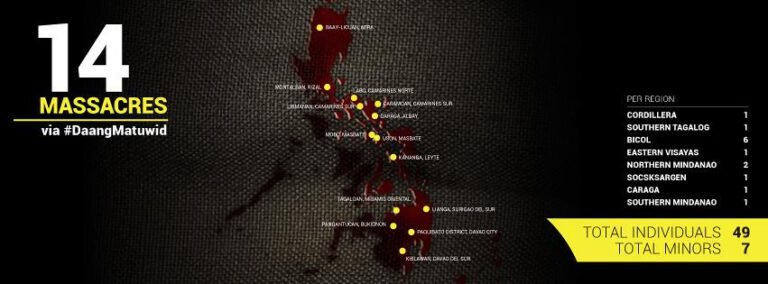
Según informes de la organización de defensa de los derechos humano, Karapatan, desde junio de 2010 hasta el 30 de septiembre de 2015 se han cometido 294 asesinatos extrajudiciales y 318 asesinatos frustrados; 27 personas han desaparecido; 172 personas han sido víctimas de tortura; 6 personas han sido víctimas de violaciones sexuales; 555 personas han sido víctimas de asalto físico y lesiones ; se han llevado a cabo 911 arrestos y detenciones ilegales, principalmente por cargos fabricados; más de 65.000 personas han sido forzadas a evacuar debido a operaciones militares; se han cometido 15 masacres (49 individuos asesinados en Montalban-Rizal, Labo-Camarines Norte, Libmanan y Caramoan -Camarines Sur, Daraga – Albay, Mobo-Masbate, Uson-Masbate, Kananga-Leyte, Tagaloan-Misamis Oriental, Pangantukan-Bukidnon, Lianga-Suriago del Sur, Paquibato Distric-Davao City y Kiblawan-Davao del Sur) y muchas otras violaciones de los derechos humanos. Solamente entre agosto de 2015 y el 1 de septiembre de 2015 Karapatan ha registrado 16 víctimas de asesinatos políticos.[i]

Actualmente hay 537 prisioneros políticos en Filipinas, cuyo encarcelamiento se ha llevado a cabo mediante el uso de instrumentos fraudulentos, tales como la formulación de falsos cargos; órdenes judiciales deficientes; falsos testimonios; testigos sobornados por las fuerzas militares; la colocación ilícita de pruebas falsas para justificar la formulación de cargos que no admiten libertad bajo fianza y la flagrante distorsión de la ley vigente.

Ni uno solo de los perpetradores de estos asesinatos o violaciones de los derechos humanos ha sido condenado. Al contrario: los militares responsables de estas operaciones suelen ser promocionados, especialmente en Mindanao, cuyas vastas tierras prometen gran riqueza de recursos minerales y plantaciones fértiles.

La tendencia indica que la realidad sobre el terreno continúa deteriorándose significativamente en lugar de mejorar, mientras el Gobierno acelera su carrera desenfrenada por implementar su programa de contrainsurgencia, Oplan Bayanihan (Cooperative Effort), que hunde sus raíces en el estratégico Oplan Bantay Laya (Freedom Watch), establecido durante el régimen de Gloria Arroyo (2000-2010). Este programa ha sido identificado como la causa de continuadas violaciones del derecho a la vida, cometidas principalmente por las fuerzas de seguridad del estado: policía, militar, paramilitar y todos aquellos bajo la supervisión de éstas.

El gobierno de los Estados Unidos colabora directamente con el filipino en su programa de contrainsurgencia aportando financiación, doctrina y dirección táctica. Así mismo, hay unidades de las Fuerzas Especiales de los Estados Unidos (US Special Forces) establecidas discretamente en ciertos enclaves de Mindanao que han participado en operaciones de inteligencia y ataque mediante el uso de drones y otros dispositivos de alta tecnología.

La política de contrainsurgencia tiene un nivel de alcance muy amplio. Además de las actividades conjuntas de las Fuerzas Armadas de Filipinas y sus distintos grupos paramilitares, que operan con aparente independencia bajo la guisa de “guerreros tribales”, “organizaciones civiles voluntarias” y “guardias de seguridad privada”, este programa también incluye actividades que, en apariencia, son de carácter de civil. Las desarrollan e implementan, entre otras,  las siguientes agencias: The Office of the Presidential Adviser on the Peace Process – OPAPP (la Oficina del Asesor Presidencial sobre el Proceso de Paz); The Department of Social Welfare and Development – DSWD (el Departamento de Asistencia Social y Desarrollo), y The Department of the Interior and Local Government – DILG (Departamento del Interior y del Gobierno Local), así como algunas ONGs financiadas por grandes corporaciones y agencias imperialistas. Los programas y proyectos que estas y otras agencias ponen en marcha se presentan como acciones para “la paz y el desarrollo”, pero en realidad se trata de acciones cuya finalidad es el control social y político y el cambio de conductas de aquéllos individuos y comunidades “incómodos” para el gobierno, lo que se conoce como guerra psicológica.

En su informe de 2007 para el Consejo Nacional de Derechos Humanos, el entonces Relator Especial sobre las ejecuciones extrajudiciales, arbitrarias o sumarias, el Profesor Philip Alston, identificó las causas de los asesinatos extrajudiciales en Filipinas: el “vilipendio”, “etiquetado” o la culpabilidad por asociación. Alston también documentó el grado en el que el programa gubernamental de contrainsurgencia ha impactado en el derecho político y civil de las personas. [ii]

Las observaciones de Alston se confirman en las afirmaciones realizadas por el General Avelino Razon (Jefe de la Policía Nacional de Filipinas en 2007) en el curso de la investigación conducida por la Comisión Melo[iii], en la que subscribió las declaraciones del General Palparan: “organizaciones como Karapatan o Bayan Muna[iv] son “frentes” del Partido Comunista y su grupo armado.”. Esta declaración fue confirmada también por el Jefe de las Fuerzas Armadas de Filipinas, el Teniente General Noel Coballes, en su comunicado del 12 de Julio de 2013 en el que define a Karapatan y al grupo legal National Union of Peoples Lawyers como enemigos de las fuerzas militares. Los actos y declaraciones de la policía y los militares perpetradores en los casos arriba mencionados, son pruebas del tipo de acusaciones arbitrarias que se dirigen contra civiles, activistas y defensores de los derechos humanos.

Este proceder continúa estando muy arraigado en las instituciones políticas y militares. Las causas han sido identificadas, pero no hay ningún progreso significativo ni concreto que prevenga o detenga estos asesinatos, o que garantice la asunción de responsabilidades.  Al contrario, este fenómeno se extiende y perpetúa.

Así, los asesinatos selectivos, las desapariciones y los ataques contra activistas políticos y defensores de los derechos humanos continúan con impunidad, a pesar de que el gobierno de Filipinas garantizó, durante el Examen Periódico Universal de las Naciones Unidas en 2012, que tomaría “firmes medidas para abordar el problema de los asesinatos extrajudiciales y las desapariciones forzadas”. Pese a esto, la violencia de estado ha continuado sin cesar durante la administración del Presidente Benigno Simeon “Noynoy” Aquino III (Desde 2010 al momento actual ).

En este Examen Periódico Universal de las Naciones Unidas de 2012 se evaluó la actuación e historial del gobierno de Filipinas en materia de derechos humanos. Varias misiones extranjeras reclamaron el desmantelamiento inmediato de grupos paramilitares, tales como CAFGU, SCAA, CVO, así como la derogación del Executive Order 546 (Decreto Ejecutivo 546). Este decreto legitima el uso de grupos paramilitares civiles como fuerzas multiplicadoras para combatir los supuestos grupos rebeldes, dando vía libre a que los grupos paramilitares y las Fuerzas Armadas de Filipinas cometan crímenes con total impunidad, y asegurando así que los intereses de grandes corporaciones extranjeras, como plantaciones agroindustriales y compañías transnacionales mineras, sean protegidos.

El Parlamento Europeo aprobó una resolución similar en mayo de 2012, y los Relatores Especiales de las Naciones Unidas sobre los Defensores de los Derechos Humanos y los Asesinatos Extrajudiciales presentaron una declaración parecida en julio de 2012. El Gobierno de Filipinas rechazó esta recomendación y mantuvo la vigencia del Decreto Ejecutivo 546. De hecho, en el presupuesto nacional de 2015 se destinaron 2 billones de pesos filipinos a la financiación de grupos paramilitares. A esta cantidad habría que añadir las compensaciones, beneficios y gratificaciones económicas que las compañías mineras y las unidades locales de gobierno destinan para la financiación y control de estos grupos, como quedó probado durante las investigaciones in situ conducidas por el Congreso sobre el asesinato de la activista anti-minería Juvy Capion y de sus dos hijos.

A día de hoy no hay signos de que el terrorismo de estado en Filipinas vaya a parar. Al contrario, recientes acuerdos como el TPPA (Trans Pacific Partnership Agreement) o el EDCA (Enhanced Defense Cooperation Agreement), ambos promovidos por los Estados Unidos, apuntan a que Filipinas avanza en la dirección de convertirse en un enclave estratégico militar para los Estados Unidos en el Sudeste Asiático.

En concreto el EDCA – Enhanced Defense Cooperation Agreement (Acuerdo de Cooperación Reforzada en Materia de Defensa), firmado por Aquino y Obama en abril de 2014, elude la proscripción de bases y tropas militares extranjeras establecida en la constitución Filipina para permitir que Estados Unidos incremente la llamada presencia rotativa de sus tropas y construya bases militares bajo la forma de instalaciones temporales autorizadas en áreas de las fuerzas armadas de Filipinas.

El gobierno de Aquino presenta el EDCA como un gran avance en la guerra contra el terrorismo, también instigada por Estados Unidos, y como un instrumento para consolidar el eje estadounidense en el Sudeste Asiático, ya que E.E.U.U. proyecta desplegar el 60% de sus fuerzas navales y el 50% de sus fuerzas terrestres y aéreas en la región.

Tanto las autoridades filipinas como las estadounidenses promocionan el EDCA como una herramienta para reequilibrar la fuerza militar estadounidense respecto a China, y como el instrumento para contrarrestar la amenaza que supone China para algunos países vecinos y que mantendrá el mar del Sur de China abierto a la navegación internacional y al comercio.

Han pasado casi 30 años desde que el dictador Ferdinand Marcos fue derrocado. Sin embargo, todos los regímenes de la era post-dictatorial, incluyendo el actual, mantienen muchos elementos de la dictadura en Filipinas, desde la presidencia de Corazon Aquino (1986-1992) y la de Fidel V. Ramos (1992-1998) hasta el régimen posterior de Joseph Estrada, Gloria Macapagal Arroyo y Benigno Aquino III. Estos elementos son, entre otros, el mantenimiento de una sociedad semi-colonial y semi-feudal, dominada por los Estados Unidos a la cabeza de otros poderes imperialistas y por grandes empresarios, terratenientes y burócratas capitalistas locales; un estado autoritario controlado por las clases dominantes cuyo núcleo son unas fuerzas armadas indoctrinadas por Estados Unidos; y la supresión de los derechos de los trabajadores, campesinos, mujeres, la juventud y las comunidades indígenas, a pesar de que procesos democráticos formales son reconocidos.

Al igual que durante las legislaturas que sucedieron a Marcos, el programa de contrainsurgencia de Aquino, así como la intensificación de la militarización, sirve a los intereses de poderes imperialistas, a las grandes corporaciones y a los terratenientes, que despliegan operaciones mineras, madereras y agroindustriales a gran escala con la voluntad de saquear los ricos recursos del país, incluyendo los que conservan las comunidades indígenas en sus tierras ancestrales. El propósito de esta política no es únicamente erradicar la resistencia armada liderada por el Partido Comunista de Filipinas (Communist Party of the Philippines – CPP) y el Nuevo Ejército del Pueblo (New People’s Army – NPA): su objetivo es la represión política, así como acabar con las formas de resistencia frente a las actividades del sector corporativo y financiero que están mermando los recursos naturales del país. Esto lo demuestra el ataque sistemático a infraestructuras sociales creadas por las comunidades indígenas Lumads, como más arriba se expone.

“¡Salvad nuestras escuelas!, ¡Parad las matanzas de Lumads!” son algunas de las consignas que proclamaba el grupo de 700 indígenas procedentes de Mindanao el pasado 26 de octubre de 2015 durante la calurosa acogida de estudiantes y académicos de la Universidad de Filipinas Diliman en Manila, donde permanecerán un mes para denunciar la violencia de estado y la militarización de sus tierras.

Los datos que figuran en este artículo provienen de las investigaciones e informes elaborados por Karapatan, Filipinas y La Liga Internacional de la Lucha de los Pueblos (International League of Peoples’ Struggle – ILPS).

Información adicional se puede solicitar en las siguientes direcciones:
Paloma Polo: palomapoloca@gmail.com
Cristina Palabay, Karapatan: karapatan@karapatan.org
International League of Peoples’ Struggle – ILPS : ilpschair@casema.nl


[i] Para acceder a información y estadísticas más detalladas sobre estas violaciones se puede consultar este enlace: http://karapatan.org/.

[ii] El informe completo de Alston se puede consultar en este enlace: http://www.karapatan.org/AlstonReport

[iii] Melo Commission Report (Informe de la Comisión Melo, 2007, p. 8.) Gloria Macapagal Arroyo emitió la Orden Administrativa nº 157 para crear una comisión independiente que investigase los asesinatos de periodistas y activistas. Esta comisión estaba liderada por Jose Melo, el entonces juez adjunto del Tribunal Supremo. La Comisión Melo ha sido fuertemente criticada y cuestionada por defensores de los derechos humanos.

[iv] Bayan Muna (En Español: “Primero el Pueblo”) es un partido político de izquierdas en Filipinas. Su plataforma promueve un gobierno progresista que apoye a la clase trabajadora, con representación significativa de todos los sectores democráticos de Filipinas. Bayan Muna fue el segundo partido más popular durante las elecciones presidenciales de 2007 en Filipinas.