
Statement
March 14, 2026
The International Coalition for Human Rights in the Philippines condemns the US-Israeli war on Iran. The US-led strikes have resulted in widespread killings of civilians and are wreaking havoc on oil prices and thus the costs of living for people across the world. These attacks must immediately be put to an end.
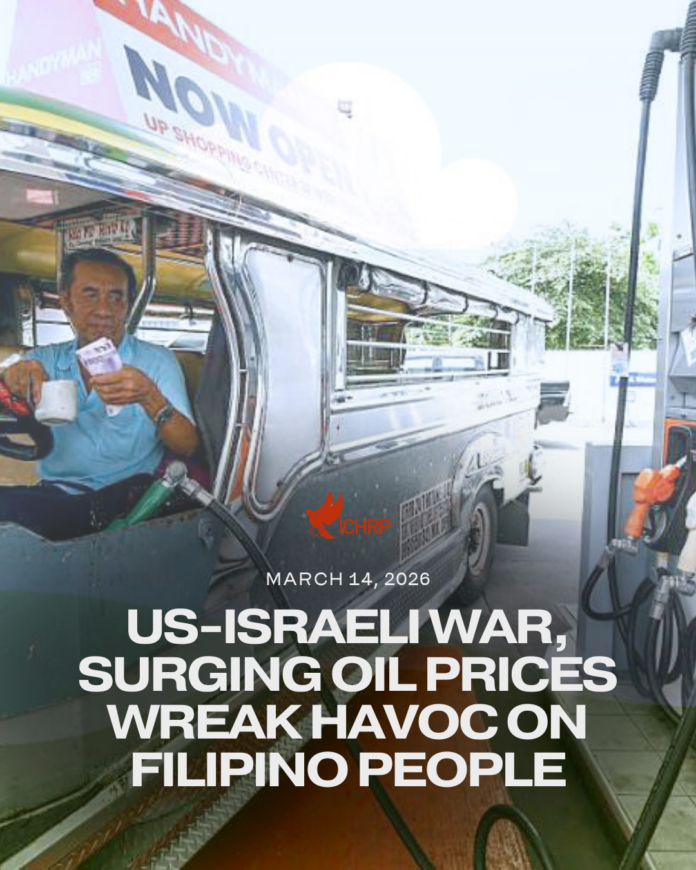
The closure of the Strait of Hormuz as a consequence of unprovoked US-Israeli aggression against Iran has already led to significant economic costs for the Philippines. Gasoline price increases forced the country to cut its work week to 4 days as it struggles to adjust to the potential cut off of its oil supplies from the Middle East. The continuance of the US-Israeli war on Iran has catastrophic day-by-day consequences for the Philippines.
The Philippine economy is more dependent than most other Asian nations on Middle East oil. It imports 98% of its oil from the Middle East, the vast majority of it transits the Strait of Hormuz. If the conflict continues, the country is expected to experience projected increases of 7.48 pesos per liter for petrol and 17.28 pesos for diesel.
Prices could lead to increased costs for goods and services, potentially resulting in higher inflation and higher unemployment. Rising fuel prices push up the operating costs for farmers, transport workers, and small businesses, which in turn lead to higher food prices and economic pressure on households. The deregulated oil market limits government intervention, leaving consumers to bear the economic shocks, especially low-income groups.
In addition to oil, approximately 91% of the country’s liquefied petroleum gas (LPG) that is essential for cooking arrives on ships that go through the Strait of Hormuz. The interconnected nature of regional oil supply chains means that shortages in neighboring countries will directly affect the Philippines.
The Philippines also imports a significant portion of its fertilizers (about 7%) directly from the Middle East. Its main suppliers (China, Indonesia, Malaysia) of essential nitrogen fertilizers, such as urea and ammonia, are also significantly affected by the closure of the Strait of Hormuz. The disruption will lead to increased fertilizer prices and reduced availability. A longer-term disruption will ultimately threaten food security in these countries, as well as in the Philippines.
While the government has taken baby steps to address the situation, such as the reduced work week and fuel tax reductions when the price of oil exceeds $80 per barrel, these measures are far from sufficient. Fuel tax reductions will be of limited effect as the price is currently well above these thresholds.
Inflation and potential fuel shortages are the key risks to the Philippines economy as long as the war continues. These impacts will be most acute on the great majority of the people who already struggle with grinding poverty. Because oil and gas supplies are now disrupted for more than two weeks, there will be a broader global economic and financial crisis which will hurt the Filipino people.
